
Auction: 26776 - America 250th Anniversary Sale Ft. Coins, Medals, Banknotes, Objets de Vertu & Ephemera
Lot: 156
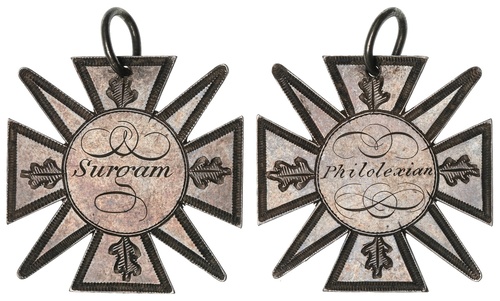
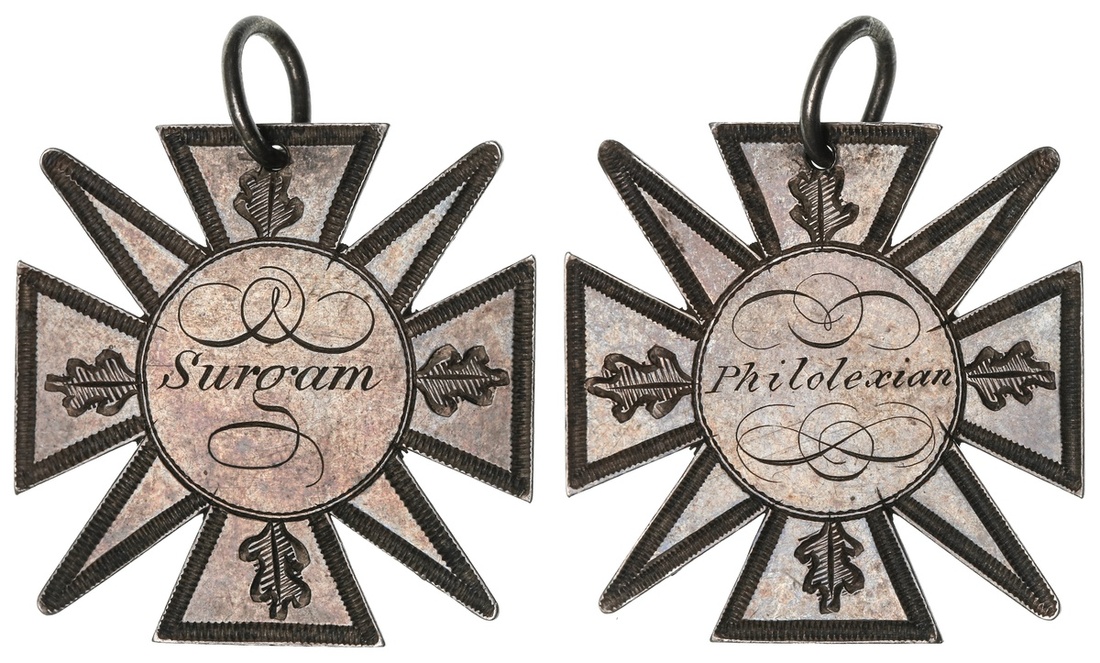
USA, Columbia University, Philolexian Society, Silver Hand-Engraved Society Medal, undated (c. early 19th century), unsigned, PHILOLEXIAN in central circle, oak leaf in each angle, rev. SURGAM in central circle, oak leaf in each angle, 4.10g, 31mm x 31mm (Columbia Medals Collection, 5/239), a masterful hand-engraving, pierced and with suspension loop for wear, some slight bending to edges, yet toned, extremely fine and a very scarce survivor
Provenance
~ Creighton Family Archive ~
Sold by direct family descent
The Philolexian Society, affectionately known to its members as "Philo", is the oldest continuously recognised student organisation at Columbia University.
A literary society has been a part of college since 1768, when silver Literary Society prize medals were first awarded (see lot 155). After the Revolution this group was replaced by another called the Columbia College Society for Progress in Letters, which existed up until 1795. Building on these earlier efforts, the Philolexian Society was formed on 17 May 1802.
Among its founding members were Nathaniel Fish Moore, later a Columbia College president, and James Alexander Hamilton, son of Alexander Hamilton. Ernest A. Cardozo, writing on the occasion of the Society's hundredth birthday, states that the Society was established in order to "improve its members in oratory, composition and forensic discussion". It therefore held weekly meetings for the reading of essays, the delivery of orations and the carrying on of formal debates. Cardozo goes on to state that over a period of one hundred years: "almost all conceivable questions have been debated. Political questions, it is not surprising, predominate; but morals, religion, philosophy, literature, social, economic and college questions, all have had their day".
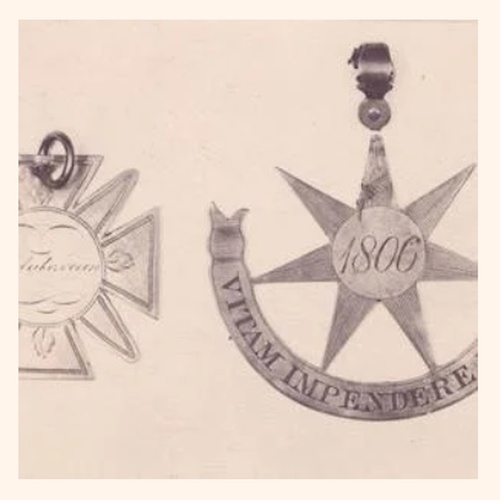
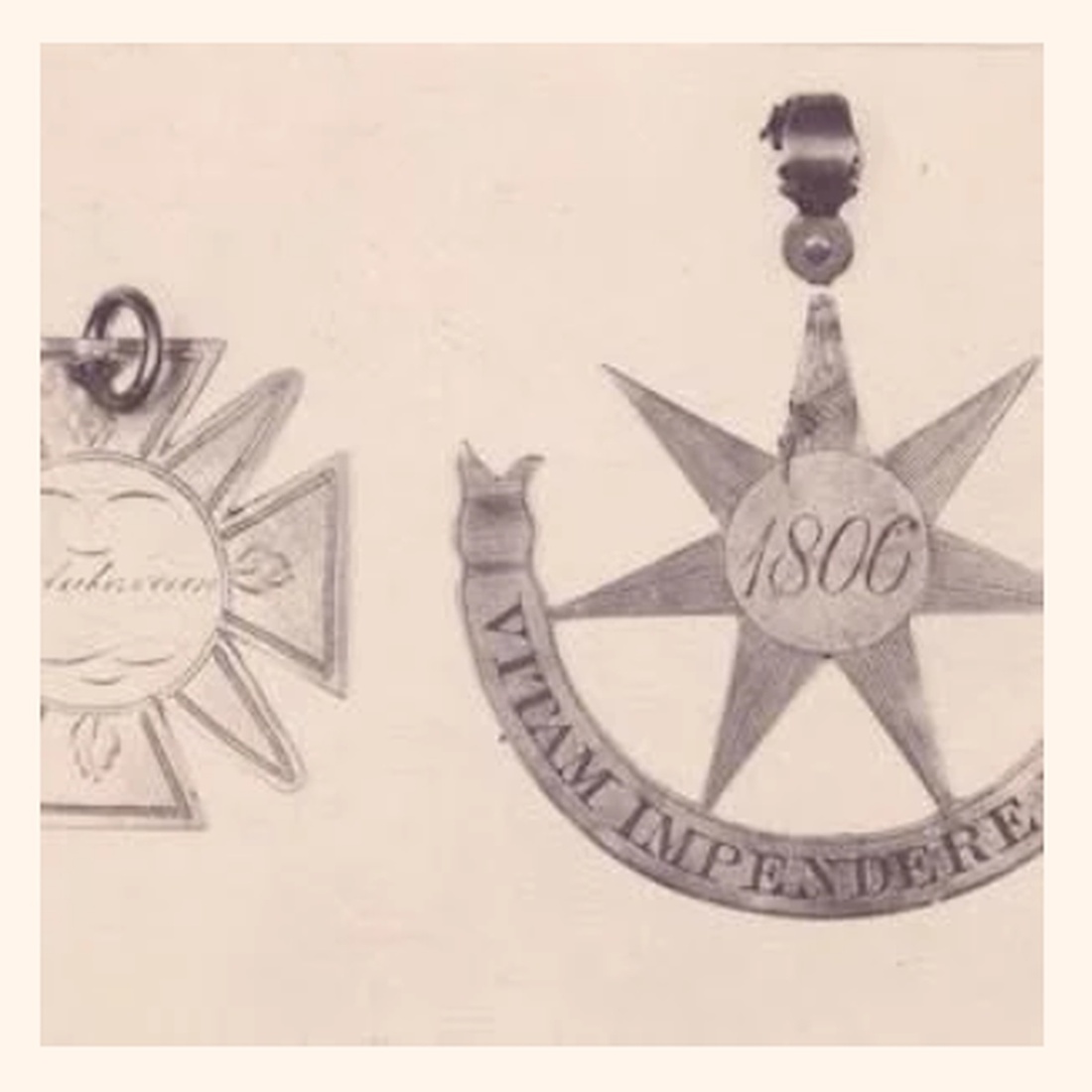
The Society was considered to be at the heart of student life and energy, and in 1806 it was joined by a rival organisation, the Peithologian Society, which was largely founded to accommodate freshmen who were initially ineligible for Philolexian membership.
For roughly the next century, the Peithologian Society served as Philolexian's principal literary rival, until Peithologian eventually became dormant. In tribute to this old rivalry, Columbia University adopted the colours of both societies, Philolexian blue and Peithologian white, as the official colours of the University.
The name Philolexian derives from the Greek for "love of discourse", and its Latin motto "Surgam" means "I shall rise". This motto has come to define much of the Society's identity and spirit of resilience, fitting, given that Philolexian has weathered several periods of dormancy across its history, including a stretch in the mid-20th century until it was revived in 1985.
Both the name and the motto of the Society appear on this simple yet elegantly designed early silver medal, the shape of which imitates the Society's seal. The seal, a four-sided square with indentations at the four corners of a circle, has at its centre a radiant sun. Early gold badges of the Society in this shape are listed by Cardozo, yet no early mention is made of any in silver. However, there is a record of a rosette later in the 19th century. The existence of silver medals for the Peithologian Society, and this medal for the Philolexian Society, suggests that they were likely worn or awarded to members of each society to distinguish their allegiance.
Due to the Society's origins dating to 1802, this medal was likely awarded to Reverend William Creighton (1793–1865) (see lot 157), who graduated from Columbia in 1812 with a BA in theology. William also served as a trustee to the University from 1828 until 1840. William's father, James Creighton (1751–1822), had also attended the university, then still King's College, and was himself acknowledged for his literary talents in 1770, when he was awarded the King's College Literary Society medal.
Fascinatingly, there is a reference to a "Creighton" noted by Cardozo when writing about the publications of the Society. This reference to Creighton, supposedly William, comes from The Philolexian Observer. This publication included a series of twelve papers published from 10 December 1813. The author of the paper, an anonymously named individual called "Philolecticus", states that the purpose of the publication is to help advance the reputation of the Society as well as its laws and constitution, and "in general to write on any miscellaneous subject which the author thinks may be of interest to the society". In reality, the publication became an opportunity for criticism of the essays written and sent in to Philolecticus. Cardozo notes that the only "really humorous paper in the series is the tenth", which is titled "Ghost of the Philolexian" and is signed "Creighton", who mocks the Observer "in a dignified jocular manner".
Cardozo goes on to quote the article: "You began to make a punch bowl…but you produced nothing but a tea-cup — and now, Mr Philolecticus, let me tell you into what a hobble you have brought yourself. You are excluded from the delights of Elysium. Charon declares that you shall not set foot in his boat, for that such a mass of conceit and egotism would most assuredly sink it. Pluto, moreover, says he will provide a complete set of The Philolexian Observer, which you shall be compelled to read as the worst punishment of all, and by way of a little recreation he says he will lend you a few numbers of The Athenaeum of Yale College."
In a calm, judicious, temperate tone comes the answer of "Philolecticus": "keep yourself cool, good Mr Philolexian, I promise you, you shall never be disturbed".
Cf. Cardozo, Ernest A., A History of the Philolexian Society of Columbia University from 1802-1902, Philolexian Society, New York, 1902
Subject to 20% VAT on Buyer’s Premium. For more information please view Terms and Conditions for Buyers.
Estimate
$500 to $800
Starting price
$400

Watch, listen and bid as if you were in the room. Now available for auctions worldwide.
Click here to bid live
An exclusive and confidential service for the discerning collector or vendor.
View the Gallery
Download every Spink catalogue on your iPad, iPod or iPhone using free Spink app.
Download From iTunes© 2026 Spink & Son. All rights reserved.