
Auction: 26776 - America 250th Anniversary Sale Ft. Coins, Medals, Banknotes, Objets de Vertu & Ephemera
Lot: 155
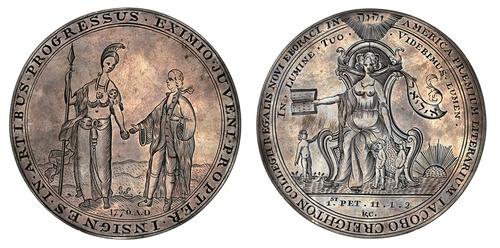
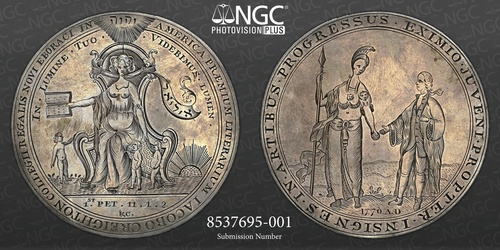
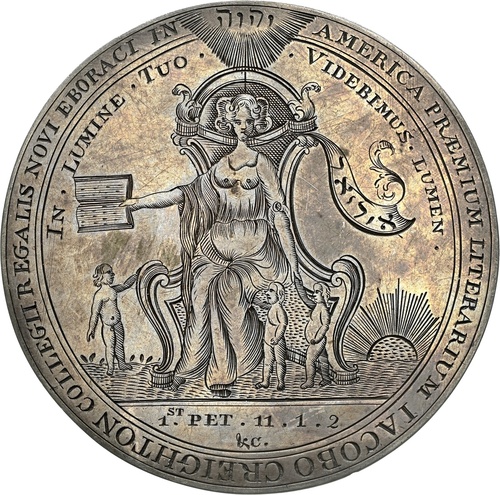
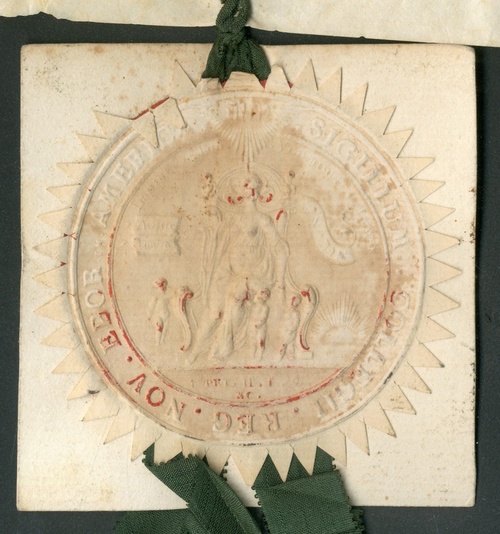
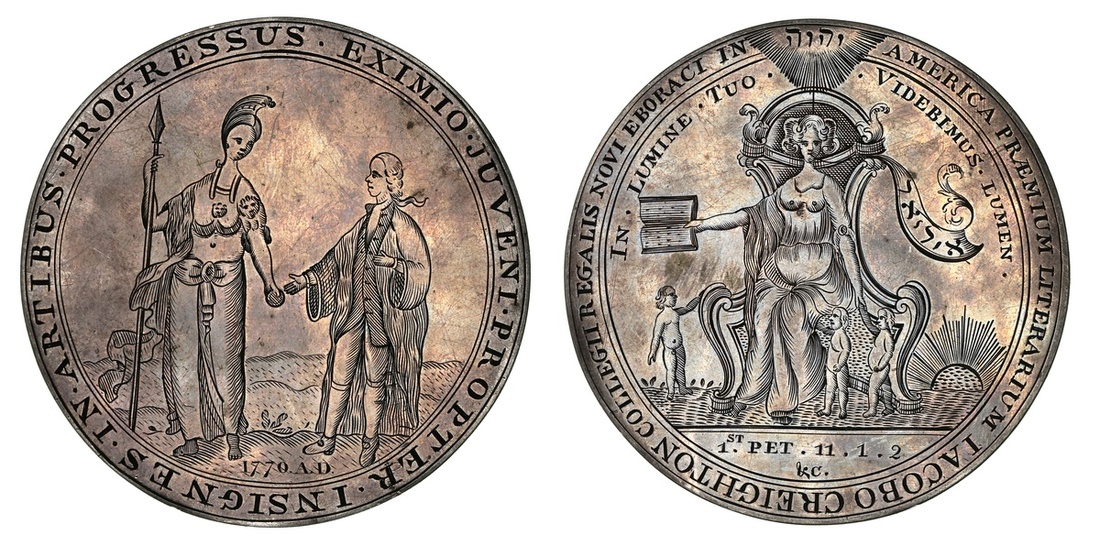
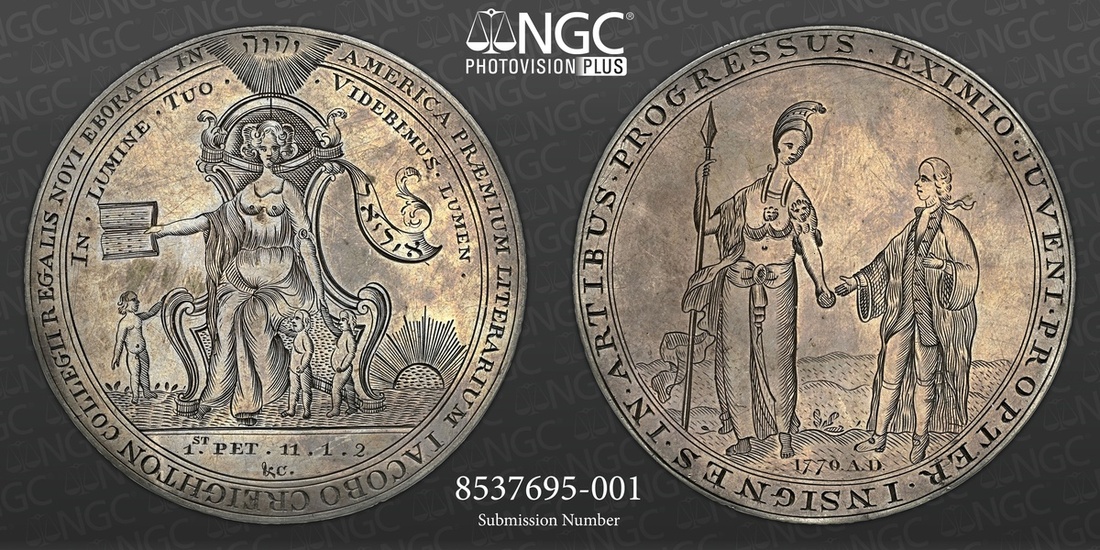
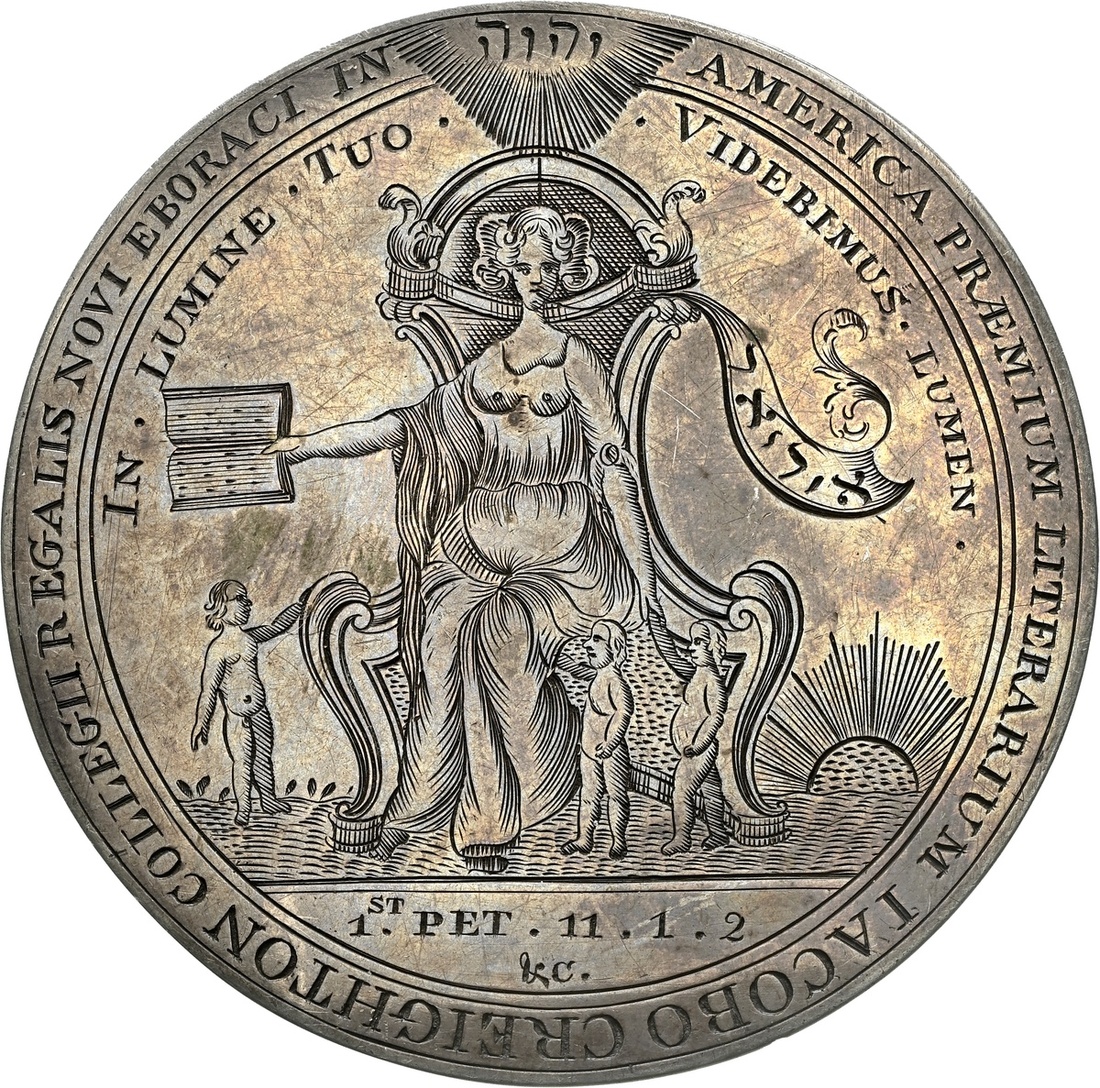
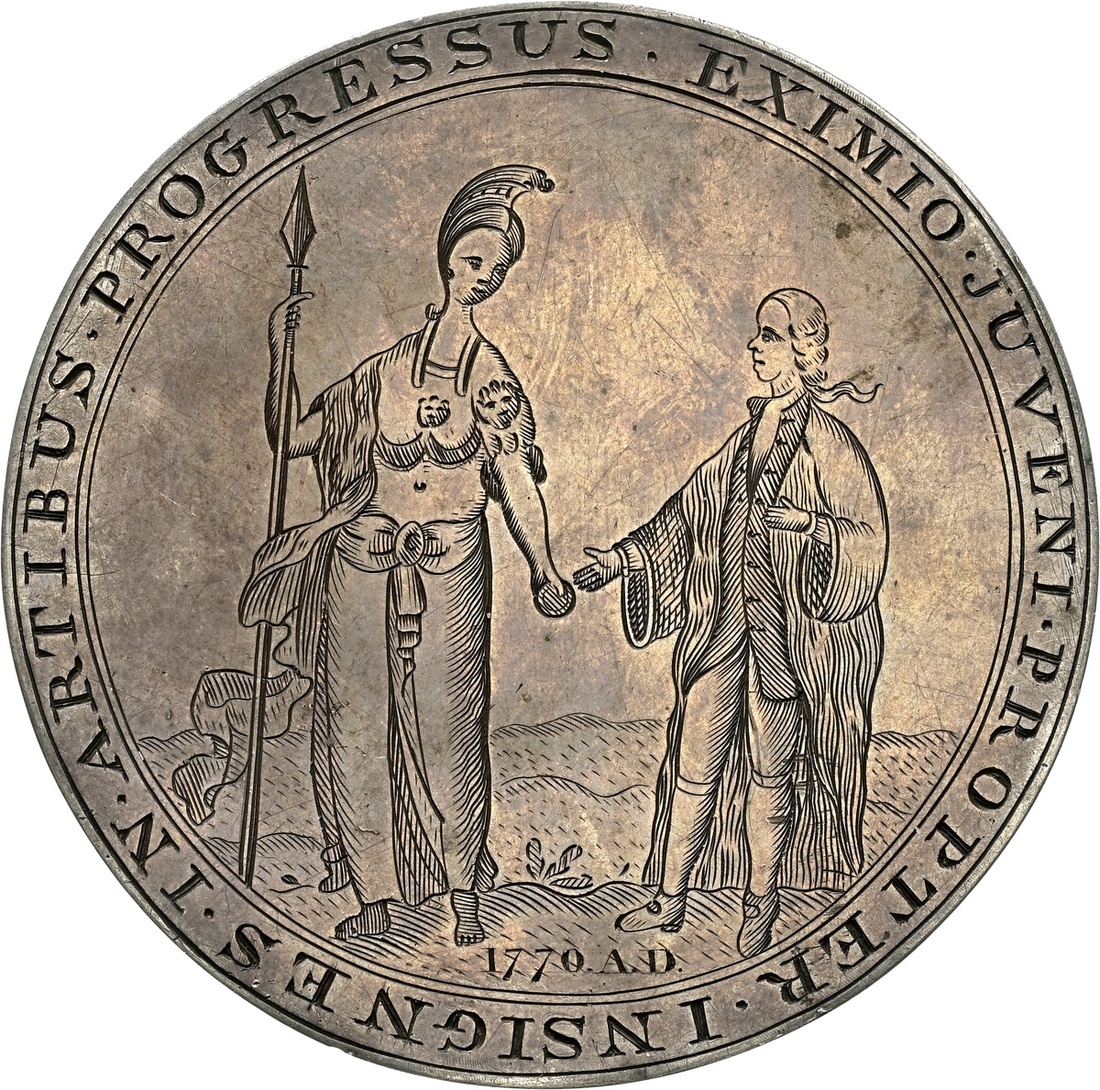
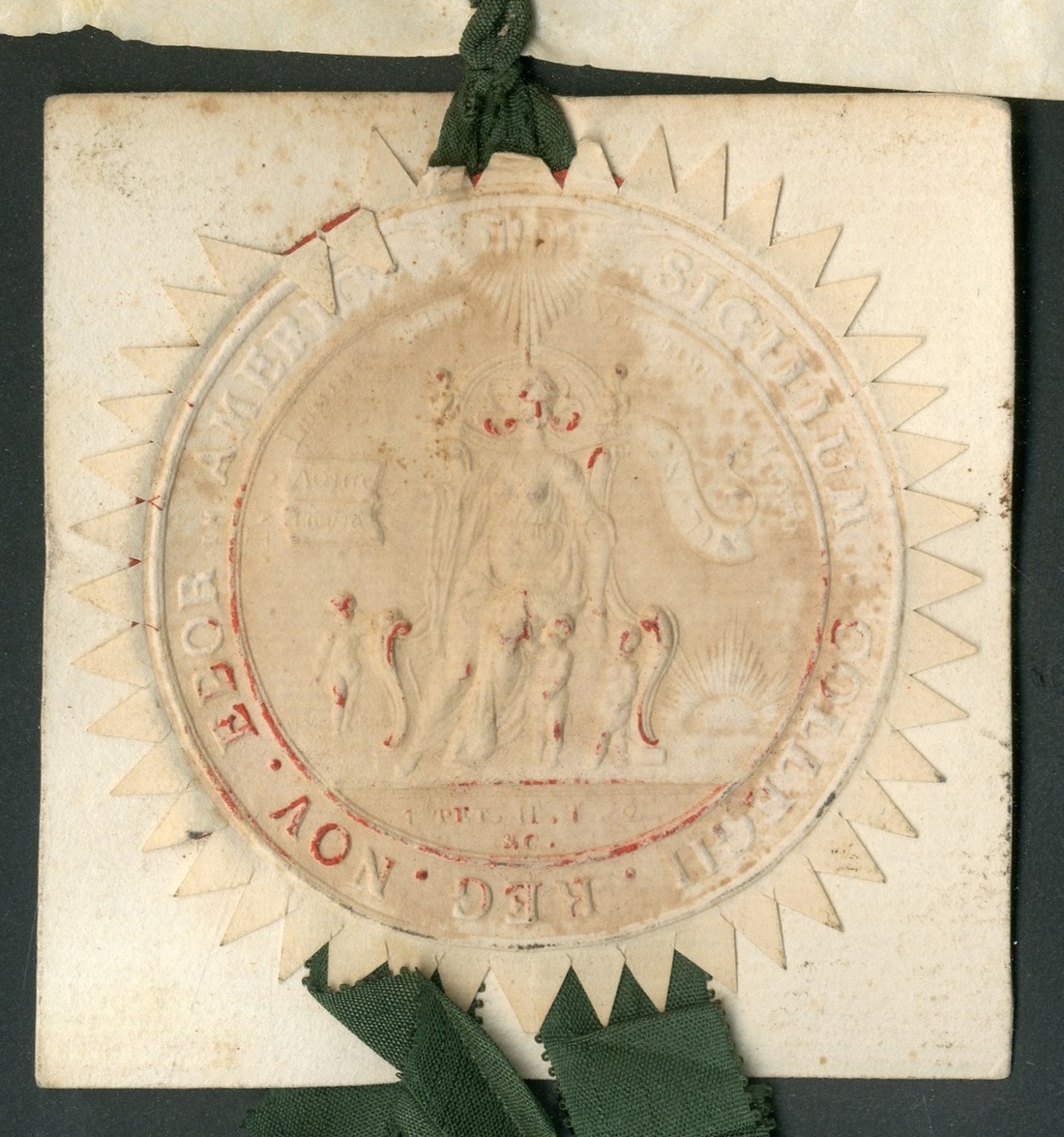
NGC MS61 | USA, King's College (Columbia University), Literary Society, Silver Hand-Engraved Prize Medal, 1770, attributed to Elisha Gallaudet, awarded to Mr James Creighton (1751-1822), COLLEGII REGALIS NOVI EBORACI IN AMERICA PRÆMIUM LITERARIUM IACOBO CREIGHTON | IN • LUMINE • TUO • • VIDEBIMUS • LUMEN •, college seal designed by Reverend Samuel Johnson, with maternal figure of Alma Mater seated on throne at centre, surrounded by three infants, whom she teaches from book in outstretched hand. Radiant sun rises behind. Scroll reads "God's Light" in Hebrew and "God" in Hebrew in radiant border above. 1
Provenance
~ Creighton Family Archive ~
Sold by direct family descent
Established in 1768, the King's College Literary Society medal is the first civilian medal to have been awarded in America which is extant today. Only four examples are known to have survived from a believed 28 original pieces listed in the society's minutes book. An initial order of 4 was placed on 17 May 1767, followed by another of the same amount on 3 November. Each order at the cost of $8 was placed with the New York silversmith Elisha Gallaudet. Gallaudet is a recognisable name within numismatics for his contribution to the Continental Dollar of 1776, which is widely regarded as the first coin of the United States.
A further batch of 20 silver medals was ordered on 2 June 1769, placed by Mr Charles Evers of the society, to be engraved in London by silversmith Richard Rugg. Apart from the minor differences seen between the New York and London medals, due to their hand engraved nature, the Rugg examples also include the mark R.R. and the mark for sterling silver.
Of the four known medals, just three are engraved to recipients: this medal, awarded to James Creighton (1751-1822), a Loyalist lawyer from a well-established New York family, one to Gouverneur Morris, statesman and Founding Father; and one to Benjamin Moore, Bishop of New York, who administered Holy Communion to Alexander Hamilton on his deathbed. The Creighton medal also represents only the second example currently in private hands, two pieces having been acquired by the Museum of the City of New York and the Columbiana Collection at Columbia University.
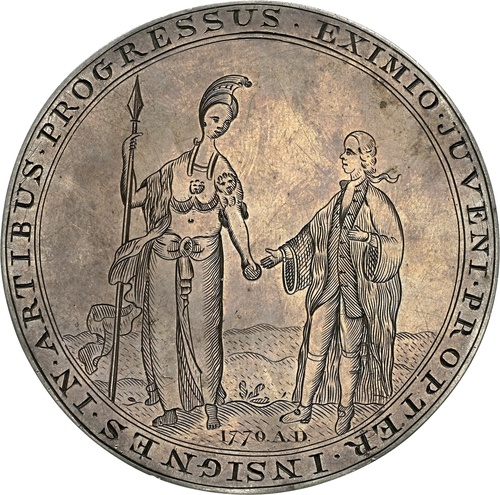
The design of these medals was taken from the college seal, which was created in 1755 by the first college president Samuel Johnson. It shows the maternal figure of Alma Mater seated on a throne, surrounded by three infants, whom she is teaching from a book. The College's motto which translates to 'in thy light, shall we see light', taken from psalm 36:9, is also present. The reverse of the medals show Minerva presenting a medal to a student in academic robes.
The ordering of these medals from New York and from across the Atlantic, may at first seem unusual. Why was a relatively small college society looking as far afield as London? What it in fact reveals is the interconnected nature of Anglo-American life and society at this time. This was still an age when to be born in America was to be considered a British citizen. These young men therefore understood themselves a part of this colonial society and it is into this environment that James Creighton was born and raised.
However, James's life coincided with a period of seismic change for those living in North America. Born into a British colony under the rule of a British king, by the start of his early adult life America had broken with Britain and with the signing of the Declaration of Independence in July 1776 the nation was set on a new course.
The American Revolution altered his life decisively. The Creighton family were Loyalists, remaining faithful to the British Crown during the American Revolution. As a result James found himself on the wrong side of the political transformation. James, like many of his King's contemporaries, did not embrace independence easily, nor did he possess the political adaptability that allowed others to thrive in the new order.
This medal not only tells the story of James Creighton but also that of the foundations and early story of King's College, later Columbia University, and ultimately how both are inextricably linked to the War of Independence.
James Creighton was born in New York in 1751 into a family that had already been established in British North America for more than sixty years. The Creightons were not adventurers or frontiersmen but a professional and mercantile family. Their personal and professional ties therefore saw them linked to the central figures and events of colonial-era America and the early republic. However, like so many Loyalist families their importance within early-America has been sidelined and overlooked.
The family's American origins lay with James Crichton, a native of Scotland who arrived around 1690 and settled in Elizabethtown, New Jersey. A storekeeper by trade, he married an English widow who had come to America in the entourage of Chief Justice Bridget of New Jersey, anchoring the family early within colonial legal circles. Over the next generations the Creightons moved to New York City, intermarrying with Huguenot refugees, New England families, and members of the colonial elite. By the time James was born, the family had become thoroughly embedded in the social fabric of colonial New York. James's upbringing, including his academic education at King's College, reflects the advantages that came with such a position.
A movement began in 1746 to establish a college "for the instruction and education of youth in the learned languages and liberal arts and sciences". There was a widespread sense that too few Americans were educated to degree level, and it remained common for young men from affluent families to be sent to Britain for their schooling. Several notable figures who petitioned for independence and who later signed the Declaration, including Edward Rutledge, Thomas Lynch Jr and Benjamin Rush, were educated in this way.
New York, though a city of fewer than 20,000 inhabitants at the time, was seen as the natural site for such a college. Gouverneur Morris, writing to the Society for the Propagation of the Gospel, declared: "New York is the Center of English America & a Proper Place for a Colledge."
The college was established in 1754 by royal charter granted by George II, making it the first college in the province and one of the earliest in the country. Alongside royal patronage, the Church of England and the Society for the Propagation of the Gospel played a major role in its foundation. This was to the dismay of some who objected to an American institution being so closely tied to the mother country.
Founded in 1701, the Society aimed to supply Church of England clergy to overseas colonies, ministering to settlers and seeking to convert non-believers. King's College is listed among the institutions it supported. The college's charter further stipulated that the president must be a member of, and in communion with, the Church of England. The first president, Samuel Johnson, had strong ties to both bodies. Born in Connecticut, he travelled to England to study at Oxford University and take holy orders and was himself a member of the society.
Johnson was instrumental in shaping the curriculum and the character of the college. The subjects taught were broad and more in line with a modern-day college than anything that had gone before. Rather than training students solely for entry into the church, the aim was to educate them across the full range of liberal arts and sciences.
Student numbers in the early years were modest: only eight students graduated in 1758. Numbers rose to thirty by 1760 but fell to just fifteen in 1767, only a little before Creighton enrolled. These figures give a sense of just how small the institution was and suggest how closely acquainted students and teachers must have been with one another. In its early years, Johnson was supported by only two other instructors, and over the college's first twenty years, roughly 113 students graduated in total.
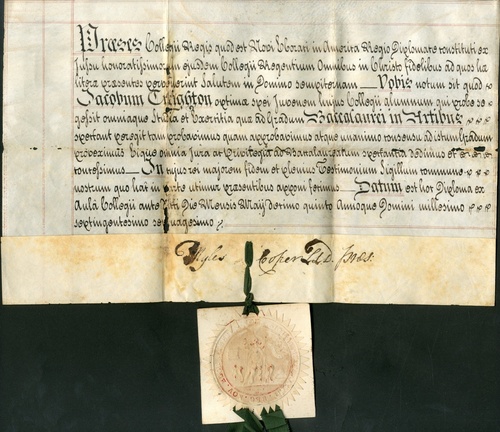
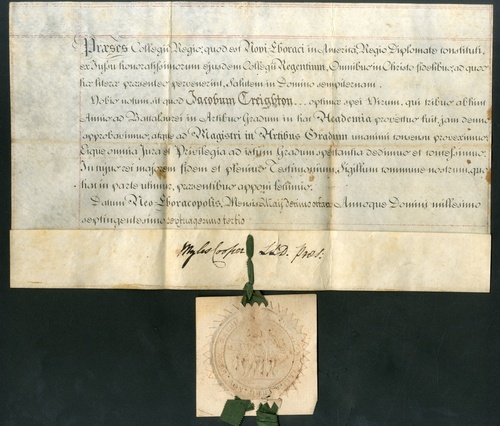
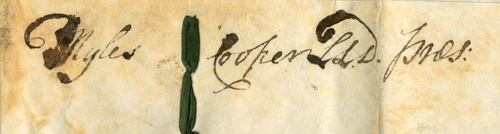
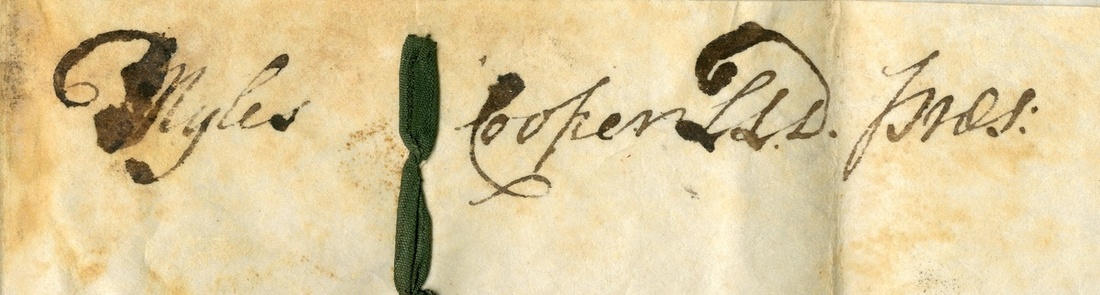
It was under the next president, Myles Cooper, that the college continued to grow and it was also under Cooper's tenure that James Creighton attended the college.
Myles Cooper (1735–1785), a Cumbrian-born Anglican priest, was a key Loyalist figure and a vocal opponent of the American Revolution. Educated at Queen's College, Oxford, he received his MA in 1760. Recommended by Thomas Secker, Archbishop of Canterbury, for service in the American colonies, Cooper arrived in New York in October 1762 to assist Samuel Johnson. He was appointed professor of mental and moral philosophy, and in 1763 became president of the college, a position he held until 1775.
Cooper was a flamboyant and likeable character, known for his love of drinking and great sociability. Under his presidency, the college continued to flourish in both size and prestige. A medical school was opened, only the second in America, and Cooper secured significant grants for expansion, many of them from Oxford University. Indeed, Cooper's own Oxford education left a lasting mark on his vision for the college. He wished to make King's College one of many within a larger university, therefore mimicking the structure of Oxbridge, rather than that of any other American college.
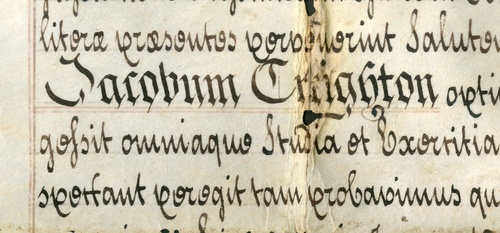
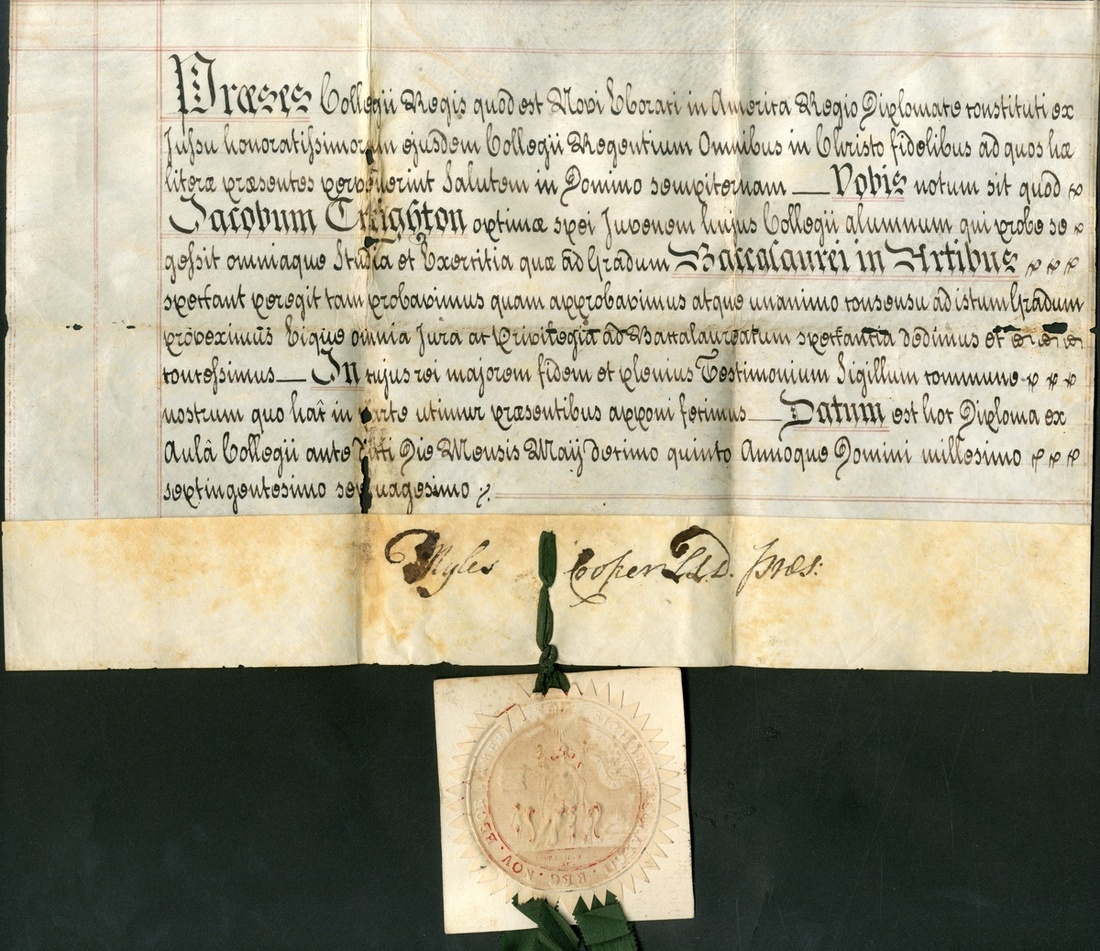
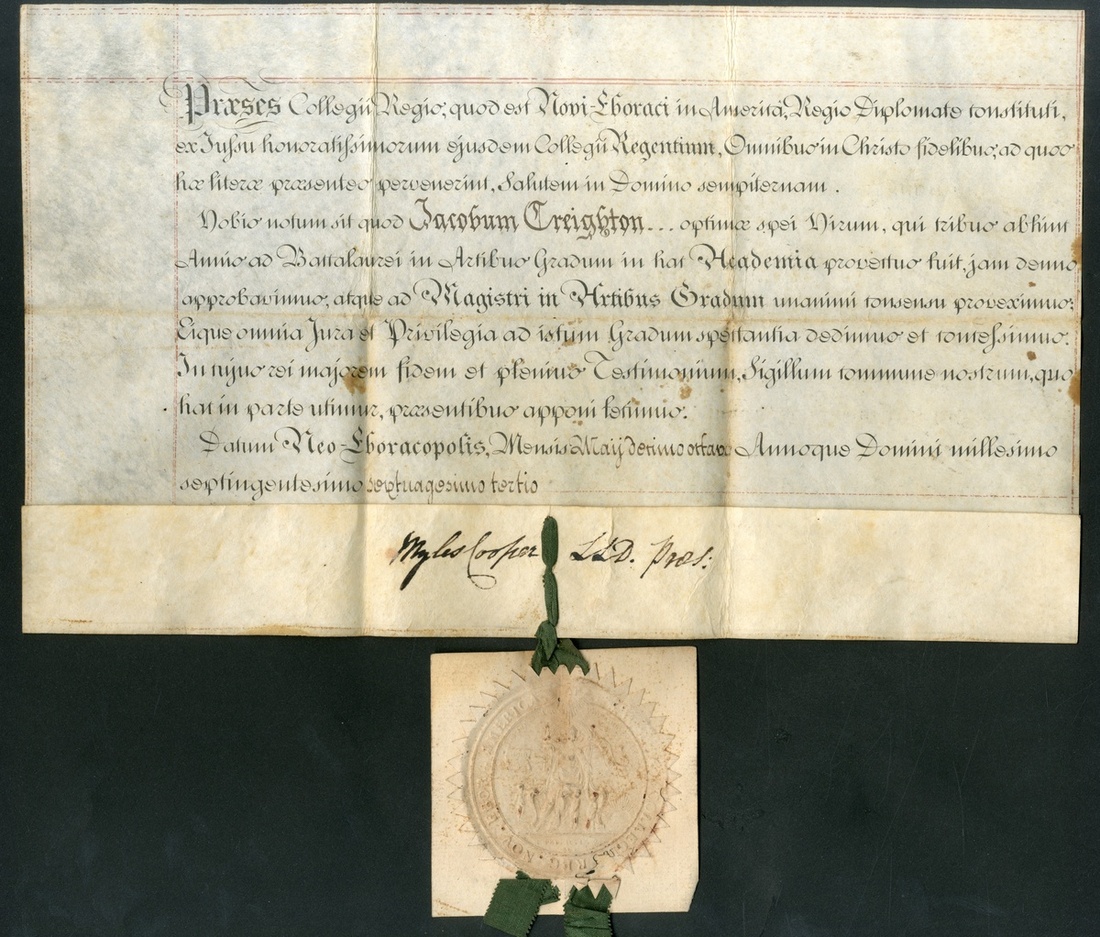
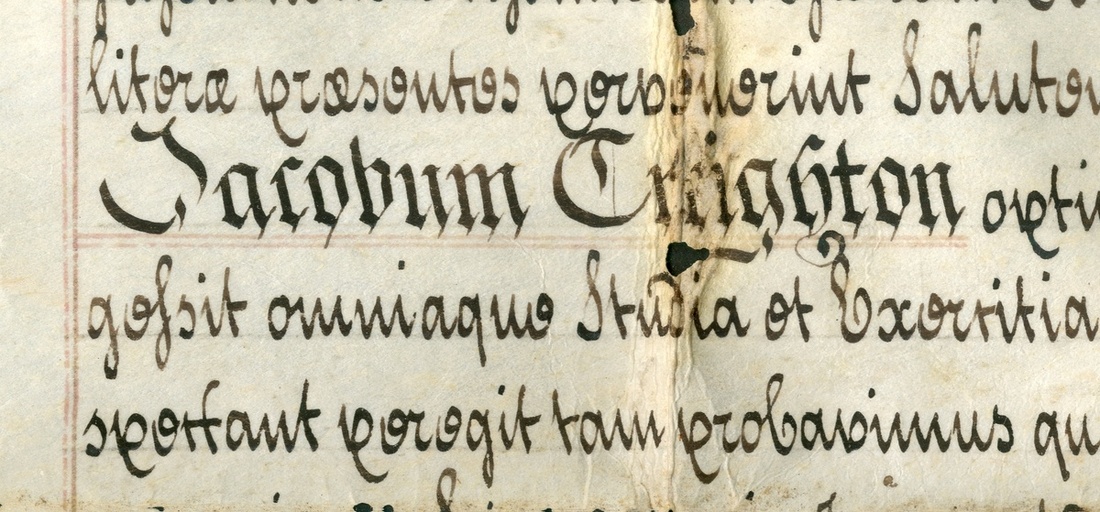
It was Cooper who introduced degree certificates in 1763, something Harvard did not do until 1813. As well as being presented and signed by Cooper they also show the college seal; the same design used for the Literary Society medals. Under Cooper's tenure the college's educational emphasis on the arts continued to grow and the creation of the Literary Society in May 1766 speaks to this. The society was funded for the "encouragement of learning and the excitement of emulation and attendance among the students". An entry of the 12 June in the New-York Gazette records the foundations of the society:
May 26, 1766. Several Gentlemen having thought proper to form themselves into a Society, under the Denomination of the Literary Society…have raised a Fund sufficient for their Purpose; and in Pursuance of their intended Plan, propose to distribute the following Premiums, either Medals, or Books, at the next Examination before the Governors and President, and to continue the same twice a year for the future.
Records also show that the first meeting was held on 9 November 1766 at the King's Arms tavern; one of New York's earliest and most fashionable public houses. Members were required to pay an annual sum of £3 for five years, from 9 November 1766 to November 1771 in order to be eligible.
James distinguished himself academically and was awarded the Literary Society medal in 1770. It is likely he was awarded it alongside his BA on Tuesday 15 May. The ceremony was held at Trinity Church to a "respectable and numerous Audience" and was presided over by President Myles Cooper. An account of the event states that Creighton delivered a speech on the subject of contentment: "An English Oration on CONTENTMENT, was then delivered by Mr Creighton, which for the brilliance of Fancy it discover'd and the earnest Fervour with which it was pronounc'd, could not but be entertaining".
Three years later on another Tuesday in May James went on to receive his MA degree. Again presided over by Cooper, James presented a talk, this time on the subject of ambition: "The business of the day was concluded with an elegant and animated oration on ambition, delivered by Mr Creighton, with great propriety, and with that earnestness and warmth, which never fail to interest the passions of the hearer. The attention and approbation shown by the audience, were high honourable to him".
There is a quiet irony in James's choice of subject matter, given how his life would ultimately unfold. He seemed destined for professional success as a lawyer within the British Atlantic world. Yet history intervened and it was contentment, not ambition, that James would need to make peace with throughout his life.
These accounts also reveal something of James's character; a warmth and integrity that earned him genuine affection from his peers. It was these personal qualities in spite of his political convictions that would serve him best in later life in the shape of unwavering friendships formed during his college days.
King's in these early days was overwhelmingly a Loyalist establishment, from the president, through to the governors and down to the students. Many students, including those who graduated alongside James in 1773, came from well-established Loyalist families. These included Beverly Robinson, the founder of the Loyal American Regiment that fought with the British; Peter van Schaack, a prominent lawyer; Reverend Henry Munro; Reverend John Stuart and Thomas Shreve; an Anglican minister who fought with the De Lancey's Brigade and the 82nd Regiment of Foot, both loyalist regiments.
Despite this, under Cooper's presidency the college also produced a remarkable number of future leaders and architects of modern America, such as, John Jay: Founding Father and statesman; Robert R. Livingston: signer of the Declaration of Independence and chancellor of New York; Egbert Benson: Founding Father and lawyer; John Stevens: inventor and engineer; Gouverneur Morris: Founding Father; and Alexander Hamilton: First US Secretary to the Treasury. George Washington himself was so impressed by Cooper that he sent his stepson, John Parke Custis, to study at the college.
Alongside Cooper's educational duties he was a publicly outspoken voice against American independence by way of numerous pamphlets he wrote on the subject. As a result of his ardent Loyalism, he and five others were publicly addressed in a letter on 24 April 1775 titled "Three Millions". The letter concluded with a warning: "fly for your lives, or anticipate your doom by becoming your own executioners". He decided to take shelter on the British warship the Kingfisher but eventually returned to his duties. However, tensions continued to grow and on the night of 10th May an angry mob arrived at the college intent on seizing him.
He managed to escape, fleeing in his night gown and with no possessions, thanks to the help of three of his students; two of whom had close ties to Creighton. Nicholas Ogden alerted Cooper to the mob and helped him escape through a back gate. Ogden was the cousin of James Creighton's future wife, Anna Maria Ogden. Alexander Hamilton and Robert Troup, Creighton's lifelong friend, helped to hold back the mob. Hamilton, angered by the crowd's use of violence to acquire justice, launched into a speech declaring justice would not be served by such actions. Despite Hamilton's reputation as a revolutionary, his defence of his teacher shows his remarkable ability, even as a young man, to separate political convictions and personal feelings.
Cooper eventually set sail for England on the Exeter on 25 May, never to return to America.
Alongside Cooper, several governors and several of Creighton's fellow graduates also fled the country, some to England and others to Nova Scotia. Loyalist New Yorkers who resettled in Halifax later founded a King's College there, and many of them regarded this new institution, rather than Columbia University, into which King's College was reincorporated in 1784, as the true successor to the original.
James, like these men too, had to seek safety away from New York "at the peace" in 1783. Marriage and family deepened his vulnerability to the era's disruptions and when independence was secured and British authority dissolved, loyalty became a dangerous liability. A popular riddle of the time summed up the threat, it went: "What is a Tory?", the answer, "A Tory is a thing whose head is in England and its body in America‚ and its neck ought to be stretched".
In 1783, James married Anna Maria Ogden, daughter of Dr Jacob Ogden of Jamaica, Long Island, and Elizabeth Bradford. Through this marriage he was connected to some of New York's most prominent families, but it also bound his fortunes to the wider Atlantic world. In the years that followed, James, his wife and their children moved restlessly between New York, the West Indies, Nova Scotia and back again; an exile in all but name. During this time personal tragedy was continually followed by financial instability; two children died in infancy, hopes of professional stability repeatedly collapsed and his inheritance was lost.
Despite political differences one of his closest connections was John Jay, a fellow King's College man whose career rose spectacularly. Jay's trajectory, from colonial lawyer to revolutionary leader, diplomat, Chief Justice of the United States, and governor of New York, embodied the success that James himself might reasonably have expected before history intervened. Letters between the pair and between other friends and associates reveal this friendship as well as the fate of the Creighton family after their exile.
One such letter was written by James to John Jay on 2 September 1791. The letter is remarkable not for bitterness, but for dignity. James opens not with complaint, but with deference and affection, anxious that time and political differences may have diminished Jay's esteem for him. He congratulates Jay on his public honours and his growing family, acknowledging the distance that now separates their circumstances. "It will be great consolation to me to know," he wrote, "that the various occurrences which have intervened since I last had the pleasure of seeing you, have not deprived me of your friendly concern."
Only gradually does he turn to his own situation, and when he does, he insists above all on his moral integrity. He states, "abortive almost all my schemes of Life have proved", yet despite these failures he writes no act "that a mind of conscious rectitude can condemn" has marked his life.
He speaks tenderly of his wife and four surviving children, even as he recounts unbearable losses: one infant already buried, another lying without hope of recovery. The West Indies, where he had lived nearly six years, had at first seemed tolerable, but sickness drove the family onward in search of a healthier climate. Halifax offered neither health nor livelihood. The legal profession there was, he writes, "at the lowest ebb", unable to support even half its practitioners. To this was added the loss of his expected inheritance, leaving him, as he says, "in circumstances the most distressing to a feeling mind."
Most poignant is his uncertainty about returning home. New York, his birthplace, his education, his professional identity, no longer seemed a place where he could expect support. And so he turns to Jay, not demanding help, but enquiring with heartbreaking humility. He asks of Jay: "Will you my dear Sir, have the goodness to hold out some favorable prospect for me? Is there any situation in any of the American States to which you would remove me, and to which you may think my poor abilities & integrity equal? Let me owe you the double obligation of bringing me forward into life, and then sustaining me in it".
This letter is not merely a plea; it is a testament to a life quietly undone by revolution. James Creighton was not reckless, incompetent, or immoral. He was, rather, the kind of man for whom the older order had been designed, and for whom the new one had little use.
Jay did not abandon him and their friendship held. Letters over the following months between Jay, his wife Sarah Livingston Jay and close friend Robert Troup, go on to reveal this.
Sarah writing to her husband the 17 May 1792 uncovers that Jay had arranged for and paid a sum of "one hundred & twenty dollars for the passage of Mr. Craighton & family" to New York. She goes on to say that due to poor weather she has not yet been able to visit the family but while she was out visiting Lady Elizabeth Temple, wife of Sir John Temple the first British consul-general to the United States, "P. Munro" and Creighton came to visit "inquiring for an house".
It is likely that P. Munro was Sarah's nephew-in-law, Peter Jay Munro, the son of her husband's sister, Eva Jay. Peter's father was the loyalist Reverend Henry Munro who graduated with Creighton in 1773. These relationships further evidence the complexity of personal relationships after the revolution, and how differing political affiliations continued to exist within families and social circles.
The following day, 18 May, James writes to Jay, also about his struggle to find suitable housing. He writes that he hopes to find a "small building at the lowest rate possible" but that due to the influx of foreigners it was a difficult task and he therefore awaits Jay's suggestions and instructions on the matter. He concludes by stating: "I shall take the opportunity of thanking you for this, and the many favors you have conferred on your ever faithful".
A letter from Creighton's friend from college days, Robert Troup, also refers to his assistance to the family in a letter to John Jay dated 27 May 1792. He writes: "Our friend James Creighton— his wife & family have come to settle here— I have been several times to see them— I have offered & mean to render them every service in my power— From appearances I conjecture they are in distress— Few of our Soldiers in the field during the late war reaped more laurels than Mrs. Creighton did within the British lines in her conflicts with the Tory ladies. As an old veteran therefore in affliction she is deserving of every attention we can shew her."
Jay and Troup sustained Creighton not politically but humanely and the family was eventually successful in settling in New York. A letter from John Jay to Alexander Hamilton dated 23 April 1799 lists James Creighton as a notary in the city of New York and by 1807 he had been appointed Justice of the Eighth Ward, a modest but respectable position that restored some measure of security and dignity. However, when a newspaper announced his appointment, he was sharply characterised as "an old Tory". He lived quietly thereafter, dying aged 71 in January 1822 in his birthplace of New York and was buried at Trinity Church Cemetery.
Seen in this fuller light, James Creighton stands not as a marginal figure, but as a man pushed aside by circumstance and forgotten by history. Yet his life tells an essential story about Loyalism in early America, and his place within the circle of the Founding Fathers reminds us that the revolution left as many lives fractured as it forged, revealing the personal cost of political transformation. His letters with John Jay and Robert Troup preserve what official histories often omit: a voice of endurance, the weight of loss, and the quiet hope that integrity might still find its reward.
If James Creighton's life appears tragic, it is only in contrast to what might have been. His children and grandchildren would flourish. One son: James Orde Creighton, became a commodore in the United States Navy; another Jacob Ogden Creighton served as a British army officer in Canada. His son William (1793-1865) became an eminent Episcopal clergyman, refusing the bishopric of New York and presiding for a decade over the General Convention of the Episcopal Church (see lots 156 and 157).
Subject to 20% VAT on Buyer’s Premium. For more information please view Terms and Conditions for Buyers.
Estimate
$35,000 to $40,000
Starting price
$30000
Watch, listen and bid as if you were in the room. Now available for auctions worldwide.
Click here to bid live
An exclusive and confidential service for the discerning collector or vendor.
View the Gallery
Download every Spink catalogue on your iPad, iPod or iPhone using free Spink app.
Download From iTunes© 2026 Spink & Son. All rights reserved.