
Auction: 26776 - America 250th Anniversary Sale Ft. Coins, Medals, Banknotes, Objets de Vertu & Ephemera
Lot: 89
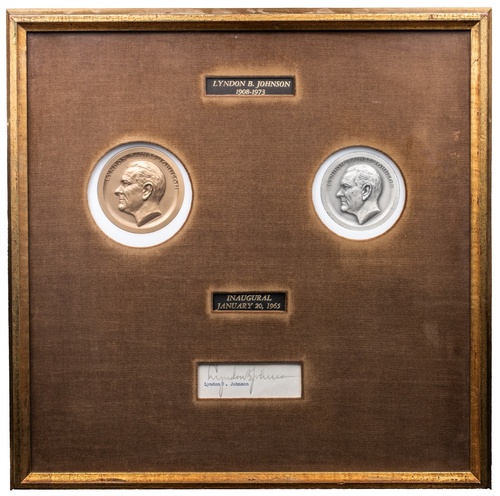
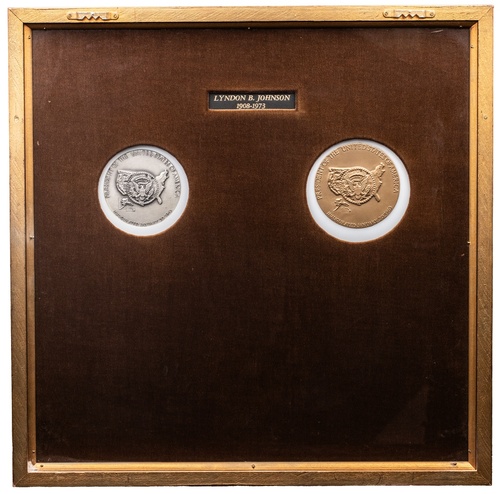
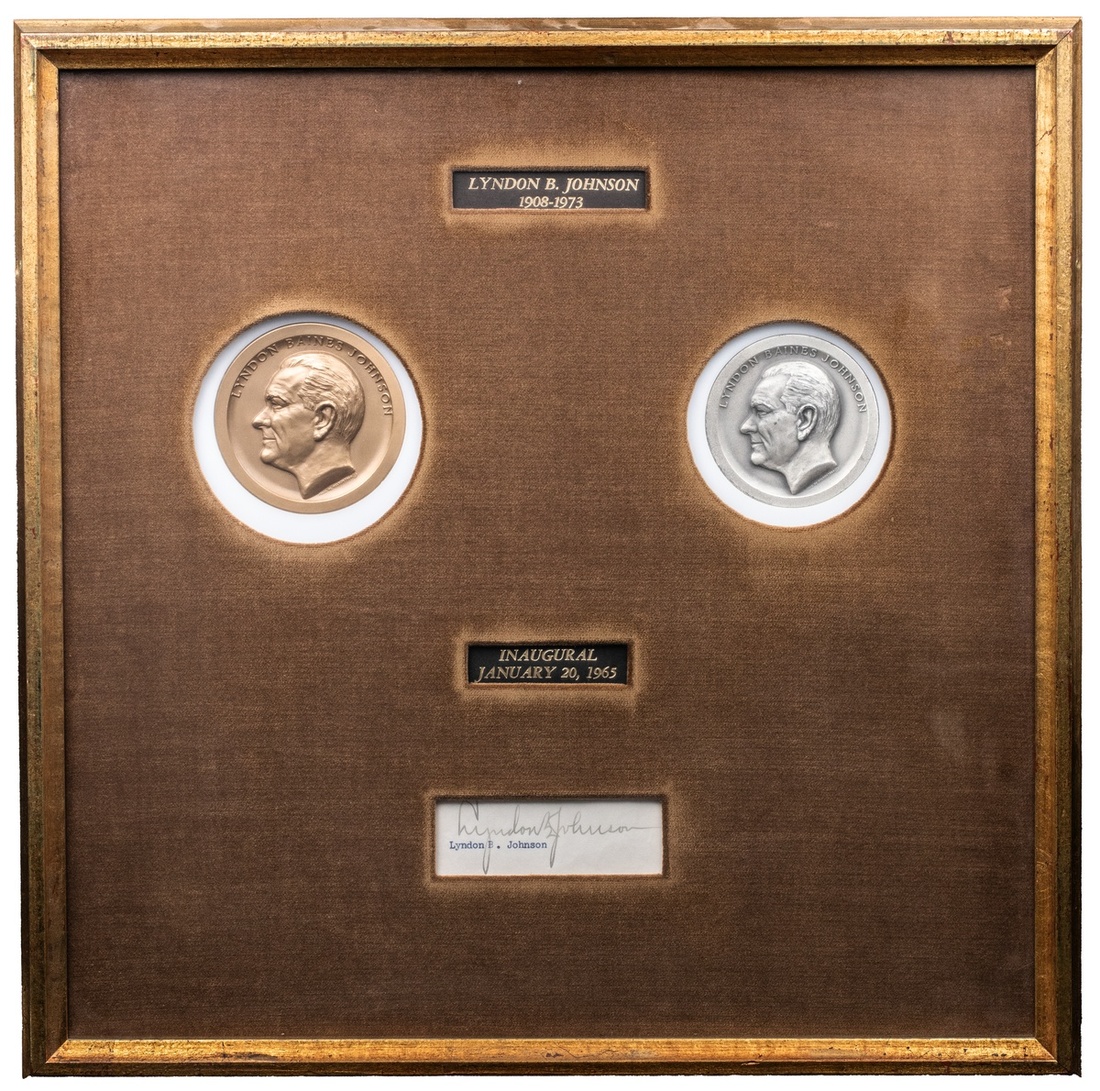
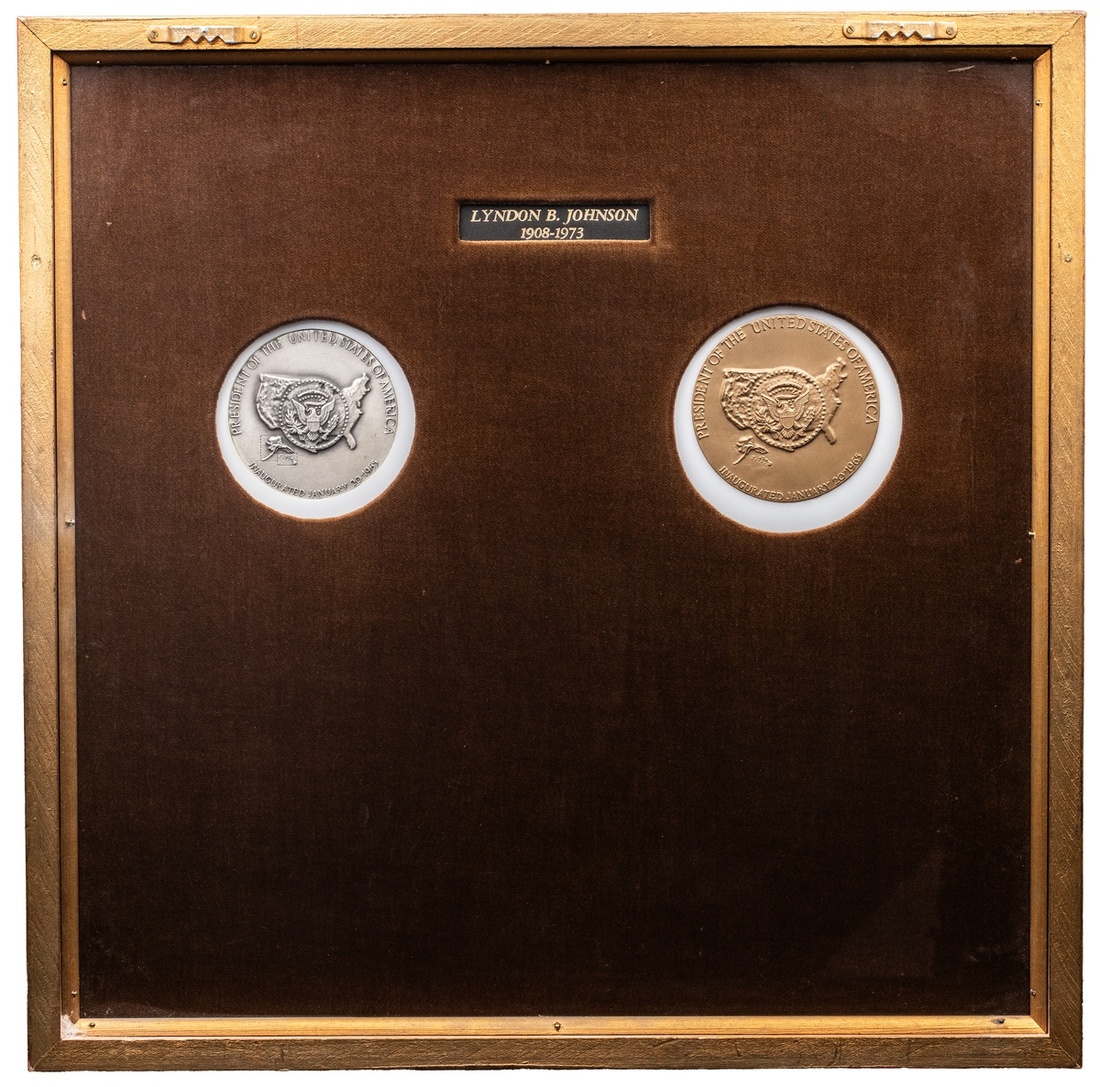
(x) Commanders-in-Chief, LYNDON B. JOHNSON, 36th President of the United States (November 22, 1963 - January 20, 1969), Official AE Inauguration Medal, 1965, by F. de Weldon for the Medallic Art Company (New York City), LYNDON BAINES JOHNSON, bust left, rev. PRESIDENT OF THE UNITED STATES OF AMERICA, heraldic eagle over map of America, 64mm, much as issued; another, AR Medal, as before, much as issued; with, cut signature "Lyndon B Johnson" on typed letter, mounted in frame, 395mm x 395mm
Not inspected outside of the frame. Sold as is.
Provenance
Presented to His Royal Highness Prince Bandar bin Sultan Al Saud, Saudi Arabian Ambassador to the United States (1983-2005), by James Addison Baker III, 67th Secretary of the Treasury and 10th White House Chief of Staff to President Ronald Reagan.
James Addison Baker III also served as 16th White House Chief of Staff and 61st Secretary of State to President George H. W. Bush.
Born in a farmhouse near Stonewall, in the Texas Hill Country, to a family that swung between modest comfort and real hardship, Johnson worked his way through Southwest Texas State Teachers College and spent a formative year teaching at a poor, segregated Mexican-American school in Cotulla, an experience of his students' poverty he invoked directly, decades later, while signing civil rights and education legislation as president.
He entered politics as a Congressional aide, then ran the National Youth Administration in Texas under the New Deal, impressing Franklin Roosevelt enough that when Johnson won a special House election in 1937, he found himself with an unusually direct line to the White House from the start.
After Pearl Harbor he became the first sitting member of Congress to report for active military duty, served briefly as a Navy Reserve officer in the Pacific, and received a Silver Star for a single observation flight over New Guinea that came under Japanese fire, an award historians have long debated as more a product of General MacArthur's political instincts than of anything Johnson personally did, since the rest of the crew received nothing and Roosevelt recalled all sitting congressmen from combat duty within months.
His Senate election in 1948 was decided by a margin of eighty-seven votes, tainted from the start by irregularities out of Jim Wells County that earned him the lasting, needling, nickname "Landslide Lyndon," but the seat became the platform for the most formidable legislative career of his generation. He rose to Senate Democratic leader in 1953 and, when the party retook the majority two years later, became the youngest majority leader in the chamber's history, mastering it through a style of persuasion so physical and relentless it earned its own name, the "Johnson Treatment," conducted at close range with a hand on the lapel and a face a few inches from its target.
A serious heart attack in 1955 barely slowed him. He sought the Presidency himself in 1960, lost the nomination to John F Kennedy, and accepted the Vice Presidency despite real doubts about the job's substance, finding the following three years about as marginalising as he had feared. He was sworn in aboard Air Force One at Dallas's Love Field on November 22, 1963, hours after Kennedy's assassination, and administered the oath by Federal judge Sarah Hughes, the first woman ever to swear in a President. What followed was a legislative record that dwarfed nearly everyone's expectations of him: a landslide election of his own in 1964 over Barry Goldwater gave him the mandate to push through the Civil Rights Act that same year, the Voting Rights Act in 1965 after the violence at Selma forced the issue, and the creation of Medicare and Medicaid, alongside an Immigration and Nationality Act that dismantled the national-origin quota system in place since the 1920s, Head Start, the Job Corps, and the public broadcasting legislation that eventually produced PBS and NPR.
He signed the Fair Housing Act in April 1968 within days of Martin Luther King's assassination, closing out a run of domestic legislation historians still measure against the New Deal itself for its scope. Vietnam undid nearly all of it. The Gulf of Tonkin Resolution in 1964 gave him a broad mandate he expanded steadily into a massive, unpopular troop commitment, and the credibility gap between his public assurances and the war's actual course widened until the Tet Offensive in early 1968 collapsed what remained of the public's patience, even though it was a tactical defeat for the North Vietnamese and Viet Cong.
On March 31, 1968, in a televised address most of the country expected to be about the war alone, he closed with the announcement that he would not seek or accept his party's nomination for another term, a renunciation of power that stunned even close aides. He left office in January 1969 for his Texas ranch, watched the war and the country's divisions continue without him, and died of a heart attack there on January 22, 1973, the day before what would have been the end of a second full term. His wife, Lady Bird Johnson, whom he married in 1934, had built much of the family's early broadcasting fortune herself and went on, as First Lady, to make highway beautification and conservation her own signature cause, a quieter legacy standing alongside her husband's considerably louder one.
Subject to 5% tax on Hammer Price in addition to 20% VAT on Buyer’s Premium.
Estimate
$200 to $260
Starting price
$140

Watch, listen and bid as if you were in the room. Now available for auctions worldwide.
Click here to bid live
An exclusive and confidential service for the discerning collector or vendor.
View the Gallery
Download every Spink catalogue on your iPad, iPod or iPhone using free Spink app.
Download From iTunes© 2026 Spink & Son. All rights reserved.