
Auction: 26776 - America 250th Anniversary Sale Ft. Coins, Medals, Banknotes, Objets de Vertu & Ephemera
Lot: 88
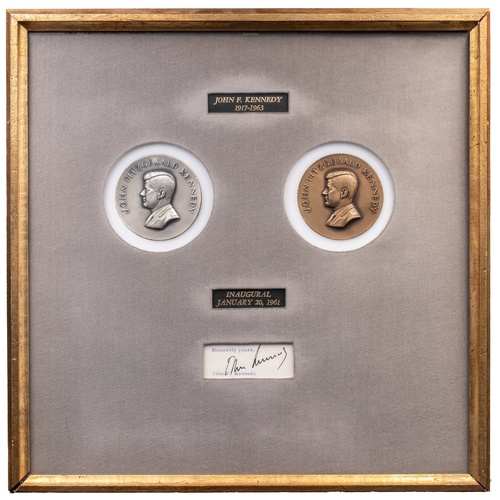
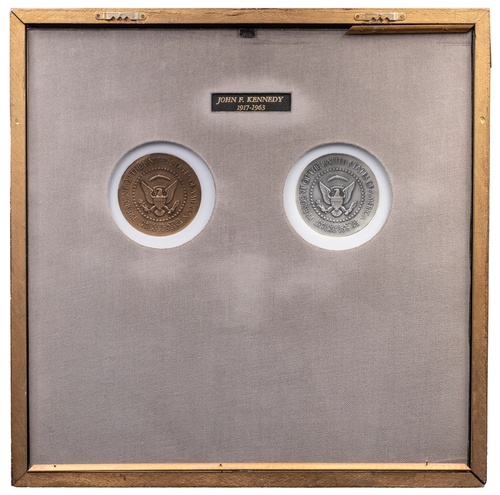
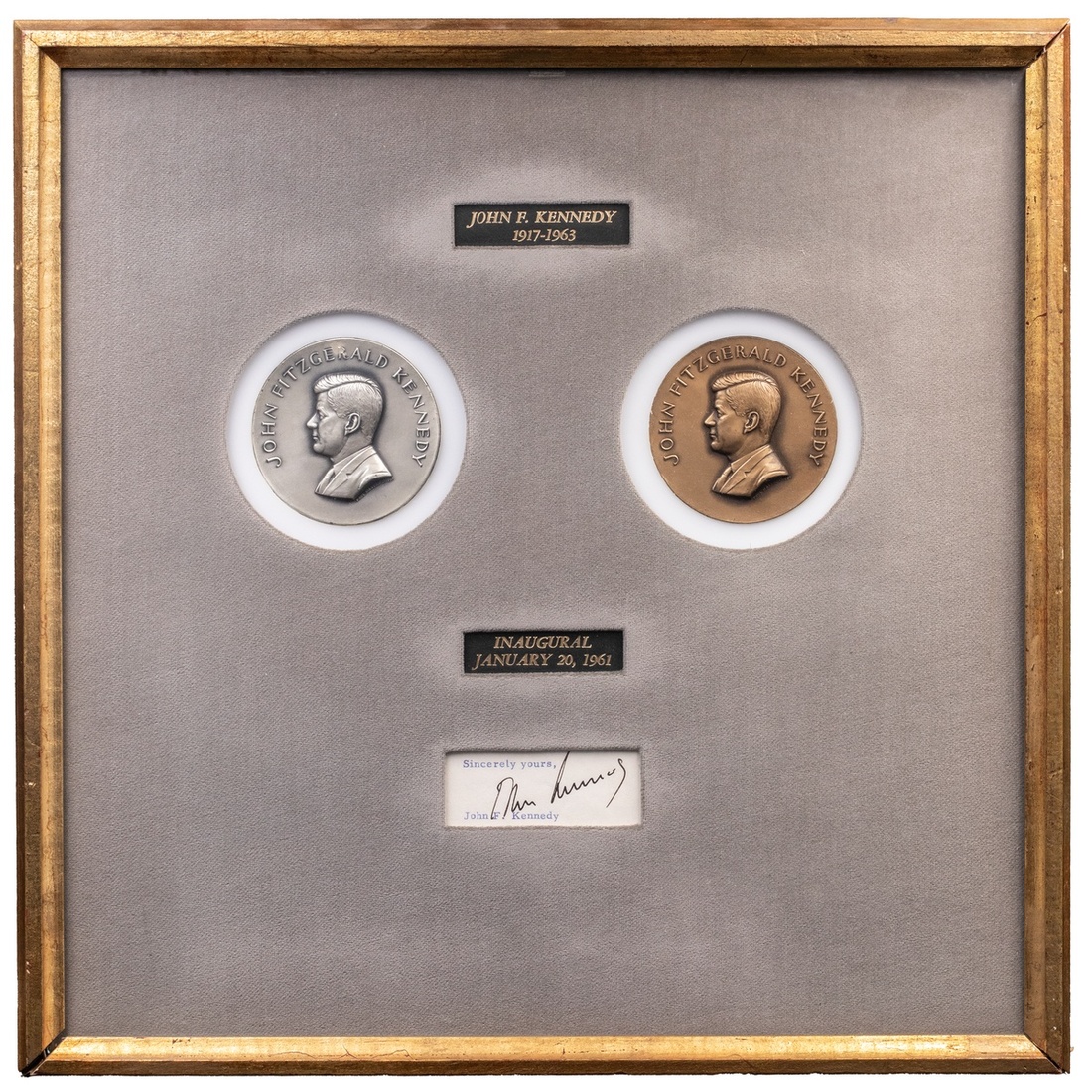
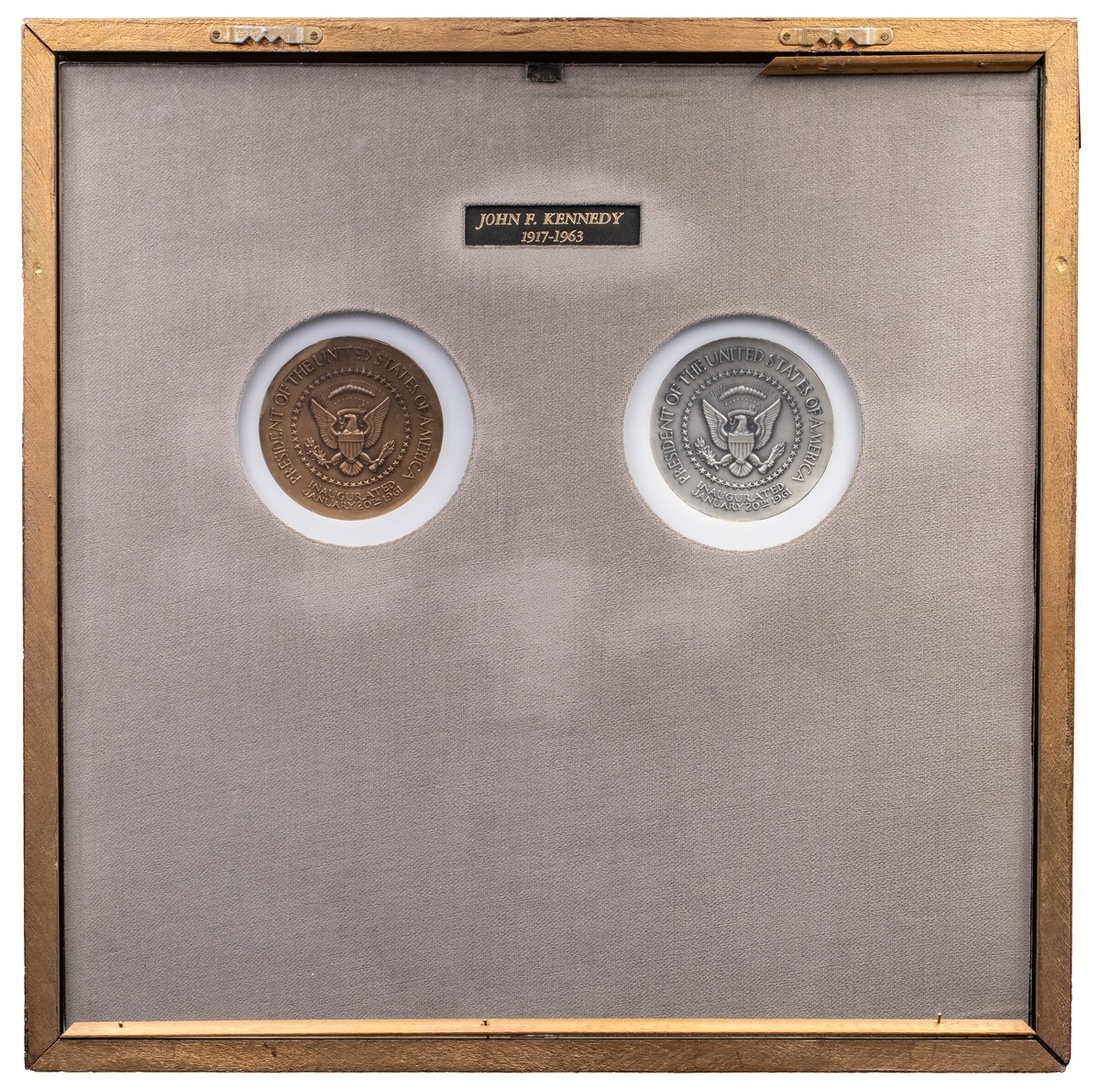
(x) Commanders-in-Chief, JOHN F. KENNEDY, 35th President of the United States (January 20, 1961 - November 22, 1963), Inauguration, Official Silver Medal, 1961, by Paul Manship for the Medallic Art Company (New York City), JOHN FITZGERALD KENNEDY, draped bust left, rev. PRESIDENT OF THE UNITED STATES OF AMERICA, heraldic eage, 70mm, some light contact marks, good extremely fine; another, Official AE Medal, as before, small evidence of lacquer, about as issued; with, cut signature "John Kennedy" from typed letter, mounted in frame, 395mm x 395mm, damage to frame
Not inspected outside of the frame. Sold as is.
Provenance
Presented to His Royal Highness Prince Bandar bin Sultan Al Saud, Saudi Arabian Ambassador to the United States (1983-2005), by James Addison Baker III, 67th Secretary of the Treasury and 10th White House Chief of Staff to President Ronald Reagan.
James Addison Baker III also served as 16th White House Chief of Staff and 61st Secretary of State to President George H. W. Bush.
Born into a wealthy and relentlessly competitive Massachusetts family, the second of Joseph P. Kennedy Sr.'s nine children, Kennedy was a sickly child, plagued through his life by scarlet fever, colitis, and a chronic spinal weakness that would eventually be compounded by war wounds. He was not, at first, the son groomed for politics; that role belonged to his elder brother Joe Jr., and it passed to Jack only when Joe was killed in 1944 on a volunteer bombing mission that detonated prematurely over England.
Jack's own war record supplied its own legend by then: commanding the patrol boat PT-109 in the Solomon Islands in August 1943, he survived a night collision with a Japanese destroyer that split his boat in half, then swam for hours towing an injured crewman by gripping a life-jacket strap in his teeth, an act that earned him the Navy and Marine Corps Medal and left him with a back injury that troubled him for the rest of his life.
He carried a second, more closely guarded medical secret throughout his political career: a diagnosis of Addison's disease, an adrenal insufficiency managed with corticosteroids and kept from the public, since a chronic and potentially fatal illness sat uneasily with the image of vigour his campaigns worked hard to project.
He entered the House in 1947, and the Senate in 1953, the same year he married Jacqueline Bouvier, and nearly died the following year from complications of back surgery undertaken to relieve pain that had never fully healed from the war. During the long recovery he produced "Profiles in Courage", a study of senators who had defied their own party's interests for principle, which won the 1957 Pulitzer Prize for Biography, though historians have long debated how much of the finished text came from Kennedy's own pen rather than his aide Theodore Sorensen's.
A near miss for the Vice Presidential nomination in 1956 only sharpened his ambitions, and by 1960 he was contesting his own party's Presidential nomination against Lyndon Johnson and Hubert Humphrey, winning it and then addressing head on the concern that, as a Catholic, he might govern at the Vatican's direction, a suspicion he confronted directly before Houston's Protestant ministers rather than letting it fester unanswered.
His televised debates against Richard Nixon that fall, the first of their kind, are still cited as a hinge point in how the medium itself could shape a campaign, since radio listeners and television viewers came away with strikingly different impressions of who had won.
He took the White House by one of the narrowest popular margins in American history, becoming, at forty-three, the youngest man ever elected to the office and the first Catholic to hold it. His Presidency opened on optimism and stumbled almost immediately into humiliation: the CIA-backed invasion of Cuba by exiles at the Bay of Pigs in April 1961 collapsed within days, and Kennedy, though the plan had been inherited from Eisenhower's administration, took public responsibility for it rather than deflect the blame downward.
He founded the Peace Corps that same year, faced down a renewed Soviet challenge over Berlin that produced the Wall dividing the city, and in 1962 committed the country, in a speech at Rice University, to landing a man on the Moon before the decade was out, a goal that sounded closer to science fiction than policy at the time it was made.
The defining thirteen days of his Presidency came that October, when American reconnaissance discovered Soviet nuclear missiles under construction in Cuba, and Kennedy chose a naval quarantine over the air strikes and invasion many of his advisors pushed for, threading a resolution through backchannel diplomacy that removed the missiles in exchange for a public pledge not to invade Cuba and a quiet, unpublicised withdrawal of American missiles from Turkey.
At home, his early caution on Civil Rights hardened into open commitment only under the pressure of events he did not choose, the Freedom Rides, the violent resistance to integrating the University of Mississippi and then Alabama, until he delivered a nationally televised address in June 1963 framing Civil Rights as a moral issue the country could no longer defer, and sent to Congress the bill that would become, after his death, the Civil Rights Act (1964).
He signed a Limited Test Ban Treaty with the Soviets that same summer, while quietly expanding the American military advisory presence in South Vietnam from a few hundred personnel to more than sixteen thousand, a policy whose consequences his successor would inherit and vastly enlarge.
His family life carried its own private grief alongside the public triumphs: an infant son, Patrick, died two days after a premature birth in August 1963, a loss that visibly affected both Kennedys in the months before Dallas, even as rumours of the president's own infidelities, later substantiated by historians, circulated beneath the surface of a marriage the public was shown only in its most polished form.
He was killed on November 22, 1963, shot while riding in an open motorcade through Dealey Plaza in Dallas, and died within the hour. Lee Harvey Oswald was arrested and charged, then murdered two days later by Jack Ruby before he could stand trial, an irregularity that has fed a market of conspiracy theories running now for more than six decades against the Warren Commission's official finding of a lone gunman.
His running-mate, Lyndon Baines Johnson was sworn in aboard Air Force One that same afternoon, and much of the legislative program Kennedy had struggled to move through a resistant Congress, Civil Rights chief among it, passed within the following year, carried forward partly on the momentum of a national grief that Kennedy's widow, within days of the funeral, helped cast in the language of Camelot, a framing that has shaped how the brief Presidency is remembered ever since, sometimes more generously than the record on its own would support.
The country's memorial to him arrived with unusual speed even by the standards of Washington improvisation. Congress authorized a Kennedy half dollar barely a month after the assassination, and the Mint was able to move so quickly only because it repurposed existing work: Chief Engraver Gilroy Roberts adapted his own obverse portrait, and Assistant Engraver Frank Gasparro his own rendering of the Presidential Seal, both originally created for Kennedy's 1961 inaugural medal (exhibited in two metals in this lot).
Jacqueline Kennedy herself shaped the decision in a small but telling way, specifically declining to have her husband replace George Washington on the Quarter and steering the tribute to the half dollar instead, then objecting to the Engraver's first pass at his hairline closely enough that the mint reworked the dies mid-production, leaving a scarce early "accented hair" variant now prized by collectors.
The change required Congress to waive the twenty-five-year rule against redesigning a circulating coin, since the Franklin half dollar it replaced had been in production only fifteen. The public's reception when the coin reached banks that March was less a currency release than a wave of secular relic-collecting, and much of that first 'constitution standard' silver run has never circulated at all, tucked into drawers and coin albums instead, which is as fitting a memorial as any for a Presidency that ended before it could finish becoming history rather than myth.
Subject to 5% tax on Hammer Price in addition to 20% VAT on Buyer’s Premium.
Estimate
$500 to $600
Starting price
$320
Watch, listen and bid as if you were in the room. Now available for auctions worldwide.
Click here to bid live
An exclusive and confidential service for the discerning collector or vendor.
View the Gallery
Download every Spink catalogue on your iPad, iPod or iPhone using free Spink app.
Download From iTunes© 2026 Spink & Son. All rights reserved.