
Auction: 26776 - America 250th Anniversary Sale Ft. Coins, Medals, Banknotes, Objets de Vertu & Ephemera
Lot: 90
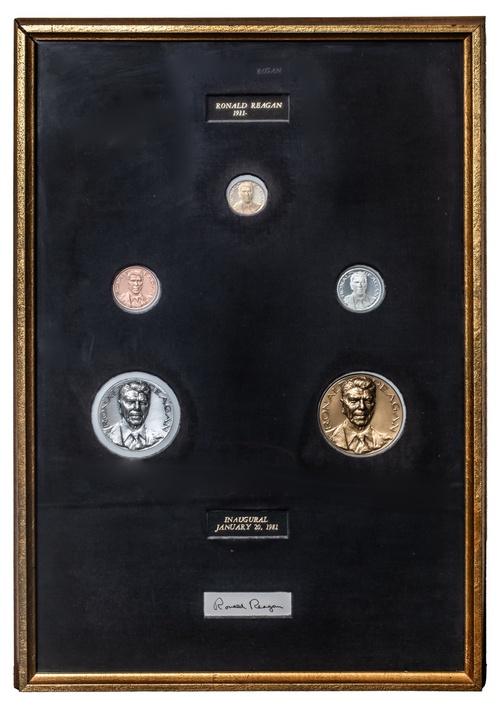
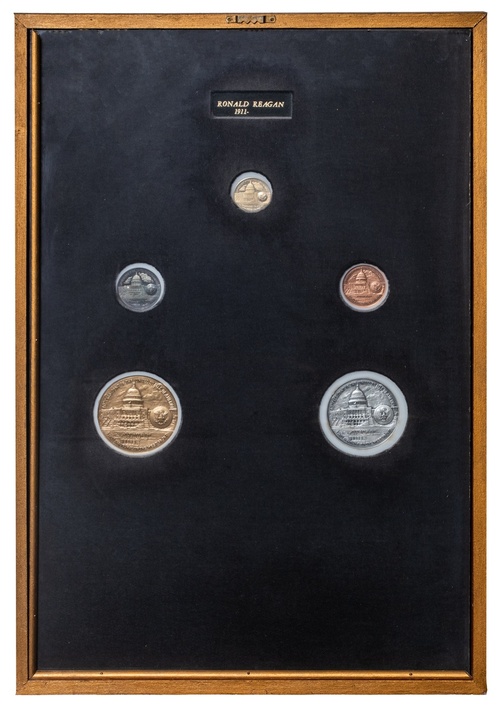
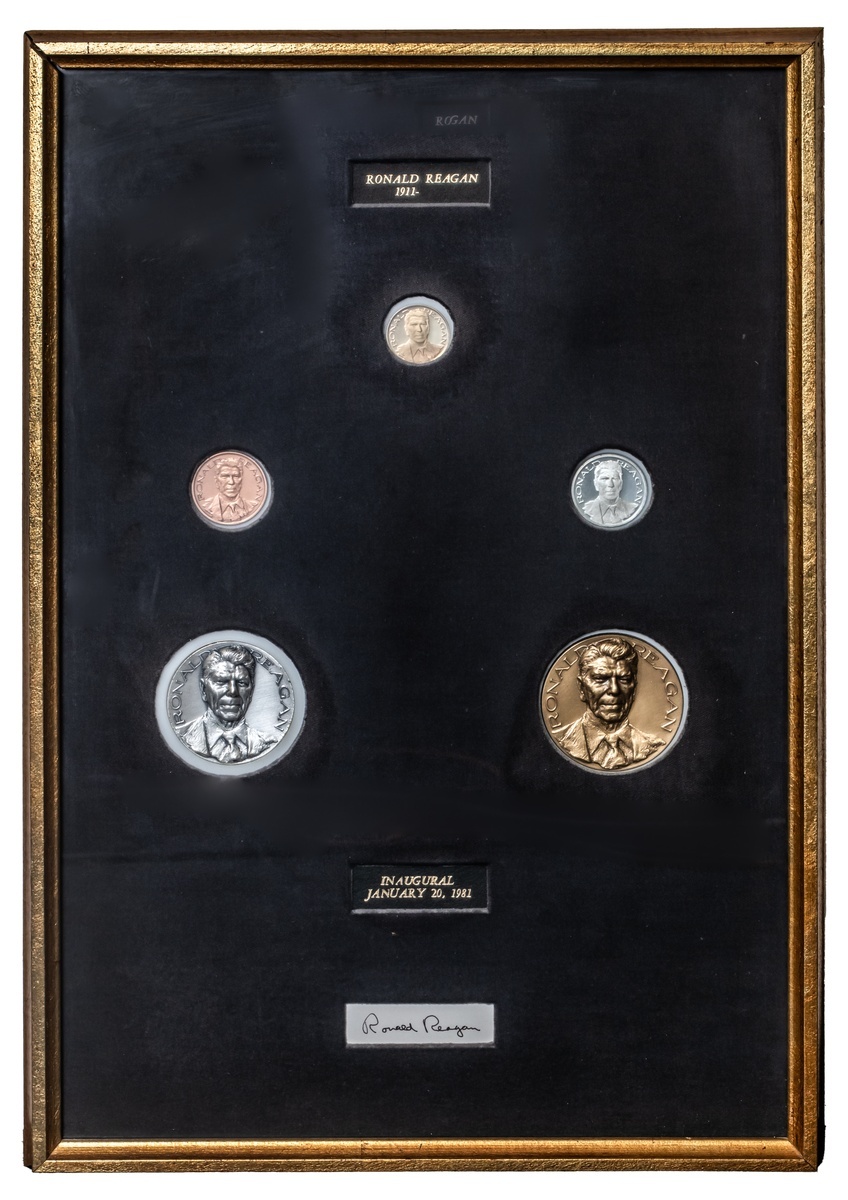
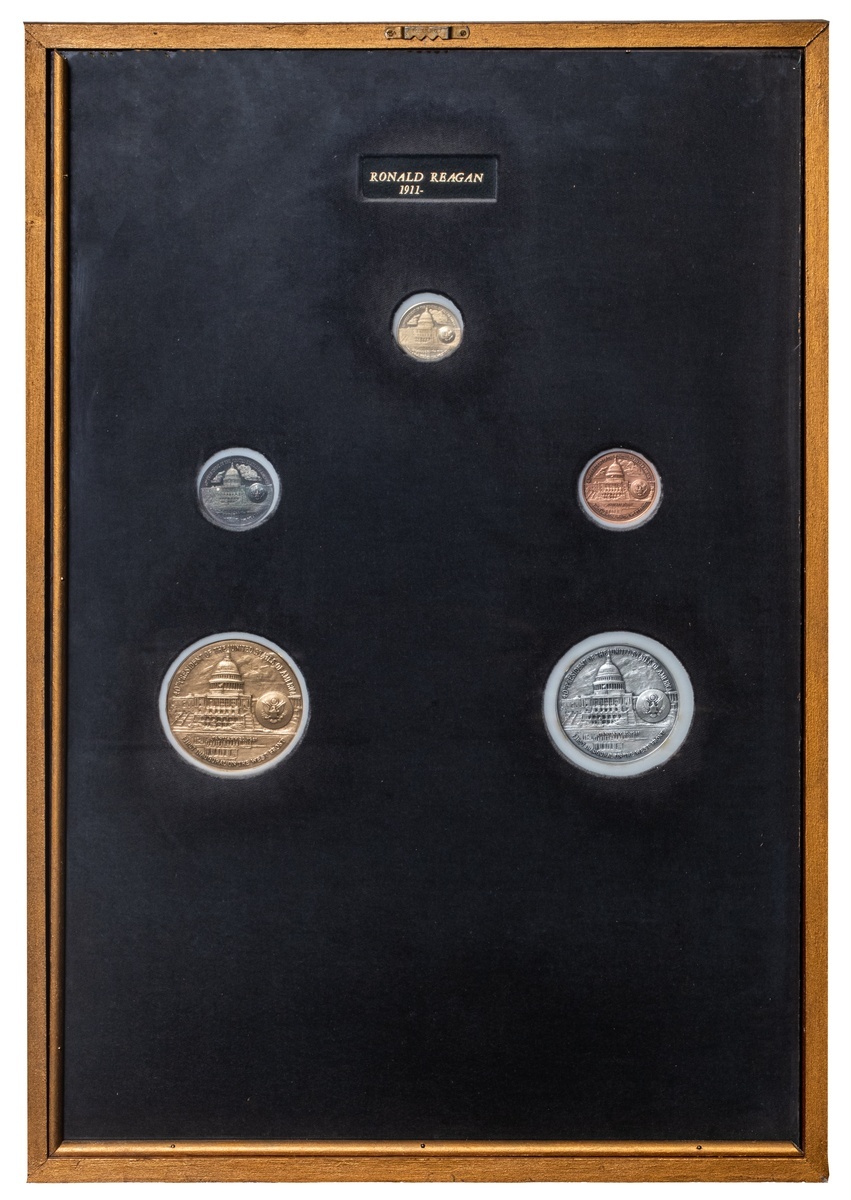
(x) Commanders-in-Chief, RONALD REAGAN, 40th President of the United States (January 20, 1981 - January 20, 1989), First Inauguration, Quintet of Medals in Gold, Silver and AE, 1981 (5), by E. Fraughton for the Medallic Art Company (New York City), RONALD REAGAN, draped bust facing, rev. 40TH PRESIDENT OF THE UNITED STATES OF AMERICA, view of the Capitol building; presidential seal to right, 30mm [gold]; 36mm [silver and AE]; 64mm [silver and AE], all much as struck, only 1,381 gold medals struck, thus RARE; with, cut signature "Ronald Reagan", mounted in frame, 395mm x 580mm, damage to frame
Not inspected outside of the frame. Sold as is.
Provenance
Presented to His Royal Highness Prince Bandar bin Sultan Al Saud, Saudi Arabian Ambassador to the United States (1983-2005), by James Addison Baker III, 67th Secretary of the Treasury and 10th White House Chief of Staff to President Ronald Reagan.
James Addison Baker III also served as 16th White House Chief of Staff and 61st Secretary of State to President George H. W. Bush.
Born in Tampico, Illinois, and raised through a series of small-town moves dictated by his father Jack's itinerant shoe-selling and persistent drinking, Reagan found his footing as a teenage lifeguard on Dixon's Rock River, a job he held for seven summers and later credited with seventy-seven rescues, each one, by his own count, notched into a wooden log at the beach.
He worked his way through Eureka College on athletic scholarships and odd jobs, talked his way into a radio job in Iowa on the strength of sheer nerve, and became locally famous re-creating Major League Baseball games from a telegraph ticker alone, once improvising several minutes of fictional foul balls when the wire itself went dead mid-game rather than admit to his listeners that he had nothing to report.
R>
A screen test converted that broadcasting charisma into a Warner Bros. contract in 1937, and over the next three decades he appeared in more than fifty films, most memorably as the dying football star of "Knute Rockne, All American," whose "win one for the Gipper" line would follow him into politics, and as the double amputee of "Kings Row," whose own anguished "Where's the rest of me?" supplied the title of his memoir.
Poor eyesight kept him out of combat in the war his contemporaries fought; he spent it instead making training and propaganda films for the Army Air Forces without ever leaving Culver City. He led the Screen Actors Guild through Hollywood's blacklist years, testified before the House Un-American Activities Committee, and, unknown to the public until FBI files surfaced decades later, served the Bureau as a confidential informant on suspected Communist sympathisers within the industry.
His politics migrated rightward across the 1950s largely through his later work as a corporate spokesman for General Electric, touring plants nationwide and absorbing management's arguments as thoroughly as he had once absorbed a script, and by 1964 he was conservative enough to deliver a nationally televised address for Barry Goldwater's doomed campaign, "A Time for Choosing," a speech so effective in isolation that it launched Reagan's own political career even as it failed to save Goldwater's.
Two years later he won the California Governorship, was re-elected in 1970, presided over bitter clashes with student protesters at Berkeley, and, less remembered by his later admirers, signed one of the era's more permissive abortion liberalisation laws before positioning himself thereafter as a champion of the pro-life cause.
After an unsuccessful 1976 primary challenge to incumbent Gerald Ford, he won the Republican nomination and then the Presidency itself in 1980, defeating a Jimmy Carter weighed down by stagflation and the Iran hostage crisis, a crisis that resolved, with theatrical timing that was pure coincidence, on the very afternoon of Reagan's inauguration.
His Presidency nearly ended within months of starting: on March 30, 1981, John Hinckley Jr. shot him outside the Washington Hilton, a bullet ricocheting off the limousine and lodging near his heart, and Reagan, characteristically, greeted the surgical team with "I hope you're all Republicans" before going under anesthesia.
He recovered to push through the largest peacetime tax cuts in the country's history alongside sweeping deregulation and a historic military buildup, a combination that supporters called "Reaganomics" and that produced both a sharp recovery from recession and a federal deficit that ballooned despite the small-government rhetoric surrounding it.
He broke the air traffic controllers' strike in 1981 by firing some eleven thousand of them outright, reshaping American labor relations for a generation, and appointed Sandra Day O'Connor as the first woman to sit on the Supreme Court.
His rhetoric toward Moscow, an "evil empire" in 1983 and the Berlin wall he demanded be torn down at the Brandenburg Gate in 1987, ran alongside an unexpectedly productive personal rapport with Mikhail Gorbachev, whose summits with Reagan at Geneva, Reykjavik, Washington, and Moscow produced the INF Treaty eliminating an entire class of nuclear missiles and helped ease the Cold War toward its end.
That record sat uneasily beside the Iran-Contra affair, in which members of his administration secretly sold arms to Iran to fund Nicaraguan rebels in direct defiance of Congress, a scandal Reagan addressed on television with an admission that mistakes had been made under his watch without ever fully explaining what he had known and when.
He survived colon cancer surgery in 1985 and left office in January 1989 with approval ratings few two-term presidents have matched. Until 2016, Reagan was, notably for such a conservative figure, Reagan was the only American President ever divorced, having ended his first marriage to actress Jane Wyman in 1949 before marrying Nancy Davis in 1952. He spent his last public years modeling a different kind of courage: in November 1994, in a handwritten letter released to the country, he announced his own Alzheimer's diagnosis and described himself as "beginning the journey that will lead me into the sunset of my life," a disclosure widely credited with easing the stigma around the disease for millions of American families.
He died at his home in Bel Air a decade later, on June 5, 2004, and lay in state at the Capitol before burial at his presidential library in Simi Valley. The coin that carries his likeness closes out a program in a way that fits his story almost too neatly. The Presidential $1 Coin series, minting a dollar for every deceased President in order since Washington's in 2007, reached Reagan in 2016 and then simply stopped there, since the next man in line, Jimmy Carter, had been still living, and the law establishing the series required a President be dead at least two years before his coin could be struck. Reagan's Dollar, released that February on what would have been his hundred and fifth birthday, thus became the fortieth and final issue of a nine-year program purely by the accident of whose turn came next.
Subject to 5% tax on Hammer Price in addition to 20% VAT on Buyer’s Premium.
Estimate
$2,000 to $2,500
Starting price
$1400
Watch, listen and bid as if you were in the room. Now available for auctions worldwide.
Click here to bid live
An exclusive and confidential service for the discerning collector or vendor.
View the Gallery
Download every Spink catalogue on your iPad, iPod or iPhone using free Spink app.
Download From iTunes© 2026 Spink & Son. All rights reserved.