
Auction: 26776 - America 250th Anniversary Sale Ft. Coins, Medals, Banknotes, Objets de Vertu & Ephemera
Lot: 87
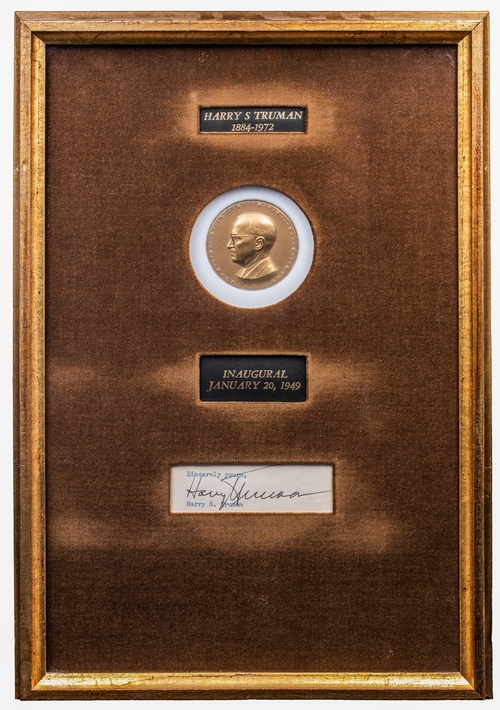
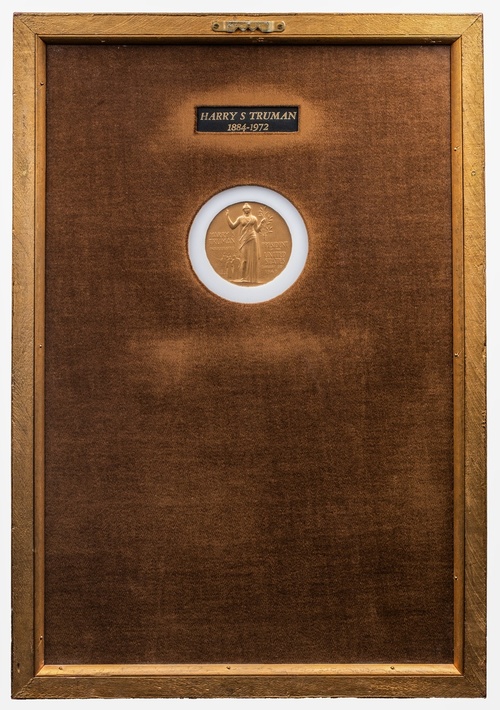
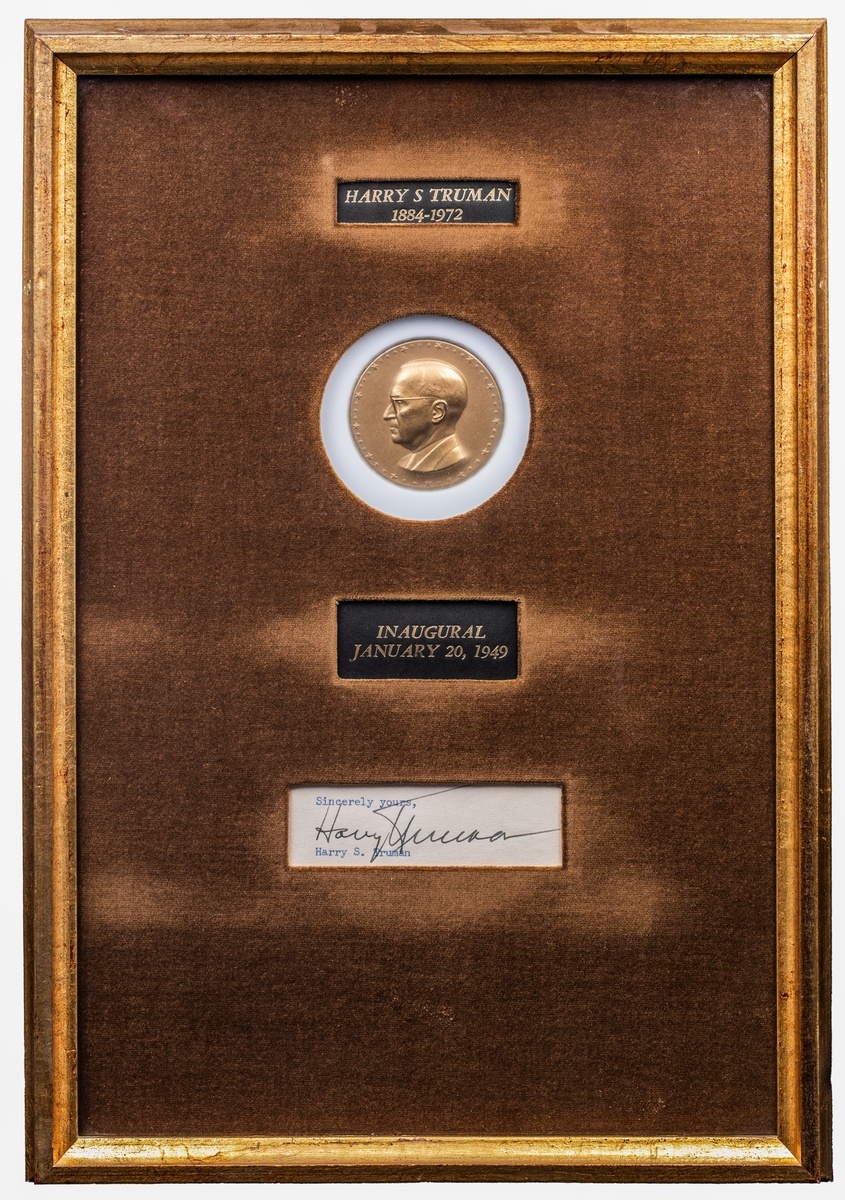
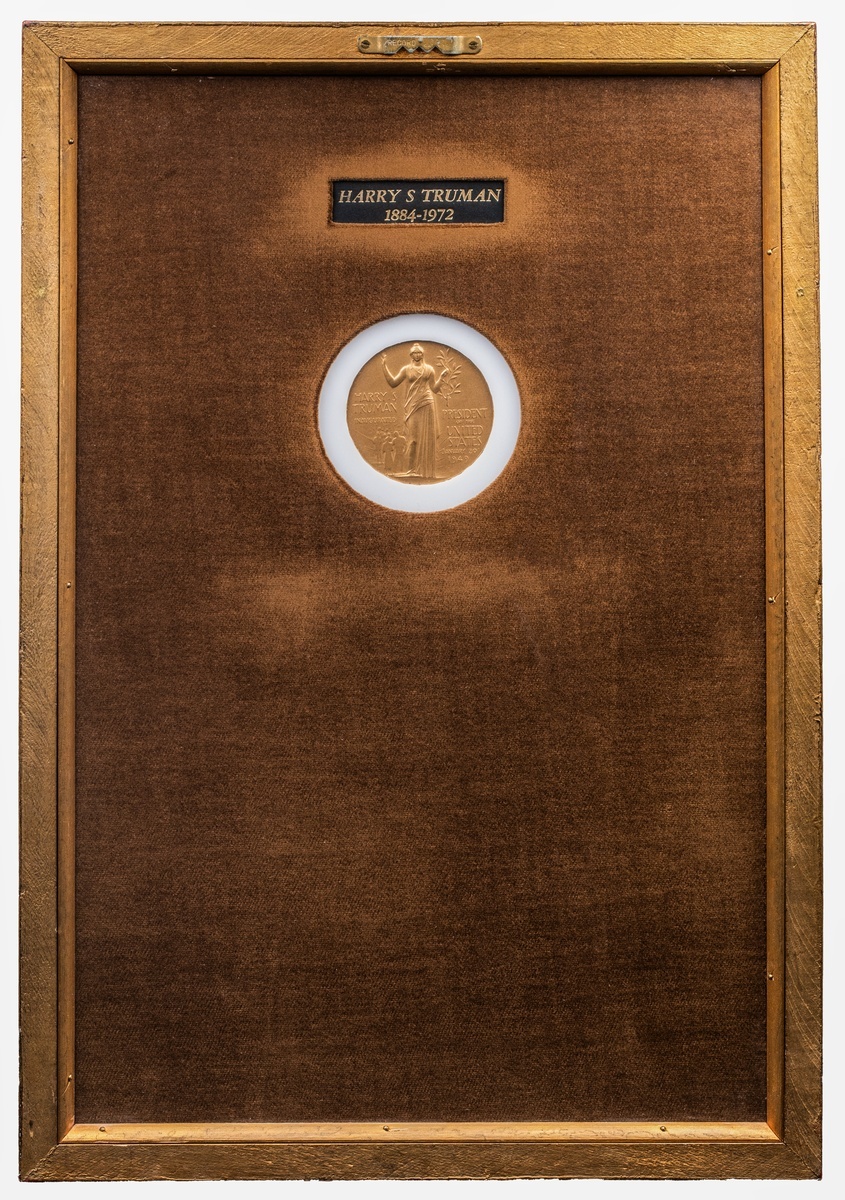
(x) Commanders-in-Chief, HARRY S. TRUMAN, 33rd President of the United States (April 12, 1945 - January 20, 1953), Second Inauguration, Official AE Medal, 1949, by C. Paul Jennewein, draped bust left, stars around, rev. Liberty standing, dividing legend, 50mm (Smithsonian 2014.29.11), couple of spots of discolouration, otherwise much as issued; with, cut signature "Harry Truman" from typed letter, mounted in frame 267mm x 395mm
Not inspected outside of the frame. Sold as is.
Provenance
Presented to His Royal Highness Prince Bandar bin Sultan Al Saud, Saudi Arabian Ambassador to the United States (1983-2005), by James Addison Baker III, 67th Secretary of the Treasury and 10th White House Chief of Staff to President Ronald Reagan.
James Addison Baker III also served as 16th White House Chief of Staff and 61st Secretary of State to President George H. W. Bush.
Truman came to the Presidency more furnished with failure than most who have held it: a Missouri farm boy who left the land for an Artillery command in France (his gun crew, unbroken and famously well drilled, called him "Captain Harry"), then home to a haberdashery in Kansas City that went under within two years, taking his savings with it.
What rescued him was the Pendergast machine, the Kansas City political organisation that put him on the county bench and later, in 1934, into the United States Senate, a debt of patronage he never fully shed in the press though he governed, by nearly every account, with clean hands. It was in the Senate that he built the reputation that mattered: chairing the wartime committee that rooted out fraud and waste in defense contracting, work credited with saving the government billions and with putting his name, at last, before Franklin Roosevelt as a safe, uncontroversial choice for the 1944 Vice Presidential candidacy.
His middle initial was itself a small act of diplomacy, and worth pausing on. His parents, unable to settle between his grandfathers Anderson Shipp Truman and Solomon Young, gave him simply the letter S, honoring both without naming either. Strictly, then, it abbreviates nothing, and the strictest usage would leave it bare, without a period (or in the case of this accompanying signature absent entirely). Truman himself was inconsistent on the point throughout his life, and the library that bears his name still uses the period; the grammar, like much else about him, was settled by habit rather than rule.
He had been Vice President only eighty-two days, and had met privately with Roosevelt perhaps twice, when he was informed on the evening of April 12, 1945, that he was President. He learned of the atomic bomb only after taking the oath, authorized its use against Hiroshima and Nagasaki that August, and closed out the war within the year. What followed was a foreign policy of unusual consequence for so unheralded a man: the Truman Doctrine committing American aid against Communist expansion, the Marshall Plan rebuilding Western Europe, the Berlin Airlift defying Soviet blockade by air for eleven months, the founding of NATO, and swift recognition of the new state of Israel in 1948.
At home he de-segregated the armed forces by Executive Order and proposed a "Fair Deal" of Civil Rights and social legislation that a conservative coalition in Congress, the body he took to calling the "Do-Nothing" Eightieth, mostly buried.
That Congress became his instrument of survival in 1948, a campaign remembered still as the great upset of American electoral history. The Democratic Party had split three ways, with Strom Thurmond's "Dixiecrats" bolting over Civil Rights and Henry Wallace's "Progressives" bolting from the left; Thomas Dewey, the Republican Governor of New York, was considered so certain a winner that the Gallup organization stopped polling weeks before the vote and several newspapers wrote his victory in advance.
Truman answered by taking the fight directly to the country, covering some thirty thousand miles by rail and delivering hundreds of unscripted speeches from the rear platform of his train, a style his supporters dubbed "whistle-stopping" and that produced the campaign's enduring cry: "Give 'em hell, Harry."
He won by more than two million votes, and the photograph taken the next morning at St. Louis's Union Station, Truman grinning and holding aloft an early edition of the Chicago Daily Tribune under the headline DEWEY DEFEATS TRUMAN, has outlived nearly every other image of his Presidency: proof, framed and printed, of how completely the professionals had gotten it wrong.
The medal struck for his inauguration that following January and offered presently was a formality granted to every incomer, but in this result, unlike any other Presidential race until arguably 2016, carries something closer to vindication than ceremony.
His second term brought Korea, the dismissal of General MacArthur for insubordination, an assassination attempt by Puerto Rican nationalists at Blair House in 1950, and approval ratings that fell, by the time he declined to seek re-election in 1952, among the lowest ever recorded for a sitting President.
History has been considerably kinder in the retelling than the polls of the moment allowed. He kept, famously, a sign on his desk reading "The Buck Stops Here," and retired without wealth to a modest house in Independence, Missouri, the plain terms on which he had always insisted he be judged.
Subject to 5% tax on Hammer Price in addition to 20% VAT on Buyer’s Premium.
Estimate
$200 to $260
Starting price
$140
Watch, listen and bid as if you were in the room. Now available for auctions worldwide.
Click here to bid live
An exclusive and confidential service for the discerning collector or vendor.
View the Gallery
Download every Spink catalogue on your iPad, iPod or iPhone using free Spink app.
Download From iTunes© 2026 Spink & Son. All rights reserved.