
Auction: 26776 - America 250th Anniversary Sale Ft. Coins, Medals, Banknotes, Objets de Vertu & Ephemera
Lot: 86
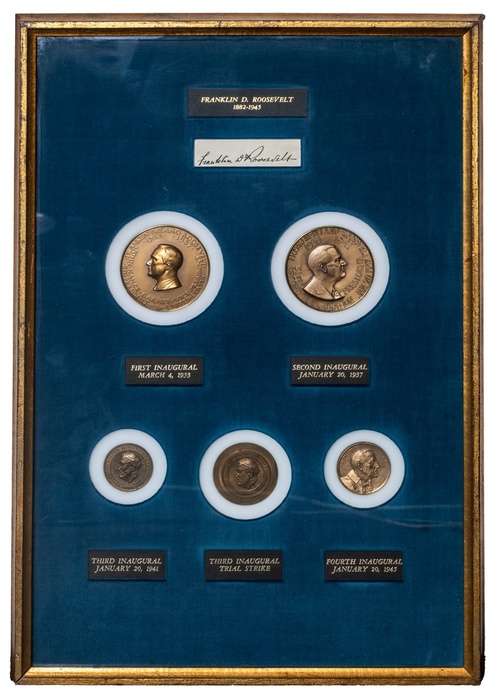
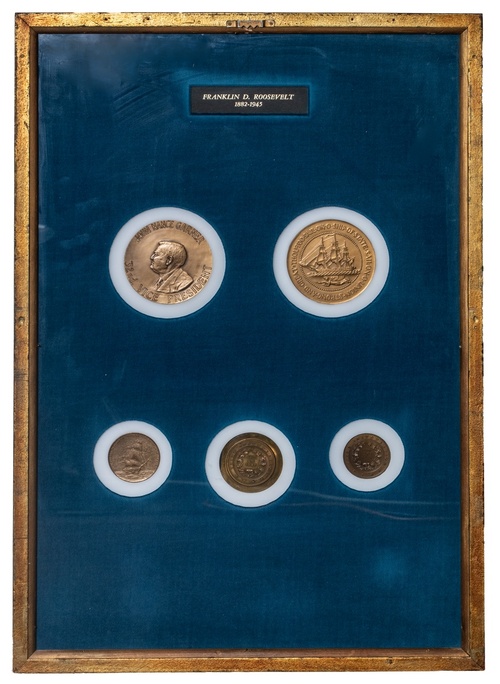
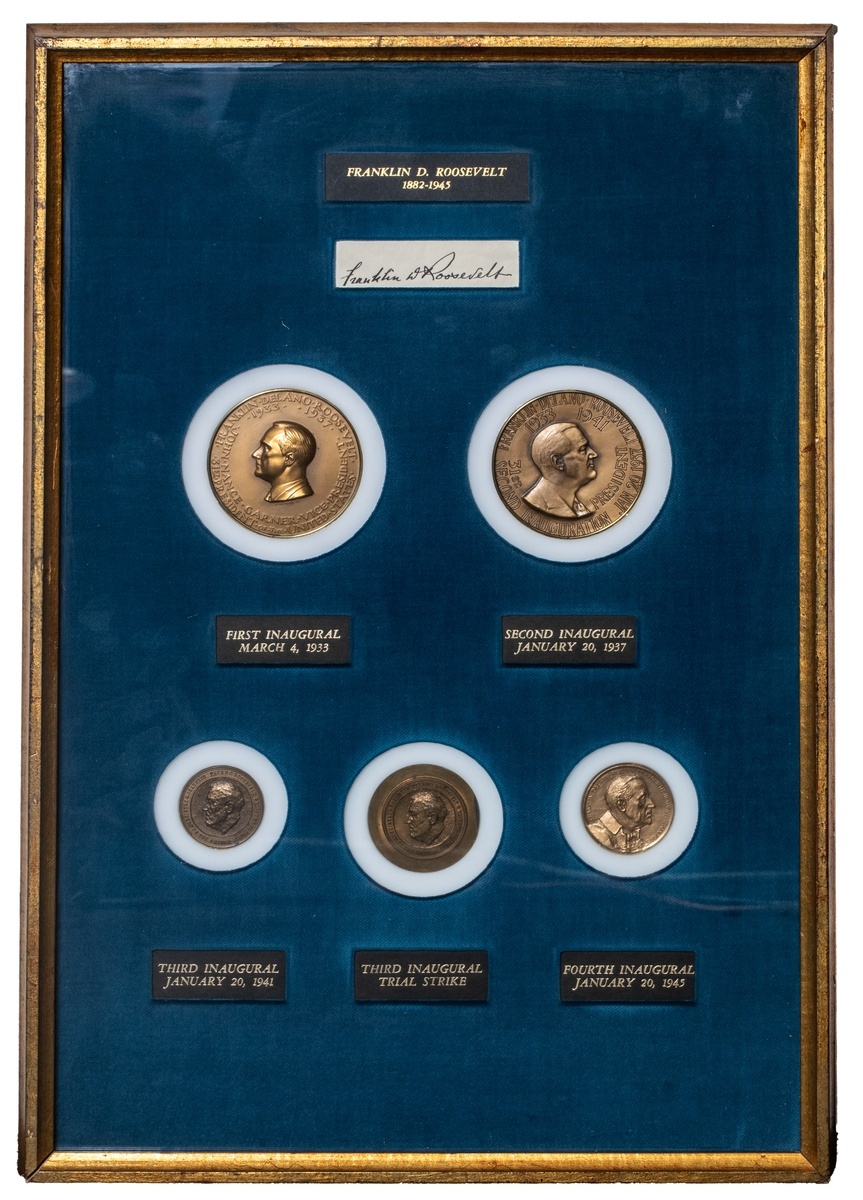
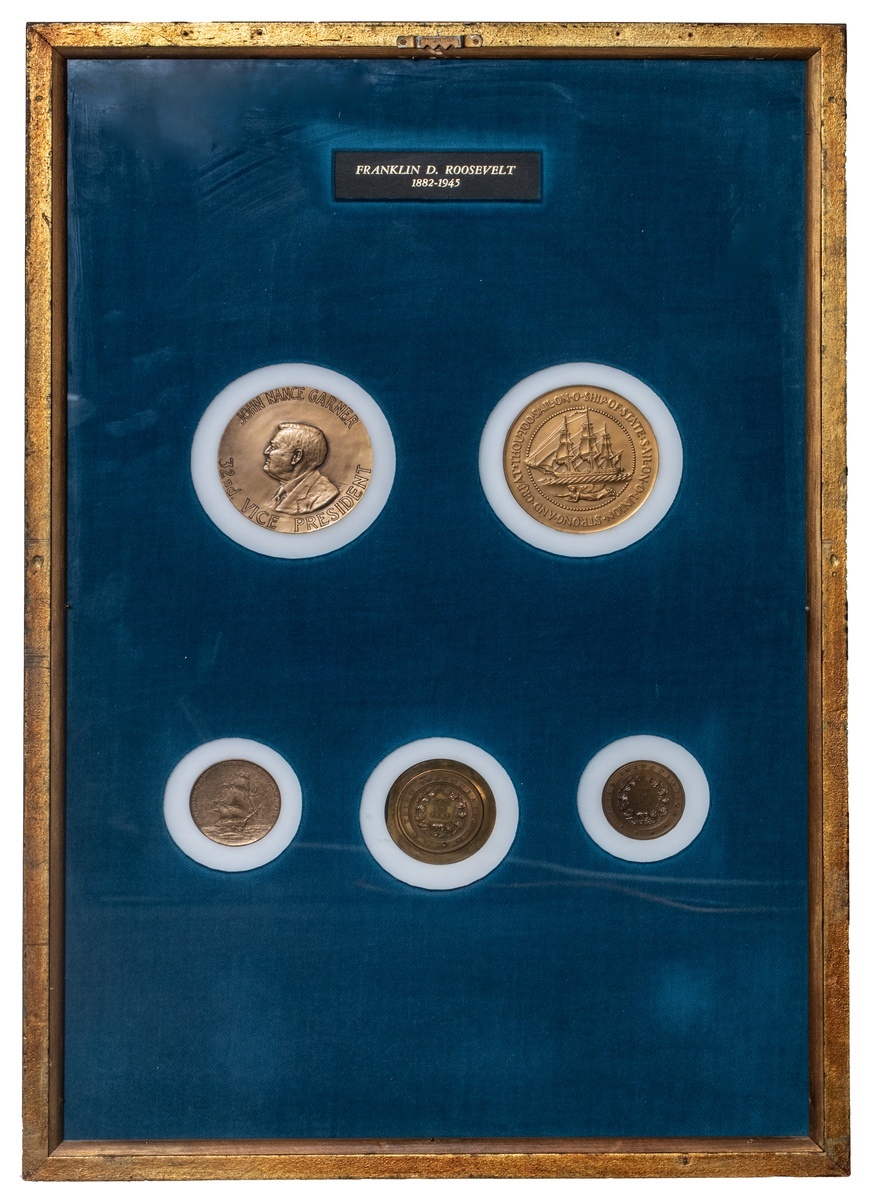
(x) Commanders-in-Chief, FRANKLIN DELANO ROOSEVELT, 32nd President of the United States (March 4, 1933 - April 12, 1945), First Inauguration, AE Medal, 1933, by P. H. Manship, draped bust left, legend in two lines around, rev. THOU TOO SAIL ON O SHIP OF STATE SAIL ON O UNION STRONG AND GREAT, the ship USS CONSTITUTION, and an angel below it, 76mm (National Archives MO 2010.10.12b), some minor contact marks, otherwise much as issued, only 1,500 struck; and, Second Inauguration, AE Medal, 1937, by Joseph Atchison, draped bust right, legend around, rev. draped bust left, legend around, 77mm (Dusterburg-OIM 9B76), much as issued, only 1,025 struck; and Third Inauguration, AE Medal, 1941, by Jo Davidson and John R. Sinnock, bust left, legend around, rev. THIRD INAUGURATION, JAN. | 20 | 1941 in wreath, 41mm (PCGS 660416), extremely fine, only 2,000 struck; and Third Inauguration, AE Medal Trial Strike, as before, couple of spots of corrosion, yet much as struck and RARE; and, Fourth Inauguration, AE Medal, 1945, by Jo Davidson, FRANKLIN DELARO ROOSEVELT ~ FOURTH INAUGURATION 1945, draped bust right, rev. THOU TO SAIL ON O SHIP OF STATE ~ SAIL ON O UNION STRONG AND GREAT, ship sailing right, 44mm (National Archives MO 1945.78.1), extremely fine, only 3,500 struck; with, cut signature "Franklin D Roosevelt", mounted in frame, 395mm x 580mm
Not inspected outside of the frame. Sold as is.
Provenance
Presented to His Royal Highness Prince Bandar bin Sultan Al Saud, Saudi Arabian Ambassador to the United States (1983-2005), by James Addison Baker III, 67th Secretary of the Treasury and 10th White House Chief of Staff to President Ronald Reagan.
James Addison Baker III also served as 16th White House Chief of Staff and 61st Secretary of State to President George H. W. Bush.
Born to Hudson Valley wealth at Hyde Park, New York, and a fifth cousin of Theodore Roosevelt whose relation grew closer still when he married TR's niece Eleanor in 1905, with the sitting President himself giving away the bride, Roosevelt cut an unremarkable figure through Groton, Harvard, and an unfinished stint at Columbia Law before entering politics as a New York state Senator and then Wilson's Assistant Secretary of the Navy, a post from which he ran, unsuccessfully, for Vice President in 1920.
His marriage survived a crisis in 1918 that reshaped it permanently: Eleanor discovered love letters proving his affair with her own social secretary, Lucy Mercer, and while the couple never divorced, pressured by his domineering mother and by his adviser Louis Howe's warning that scandal would end his career outright, the partnership that continued afterward was, by most accounts, a formidable political alliance conducted increasingly along separate personal lives.
In 1921, at Campobello Island, he was struck by a sudden paralytic illness, diagnosed at the time as polio, though some modern physicians reviewing the case have proposed Guillain-Barré syndrome as an alternative explanation, and it left him unable to walk unaided for the rest of his life. He built an elaborate, largely successful public performance around the disability, fitted with heavy steel leg braces that let him appear to stand and "walk" a few staged steps with support, and a co-operative press corps that all but never photographed him in the wheelchair he depended on privately.
He bought and developed Warm Springs, Georgia, as a hydrotherapy retreat for fellow polio patients and founded the National Foundation for Infantile Paralysis to fund research toward a cure, philanthropic work that would outlive him in a form few could have anticipated at the time.
Elected New York's Governor in 1928 and re-elected in a landslide as the Depression deepened, he brought an activist state relief program to the Presidency itself after defeating the incumbent Herbert Hoover in 1932. His first hundred days produced a legislative burst without precedent, emergency banking reform, the Agricultural Adjustment Act, the Civilian Conservation Corps, the Tennessee Valley Authority, and a direct new channel to the public in the radio fireside chat, through which he talked Americans through the banking panic in a tone of calm, unhurried reassurance that few politicians before him had managed over the airwaves. Social Security, passed in 1935, became the New Deal's most durable legacy, and the Wagner Act's protections for union organizing reshaped American labor for a generation.
His 1937 attempt to expand the Supreme Court after it struck down several of his early programs badly overreached his political capital, failed in Congress outright, and cost him allies even as the Court, for reasons historians still debate, began upholding New Deal legislation not long after.
He broke Washington's two-term tradition by winning a third term in 1940 and a fourth in 1944, the only President to serve more than eight years, a run that Congress closed off for everyone after him with the Twenty-Second Amendment. Wartime leadership occupied nearly all of those last two terms: he supplied Britain through Lend-Lease while formally neutral, met Churchill at sea to draft the Atlantic Charter, and brought the country fully into the war after Pearl Harbor, telling Congress the following day that December 7, 1941, would be "a date which will live in infamy," a line he changed from an earlier, flatter draft only shortly before delivering it.
He coordinated Allied grand strategy with Churchill and Stalin at Casablanca, Tehran, and finally Yalta, insisted on unconditional surrender from the Axis powers, and quietly set the Manhattan Project in motion, though its results would fall to his successor to decide upon. That record carries one of the gravest stains of any modern presidency alongside it: Executive Order 9066, signed in 1942, authorized the forced removal and internment of well over a hundred thousand Japanese Americans, the great majority of them citizens, a decision the Federal Government would not formally apologize and compensate for until decades later.
He entered his fourth term visibly failing, his heart disease and hypertension managed and concealed from the public much as Wilson's stroke and Cleveland's cancer had been managed before him, and on April 12, 1945, he died of a massive cerebral haemorrhage at Warm Springs, weeks before Germany's surrender and months before Japan's.
Lucy Mercer, not Eleanor, was in the room when he died, a detail Eleanor learned only afterward and one of the more quietly devastating footnotes to a marriage that had, by then, become something closer to a lifelong political partnership than a romance.
His dog Fala, a Scottish terrier who travelled everywhere with him, briefly became a small controversy of his own in the 1944 campaign, when Roosevelt mocked Republican claims that he had sent a Navy destroyer back to retrieve the dog after supposedly leaving him behind in the Aleutians, telling an audience that his own family could not "resent attacks" on him but that Fala's "Scotch soul" certainly could.
The coin that carries his face today exists because of the disease that nearly ended his career before it began. Within a month of his death, Congress moved to put Roosevelt on the Dime specifically because of his association with the March of Dimes, the fundraising campaign born from his own foundation, and the Mint rushed Chief Engraver John Sinnock's design into production so quickly that it reached circulation on what would have been Roosevelt's sixty-fourth birthday in January 1946.
The new coin picked up two minor controversies almost immediately: early Cold War anxiety turned Sinnock's own initials, JS, into a rumour that the engraver had secretly honored Joseph Stalin, and the sculptor Selma Burke argued for years afterward that Sinnock's portrait had been lifted from her own 1945 bronze relief of the president rather than created independently, a dispute over credit that numismatists still can not fully settle today.
Subject to 5% tax on Hammer Price in addition to 20% VAT on Buyer’s Premium.
Estimate
$1,500 to $2,000
Starting price
$1000
Watch, listen and bid as if you were in the room. Now available for auctions worldwide.
Click here to bid live
An exclusive and confidential service for the discerning collector or vendor.
View the Gallery
Download every Spink catalogue on your iPad, iPod or iPhone using free Spink app.
Download From iTunes© 2026 Spink & Son. All rights reserved.