
Auction: 26776 - America 250th Anniversary Sale Ft. Coins, Medals, Banknotes, Objets de Vertu & Ephemera
Lot: 85
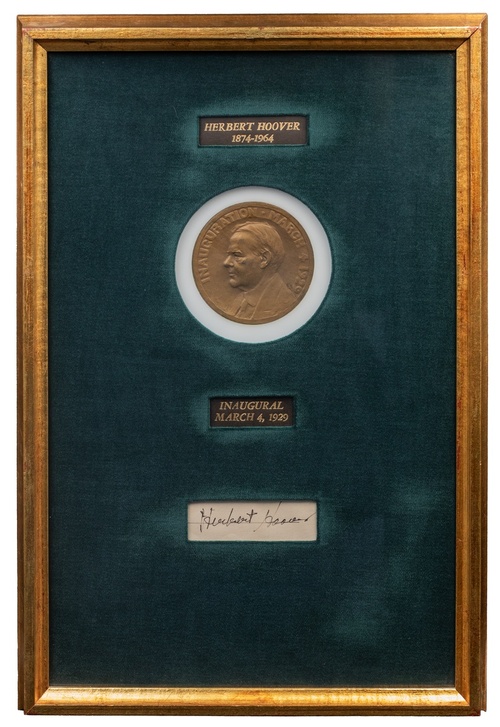
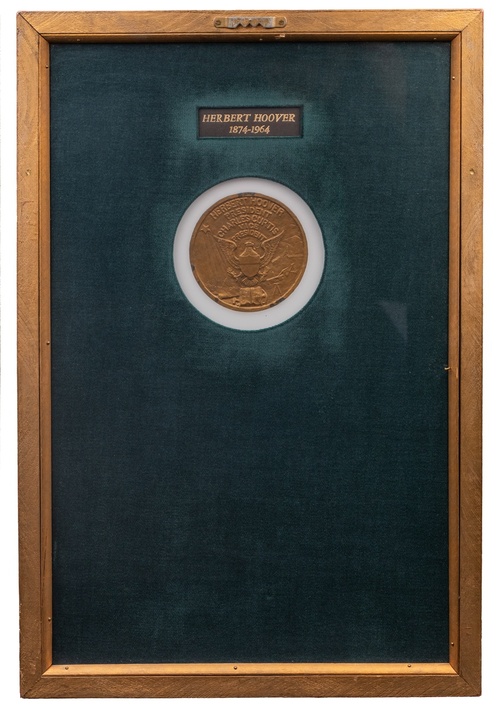
(x) Commanders-in-Chief, HERBERT HOOVER, 31st President of the United States (March 4, 1929 - March 4, 1933), Inauguration, Official AE Medal, 1929, by Henry Kirke Bush-Brown for the US Mint, INAUGURATION MARCH 4 1929, draped bust left, rev. HERBERT HOOVER | PRESIDENT | CHARLES CURTIS | VICE | PRESIDENT, heraldic eagle, 70mm (Dusterberg-OIM 7B70), some spots of corrosion, otherwise much as issued, only 1,012 pieces struck; with, his cut signature "Herbert Hoover" from a document, mounted in frame, 267mm x 395mm
Not inspected outside of the frame. Sold as is.
Provenance
Presented to His Royal Highness Prince Bandar bin Sultan Al Saud, Saudi Arabian Ambassador to the United States (1983-2005), by James Addison Baker III, 67th Secretary of the Treasury and 10th White House Chief of Staff to President Ronald Reagan.
James Addison Baker III also served as 16th White House Chief of Staff and 61st Secretary of State to President George H. W. Bush.
Born in a two-room cottage in West Branch, Iowa, the first President born west of the Mississippi, Hoover was orphaned twice over by the age of nine, his father dead of heart disease, his mother of typhoid, and was passed among relatives before an uncle in Oregon took him in. Raised a Quaker, he entered Stanford's inaugural class in 1891 to study geology, worked his way through as a laundry agent and newspaper delivery boy, and left with a profession, mining engineering, that would make him wealthy well before it made him famous.
By his forties, after assignments spanning the Australian outback and the mines of northern China (he was in Tianjin in 1900, organizing the foreign community's defenses during the Boxer Rebellion), he had become one of the most sought-after mining consultants in the world and a self-made millionaire, known in the trade papers simply as "the Great Engineer."
The war remade his reputation entirely. Stranded American tourists in London in 1914 found in Hoover an improbable rescuer, and from there he organized the Commission for Relief in Belgium - a private humanitarian effort that fed the German-occupied nation of seven million people through four years of blockade and became, by most estimates, the largest food relief operation the world had yet seen. Understandably Hoover was lauded again as "the Great Humanitarian" and the "Saviour of Belgium". Wilson brought him home to head the U.S. Food Administration, where the verb "hooverize" entered the language as shorthand for wartime conservation, and after the armistice he extended the work eastward, into a Europe of famine and revolution.
He directed relief into Soviet Russia during the 1921 famine over the objections of Americans who found feeding Bolsheviks distasteful, reportedly answering that twenty million people were starving and would be fed whatever their politics. He took no salary for any of it. By 1920, he was, by acclaim rather than election, the most admired man in American public life who had never held elected office. He entered the cabinet instead, serving as an unusually expansive Secretary of Commerce under Harding and Coolidge, where he set industrial standards, organised early radio regulation, and turned a minor department into a genuine instrument of Federal reach, before winning the Presidency itself in a landslide in 1928.
Then came the collapse. The stock market crashed seven months into his term, and the response that followed was less passive than legend allows, the Reconstruction Finance Corporation lent Government funds to shore up banks and railroads, the Federal Home Loan Bank Act attempted to steady the mortgage market, but it was relief extended chiefly to institutions rather than individuals, hedged always by Hoover's conviction that direct Federal aid to citizens would corrode the character it was meant to save.
The Smoot-Hawley Tariff (1930) came next, raising duties to some of the highest levels in American history (60% protectionist import rates), and only deepening the global trade contraction that was already strangling the recovery he needed. Worse for his standing was the summer of 1932, when thousands of unpaid Great War veterans camped in Washington demanding early payment of promised bonuses. Hoover ordered the camps cleared, and the Army, under Douglas MacArthur and with Dwight Eisenhower and George Patton among the officers involved, dispersed the Bonus Army with cavalry, tear gas, and fire, an image that outlasted any defence he could offer of it.
It was on his watch, if to his lasting credit, that construction began on the great dam at Boulder Canyon, later renamed for him. Little of this squared with the private man. He and his wife Lou, who had met him in a Stanford Geology class and remains the only First Lady with a science degree, had learned Mandarin during their years in China and were known to lapse into it at the White House dinner table when they wished to speak without being understood by the staff.
Unable to find time for conventional exercise, Hoover devised a punishing medicine-ball game, promptly named "Hoover-ball", that he played each morning on the South Lawn with cabinet members and reporters; the ritual, said to be more strenuous than tennis, did nothing to soften the public sense of him as cold and unreachable, a misreading his admirers always found painful given the record of Belgium and the famine years.
He lost to Franklin Roosevelt in 1932 by a margin nearly as decisive as his own victory four years earlier, and spent much of the following decade as the New Deal's most persistent conservative critic, a role that further dimmed a reputation the Depression had already darkened past easy repair. Rehabilitation came late and from an unlikely quarter: Truman, whom Hoover had never expected much warmth from, appointed him in 1947 to oversee a survey of post-war conditions in Germany as part of a famine prevention initative. Hoover produced a report based on his findings which recommended not punishing the starving German people, but instead supporting Germany's economic recovery, stating that "If Western Civilization is to survive in Europe, it must also survive in Germany”, putting aside political sensitivities in favour of humanitarian outreach, as he had done in Russia some 25 years previously. The resulting "Hoover Speisung", known as the Hoover Feeding Programme, provided life-saving rations to to German children, pregnant women, and hard labourers. He oversaw similar initatives across the formerly occupied European nations, against stern opposition from the Allies.
He lived another decade beyond that, dying in 1964 at ninety, one of the longest retirements of any American president and, by its end, a figure history had begun, tentatively, to judge less by 1932 than by everything that came before and after it.
Subject to 5% tax on Hammer Price in addition to 20% VAT on Buyer’s Premium.
Estimate
$200 to $300
Starting price
$150
Watch, listen and bid as if you were in the room. Now available for auctions worldwide.
Click here to bid live
An exclusive and confidential service for the discerning collector or vendor.
View the Gallery
Download every Spink catalogue on your iPad, iPod or iPhone using free Spink app.
Download From iTunes© 2026 Spink & Son. All rights reserved.