
Auction: 26776 - America 250th Anniversary Sale Ft. Coins, Medals, Banknotes, Objets de Vertu & Ephemera
Lot: 84
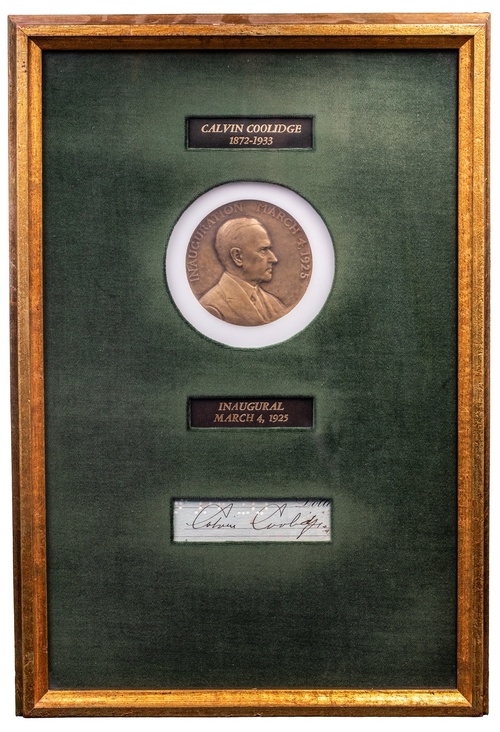
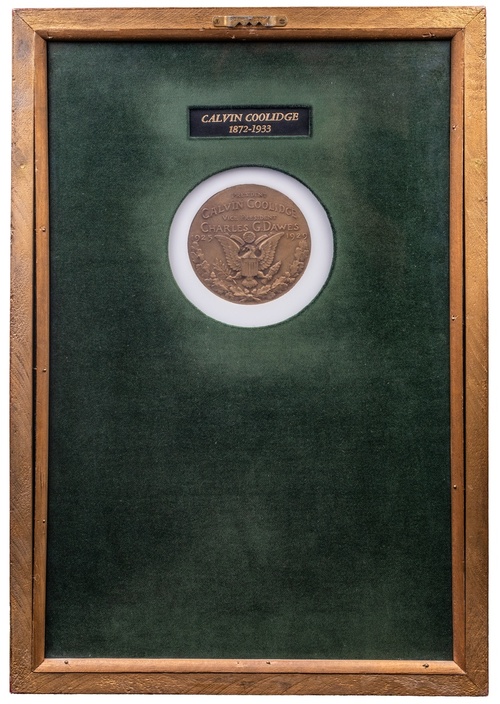
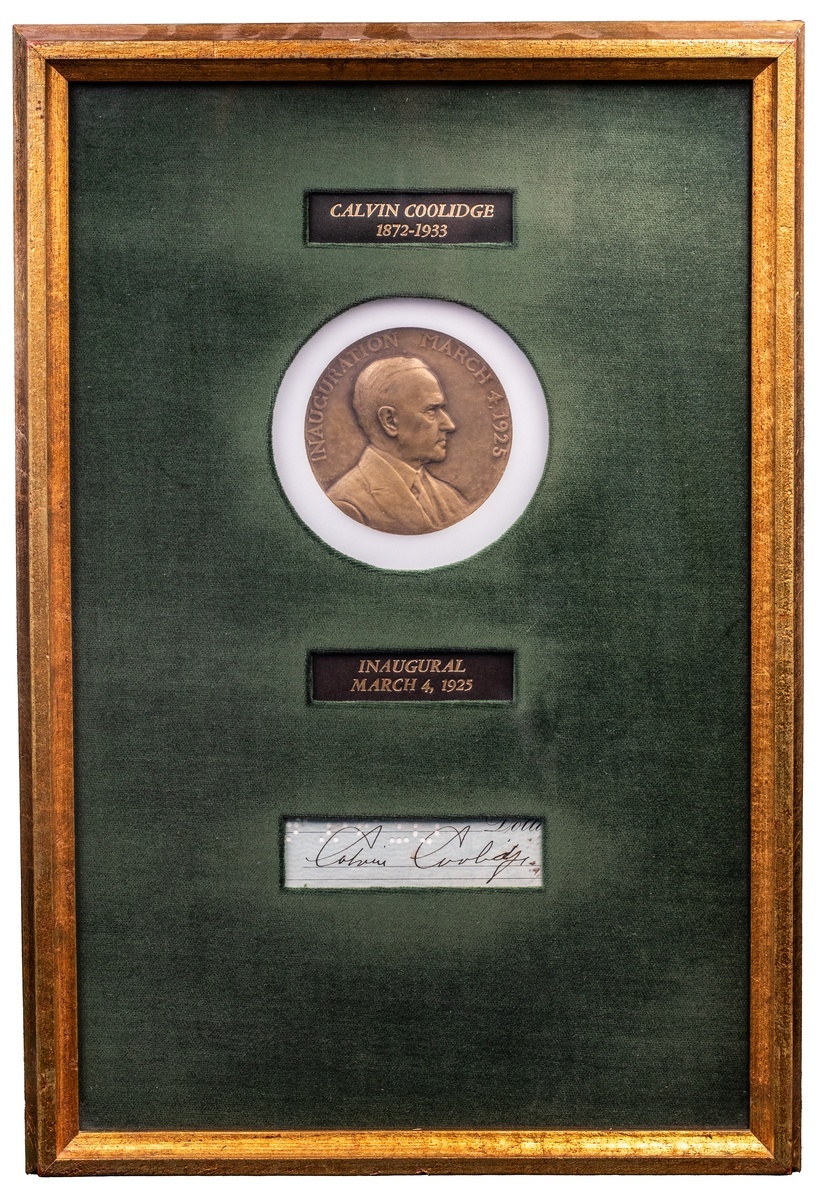
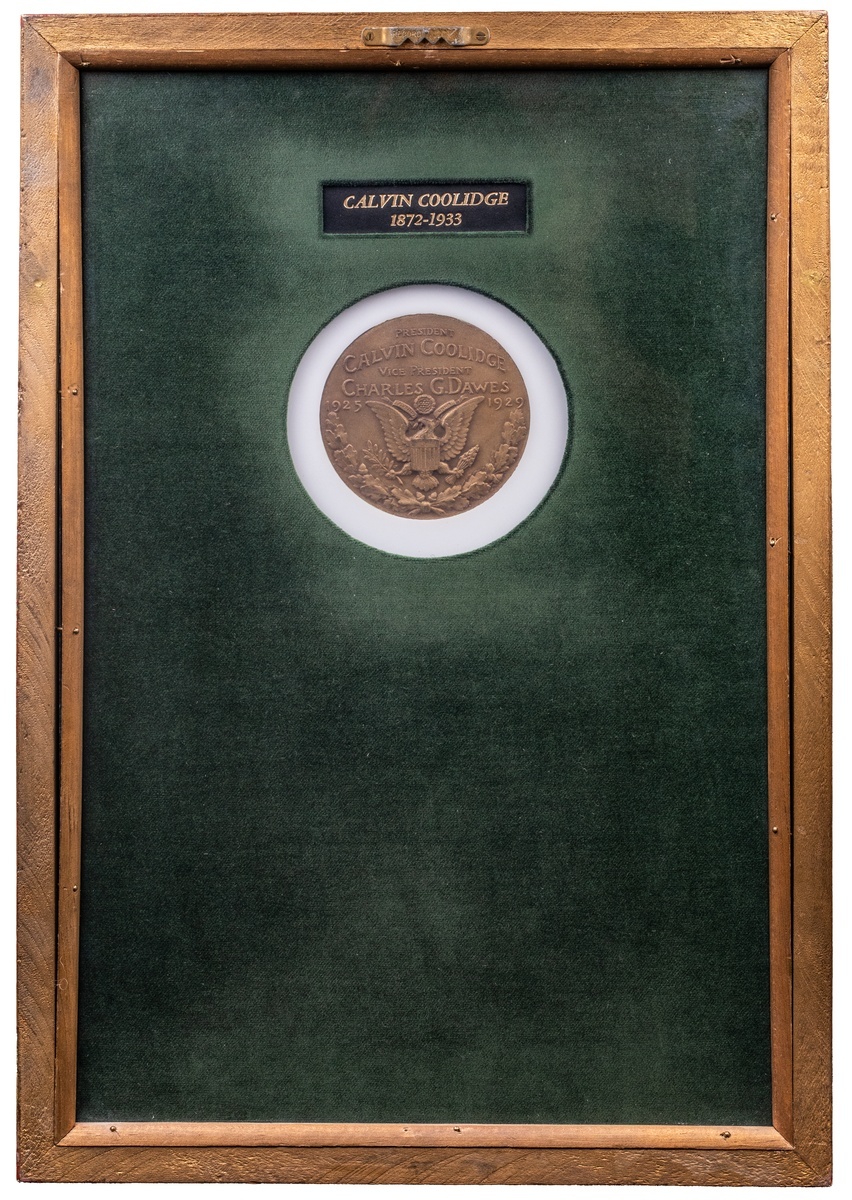
(x) Commanders-in-Chief, CALVIN COOLIDGE, 30th President of the United States (August 2, 1923 - March 4, 1929), Second Inauguration of Calvin Coolidge, AE Medal, 1925, by Julio Kilenyi for the Medallic Art Company, INAUGURATION MARCH 4 1925, draped bust right, rev. PRESIDENT | CALVIN COOLIDGE | VICE PRESIDENT | CHARLES G. DAWES, heraldic eagle, 70mm (PCGS 76636; NGA 2015.19.3757.b), a very pleasing extremely fine, the SECOND RAREST presidential inauguration medal, only 75 struck; with, cut signature "Calvin Coolidge", mounted in frame, 267mm x 395mm
Not inspected outside of the frame. Sold as is.
Provenance
Presented to His Royal Highness Prince Bandar bin Sultan Al Saud, Saudi Arabian Ambassador to the United States (1983-2005), by James Addison Baker III, 67th Secretary of the Treasury and 10th White House Chief of Staff to President Ronald Reagan.
James Addison Baker III also served as 16th White House Chief of Staff and 61st Secretary of State to President George H. W. Bush.
Vermont-born and Amherst-trained, Coolidge rose through Massachusetts politics by a habit of saying little and doing what he said; a manner that carried him from the Northampton city council to the governorship, and to national fame in 1919 when he broke the Boston police strike with the pronouncement that there was no right to strike against the public safety, anywhere, by anyone.
Elected Harding's Vice President in 1920, he ascended to the Presidency itself in August 1923 under circumstances that read like folklore: roused at his parent's Vermont farmhouse in the small hours, he was sworn in by the light of a kerosene lamp by his own father, a notary public, using the family Bible on the parlor table.
His fiscal record was the most disciplined of the era. Working with Treasury Secretary Andrew Mellon, he pushed through successive Revenue Acts that cut the top marginal income-tax rate from the wartime peak of 73 percent down to 25 percent, on Mellon's theory that lighter rates on capital would swell revenue rather than starve it. Every Coolidge budget ran a surplus, and the proceeds went to retiring a substantial share of the federal debt left over from the Great War.
Less remarked upon, then and since, was the cheap-money policy the Federal Reserve pursued in parallel, partly to help Britain defend its return to the gold standard; a policy of low rates that fed the stock speculation of the later 1920s and that some historians trace directly to the crash that followed within eight months of Coolidge's departure. He himself distilled his philosophy into a line still (mis)quoted today: "After all, the chief business of the American people is business."
Legislatively, his was a busier term than his reputation for reticence suggests. He signed the Immigration Act of 1924, which imposed strict national-origin quotas and shut off most Asian immigration; the same year, in a far less noted act, he extended full citizenship to Native Americans born within U.S. borders. He vetoed the McNary-Haugen farm relief bill twice, alienating agrarian Republicans in defense of laissez-faire principle, and signed the Radio Act of 1927, creating the federal commission that would police the young medium of broadcasting. He dedicated the newly authorised Mount Rushmore in 1927, and in his last year in office watched his Secretary of State negotiate the Kellogg-Briand Pact, by which dozens of nations solemnly renounced war as an instrument of policy — an idealism history would not be kind to.
Off the record, "Silent Cal" cultivated his own legend: told by a dinner companion that she'd wagered she could get more than two words out of him, he is said to have replied, "You lose." He slept prodigiously, napped daily, played practical jokes on his Secret Service detail, and kept a White House menagerie that included a raccoon named Rebecca, delivered in 1926 as a Thanksgiving entrée but spared, a pygmy hippopotamus named Billy gifted by industrialist Harvey Firestone in 1927, and two lion cubs from the Mayor of Johannesburg that he pointedly named "Tax Reduction" and "Budget Bureau".
Beneath the whimsy sat one unhealed wound: his younger son died of blood poisoning in 1924 after a tennis blister went untreated, and Coolidge wrote afterward that the power and the glory of the Presidency had gone with him. In 1927, at a Black Hills press conference, he ended speculation about a third term with a single distributed slip of paper: "I do not choose to run for President in nineteen twenty eight."
He left office to near-universal applause for the prosperity he had presided over — a prosperity whose foundations cracked within the year. Whether his silence was statesmanlike restraint or simply the quiet of a man with nothing more to add remains, fittingly, an open question.
Subject to 5% tax on Hammer Price in addition to 20% VAT on Buyer’s Premium.
Estimate
$2,000 to $3,000
Starting price
$1500
Watch, listen and bid as if you were in the room. Now available for auctions worldwide.
Click here to bid live
An exclusive and confidential service for the discerning collector or vendor.
View the Gallery
Download every Spink catalogue on your iPad, iPod or iPhone using free Spink app.
Download From iTunes© 2026 Spink & Son. All rights reserved.