
Auction: 26776 - America 250th Anniversary Sale Ft. Coins, Medals, Banknotes, Objets de Vertu & Ephemera
Lot: 83
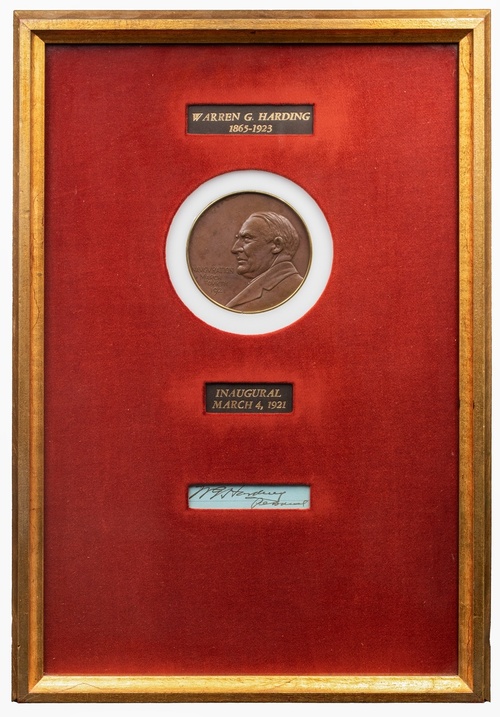
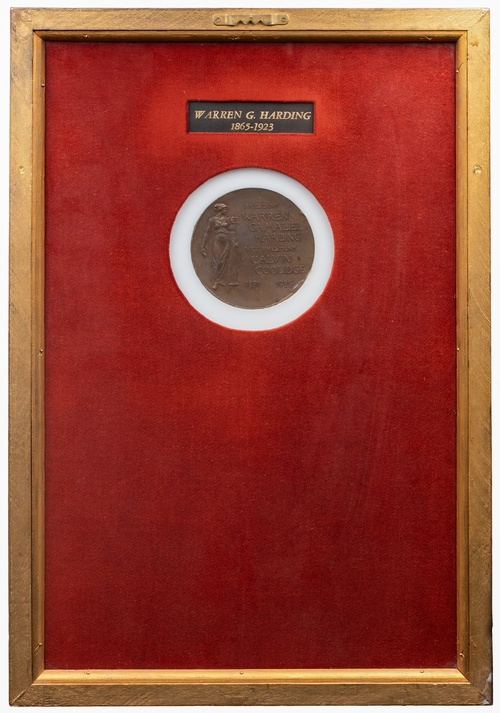
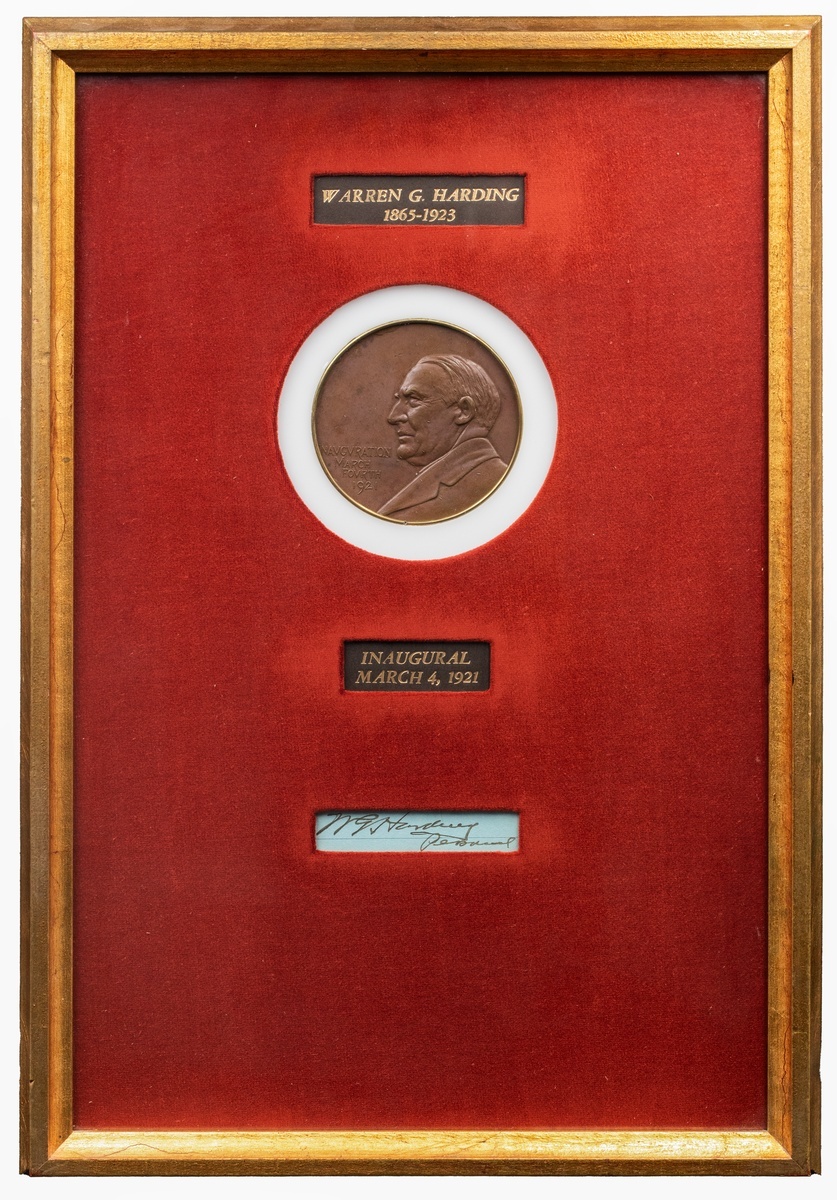
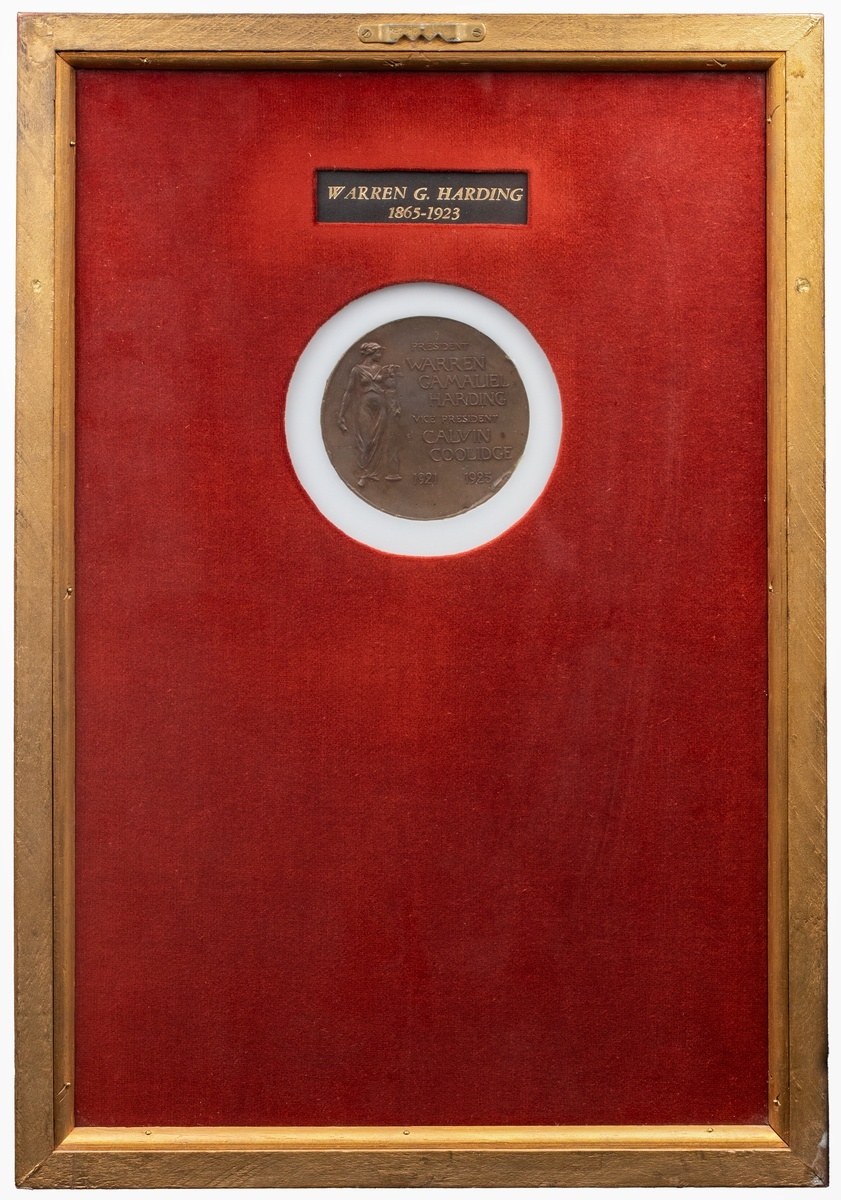
(x) Commanders-in-Chief, WARREN G. HARDING, 29th President of the United States (March 4, 1921 - August 2, 1923), Inauguration, AE Medal, 1921, by Darrell Clayton Crain, draped bust left, INAVGVRATION | MARCH | FOVRTH | 1921 in field, rev. Liberty standing right, PRESIDENT | WARREN | GAMALIEL | HARDING | VICE | PRESIDENT | CALVIN | COOLIDGE | 1921 1925, 70mm (Smithsonian 2014.29.5), with some general light contact marking, some metal flawing to reverse edge, otherwise with a pleasing dark brown tone, about extremely fine, a generally scarce medal; with, his cut signature "W G Harding", mounted in frame, 267mm x 395mm
Not inspected outside of the frame. Sold as is.
Provenance
Presented to His Royal Highness Prince Bandar bin Sultan Al Saud, Saudi Arabian Ambassador to the United States (1983-2005), by James Addison Baker III, 67th Secretary of the Treasury and 10th White House Chief of Staff to President Ronald Reagan.
James Addison Baker III also served as 16th White House Chief of Staff and 61st Secretary of State to President George H. W. Bush.
Born near Blooming Grove, Ohio, one more entry in the long run of Ohio-born presidents that dominated the Gilded Age and its aftermath, Harding built his career and his fortune out of a small-town newspaper, the Marion Star, which he bought as a young man and turned into a genuinely respected local paper, largely with the business sense of his wife Florence Kling De Wolfe, a divorced, strong-willed older woman he married in 1891 and whom he called "the Duchess" for the rest of his life.
His political rise through the Ohio State Senate, the Lieutenant-Governorship, and eventually the U.S. Senate was notable mainly for how unremarkable it was: an affable, well-liked figure who missed a striking number of votes and left almost no legislative mark, exactly the kind of inoffensive record that made him a plausible compromise once the 1920 Republican convention deadlocked.
He was said to have been settled on by party bosses gathered in a Blackstone Hotel suite in Chicago, the origin of the phrase "smoke-filled room," which has stood for backroom political dealmaking ever since. His general election campaign that year, run on the promise of a "return to normalcy" after the exhaustions of war and reform, crushed Democrat James Cox, whose Vice Presidential nominee, a young Franklin Roosevelt, would have a rather longer run in the office Harding had just won, in the largest popular vote landslide the country had yet seen.
It is worth noting, since it dogged him at the time, that a smear campaign during that same race alleged Black ancestry somewhere in Harding's family line, a rumour genealogists and later historians examining the question directly have found no evidence to support.
His Presidency, telescoped into twenty-nine months, produced more substance than its scandal-soaked reputation usually allows. He signed the Budget and Accounting Act (1921), creating the first systematic Federal budgeting process and the agency that became the Bureau of the Budget, hosted the Washington Naval Conference that same year, a genuine disarmament achievement fixing warship tonnage ratios among the major powers years before such agreements became commonplace, and commuted the sentence of the imprisoned Socialist leader Eugene Debs in 1921, going so far as to invite him to the White House afterward, a small act of political grace toward a man his own predecessor had jailed.
In October of that year, speaking in Birmingham, Alabama, he told a segregated crowd that Black Americans deserved full political and economic equality, a position that startled and angered much of his Southern audience and that few Presidents of his era were willing to state so plainly in public, even as he stopped short of endorsing full social equality in the same breath. That record collapsed under the weight of what came after him.
Interior Secretary Albert Fall had secretly leased the Navy's oil reserves at Teapot Dome, Wyoming, and Elk Hills, California, to private companies in exchange for personal bribes, a scheme that surfaced only after Harding's death and sent Fall to prison, the first cabinet officer in American history to serve time for actions taken in office.
The head of the Veterans' Bureau, Charles Forbes, was separately convicted for embezzling funds meant for sick and wounded veterans, and Attorney General Harry Daugherty's own circle, the so-called "Ohio Gang", generated enough scandal that one of his closest associates, Jess Smith, took his own life as the investigations closed in.
Harding, by most accounts, was less a participant in this corruption than a poor judge of the friends he had elevated into it, and is often quoted, in a line that captures the anguish of his final year, complaining that it was not his enemies but his own damned friends who kept him pacing the floor at night.
His personal life carried its own long-running scandal, most of it kept out of public view during his lifetime. He conducted a lengthy affair with Carrie Fulton Phillips, later paid, along with her husband, a substantial sum by Republican operatives anxious to keep her quiet during the 1920 campaign, and a separate, younger mistress, Nan Britton, who published a lurid 1927 memoir claiming Harding had fathered her daughter, Elizabeth Ann, including in an encounter in a White House closet.
The Harding family denied it for generations, citing childhood mumps as evidence of his sterility, until a 2015 DNA study of descendants on both sides at the urging of a Harding grand-nephew, confirmed unambiguously that Elizabeth Ann Blaesing had indeed been his daughter, closing a paternity question that had run open for nearly a century.
Harding himself did not live to see any of it resolved either way: on a cross-country speaking tour billed as a "Voyage of Understanding," he died suddenly in a San Francisco hotel room on August 2, 1923, almost certainly of heart disease, though Florence Harding's refusal to permit an autopsy left just enough uncertainty for poisoning rumours to circulate for years afterward.
Historians have ranked him among the least effective Presidents ever since, a verdict his defenders argue rests more on the scandals that followed his death than on the narrower, genuinely competent record he left behind while alive.
Subject to 5% tax on Hammer Price in addition to 20% VAT on Buyer’s Premium.
Estimate
$200 to $400
Starting price
$140
Watch, listen and bid as if you were in the room. Now available for auctions worldwide.
Click here to bid live
An exclusive and confidential service for the discerning collector or vendor.
View the Gallery
Download every Spink catalogue on your iPad, iPod or iPhone using free Spink app.
Download From iTunes© 2026 Spink & Son. All rights reserved.