
Auction: 26776 - America 250th Anniversary Sale Ft. Coins, Medals, Banknotes, Objets de Vertu & Ephemera
Lot: 82
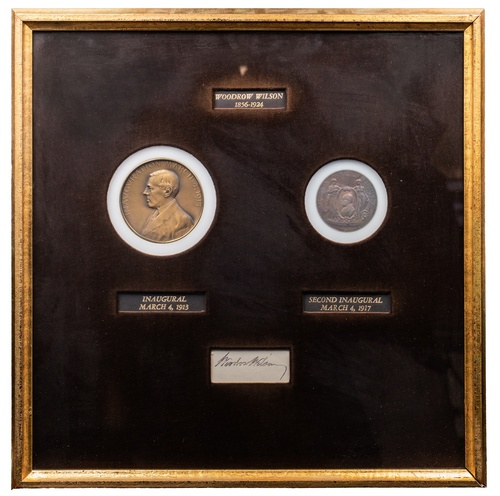
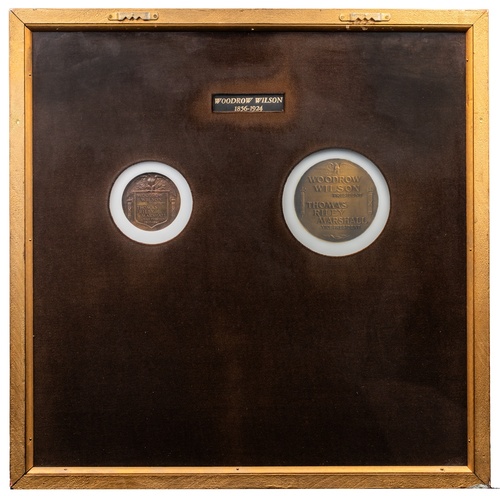
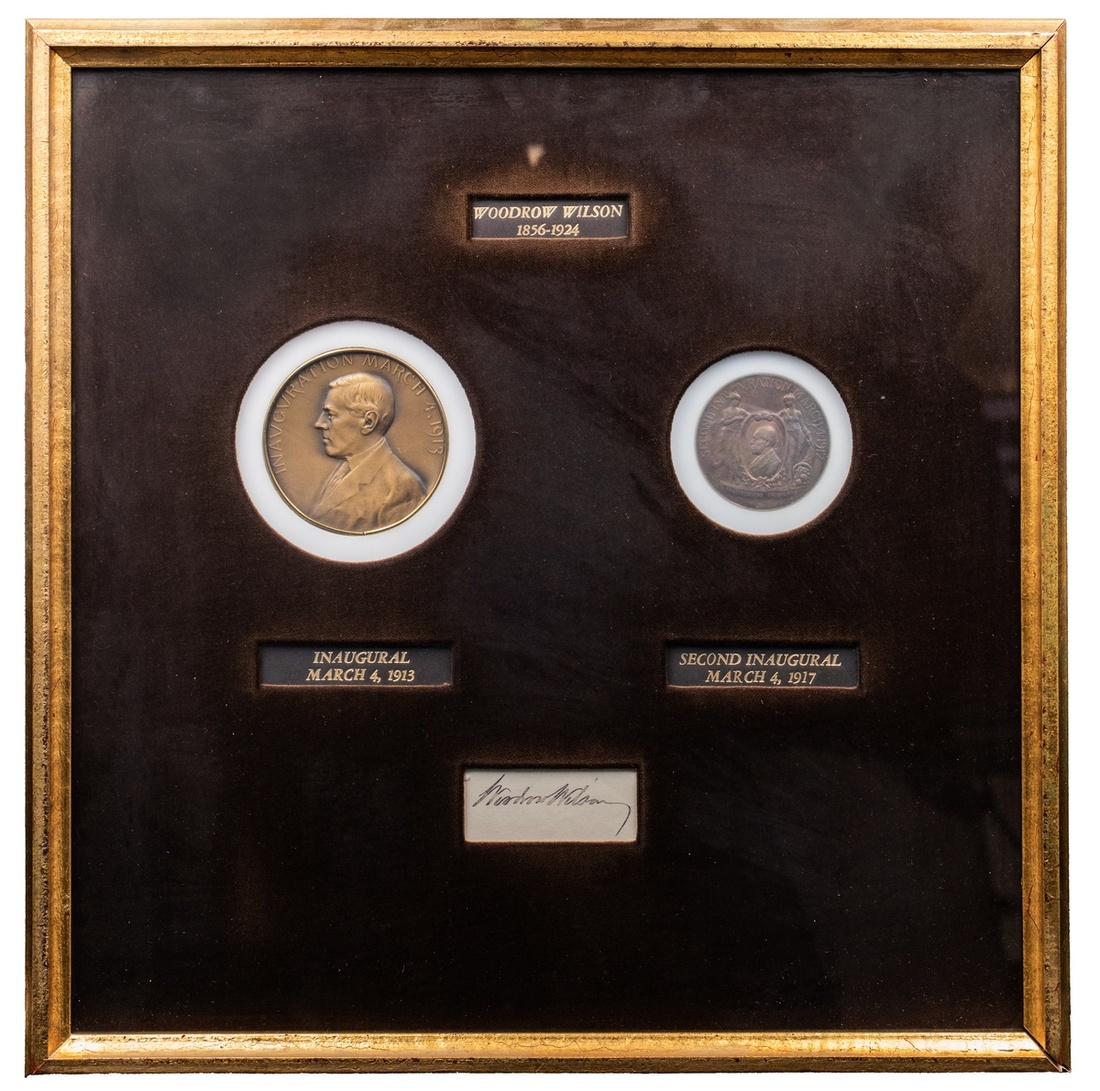
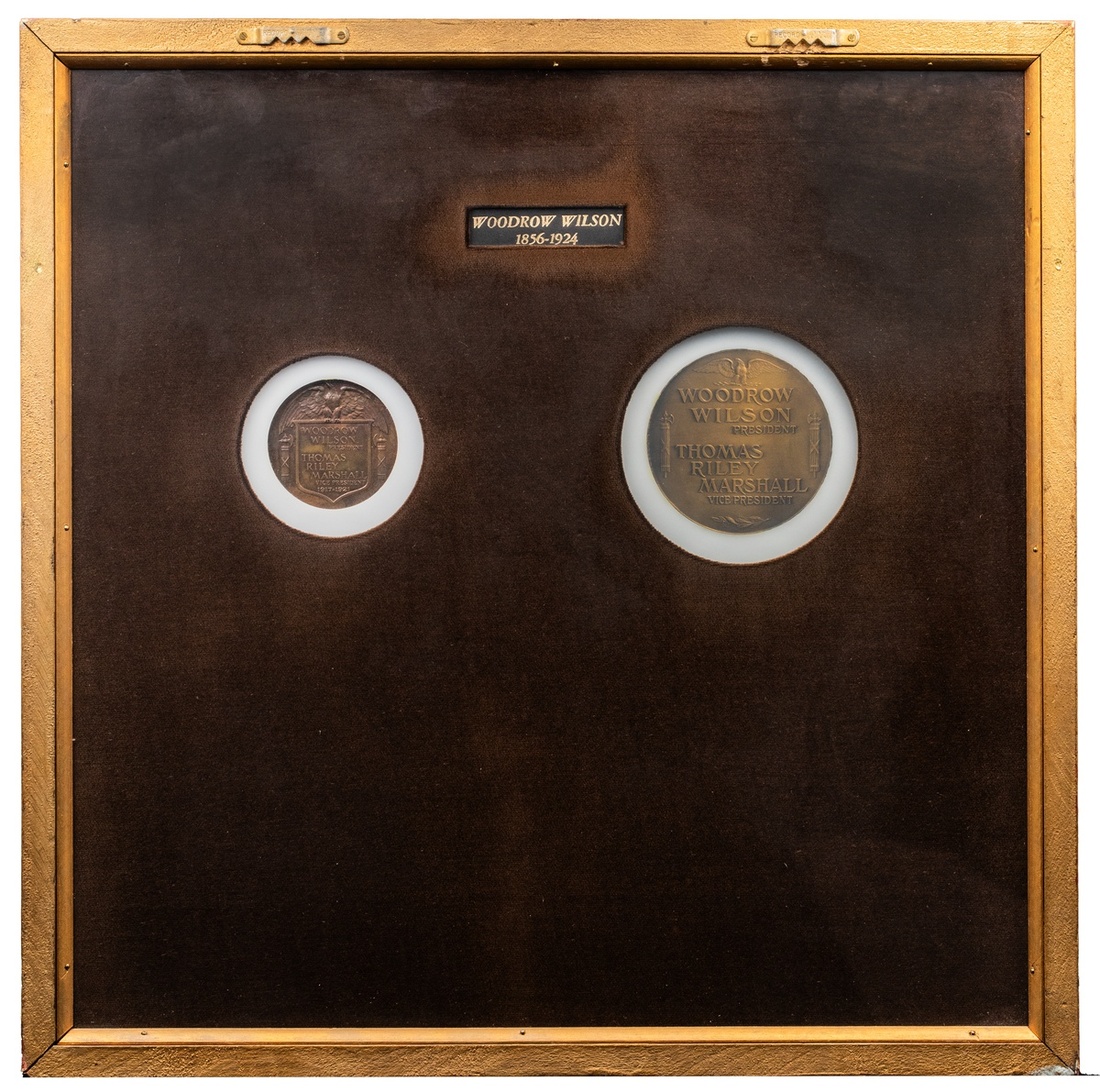
(x) Commanders-in-Chief, WOODROW WILSON, 28th President of the United States (March 4, 1913 - March 4, 1921), First Inauguration, Official AE Medal, 1913, by Whitehead Hoag, INAVGVRATION MARCH 4, 1913, draped bust left, rev. legend in 7 lines, 70mm (cf. Smithsonian 2014.29.4), extremely fine; and; Second Inauguration, AE Medal, 1917, by Darrell Clayton Crain and R. Harris and Co., SECOND INAVGVRATION MARCH 4 1917, draped bust left within frame, with suporters, rev. legend in 8 lines within tablet, eagle above, 51mm (cf. Smithsonian 2010.64.3), toned and with flases of red, extremely fine; with, cut signature "Woodrow Wilson", mounted in frame, 395mm x 395mm
Not inspected outside of the frame. Sold as is.
Provenance
Presented to His Royal Highness Prince Bandar bin Sultan Al Saud, Saudi Arabian Ambassador to the United States (1983-2005), by James Addison Baker III, 67th Secretary of the Treasury and 10th White House Chief of Staff to President Ronald Reagan.
James Addison Baker III also served as 16th White House Chief of Staff and 61st Secretary of State to President George H. W. Bush.
Born Thomas Woodrow Wilson in Staunton, Virginia, the son of a Presbyterian minister, Wilson spent his formative years in Georgia and South Carolina during and just after the Civil War, old enough to retain real memories of Sherman's troops passing through and of a defeated, occupied South, a childhood inheritance that shaped his lifelong identification with the region even as his career took him almost entirely outside it.
He did not learn to read fluently until around the age of ten, a delay some scholars have since attributed to dyslexia, though that remains a retrospective diagnosis rather than a settled fact, and he went on regardless to Davidson, then Princeton, a law degree at Virginia, and finally a doctorate in political science from Johns Hopkins in 1886, making him the only President to hold a PhD.
His scholarly reputation carried him to a professorship and then, in 1902, the Presidency of Princeton itself, where he pushed hard for academic reform before losing a bitter internal fight, remembered on campus as the Battle of the Graduate College, over where and how the university's new graduate school should be built, a defeat that helped push him out of academia and toward politics rather than the reverse.
Recruited by conservative New Jersey Democratic bosses in 1910 who expected a compliant figurehead for Governor, Wilson instead governed as a genuine reformer and arrived at the 1912 Democratic convention with real momentum. The Republican Party's rupture between Taft and Roosevelt that November handed him the Presidency with barely forty-two percent of the popular vote but a commanding electoral majority, and his first term produced one of the more substantial legislative records of the twentieth century's opening decades: the Underwood Tariff cut duties sharply while the newly ratified income tax made up the difference, the Federal Reserve Act created the central banking system the country still runs on, and the Clayton Antitrust Act and the new Federal Trade Commission gave regulators real teeth against monopoly power.
That progressive record sat beside a considerably darker one on race: Wilson's administration allowed and in places actively encouraged the re-segregation of Federal Agencies that had employed Black civil servants on an integrated basis for decades, a rollback that cost many their positions and stands as one of the clearest stains on his Presidency.
Re-elected narrowly in 1916 on the strength of the slogan "he kept us out of war," Wilson found neutrality impossible to sustain past early 1917, when Germany resumed unrestricted submarine warfare and British intelligence intercepted the Zimmermann Telegram proposing a German-Mexican alliance against the United States. He asked Congress for a Declaration of War that April with the declaration that the world must be made safe for democracy, then oversaw a wartime mobilization, conscription, war-production boards, and government propaganda, that came paired with a genuinely severe crackdown on dissent, the Espionage and Sedition Acts sending war critics and socialists to prison, Eugene Debs among them for a single anti-draft speech, on a sentence later commuted by his successor.
His most ambitious project was the peace that followed. His Fourteen Points, unveiled in January 1918, envisioned a new international order built on self-determination and open diplomacy, and he became the first sitting President to travel to Europe, spending months at the Paris Peace Conference personally negotiating the Treaty of Versailles, watching much of his idealism get traded away by Allied leaders more interested in punishing Germany than in remaking the post-war order along his lines.
He won the Nobel Peace Prize in 1919 largely for the League of Nations concept he brought home, only to lose the fight for it entirely in his own Senate, where Henry Cabot Lodge's opposition and Wilson's own refusal to accept any compromising reservations killed American membership outright.
He undertook a punishing cross-country speaking tour that fall to rally public support around the treaty and collapsed under the strain, suffering a severe stroke in October 1919 that left him partially paralyzed and cognitively diminished for the remainder of his term. With no constitutional mechanism yet in place for declaring a President incapacitated, his wife Edith and his physician effectively controlled access to him and the flow of information out of the White House for months, a period historians still describe as something close to an unofficial stewardship of the Presidency, exercised without any formal public acknowledgment of just how incapacitated the man nominally still in charge had become.
He left office in 1921 in visibly poor health and died in Washington in February 1924, leaving behind a Presidency whose reach, for good and ill, few twentieth-century terms have matched.
Subject to 5% tax on Hammer Price in addition to 20% VAT on Buyer’s Premium.
Estimate
$300 to $400
Starting price
$210
Watch, listen and bid as if you were in the room. Now available for auctions worldwide.
Click here to bid live
An exclusive and confidential service for the discerning collector or vendor.
View the Gallery
Download every Spink catalogue on your iPad, iPod or iPhone using free Spink app.
Download From iTunes© 2026 Spink & Son. All rights reserved.