
Auction: 26776 - America 250th Anniversary Sale Ft. Coins, Medals, Banknotes, Objets de Vertu & Ephemera
Lot: 81
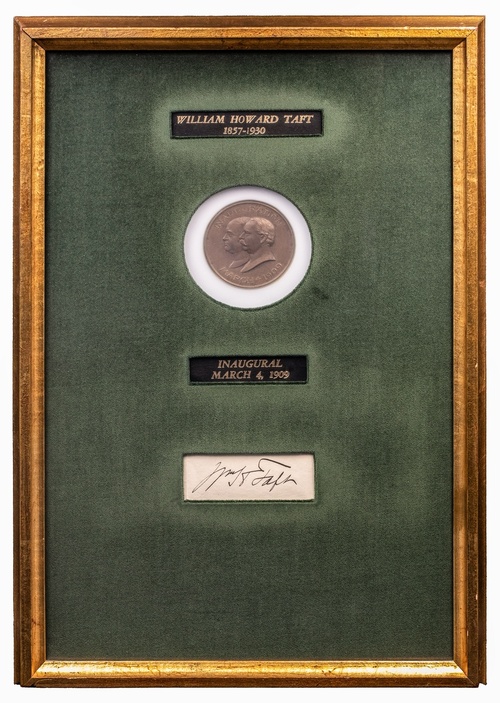
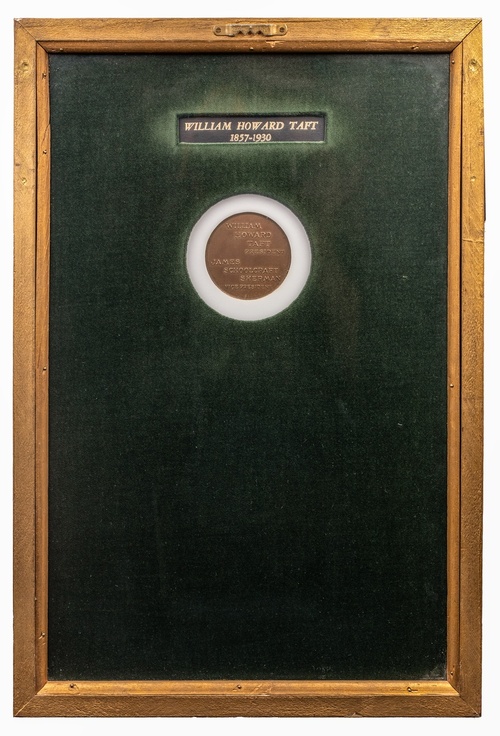
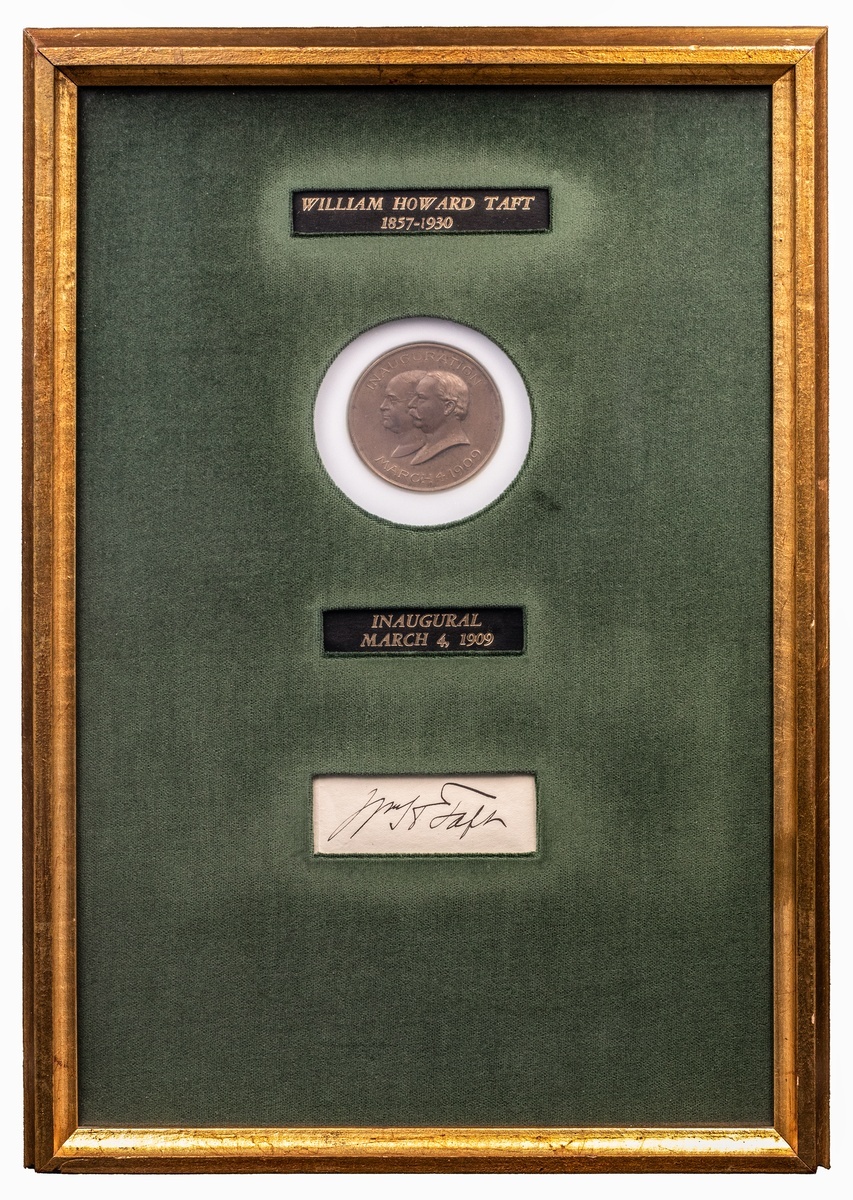
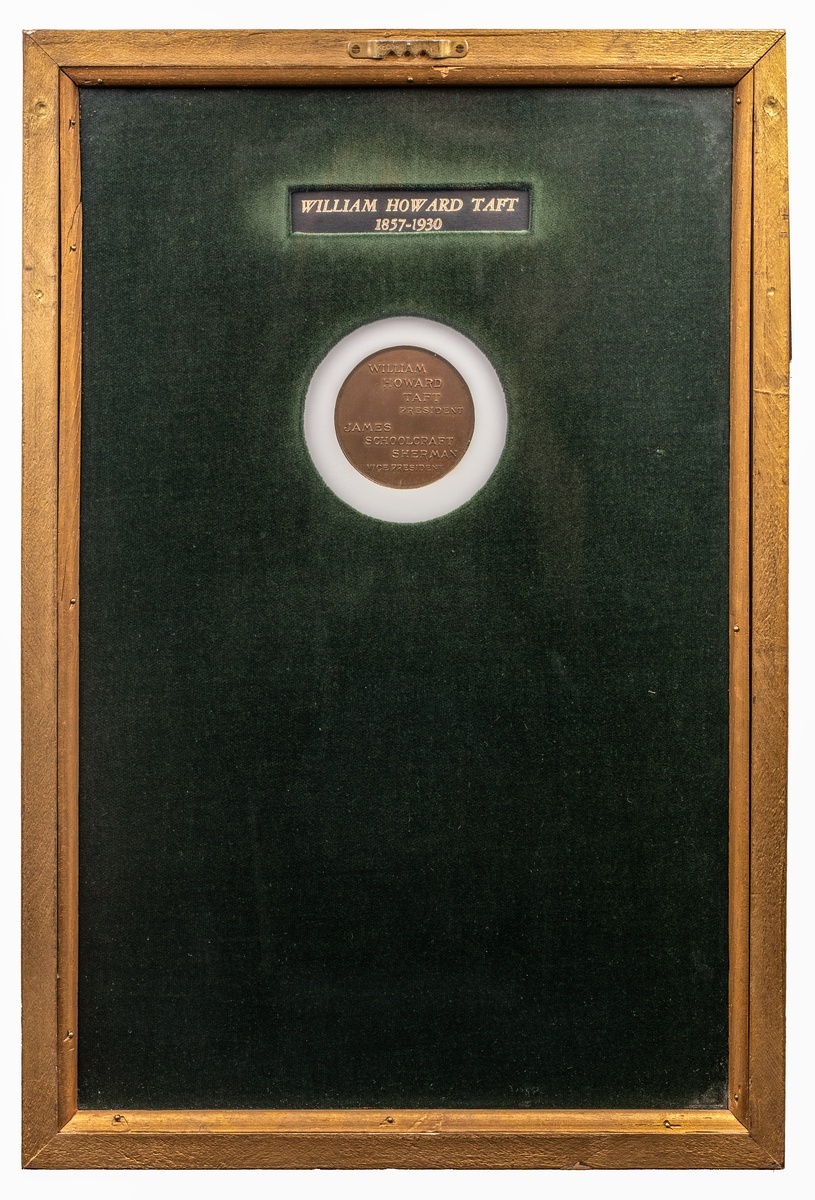
(x) Commanders-in-Chief, WILLIAM HOWARD TAFT, 27th President of the United States (March 4, 1909 - March 4, 1913), Inauguration, Official AE Medal, 1909, by Joseph K. Davison & Sons, INAUGURATION MARCH 4, 1909, busts left, rev. WILLIAM | HOWARD | TAFT | PRESIDENT | JAMES | SCHOOLCRAFT | SHERMAN | VICE PRESIDENT, 51mm (Dusterburg-4B51), some toning spots, otherwise good extremely fine, one of only 3,000 struck; with cut signature "Wm H Taft", mounted in frame, 267mm x 395mm
Not inspected outside of the frame. Sold as is.
Provenance
Presented to His Royal Highness Prince Bandar bin Sultan Al Saud, Saudi Arabian Ambassador to the United States (1983-2005), by James Addison Baker III, 67th Secretary of the Treasury and 10th White House Chief of Staff to President Ronald Reagan.
James Addison Baker III also served as 16th White House Chief of Staff and 61st Secretary of State to President George H. W. Bush.
Born in Cincinnati to Alphonso Taft, a co-founder of Yale's "Skull and Bones" Society who went on to serve as Grant's Attorney General and Secretary of War, Taft followed his father to Yale, graduated second in his class, and joined the same secret society, before building a legal and judicial career that was, by his own repeated preference, the life he actually wanted rather than the one circumstance kept handing him instead.
He served as an Ohio Superior Court judge, U.S. Solicitor General, and a Federal appeals judge through the 1890s, turning down more than one offer of a Supreme Court seat because he felt obligated to finish other work first, a pattern of dutiful self-denial that would recur throughout his career.
President McKinley pulled him away from the bench in 1901 to become the first civilian Governor-General of the Philippines, where he worked to build functioning civil institutions after a brutal war of conquest and famously described his approach to the Filipino people using the paternalistic phrase "little brown brothers", language that drew mockery even at the time, including a soldiers' marching song insisting he was no brother of theirs, and that reads today as a clear artifact of the era's colonial condescension however genuine Taft's personal affection for the islands may have been.
Theodore Roosevelt made him Secretary of War in 1904 and, having grown to trust him completely, all but handpicked him as his successor, campaigning hard on Taft's behalf in 1908 to defeat William Jennings Bryan in Bryan's third and final run for the presidency. Taft's own term, often unfavourably measured against Roosevelt's, was in fact more aggressive on at least one signature front: his administration filed some eighty anti-trust suits, more than Roosevelt, including the case that finally broke up Standard Oil in 1911.
He signed the Mann-Elkins Act extending Federal rail regulation, created the Department of Labor as a standalone cabinet post in the final days of his term, and set in motion the Constitutional amendments, ratified just as he left office, that established the Federal income tax and direct election of senators.
None of that satisfied the progressive wing of his own party, who saw the compromise Payne-Aldrich Tariff (1909) as a betrayal of the tariff cuts they had been promised, and Taft's dismissal of Chief Forester Gifford Pinchot amid a bitter dispute with Interior Secretary Richard Ballinger over conservation policy convinced Roosevelt personally that his handpicked successor had abandoned everything the two of them had built together.
That conviction drove Roosevelt to challenge Taft for the 1912 Republican nomination, and when the party's convention sided with the sitting President amid furious argument over contested delegates, Roosevelt bolted to run as the candidate of his own Progressive "Bull Moose" Party, splitting the Republican vote so thoroughly that Taft finished a distant third, carrying only Utah and Vermont, one of the worst showings by an incumbent seeking re-election in American history.
The friendship the split destroyed took years to mend, and only did so, by most accounts, when the two men crossed paths again during the First World War and found, past the wreckage of 1912, that they still liked each other after all.
Taft got the job he had wanted all along in 1921, when President Harding appointed him Chief Justice of the United States, making him the only person in American history to have led both the executive and judicial branches, and by his own account the happier and more fulfilling of the two roles by a wide margin, reportedly claiming he could hardly remember having been President at all once he had the bench back under him.
As Chief Justice he pushed through the Judiciary Act of 1925, giving the Supreme Court sweeping new discretion over which cases it heard, and lobbied Congress relentlessly for a dedicated Supreme Court building of its own, a project completed only after his death in 1930, becoming the first President to be laid to rest at Arlington National Cemetery rather than a private family plot.
He carried his weight, which fluctuated over the decades between roughly 250 and well over 300 pounds, as a running joke of the era and, more privately, a genuine health burden; modern physicians reviewing the record generally agree he suffered from what would now be recognized as severe sleep apnea, which likely explains the well-documented tendency of cabinet meetings, funerals, and even his own dinner table to catch him nodding off.
The single most famous story attached to him, that his bulk got him stuck fast in a White House bathtub until staff pried him free, turns out on close historical examination to rest on nothing sturdier than a single secondhand line in a 1934 usher's memoir, decades after the fact, with no contemporary account to back it up; the tub itself, a genuine seven-foot, ton-and-a-half custom porcelain basin roomy enough to seat four grown men comfortably, was real and well photographed, built for a 1909 trip to inspect the Panama Canal and later installed in the White House precisely so that nothing like the legend could ever actually happen.
Subject to 5% tax on Hammer Price in addition to 20% VAT on Buyer’s Premium.
Estimate
$150 to $200
Starting price
$110
Watch, listen and bid as if you were in the room. Now available for auctions worldwide.
Click here to bid live
An exclusive and confidential service for the discerning collector or vendor.
View the Gallery
Download every Spink catalogue on your iPad, iPod or iPhone using free Spink app.
Download From iTunes© 2026 Spink & Son. All rights reserved.