
Auction: 26776 - America 250th Anniversary Sale Ft. Coins, Medals, Banknotes, Objets de Vertu & Ephemera
Lot: 80
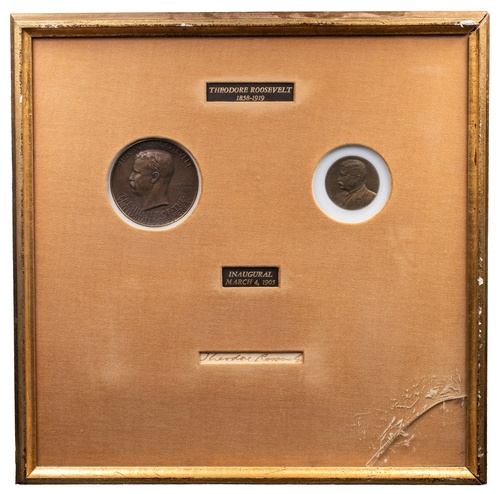
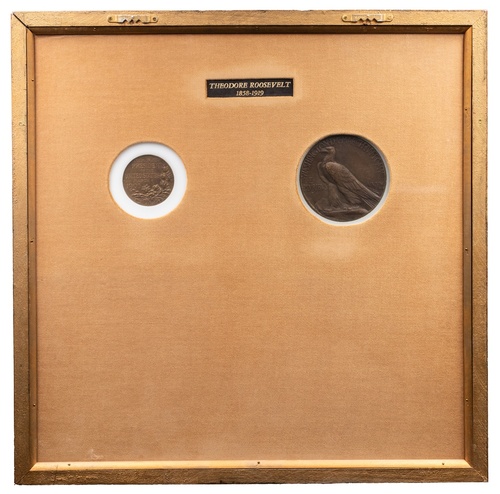
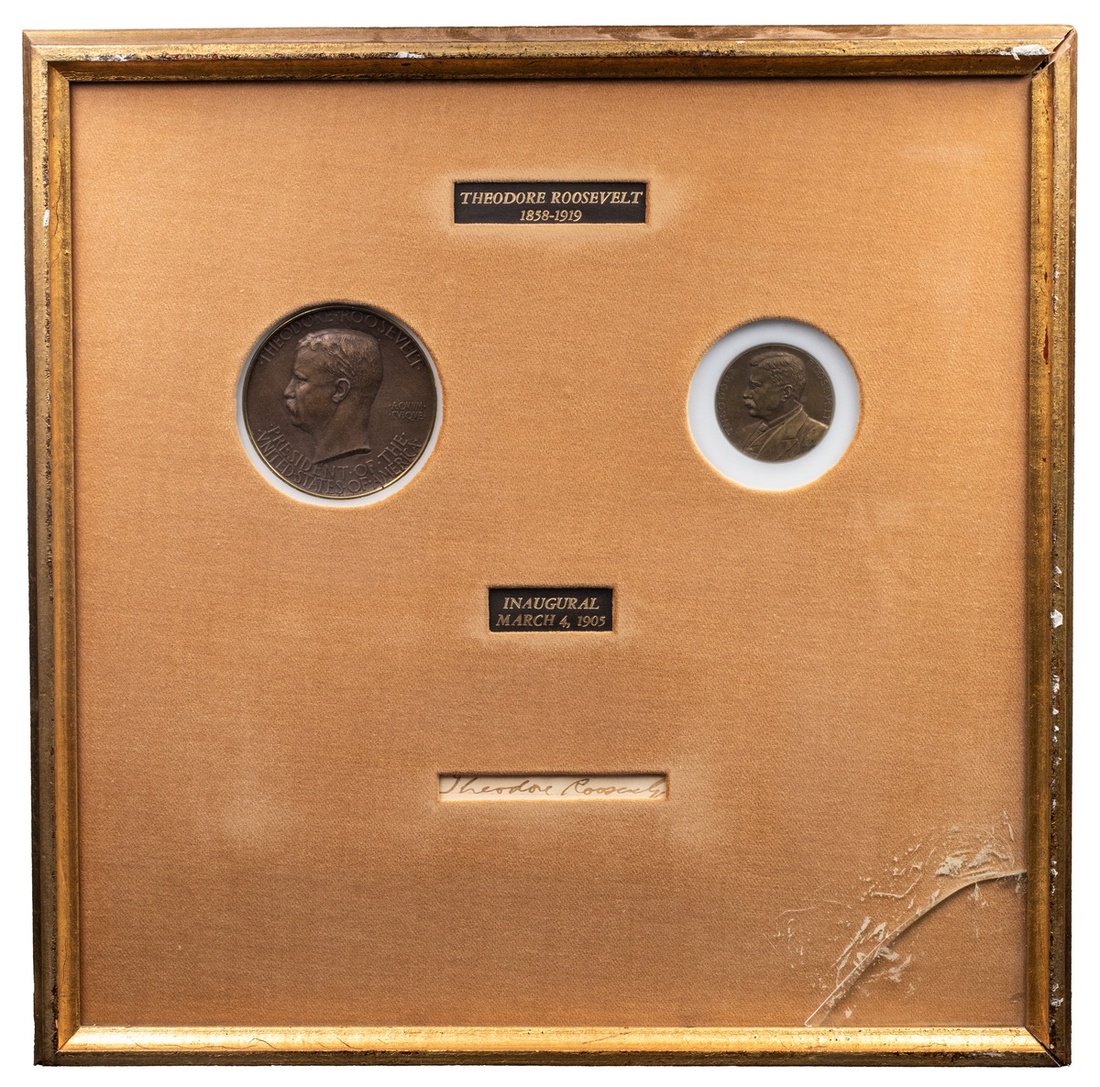
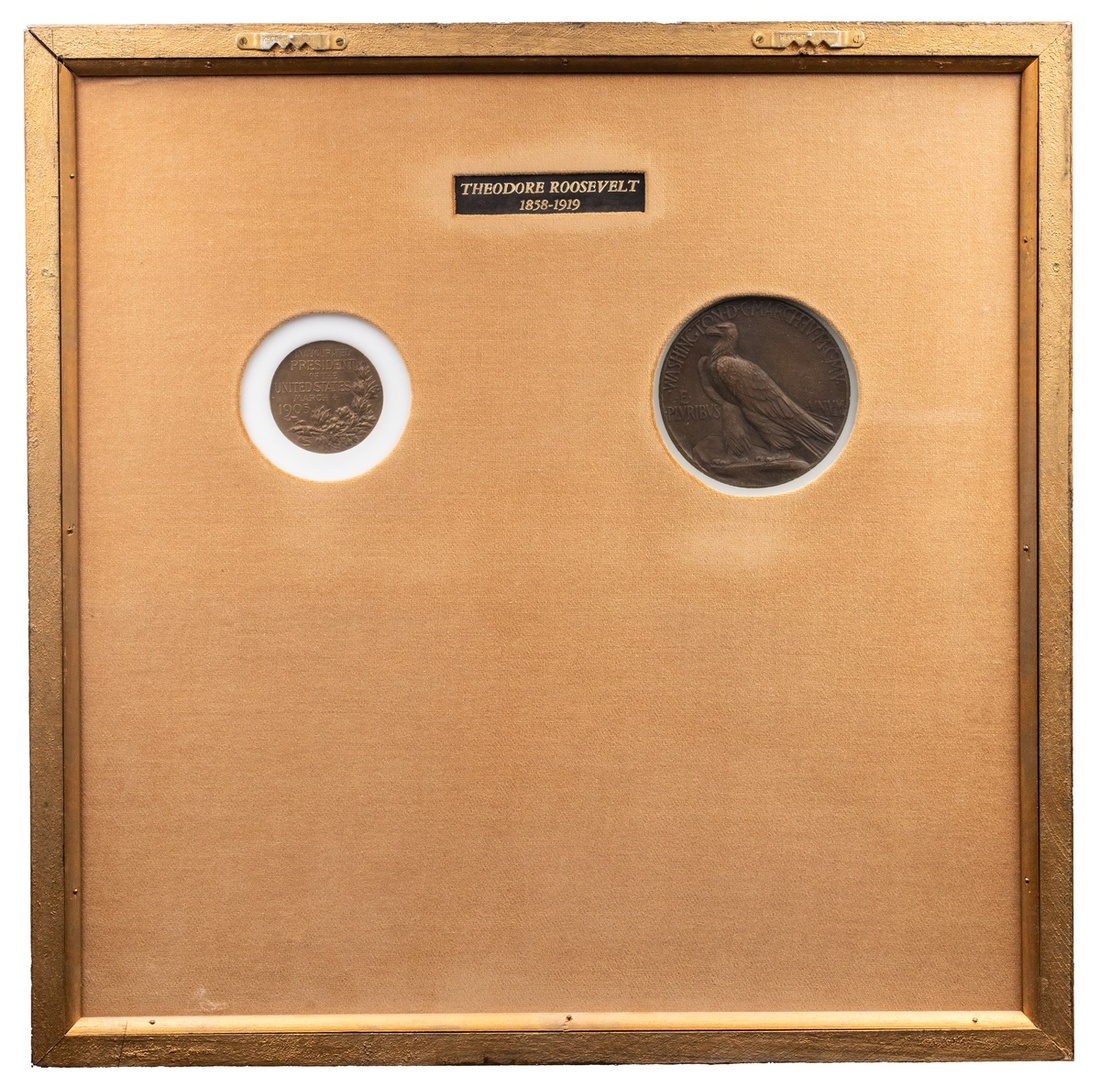
(x) Commanders-in-Chief, THEODORE ROOSEVELT, 26th President of the United States (September 14, 1901 - March 4, 1909), Second Inauguration, Official AE Medal, 1905, by Augustus Saint-Gaudens and Adolph A. Weinman, manufactured by Tiffany & Co. THEODORE . ROOSEVELT ., bust left, . PRESIDENT . OF . THE | .VNITED . STATES . OF . AMERICA, below, rev. . WASHINGTON . D . C. MARCH . IV . M .C.M.V, eagle left, 73mm (NGA 2015.19.3752.b; PCGS 624321), signs of lacquer to edge, otherwise much as issued, scarce; and Second Inauguration, Official AE Medal, 1905, by Charles E. Barber and George T. Morgan, THEODORE ROOSEVELT, draped bust left, rev. INAUGURATED | PRESIDENT | OF THE | UNITED STATES | MARCH 4 | 1905, laurel to right, 44mm (Dusterberg-OIM 3B44; MacNeil-TR 1905-3), some toning spots, otherwise good extremely fine, scarce; with cut signature "Theodore Roosevelt", mounted in frame, 395mm x 395mm, some damage to frame
Not inspected outside of the frame. Sold as is.
Provenance
Presented to His Royal Highness Prince Bandar bin Sultan Al Saud, Saudi Arabian Ambassador to the United States (1983-2005), by James Addison Baker III, 67th Secretary of the Treasury and 10th White House Chief of Staff to President Ronald Reagan.
James Addison Baker III also served as 16th White House Chief of Staff and 61st Secretary of State to President George H. W. Bush.
Born into Manhattan wealth but a sickly, asthmatic child so frail his father built him a private gymnasium and told him, in effect, that he had the mind but not yet the body, and would have to make the body himself, Roosevelt spent his adolescence constructing the physical will that became his signature. He graduated Harvard in 1880, married Alice Hathaway Lee that same year, and then suffered the single worst day of his life on Valentine's Day, 1884, when his wife and his mother died in the same house within eleven hours of each other, Alice from kidney failure following childbirth, his mother from typhoid. His diary entry for the day is a single blacked-out X and the line "the light has gone out of my life."
He fled to the Dakota Badlands, bought a ranch, worked as a cowboy and Deputy Sheriff, and came back east two years later remade, carrying the frontier persona that would define him for the rest of his career. He rose through New York politics, the Civil Service Commission, and a reforming stint as New York City's Police Commissioner, during which he walked the beat personally at night, in disguise, to catch corrupt officers shirking their posts.
As Assistant Secretary of the Navy he pushed hard for war with Spain, then resigned to raise and lead the Rough Riders, the volunteer Cavalry Regiment whose charge up Kettle Hill and San Juan Hill in 1898 made him a national hero; the Medal of Honor he was recommended for at the time was denied for decades over political grudges and only awarded posthumously in 2001, making him, still today, the only President ever to receive it.
Party bosses, wary of his reforming instincts as New York's Governor, manoeuvered him into the Vice Presidency in 1900 to sideline him, a plan that collapsed within months when William McKinley was assassinated in September 1901 and Roosevelt, at forty-two, became the youngest President in American history, a record no one has come close to since.
His domestic program, the "Square Deal," combined trust-busting against Northern Securities and Standard Oil with new consumer protections like the Pure Food and Drug Act, passed largely in response to the public horror over Upton Sinclair's meatpacking exposé "The Jungle."
He was the first President to intervene in a labour dispute as a neutral broker rather than simply breaking the strike, forcing arbitration in the 1902 coal strike rather than sending in troops against the miners. His conservation record has aged into arguably his most consequential legacy: he created the U.S. Forest Service, established five national parks, and used the new Antiquities Act to designate eighteen national monuments, the Grand Canyon among them, protecting altogether some 230 million acres of public land.
Abroad, he backed Panamanian independence to secure the canal rights he wanted, later boasting bluntly, "I took the Isthmus," sent the "Great White Fleet" of American battleships on a world tour to announce the country's naval arrival, and personally mediated the end of the Russo-Japanese War, winning the Nobel Peace Prize in 1906, the first ever awarded to an American.
His hunting was inseparable from his politics and his self-image, framed at the time as the naturalist's pursuit of the "strenuous life" he preached constantly, and it produced the one piece of Roosevelt lore most people know without knowing it's about him. On a Mississippi hunting trip in November 1902, arranged by the State's Governor, guides led by Holt Collier, a formidable former Confederate cavalryman turned bear hunter, ran an old black bear to exhaustion and tied it to a willow tree so the President would have something to shoot. Roosevelt refused outright, calling it unsportsmanlike, and ordered the suffering animal dispatched rather than turned into his trophy.
A Washington Post cartoon of the refusal inspired a Brooklyn shopkeeper to sew a stuffed bear cub for his shop window and call it "Teddy's bear," and the name stuck to every soft toy bear made since, an irony Roosevelt himself might have appreciated less than history has, since by most accounts he actively disliked being called "Teddy" and asked people not to use it.
His hunting only grew more ambitious once he left office: the 1909–1910 Smithsonian-Roosevelt African Expedition, undertaken with his son Kermit, collected thousands of specimens, birds, plants, and several hundred big game animals among them, nominally for the Smithsonian's and the American Museum of Natural History's collections, a scale of killing that reads very differently to modern sensibilities than it did to a Progressive-era public that saw it as scientific inventory rather than slaughter.
He was, by every account, a wall of restless personal energy that the Presidency barely contained. He boxed and wrestled in the White House well into his fifties, took up judo, and lost the sight in one eye from a sparring injury he kept quiet rather than curtail the bouts. He reportedly read a book most mornings before breakfast, in several languages, and ran a household with his second wife Edith and six children (Alice from his first marriage, and Theodore Jr., Kermit, Ethel, Archibald, and Quentin from his second) that turned the White House into something closer to a menagerie, roller-skating down its halls, keeping snakes and a badger among the family pets, and once smuggling a 350-pound Shetland pony named Algonquin up in the Elevator to cheer up Archie, who was in bed with measles.
His most quoted lines have mostly held up under scrutiny, unlike much of what circulates under his name online: "Speak softly and carry a big stick, you will go far" from a 1901 Minnesota speech delivered just before McKinley's death; the "Man in the Arena" passage on the critic who counts for nothing beside the person "actually in the arena," from a 1910 address in Paris; and, most famously, what he said after being shot in the chest in Milwaukee in October 1912 by a would-be assassin, when he insisted on delivering his scheduled ninety-minute speech anyway, opening with the line "I don't know whether you fully understand that I have just been shot; but it takes more than that to kill a Bull Moose."
Having pledged not to seek a third consecutive term in 1908 and regretting it almost immediately, he ran again in 1912 as the candidate of his own Progressive "Bull Moose" Party after splitting from his handpicked successor William Taft, a rupture that divided the Republican vote badly enough to hand the election to Woodrow Wilson. A subsequent expedition down Brazil's aptly named River of Doubt in 1913 nearly killed him with fever and infection and left him permanently weakened.
He spent his last years agitating for American entry into the First World War and was devastated when his youngest son Quentin, a pilot, was shot down and killed in France on July 14, 1918; Roosevelt himself died in his sleep at his Long Island home, Sagamore Hill, in January 1919, prompting his own vice President Thomas Marshall to remark that death had to take Roosevelt sleeping, since if he had been awake there would have been a fight."
Subject to 5% tax on Hammer Price in addition to 20% VAT on Buyer’s Premium.
Estimate
$3,000 to $5,000
Starting price
$2100
Watch, listen and bid as if you were in the room. Now available for auctions worldwide.
Click here to bid live
An exclusive and confidential service for the discerning collector or vendor.
View the Gallery
Download every Spink catalogue on your iPad, iPod or iPhone using free Spink app.
Download From iTunes© 2026 Spink & Son. All rights reserved.