
Auction: 26776 - America 250th Anniversary Sale Ft. Coins, Medals, Banknotes, Objets de Vertu & Ephemera
Lot: 77
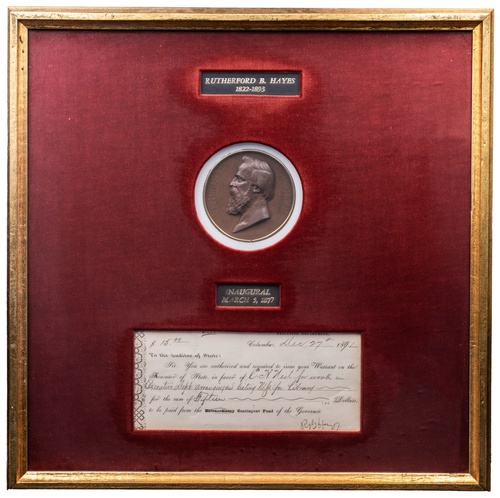
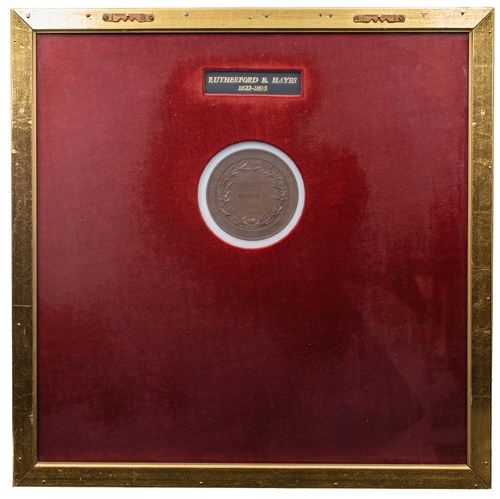
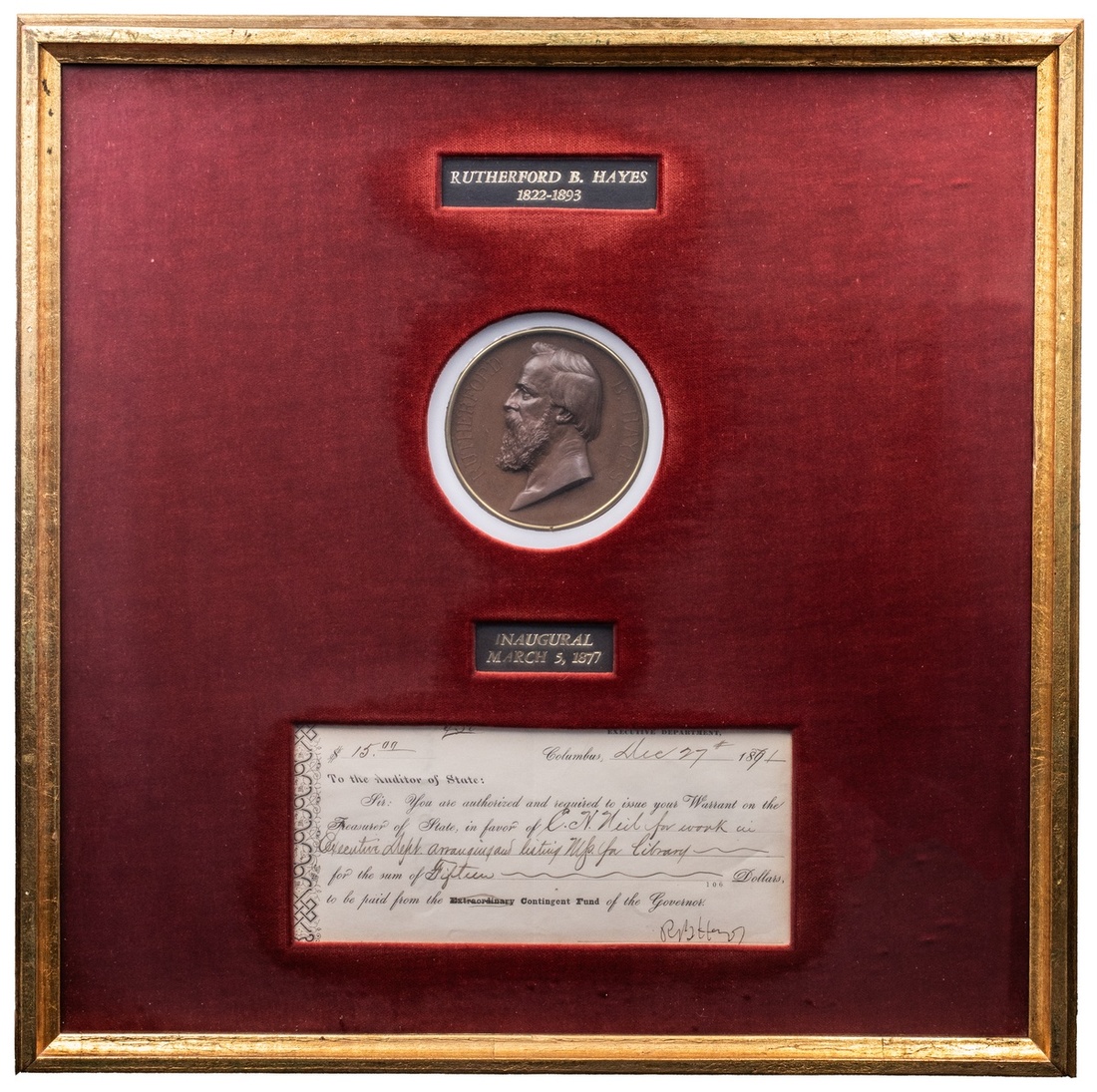
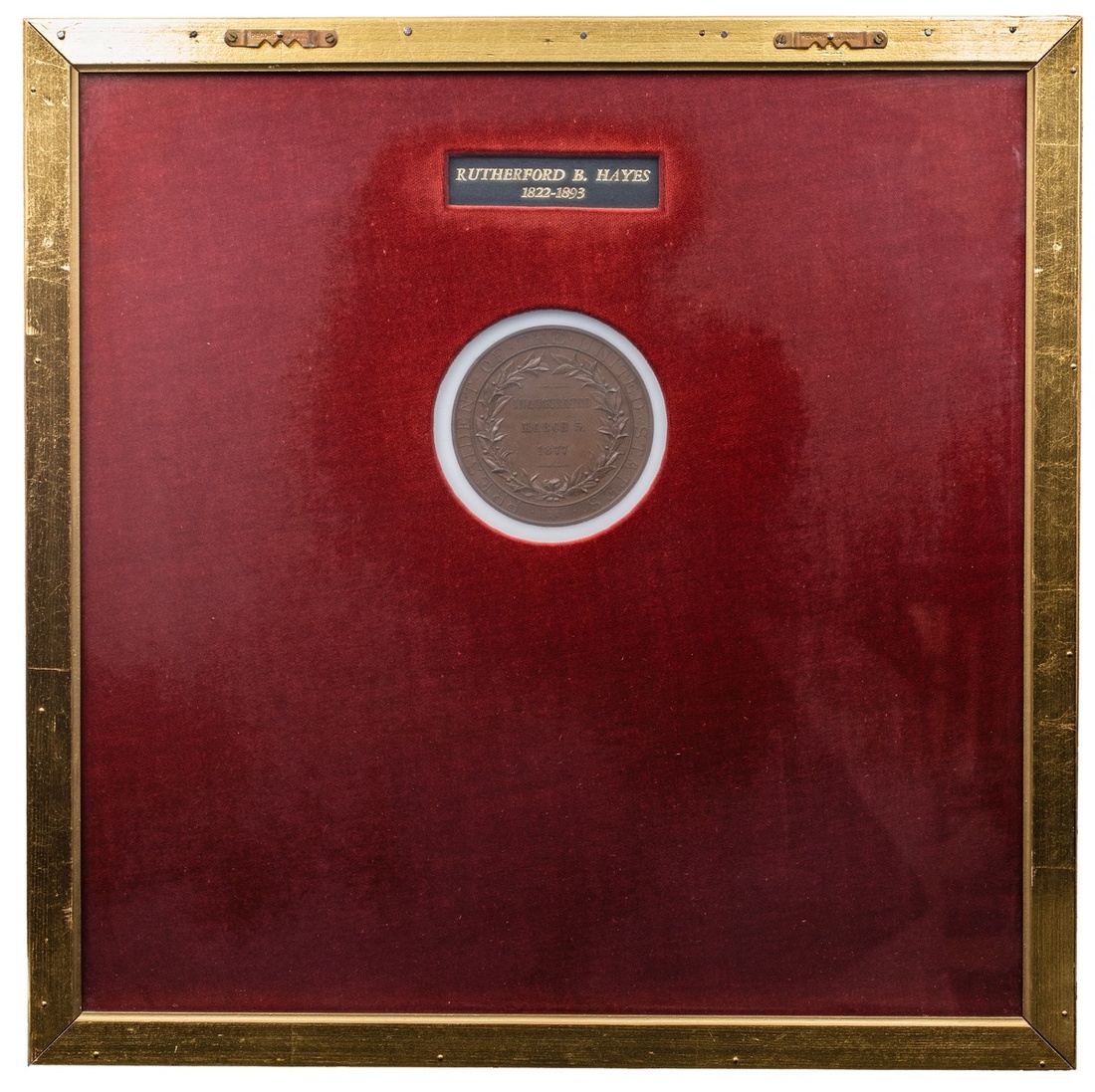
(x) Commanders-in-Chief, RUTHERFORD B. HAYES, 19th President of the United States (March 4, 1877 - March 4, 1881), Inauguration, AE Medal, 1877, by George T. Morgan, RUTHERFORD B HAYES, bust left, rev. PRESIDENT . OF . THE . UNITED . STATES ., INAUGURATED | MARCH 5 . | 1877, within wreath, 76mm (Julian PR-19), much as issued; with, his signature "R B Hayes" on Executive Department Financial Warrant, issued to C. N. Neil, dated December 27, 1871, sum of $15, mounted in frame, 395mm x 395mm
Not inspected outside of the frame. Sold as is.
Provenance
Presented to His Royal Highness Prince Bandar bin Sultan Al Saud, Saudi Arabian Ambassador to the United States (1983-2005), by James Addison Baker III, 67th Secretary of the Treasury and 10th White House Chief of Staff to President Ronald Reagan.
James Addison Baker III also served as 16th White House Chief of Staff and 61st Secretary of State to President George H. W. Bush.
Born in Delaware, Ohio, several months after his father's death, Hayes was raised largely by his mother and by an unmarried uncle, Sardis Birchard, who became both a surrogate father and, later, the financial backer of his early career.
He studied at Kenyon College and then Harvard Law School, an unusual credential for an Ohio lawyer of his generation, and built a respectable practice in Cincinnati before the Civil War gave his life its defining turn: at thirty-eight, with no obligation to serve and a young family at home, he volunteered anyway, was wounded five times over the course of the war, most seriously at South Mountain in 1862, and commanded, among others, a young officer named William McKinley, whose own path to the Presidency would follow a generation later.
Nominated for Congress while still in uniform in 1864, he refused to leave his post to campaign, reportedly saying that an Officer who would abandon the field for a seat in Congress ought to be scalped, a stance that only burnished his reputation once he won the seat anyway. He served three terms as Ohio's Governor between 1868 and 1877, building a record as a moderate reformer, supportive of Black suffrage and civil service reform, respectable enough to make him an appealing compromise candidate when the Republican Party needed a nominee untainted by the scandals of the Grant years.
The election that followed, against Democrat Samuel Tilden in 1876, became the most contested in American history to that point: Tilden led narrowly in the popular vote and appeared to have the electoral votes he needed, but returns from Florida, Louisiana, South Carolina, and Oregon were disputed by both parties, and a specially created Electoral Commission split along party lines, 8 to 7, to award every disputed vote to Hayes, handing him the Presidency 185 to 184.
The resolution, an informal bargain in which Southern Democrats accepted the outcome in exchange for the withdrawal of the last Federal troops propping up Republican Reconstruction governments, earned Hayes the lasting nickname "His Fraudulency" and effectively ended Reconstruction, a decision whose costs for the civil rights of Black Southerners would be measured in generations rather than years.
His single term, which he had pledged in advance not to seek a second one of, was defined by a running fight against his own party's machinery, most visibly in his standoff with New York Senator Roscoe Conkling over control of the lucrative New York Custom House, a battle that ended with Hayes removing Conkling's ally Chester Arthur, a future President himself, from his post as collector.
He deployed Federal troops to suppress the Great Railroad Strike of 1877, the country's first major nationwide labour uprising, at the request of Governors overwhelmed by the unrest, a use of Federal force against organized labour that set an uneasy precedent.
On monetary policy he found himself just as isolated: when Congress passed the Bland-Allison Act in February 1878, requiring the Treasury to buy between two and four million dollars of silver bullion every month and coin it into silver dollars, a measure pushed by Western mining interests and inflation-minded farmers still smarting from the 1873 demonetisation of silver, Hayes vetoed it on the grounds that a currency worth less than its face value would defraud creditors and labourers alike.
Congress overrode him within weeks, one of only a handful of successful veto overrides in that era, and the act became law over his direct and unambiguous objection. The coin born from the act became one of the most beloved in American numismatic history. The Bland-Allison Act's silver purchases fed the production of the new standard Dollar the Mint had already been quietly designing in anticipation of the law, the coin that took the name of its engraver, George T. Morgan, rather than any President or allegory, and that went on to be struck by the hundreds of millions from 1878 until 1921. Despite having fought the measure to the last available lever of his office, Hayes was sent, as a courtesy from the Mint's director, one of the very first pieces struck, a small ceremonial grace note for a President who had lost the argument.
Away from politics, Hayes's household left its own small mark on the White House. His wife Lucy, the first First Lady to hold a college degree, banned alcohol from state dinners on both temperance and diplomatic grounds, more her husband's decision than hers despite the "Lemonade Lucy" nickname that attached to her specifically; the White House installed one of the country's first telephones during his term, mostly a novelty given how few other lines existed to call, and Hayes began the tradition of the White House Easter Egg Roll in 1878 after Congress banned the practice on the Capitol grounds.
True to his word, he did not seek re-election, retired to his estate at Spiegel Grove in Fremont, Ohio, devoted much of his remaining years to prison reform and education philanthropy, and died there in January 1893.
Subject to 5% tax on Hammer Price in addition to 20% VAT on Buyer’s Premium.
Estimate
$260 to $300
Starting price
$180

Watch, listen and bid as if you were in the room. Now available for auctions worldwide.
Click here to bid live
An exclusive and confidential service for the discerning collector or vendor.
View the Gallery
Download every Spink catalogue on your iPad, iPod or iPhone using free Spink app.
Download From iTunes© 2026 Spink & Son. All rights reserved.