
Auction: 26776 - America 250th Anniversary Sale Ft. Coins, Medals, Banknotes, Objets de Vertu & Ephemera
Lot: 78
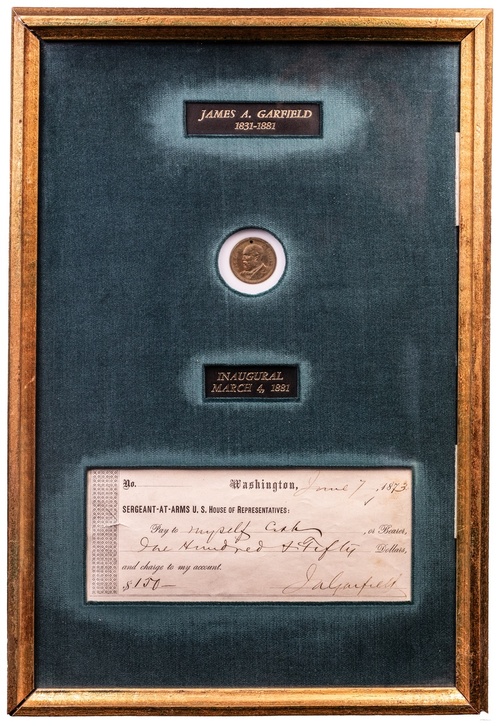
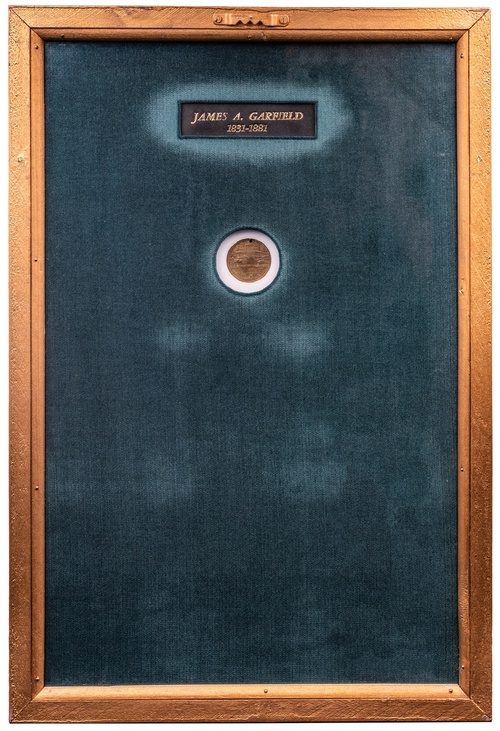
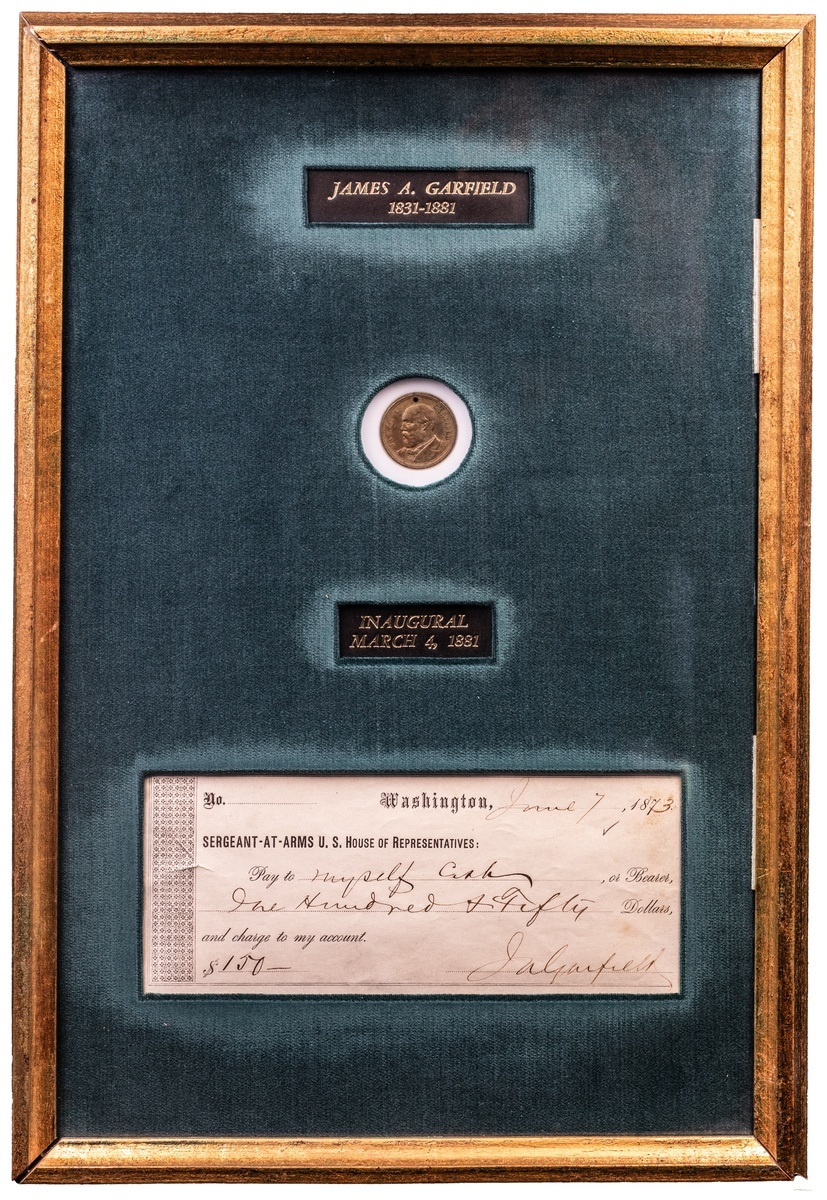
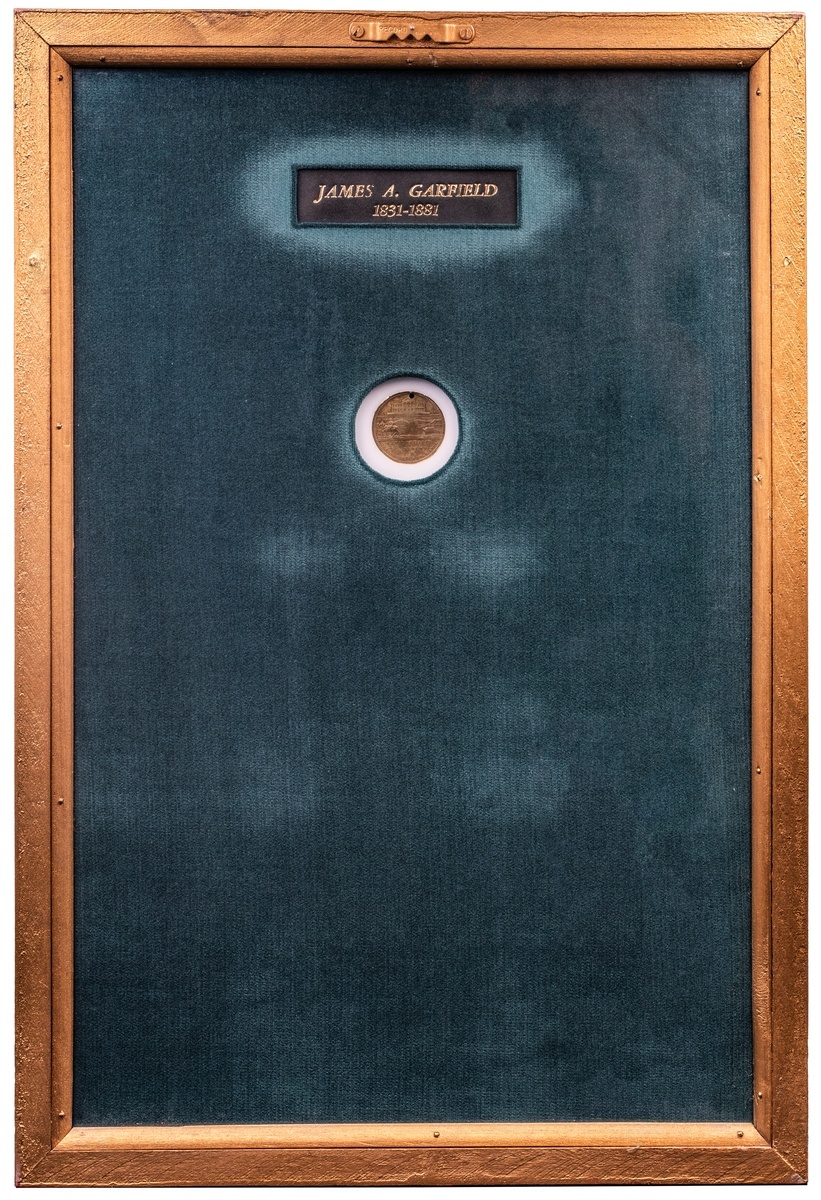
(x) Commanders-in-Chief, JAMES A. GARFIELD, 20th President of the United States (March 4, 1881 - September 19, 1881), Brass Election Campaign Medallet, 1880/81, by Peter L. Krider & Co (Silversmith, Philadelphia), JAMES A GARFIELD, draped bust three-quarters left, rev. CANAL BOY 1845 | PRESIDENT U.S | INAUGURATED MAR 4 1881, view of the White House and boy on pack mule towing canal boat in foreground, 25mm (DeWitt JG 1880-8 [Medallet]); Henry Ford Collection 72.31.166 [Medallet]), pierced, very fine; with, his signature "J a Garfield" on Sergeant-At-Arms U.S. House of Representatives cheque, dated June 7, 1873, issued to himself, sum of $150, mounted in frame, 267mm x 395mm
Not inspected outside of the frame. Sold as is.
Provenance
Presented to His Royal Highness Prince Bandar bin Sultan Al Saud, Saudi Arabian Ambassador to the United States (1983-2005), by James Addison Baker III, 67th Secretary of the Treasury and 10th White House Chief of Staff to President Ronald Reagan.
James Addison Baker III also served as 16th White House Chief of Staff and 61st Secretary of State to President George H. W. Bush.
Born in a log cabin in Orange Township, Ohio, and fatherless before his second birthday, Garfield spent his boyhood on his widowed mother's farm, doing odd jobs and reading sea stories that left him longing for a sailor's life.
At sixteen he walked to Cleveland to find a berth on a lake ship, was turned away by the only Captain in port, and settled instead for work as a driver and later a bowsman on a Pennsylvania and Ohio Canal boat, the Evening Star.
The engagement lasted only about six weeks before repeated falls into the canal brought on a fever severe enough to send him home, where his mother secured his promise to trade the towpath for a year of school. That brief, unglamorous interlude, which biographers place in 1847 or 1848 rather than any earlier year, became the founding image of his later political legend.
From there he worked his way through Williams College, taught Classics and then presided over the institution that became Hiram College, preached occasionally in the Disciples of Christ, and read law on the side, before War and Ohio politics carried him rapidly upward.
He fought for the Union at Middle Creek, Shiloh, and Chickamauga, rose to Major-General, and in 1862 was elected to Congress from Ohio's nineteenth district while still in uniform, beginning nine consecutive terms and, in time, the House Republican leadership. Those years in Washington were not free from shadow.
The scandal that trailed Garfield for the rest of his career began, fittingly for the Gilded Age, not with a bribe handed over in a back room but with a business arrangement so ordinary looking that a rising Congressman could tell himself it was nothing at all, until the day the House of Representatives said otherwise.
Crédit Mobilier of America was the shell corporation through which the men building the Union Pacific Railroad effectively paid themselves, awarding grossly inflated contracts to themselves and pocketing the difference in federal bonds and land grants meant to finance a trans-continental line. To keep Congress from asking hard questions, Oakes Ames, a Massachusetts representative and Crédit Mobilier director, quietly distributed shares of the stock to well placed colleagues, Garfield included, sometime around 1867 or 1868, on terms generous enough that the profit came with almost no risk attached.
The arrangement sat dormant for years. It detonated in September 1872, in the middle of a Presidential campaign, when a list of implicated members drawn from Ames's own correspondence reached the press, and Garfield's name appeared on it alongside the sitting Vice President, and the Speaker of the House. His first response to reporters was a denial that did not quite hold: he said Ames had offered him stock, and that he had refused it.
That account came apart before Vermont Congressman and Luke Poland's investigating committee that Winter. Ames testified that Garfield had agreed to take ten shares on credit, never paid for them outright, and that when the dividends came due, Ames simply forwarded him the net proceeds rather than transferring the stock itself: $329, paid by check drawn on the House's paymaster, the Sergeant-at-Arms. Testifying on January 14, 1873, Garfield confirmed most of this but drew a careful line, insisting the money was a loan rather than a dividend, a distinction that mattered because one implied he had owned the stock all along and the other did not. Ames maintained it was a dividend, and the two men's accounts diverged on that $300 or so for good.
When the committee's report was finally read to the House on February 18, 1873, the chamber fell into a silence Garfield himself recorded in his diary, noting only that the reading had "produced a profound sensation" in a room otherwise still. The committee's finding was that Garfield had bought the ten shares from Ames and collected $329 in dividends on them. Ames himself, and a New York Democrat, James Brooks, caught in a parallel scheme, were formally censured within days. Over a third of sitting members would lose their re-election campaigns in 1874, such was the piublic fallout from the scandal.
Garfield survived, but he emerged marked rather than cleared. There was not enough evidence against him for Congressional Investigators to act. His own biographer, Allan Peskin later noted: even Garfield's enemies never claimed that his involvement had influenced his conduct in office. The sharper judgment, from Ira Rutkow, was that Garfield's true failing was not the money, but the half-truths he offered the Committee under oath, since he had, in fact, agreed to the stock and had already banked the dividend before he tried to describe it otherwise. Newspaper editors were far less complimentary - pointing out that a man who sat on the House's own Finance Committees had no business pleading ignorance of a scheme half of Washington already knew about.
When Garfield reached the presidential ballot in 1880, Democrats revived the affair as a rallying cry, and the number itself became a taunt: walls, sidewalks, and placards across the country were chalked and plastered with "329", a bare figure that needed no further explanation to anyone who had followed the story eight years earlier. He won anyway, but barely, by a popular margin measured in the thousands rather than the hundreds of thousands.
Fascinatingly this case highlights a specific quirk and slightly curious institutional habit of the 19th Century House of Congress. In this period, the House Sergeant-at-Arms (Nehemiah G. Ordway) functioned as an informal bank for members, holding their salaries on deposit and honoring cheques against those accounts, including cheques a member wrote out to themselves simply to draw cash (as witnessed in his self-made cheque of June 7, 1873).
Garfield used the arrangement routinely and unremarkably throughout his career; with other surviving cheques in J S Copley Library (La Jolla, California) dated 1877, paying "myself debt seventy-nine 51/100 dollars" against his account there.
Extraordinarily, and with the backdrop of Crédit Mobilier still raging, President Grant would sign into law the "Salary Act" on the final full day of his first term - March 3, 1873 - legalising a retrospective salary increase for all sitting members of Congress and authorising "back pay" of almost $4,000 each. The justification being that wages were still reflective of Washington's adminstrative bill almost a Century prior. Garfield corresponded with the Sergeant-at-Arms over these wage "arrears" - thereby associating himself with the intense public furore that followed in what became better known as the "Salary Grab Act". A further cheque dated April 5, 1873 on First National Bank stationery, but scrubbed for N G Ordway, Sergt at Arms, reads: "Balance due me on 42nd Congress - $617.68". Ironically Ordway would latterly face his own indictment for corruption whilst Governor of the Dakota territory.
Incredibly, none of this derailed Garfield, and by 1880, he arrived at the Republican convention in Chicago as Ohio's favourite son, backing John Sherman and expecting nothing more for himself, only to emerge on the thirty-sixth ballot as the compromise nominee between the Grant and Blaine factions, a dark horse in the fullest sense. The campaign leaned hard on his Canal days, both in two rushed campaign biographies and in medallets struck for the occasion (one of which is also present in this lot); which paired a bust of Garfield on the obverse with a vignette of the White House rising above a boy on horseback towing a canal boat, captioned "Canal Boy 1845, President U.S. Inaugurated Mar 4 1881." The date is a Political liberty rather than an historic fact, since Garfield's own canal work came two or three years later, but the image did its rhetorical job regardless.
He would serve however only two hundred days. For on July 2, 1881, at the Baltimore and Potomac train station in Washington D.C., Charles Guiteau, a disgruntled employment seeker, shot him twice. Garfield lingered through the summer under treatment that likely did him more harm than his wounds, before eventually succumbing to his injuries on September 19 at Elberon, New Jersey.
His brief Presidency unsurprisngly left little legislative record of its own, but its abrupt end left a considerable one for others: the outrage at a killing rooted in the patronage system helped carry the Pendleton Civil Service Act through Congress two years later, a reform Garfield had favoured but never lived to sign.
The same dies that struck his inauguration medallet the previous year were once again pressed into service as mourning badges, their inscriptions quietly adjusted following his passing. Garfield holds the ignominious distinction of being one of four US Presidents to be assassinated whilst holding office.
Subject to 5% tax on Hammer Price in addition to 20% VAT on Buyer’s Premium.
Estimate
$400 to $500
Starting price
$280

Watch, listen and bid as if you were in the room. Now available for auctions worldwide.
Click here to bid live
An exclusive and confidential service for the discerning collector or vendor.
View the Gallery
Download every Spink catalogue on your iPad, iPod or iPhone using free Spink app.
Download From iTunes© 2026 Spink & Son. All rights reserved.