
Auction: 26776 - America 250th Anniversary Sale Ft. Coins, Medals, Banknotes, Objets de Vertu & Ephemera
Lot: 76
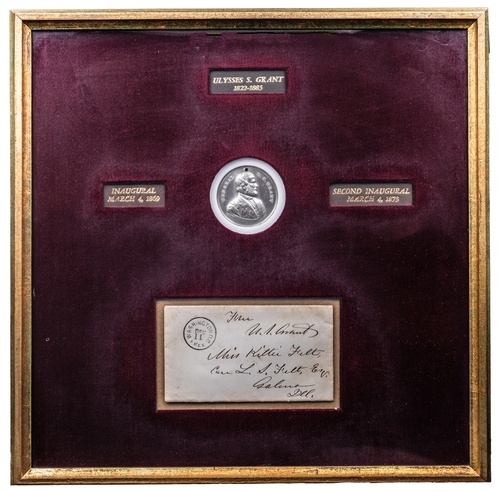
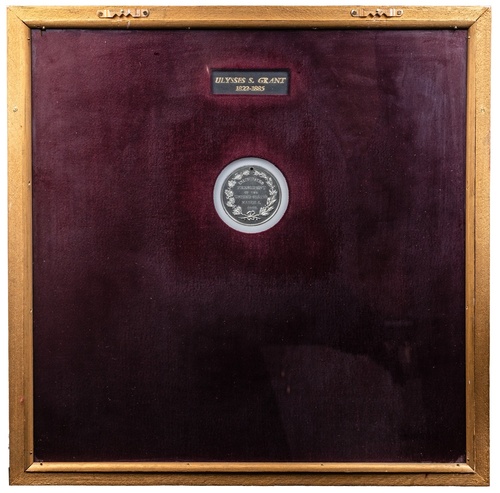
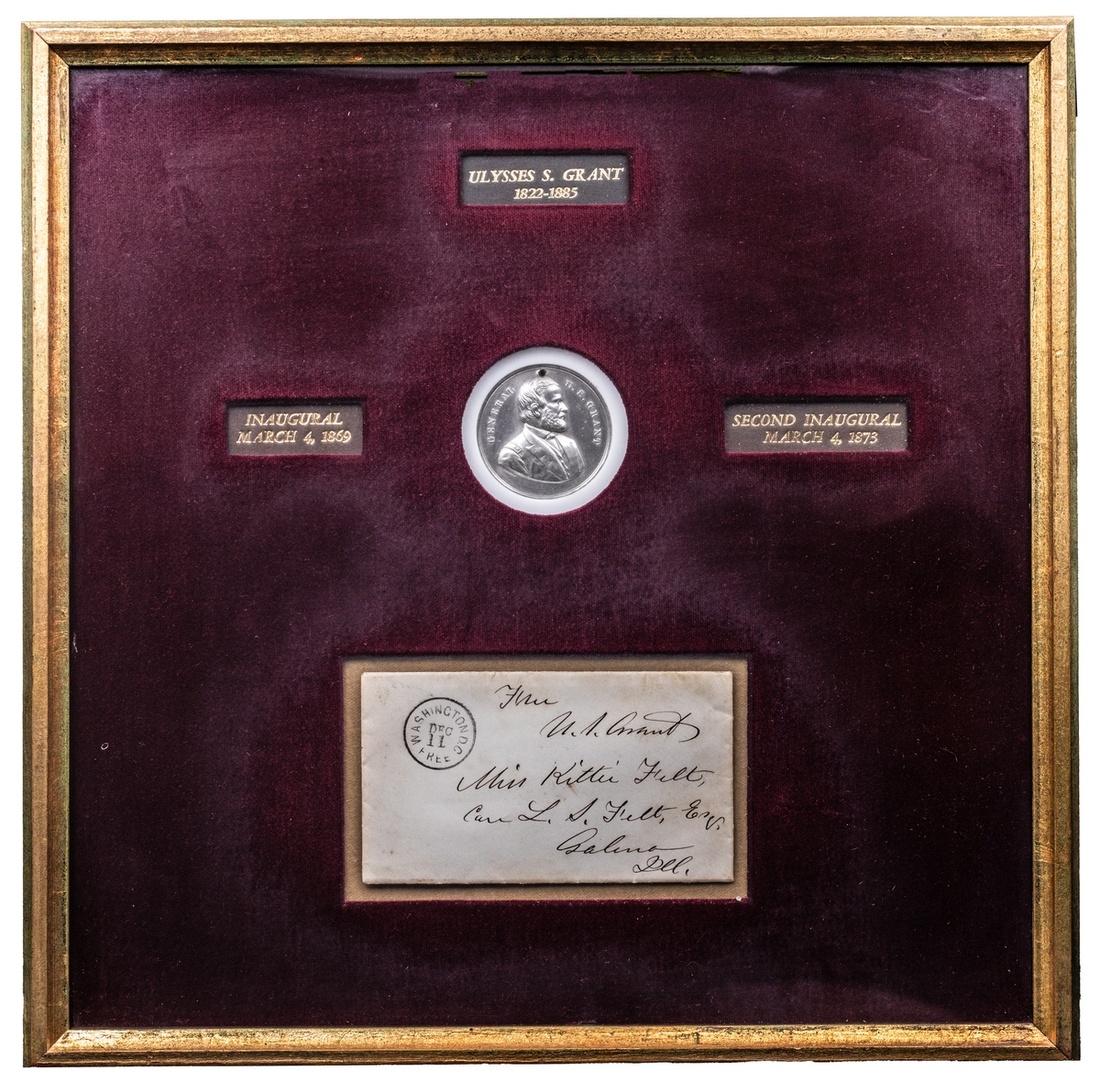
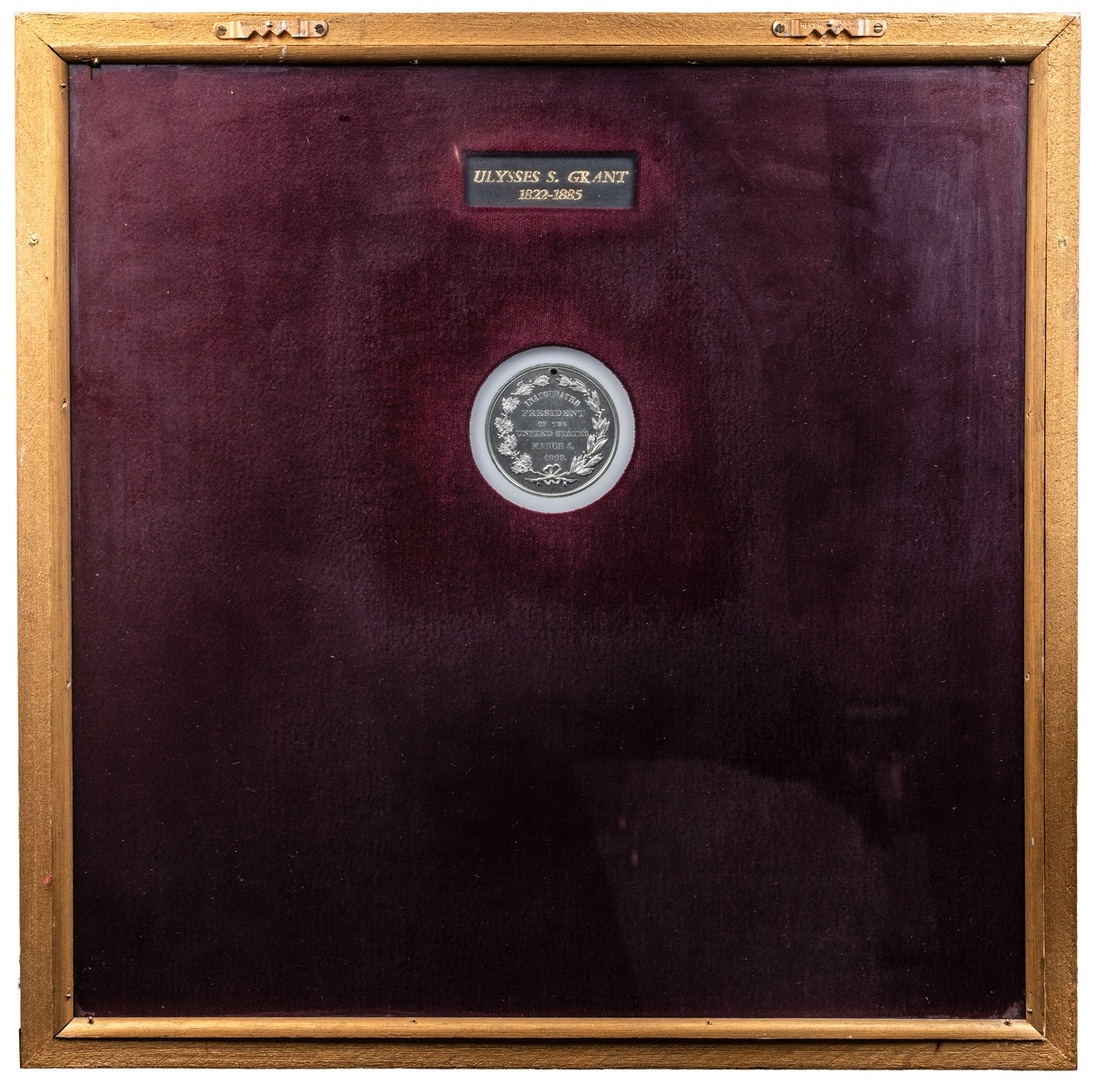
(x) Commanders-in-Chief, ULYSSES S. GRANT, 18th President of the United States (March 4, 1869 - March 4, 1877), Inauguration, WM Medal, 1869, by W. N. Key, GENERAL U. S. GRANT, draped bust right, rev. INAUGURATED | PRESIDENT | OF THE | UNITED STATES | MARCH 4 | 1869, within wreath, c.50mm, pierced, with pleasing lustrous surfaces, extremely fine; with, his signature "U S Grant" on Washington D.C. free frank postal cover, December 11, addressed to "Miss Kittie Felt" and "L. S. Felt, Esq", of Galena, Illinois, mounted in frame, 395mm x 395mm
Not inspected outside of the frame. Sold as is.
Provenance
Presented to His Royal Highness Prince Bandar bin Sultan Al Saud, Saudi Arabian Ambassador to the United States (1983-2005), by James Addison Baker III, 67th Secretary of the Treasury and 10th White House Chief of Staff to President Ronald Reagan.
James Addison Baker III also served as 16th White House Chief of Staff and 61st Secretary of State to President George H. W. Bush.
Born Hiram Ulysses Grant in Point Pleasant, Ohio, to a tanner whose trade he found so repugnant he refused to work in it, Grant owed his more famous name to a congressional clerical error: nominated to West Point as "Ulysses S. Grant" by a sponsor who mistakenly assumed his middle name was his mother's maiden name, Simpson, he found it easier to become that person than to fight the paperwork, and cadets who noticed his new initials nicknamed him "Uncle Sam."
He graduated in the middle of his class, distinguished himself as one of the finest horsemen the academy had produced, and served capably in the Mexican-American War under both Zachary Taylor and Winfield Scott, even as he privately judged the war, in his own later memoirs, to be one of the most unjust ever waged by a strong nation against a weak one.
Peacetime soldiering did him fewer favours: posted to isolated, family-less garrisons on the Pacific coast, he drank heavily enough out of loneliness that he resigned his commission in 1854 under a cloud that has never fully lifted. Civilian life went worse still, a string of failures at farming and real estate that left him, by 1860, clerking in his father's Illinois leather goods store, one of the more startling low points any future President has occupied on the eve of his rise.
The Civil War remade him almost immediately. His demand for unconditional surrender at Fort Henry and Donelson in 1862 turned his own initials into a nickname, and after Shiloh's brutal first day nearly ended his career, an oft-repeated line has Lincoln refusing calls for his dismissal with the words "I can't spare this man, he fights," a story that first surfaced only in an 1892 memoir decades after the fact and that most historians now treat as doubtful, however durable it has proven.
What is not in doubt is the record that followed: the capture of Vicksburg on July 4, 1863, splitting the Confederacy along the Mississippi, then Chattanooga, then a promotion to Lieutenant-General, a rank no one had held on active service since Washington himself, and command of every Union army. His Overland Campaign against Lee ground forward through catastrophic losses at the Wilderness, Spotsylvania, and Cold Harbor rather than retreat, a willingness to absorb casualties that appalled critics and exactly matched what Lincoln had been unable to find in his previous commanders.
At Appomattox in April 1865, Grant offered Lee's army generous terms, paroles rather than prisons, and permission for men to keep the horses and mules they would need to put in a crop, a magnanimity that shaped the peace as much as his aggression had shaped the war.
He was elected President in 1868 on the simple campaign promise "Let us have peace," and on civil rights his administration's record was more forceful than nearly any that followed for decades: he backed the Fifteenth Amendment, created the Department of Justice partly to enforce it, and pushed the Enforcement Acts and the Ku Klux Klan Act through Congress, using Federal troops and a suspension of habeas corpus in South Carolina in 1871 to break the Klan's terror campaign there with real effectiveness.
That record sat uneasily beside an administration riddled with corruption Grant himself seems never to have profited from personally but proved chronically unable to see coming in the men around him, from the Crédit Mobilier affair to the 1869 Black Friday gold panic engineered partly through his own brother-in-law, to the Whiskey Ring tax fraud that reached his private secretary Orville Babcock, whom Grant's own testimony helped acquit.
His diplomacy fared better: the Treaty of Washington in 1871 resolved the lingering Civil War-era Alabama Claims against Britain through international arbitration rather than threat, an early and genuine triumph for that method of settling disputes between nations.
He left office in 1877 to a two-and-a-half-year world tour that made him, by most accounts, the most famous private citizen on earth, feted by Monarchs and Prime Ministers who received few Americans with anything like the same curiosity, and he came within reach of a third term in 1880 before the Republican convention chose James Garfield instead.
Retirement proved far more dangerous to him than war had: he sank his savings into a Wall Street firm run partly by his own son and by a swindler, Ferdinand Ward, whose fraud collapsed the business in 1884 and left Grant effectively bankrupt and humiliated.
Diagnosed with throat cancer soon after, almost certainly the harvest of a cigar habit that had ballooned after the public began mailing him boxes of them following Fort Donelson, he spent his last months racing the disease to finish his memoirs, encouraged and published by Mark Twain on unusually generous terms, dictating and finally writing in agonising pain until he completed the manuscript just days before his death at Mount McGregor, New York, in July 1885.
Personal Memoirs of Ulysses S. Grant earned his widow several hundred thousand dollars in royalties, restoring the family's fortunes from beyond the grave, and remains, by the judgment of critics with no particular fondness for generals turned authors, one of the finest military memoirs in the English language.
His funeral procession stretched for miles through New York City, and Frederick Douglass, asked to speak at his memorial, called him a man too broad for prejudice and too great to be small at any point, a judgment history has generally softened only around the edges of his Presidency rather than the man himself.
Subject to 5% tax on Hammer Price in addition to 20% VAT on Buyer’s Premium.
Estimate
$600 to $700
Starting price
$450
Watch, listen and bid as if you were in the room. Now available for auctions worldwide.
Click here to bid live
An exclusive and confidential service for the discerning collector or vendor.
View the Gallery
Download every Spink catalogue on your iPad, iPod or iPhone using free Spink app.
Download From iTunes© 2026 Spink & Son. All rights reserved.