
Auction: 26776 - America 250th Anniversary Sale Ft. Coins, Medals, Banknotes, Objets de Vertu & Ephemera
Lot: 75
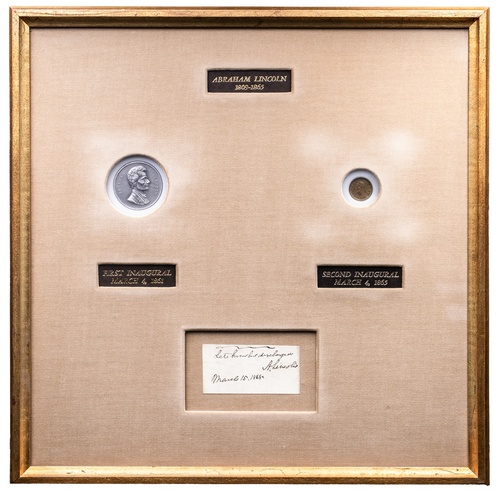
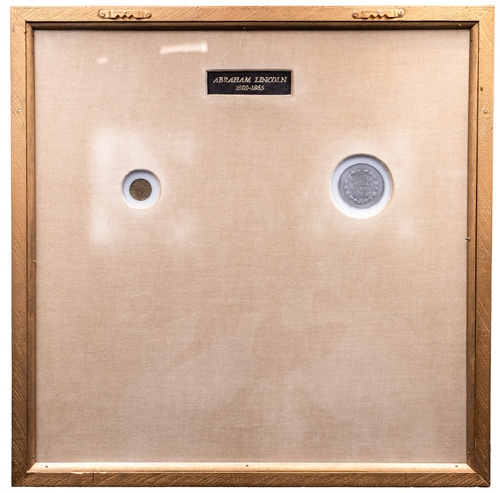
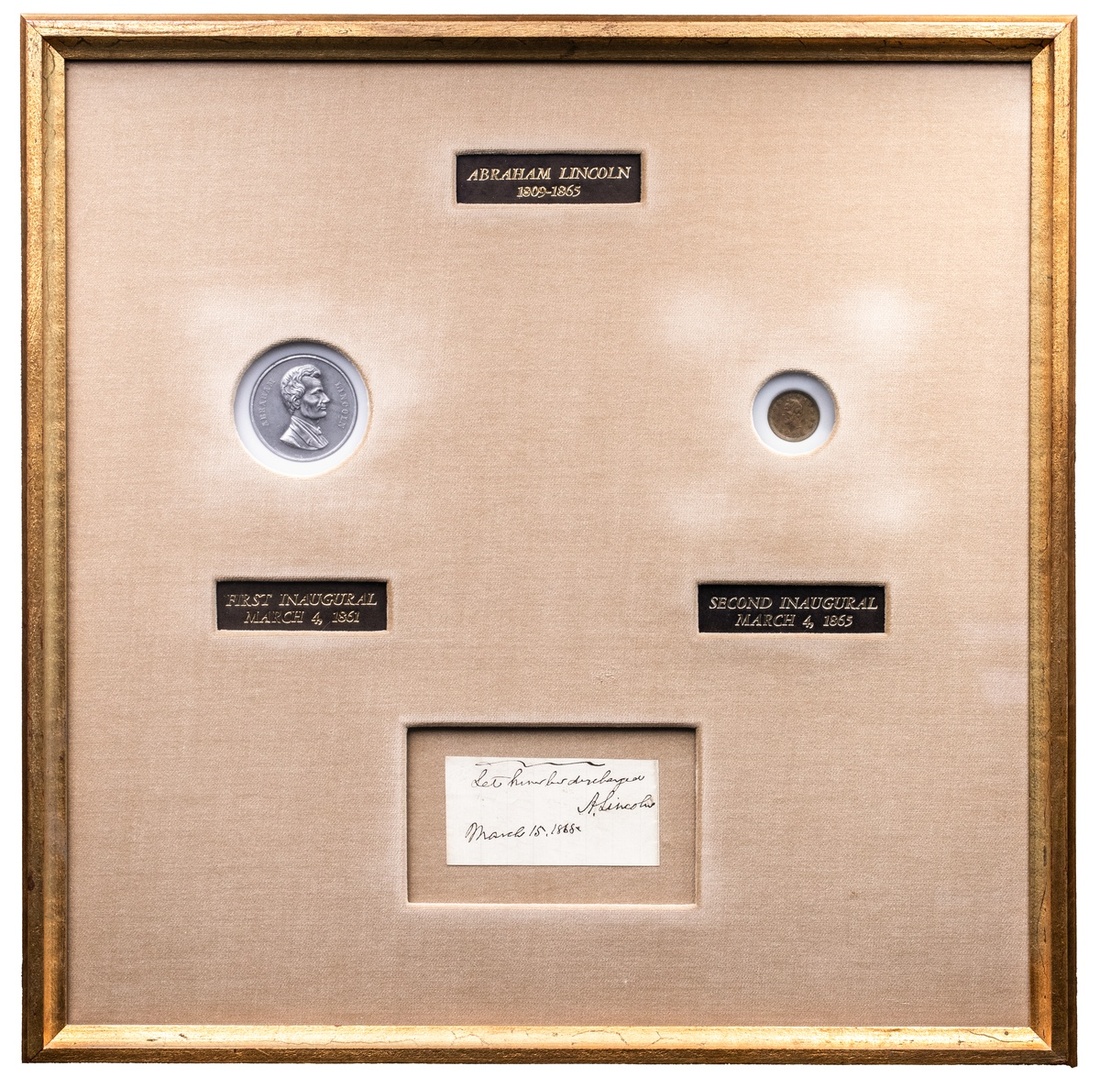
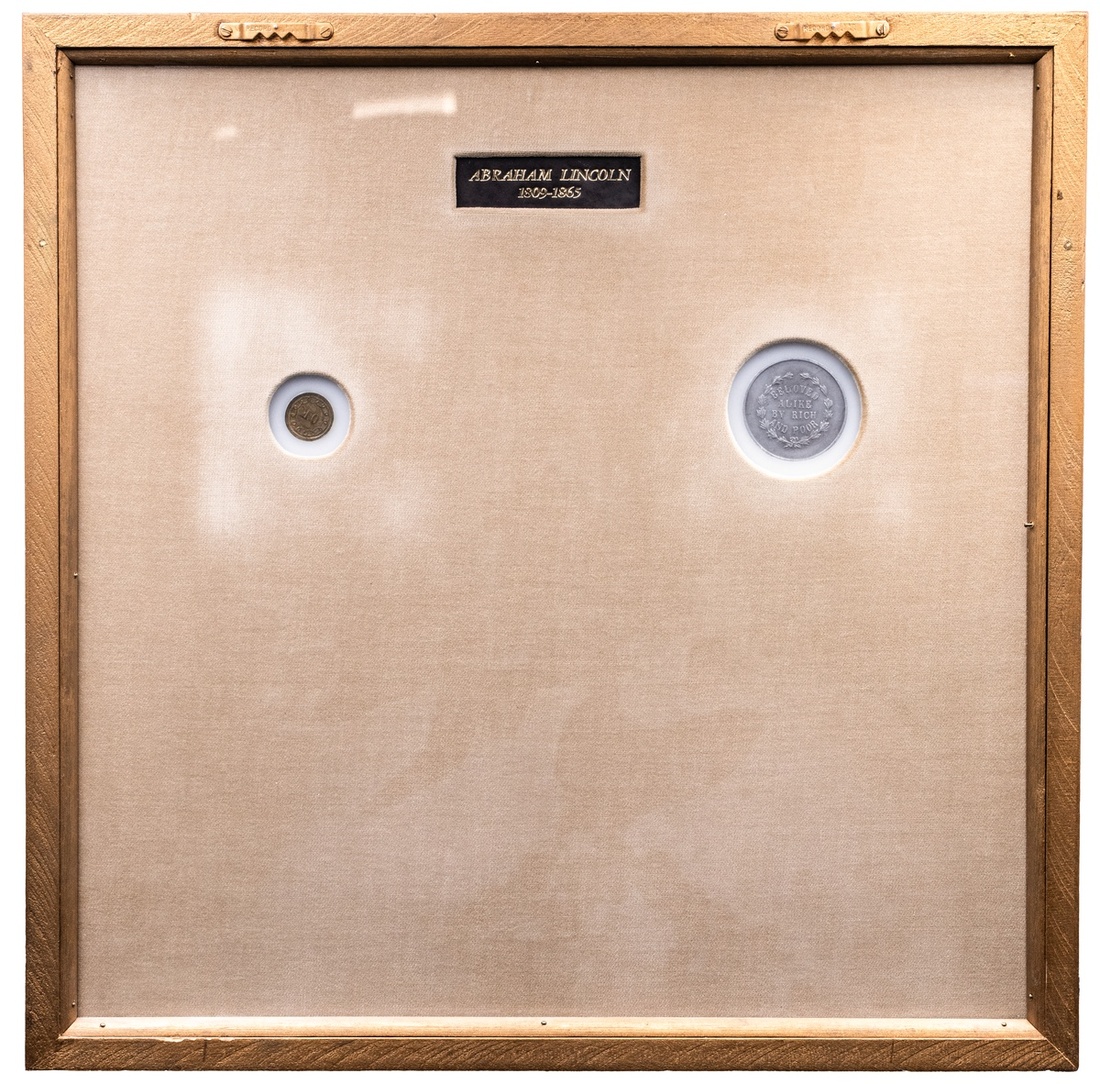
(x) Commanders-in-Chief, ABRAHAM LINCOLN, 16th President of the United States (March 4, 1861 - April 15, 1865), First Inauguration, WM Medal, undated, unsigned, ABRAHAM LINCOLN, draped bust right, rev. BELOVED | ALIKE | BY RICH | AND POOR, in wreath, c.38mm, pleasing surfaces, extremely fine; and Second Inauguration, Brass Medal, 1864, unsigned, bust left, date below, rev. OK within decorative border, c.17mm, extremely fine; with, cut signature "A. Lincoln", dated March 15, 1865, mounted in frame, 395mm x 395mm
Not inspected outside of the frame. Sold as is.
Provenance
Presented to His Royal Highness Prince Bandar bin Sultan Al Saud, Saudi Arabian Ambassador to the United States (1983-2005), by James Addison Baker III, 67th Secretary of the Treasury and 10th White House Chief of Staff to President Ronald Reagan.
James Addison Baker III also served as 16th White House Chief of Staff and 61st Secretary of State to President George H. W. Bush.
Born in a one-room log cabin in Hardin County, Kentucky, to a family that migrated first to Indiana, and then to Illinois chasing better land and better luck, Lincoln had perhaps a year of formal schooling in total, taught himself by firelight from whatever books he could borrow, and worked through a string of frontier occupations, rail-splitter, flatboatman, store clerk, postmaster, surveyor, before the law took hold of him.
He briefly commanded a company of Illinois militia during the Black Hawk War of 1832 without ever seeing combat, a fact he later turned into self-deprecating material on the House floor, joking about mosquito skirmishes and bloodless charges on wild onion patches.
Admitted to the bar in 1836, he built a substantial legal career riding the circuit courts of central Illinois while serving in the state legislature as a Whig, and in 1842 married Mary Todd, a match complicated from the start by his own recurring bouts of what contemporaries called melancholy, spells of depression documented by friends and law partners throughout his adult life, and by a domestic partnership that combined real devotion with real volatility.
His single term in the U.S. House, from 1847 to 1849, was defined less by anything he accomplished than by a fight he picked: he introduced the "Spot Resolutions" demanding President Polk identify the exact spot where Mexican forces had supposedly shed American blood on American soil, a challenge to the War's official justification that was politically costly back home and helped keep him out of elected office for most of the following decade.
He returned to his law practice, built a comfortable reputation and an equally comfortable income, and might have stayed there had the Kansas-Nebraska Act (1854) not reopened the slavery question he could not leave alone. He helped found the Illinois Republican Party, delivered the "House Divided" speech warning that the nation could not endure permanently half slave and half free, and in 1858 challenged Stephen Douglas for his Senate seat in a series of debates, conducted across seven Illinois towns before crowds numbering in the thousands, that made Lincoln a national figure even as he lost the seat itself in the legislature's vote.
Two years later, Republican delegates in Chicago passed over the front-runner, New York's William Seward, for Lincoln, a candidate with fewer enemies and a cleaner record on nativism, and he went on to win the presidency in 1860 with under forty percent of the popular vote in a fractured four-way race, an outright majority of the electoral college built entirely on Northern states. Seven Southern states seceded before he ever took the oath, and the war he had not sought opened weeks into his term with the bombardment of Fort Sumter.
What followed was four years of a war he ran with far more direct involvement than any predecessor, cycling through a sequence of cautious or unlucky generals, McClellan, Burnside, Hooker, Meade, before finally settling on Ulysses Grant, whose willingness to absorb losses and keep attacking matched the war Lincoln had concluded the Union needed to fight.
He assembled a cabinet largely out of men who had run against him for the nomination and continued to consider themselves his betters, managing their rivalries and egos with a patience and shrewdness that took most of them years to fully credit. The war's purpose shifted decisively on January 1, 1863, when the Emancipation Proclamation declared the enslaved people of Confederate territory free, a measure grounded in his war powers rather than any broader claim of authority, and one that reframed a War for Union into a war that could also be a War against Slavery itself.
Ten months later, at the dedication of a military cemetery, he delivered a speech of barely two minutes that has outlasted nearly everything else spoken in 250 years of American expression - the Gettysburg Address, redefining not just the conflict, but asking her peoples whether a nation "conceived in liberty" could actually endure.
His 1864 re-election looked genuinely uncertain through most of that Summer, war weariness having eroded Northern support badly enough that Lincoln privately drafted a memorandum preparing for defeat, and it was Sherman's capture of Atlanta in September that turned the political tide as decisively as any battle turned a military one.
He pushed the Thirteenth Amendment, abolishing slavery outright, through a reluctant House in January 1865, and closed his second inaugural address that March with a plea for reconciliation over vengeance, asking the country to move forward "with malice toward none, with charity for all."
He did not live to see most of what came next. Five days after Colonel Robert E. Lee's surrender at Appomattox, on Good Friday, April 14, 1865, Lincoln was shot in the back of the head at Ford's Theatre by the actor John Wilkes Booth, who leapt to the stage shouting a Latin tyrant-slaying slogan before escaping into the night.
Lincoln died early the next morning, the first American president to be assassinated in office. His funeral train carried his body some seventeen hundred miles back to Springfield over nearly three weeks, stopping in city after city for public viewings attended by hundreds of thousands.
A few personal facts round out a life that mythology has since smoothed considerably: he remains the only U.S. President to hold a patent, for a device to lift riverboats over shoals, drawn from his own flatboat days; he grew his famous beard only after an eleven-year-old girl named Grace Bedell wrote him during the 1860 campaign suggesting it would improve his chances; and he was, by the folklore of Illinois wrestling circles at least, one of the more formidable amateur wrestlers of his region and era, a claim the National Wrestling Hall of Fame has since seen fit to commemorate.
Subject to 5% tax on Hammer Price in addition to 20% VAT on Buyer’s Premium.
Estimate
$600 to $700
Starting price
$450
Watch, listen and bid as if you were in the room. Now available for auctions worldwide.
Click here to bid live
An exclusive and confidential service for the discerning collector or vendor.
View the Gallery
Download every Spink catalogue on your iPad, iPod or iPhone using free Spink app.
Download From iTunes© 2026 Spink & Son. All rights reserved.