
Auction: 26776 - America 250th Anniversary Sale Ft. Coins, Medals, Banknotes, Objets de Vertu & Ephemera
Lot: 74
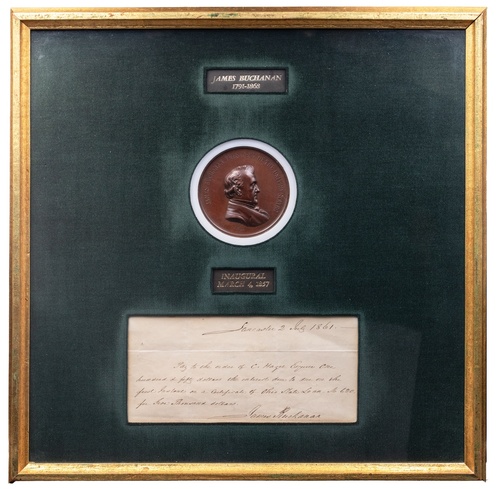
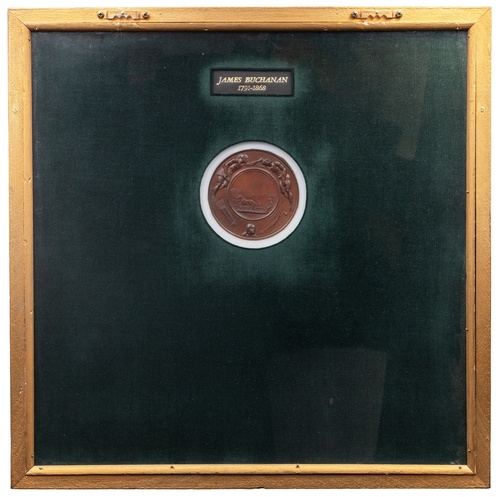
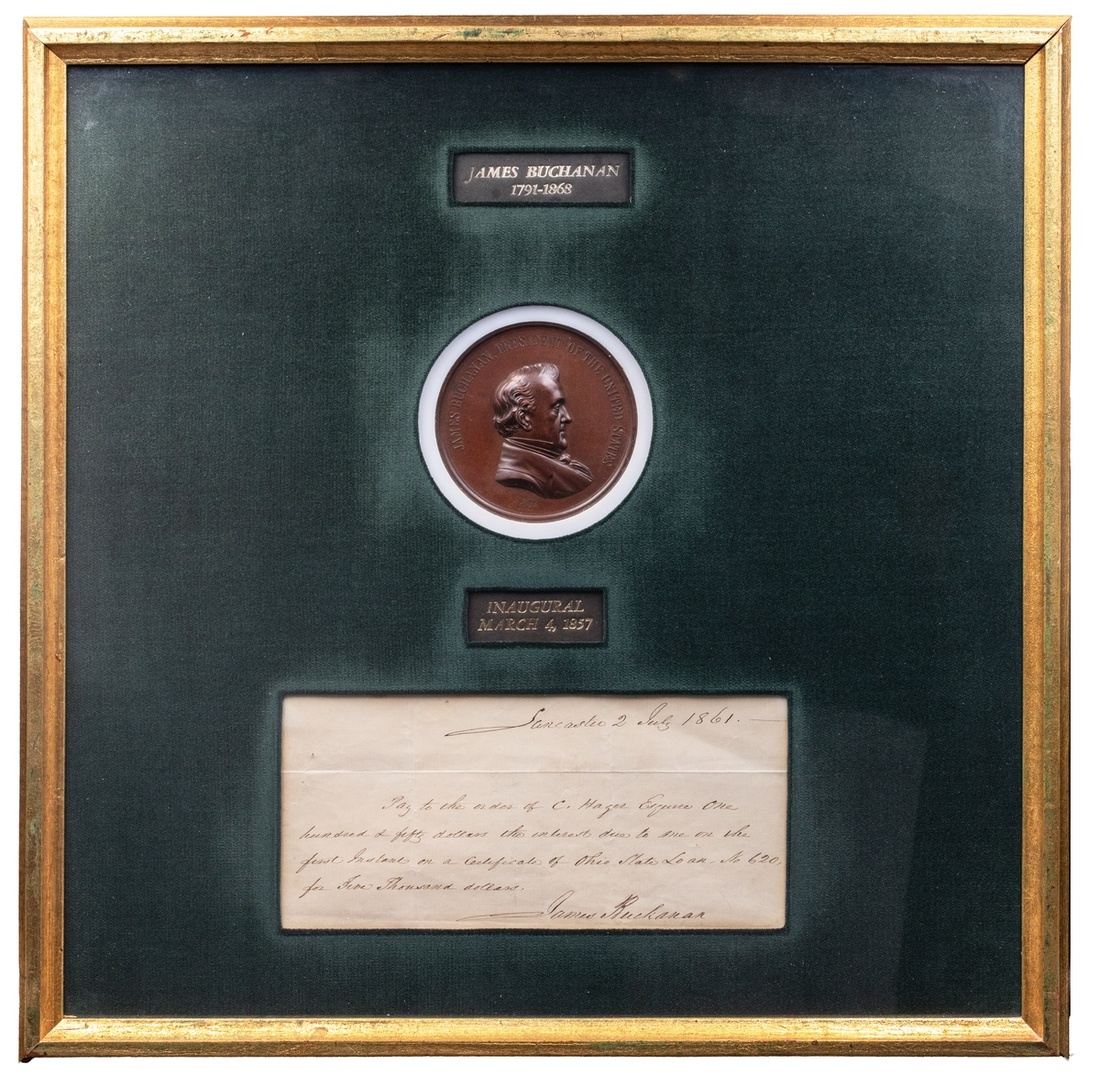
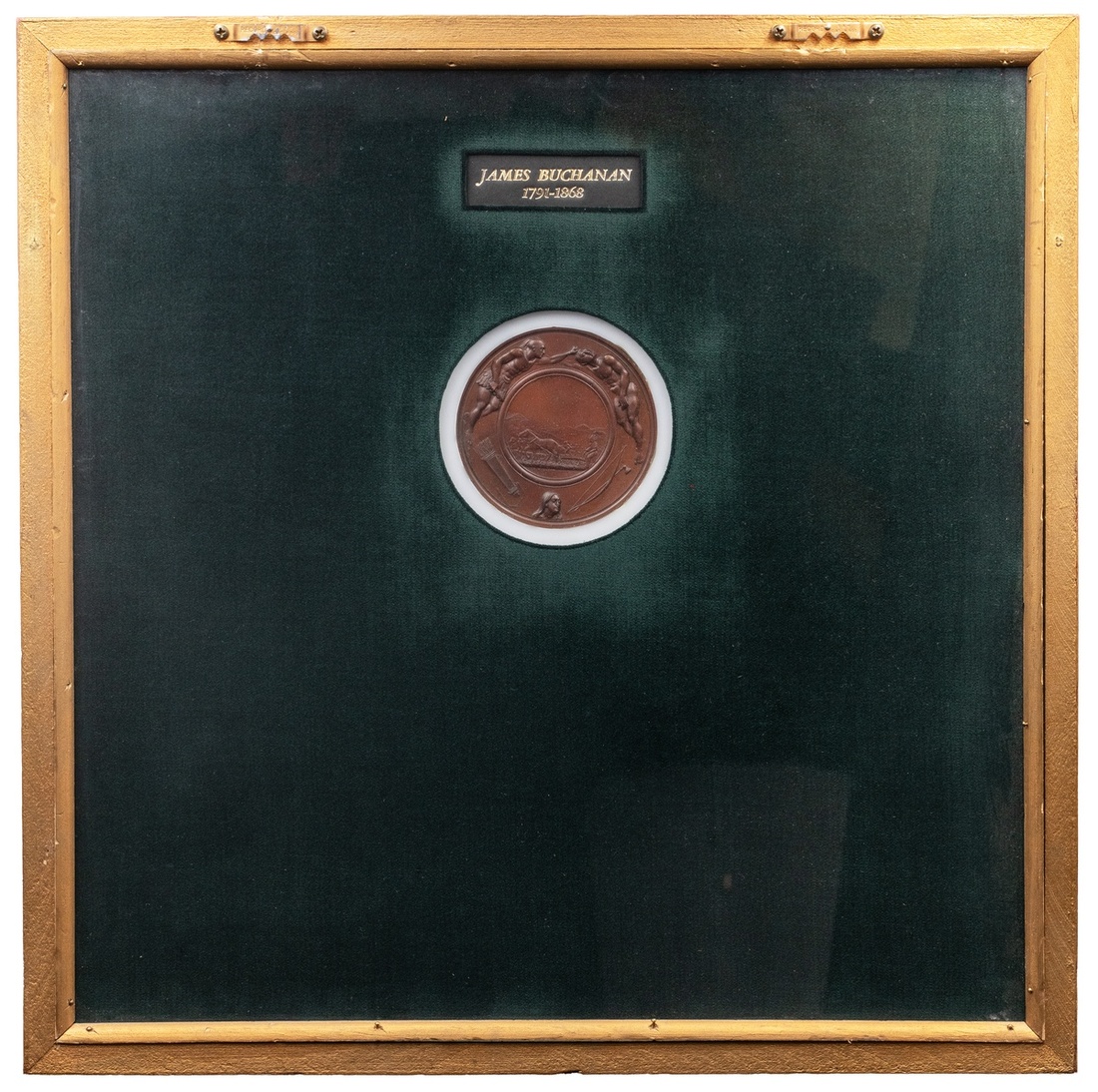
(x) Commanders-in-Chief, JAMES BUCHANAN, 15th President of the United States (March 4, 1857 - March 4, 1861), Indian Peace, AE Restrike Medal, dated 1857, by S. Ellis and J. Wilson, JAMES BUCHANAN, PRESIDENT OF THE UNITED STATES, draped bust right, rev. Native American figures around rural farm scene at centre, c. 76mm touch of rub to hair, yet pleasing red-brown surfaces, much as issued ; with, his signature "James Buchanan" on handwritten cheque, dated 2 July 1861, issued to Christopher Hager Esq. (President of the Farmers Bank of Lancaster, 1848-1868), sum of $150, mounted in frame, 392mm x 395mm
Not inspected outside of the frame. Sold as is.
Provenance
Presented to His Royal Highness Prince Bandar bin Sultan Al Saud, Saudi Arabian Ambassador to the United States (1983-2005), by James Addison Baker III, 67th Secretary of the Treasury and 10th White House Chief of Staff to President Ronald Reagan.
James Addison Baker III also served as 16th White House Chief of Staff and 61st Secretary of State to President George H. W. Bush.
Born in a log cabin trading post at Stony Batter, Pennsylvania, to a Scottish-Irish merchant father, Buchanan trained at Dickinson College and was admitted to the Pennsylvania bar in 1812, building a substantial legal practice before he was thirty. His personal life turned early and permanently on a single loss: engaged to Ann Coleman, the daughter of a wealthy Lancaster ironmaster, he saw the match collapse in 1819 amid a misunderstanding over his attentiveness, and Coleman died within weeks, in circumstances her family considered suicide.
Buchanan was shattered, asked to attend her funeral and was refused, and never courted another woman afterward. He remains the only president never to marry, a fact his niece Harriet Lane's graceful turn as White House hostess did much to soften in the public eye, to the point that she was sometimes toasted as though she held the office of First Lady herself.
His career before the Presidency was one of the longest and most varied in American political life. He served in the Pennsylvania legislature and nine years in the U.S. House, then as Andrew Jackson's minister to Russia, then a decade in the Senate, then as Polk's Secretary of State, where he negotiated the Oregon Treaty settling the boundary with British Canada at the forty-ninth parallel.
As Franklin Pierce's Minister to Great Britain in the 1850s, he was one of three American diplomats who drafted the Ostend Manifesto, a confidential 1854 memorandum proposing that the United States buy, or if necessary seize, Cuba from Spain, a document whose leak confirmed Northern suspicions that American foreign policy was being run for the benefit of the slaveholding South.
His long absence from Washington during the Kansas-Nebraska firestorm left him, unusually, untainted by that quarrel, and Democrats turned to him in 1856 partly for that reason, electing him over the new Republican Party's John C. Frémont.
It is also worth noting that for some twenty years he fostered an unusually close domestic partnership with Alabama Senator William Rufus King, with whom he would share lodgings in Washington for at least half that time. Contemporaries gossiped about the relationship's nature at the time (one Senator's diary referring to King, cattily, as Buchanan's wife). Scholars remain divided on whether it should be read as a romantic partnership or as an intense friendship of the kind openly celebrated between men in that era; nevertheless the surviving correspondence supports real intimacy without settling the question either way.
His Presidency was overtaken almost immediately by the crisis it could not survive. Two days after his inauguration, the Supreme Court handed down the Dred Scott decision [60 U.S. 393] - a defacto nationalisation of slavery by preventing the extension of American citizenship to settled black African descendants - and it later emerged that Buchanan had privately pressed a Northern Justice, Robert Grier, to join the Southern majority so the ruling would look like more than a sectional verdict, a rare and improper instance of a President reaching into the Court's deliberations before they were even public.
He backed the pro-slavery Lecompton Constitution for Kansas, splitting his own party from Stephen Douglas's wing of it, presided over the financial contraction of the "Panic of 1857", and sent troops into Utah in a brief, largely bloodless confrontation with Mormon settlers. Each of these might have defined a lesser crisis; instead they were prologue.
When South Carolina seceded in December 1860, weeks after Lincoln's election, Buchanan responded with a position that satisfied almost no one: secession, he held, was illegal, but the Federal Government had no Constitutional power to compel a state to stay. That paralysis let the crisis harden through the winter of his lame-duck months, as his cabinet split along sectional lines and an unarmed relief ship, the Star of the West, was fired on and turned back from Fort Sumter in January 1861.
He left office having neither prevented the Union's collapse nor clearly resisted it. He retired to his estate at Wheatland near Lancaster, and spent much of his remaining time writing a lengthy self-defense that blamed Republican agitation for the war he had failed to head off. He died in 1868, having lived long enough to see the war through to its end, and has been ranked by most historians ever since among the least effective Presidents the country has had, a verdict rooted less in any single decision or divisive policy than in the sustained absence of any one conviction wien it mattered most.
The Hager family was well known in Lancaster, PA for many generations. Christopher became President of the Farmers Bank of Lancaster in 1848 and served in that capacity until his untimely death in 1868. There is an interesting link between Hager's father and the wealthy iron manufacturer Robert Coleman. Coleman had bought Hager's property before selling it on to James Buchanan. Ann Coleman, was Robert's daughter.
Subject to 5% tax on Hammer Price in addition to 20% VAT on Buyer’s Premium.
Estimate
$400 to $500
Starting price
$280
Watch, listen and bid as if you were in the room. Now available for auctions worldwide.
Click here to bid live
An exclusive and confidential service for the discerning collector or vendor.
View the Gallery
Download every Spink catalogue on your iPad, iPod or iPhone using free Spink app.
Download From iTunes© 2026 Spink & Son. All rights reserved.