
Auction: 26776 - America 250th Anniversary Sale Ft. Coins, Medals, Banknotes, Objets de Vertu & Ephemera
Lot: 73
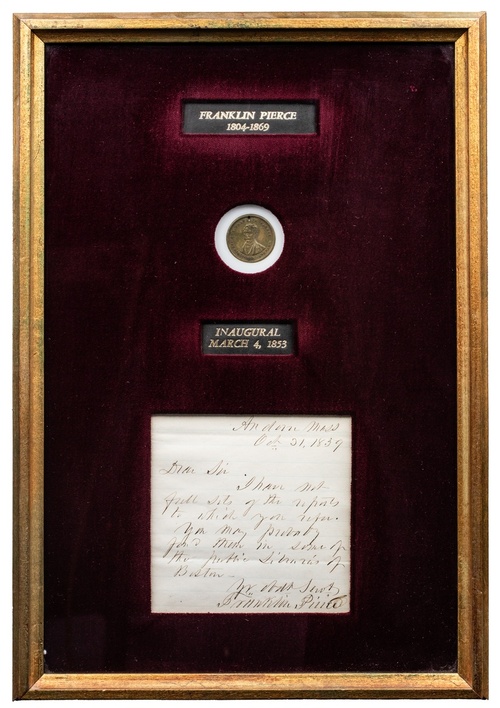
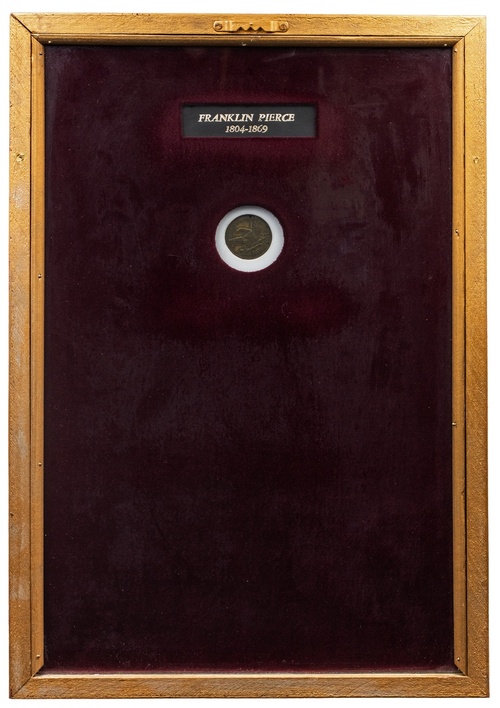
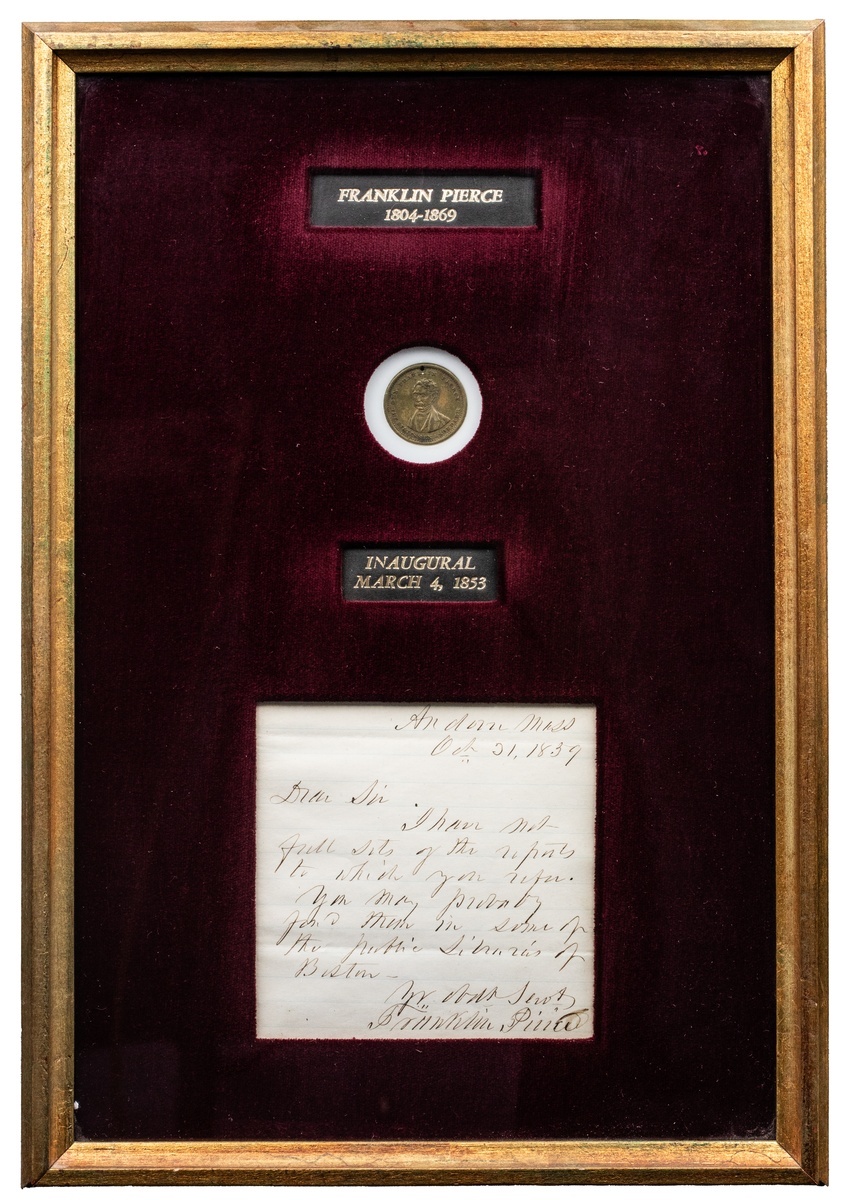
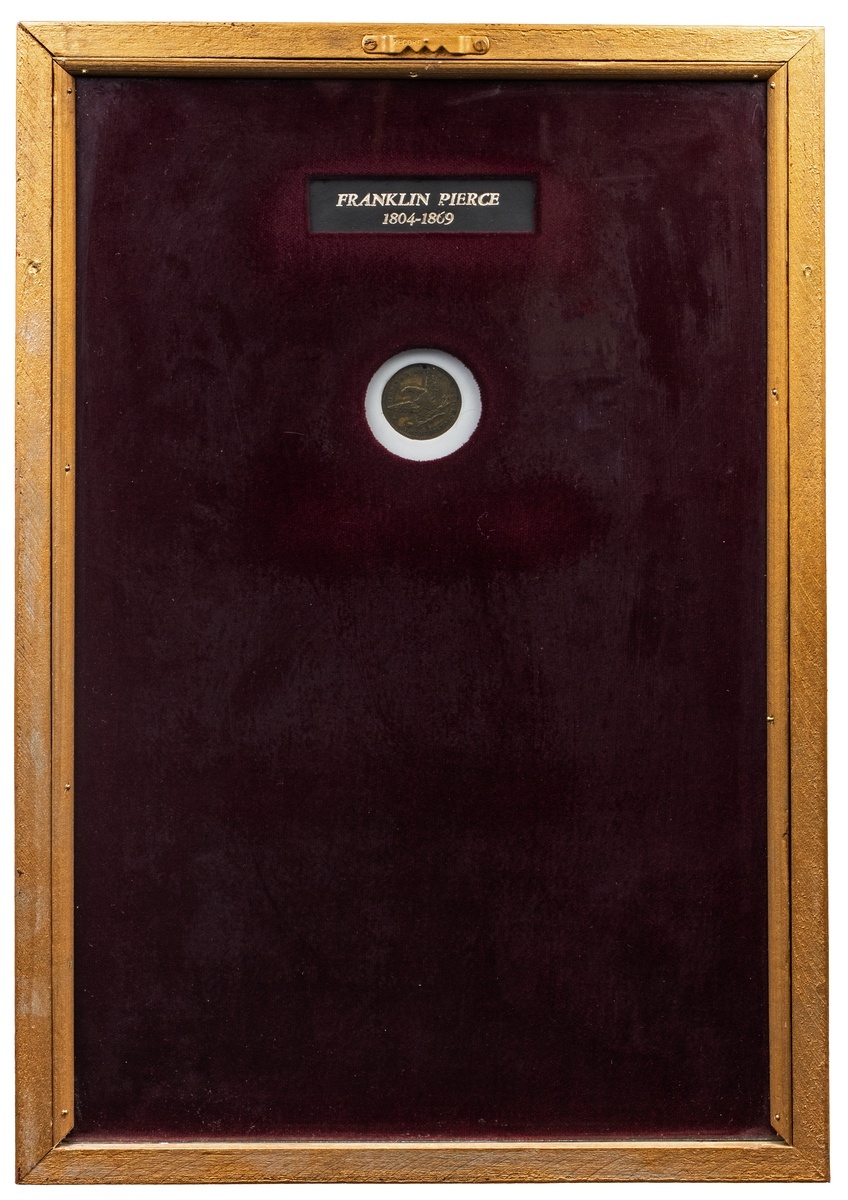
(x) Commanders-in-Chief, FRANKLIN PIERCE, 14th President of the United States (March 4, 1853 - March 4, 1857), Election Campaign, Brass Medal, 1852, unsigned, GEN FRANKLIN PIERCE | THE STATESMAN & SOLDIER, draped bust three-quarters left, rev. PIERCE & KING | THE PEOPLES CHOICE, heraldic eagle, c.27mm (DeWitt FP-1852-4), pierced, very fine; with his signature "Franklin Pierce" on letter, dated October 31, 1839, mounted in frame, 267mm x 395mm
Not inspected outside of the frame. Sold as is.
Provenance
Presented to His Royal Highness Prince Bandar bin Sultan Al Saud, Saudi Arabian Ambassador to the United States (1983-2005), by James Addison Baker III, 67th Secretary of the Treasury and 10th White House Chief of Staff to President Ronald Reagan.
James Addison Baker III also served as 16th White House Chief of Staff and 61st Secretary of State to President George H. W. Bush.
Son of a Revolutionary General and two-term New Hampshire Governor, Pierce came up through Bowdoin College (where Nathaniel Hawthorne, his lifelong friend, would later write his campaign biography) and the Concord bar into a swift rise through state and national office: the New Hampshire legislature, the U.S. House, and, at thirty-two, one of the youngest seats then held in the U.S. Senate.
He resigned in 1842, partly at the urging of a wife who found Washington intolerable, and built a reputation instead as a war hero. Commissioned a Brigadier General in the Mexican-American War, he led his brigade at Contreras despite a training injury that caused him to faint from pain in the saddle, an episode political rivals would later, unfairly, recast as cowardice.
He arrived at the Presidency almost by accident of consensus: deadlocked and unable to agree on any of its front-runners, the 1852 Democratic convention settled on Pierce, a genuine dark horse, on its forty-ninth ballot. He trounced the Whig nominee, Winfield Scott, that November. Two months before his inauguration, tragedy intervened: the train carrying Pierce, his wife Jane, and their eleven-year-old son Benjamin, their only surviving child after the deaths of two others in infancy, derailed near Andover, Massachusetts, and Benjamin was killed before his parents' eyes. Jane took it as divine judgment on her husband's ambition, wore mourning for the rest of her time in Washington, and became known to history as the "shadow of the White House."
Pierce himself, grieving and reportedly already inclined to drink, affirmed rather than swore his oath of office and delivered his entire inaugural address from memory, without notes, a feat no other President has matched. His administration was, by one measure, the most stable in American history: he retained every member of his original cabinet for the full four years, an unbroken run no other president would achieve until Franklin Delano Roosevelt. It was not, however, a quiet term.
The Kansas-Nebraska Act of 1854, which he championed at Stephen Douglas's urging, repealed the Missouri Compromise and opened the question of slavery in the new territories to "popular sovereignty," a decision that ignited the guerrilla violence of Bleeding Kansas and did more than any other single measure to fracture the Union along sectional lines.
Abroad, his administration secured the Gadsden Purchase for a southern transcontinental rail route, then stumbled badly when the leaked Ostend Manifesto, a confidential proposal by American diplomats to buy or, failing that, seize Cuba from Spain, confirmed Northern suspicions of a slaveholders' foreign policy.
The presidency cost him what remained of his party's confidence and, by most accounts, his health. He remains the only elected President denied renomination by his own party, passed over in 1856 for James Buchanan. Widowed in 1863 and increasingly given to drink, he spent his final years as one of the North's most conspicuous critics of Lincoln's war measures, a position so unpopular that a mob reportedly gathered outside his Concord home after Lincoln's assassination, suspicious of his sympathies, until Pierce himself came out to address them.
He died in 1869 of cirrhosis of the liver, and historians have judged him ever since largely by the catastrophe his signature act helped set in motion: a Presidency that, in trying to legislate the sectional crisis into quiet, helped instead to guarantee it would end in war.
Subject to 5% tax on Hammer Price in addition to 20% VAT on Buyer’s Premium.
Estimate
$400 to $500
Starting price
$280
Watch, listen and bid as if you were in the room. Now available for auctions worldwide.
Click here to bid live
An exclusive and confidential service for the discerning collector or vendor.
View the Gallery
Download every Spink catalogue on your iPad, iPod or iPhone using free Spink app.
Download From iTunes© 2026 Spink & Son. All rights reserved.