
Auction: 26776 - America 250th Anniversary Sale Ft. Coins, Medals, Banknotes, Objets de Vertu & Ephemera
Lot: 72
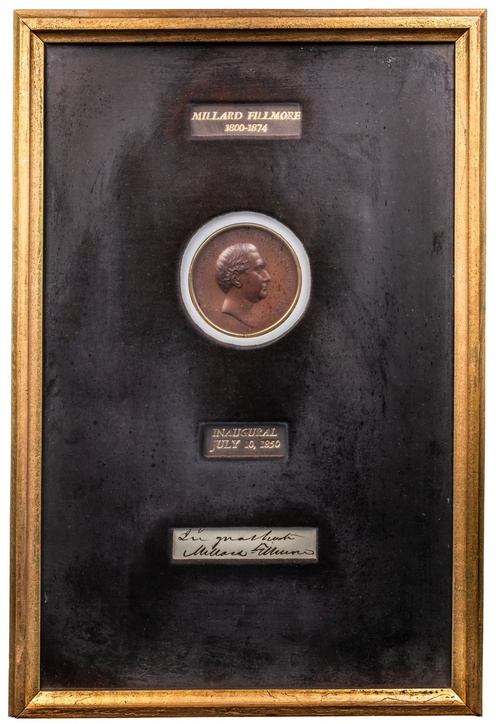
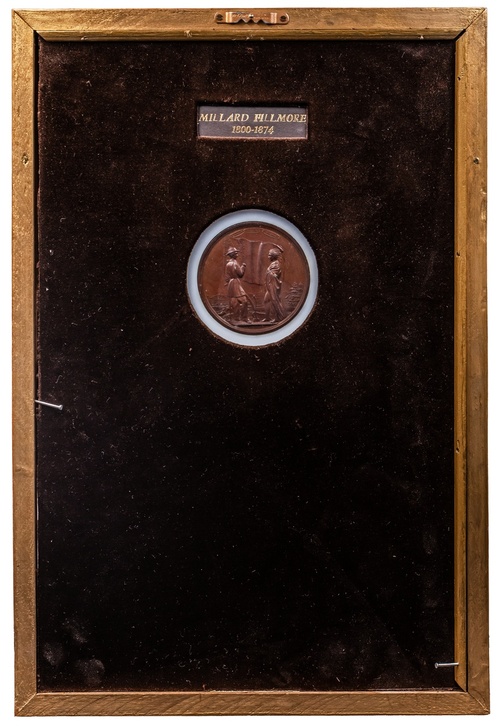
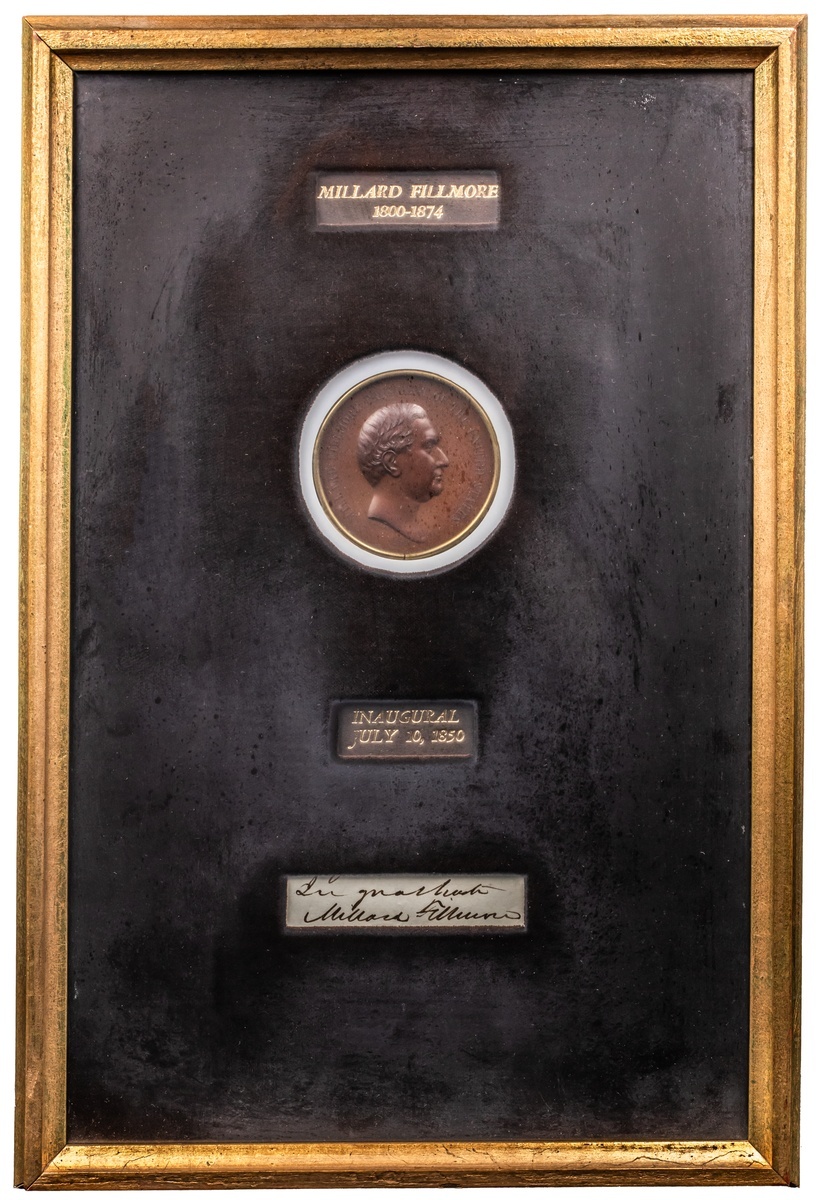
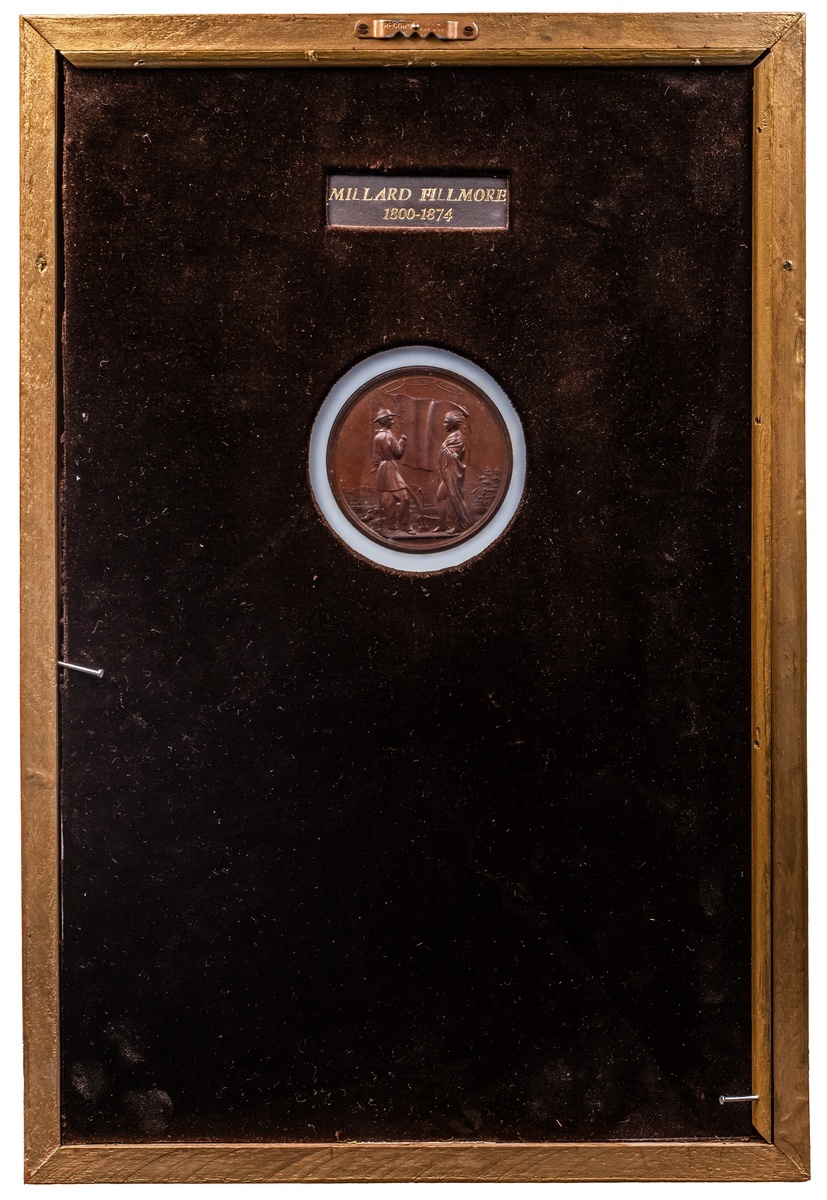
(x) Commanders-in-Chief, MILLARD FILLMORE, 13th President of the United States (July 9, 1850 - March 4, 1853), Indian Peace, AE Restrike Medal, dated 1850, by S. Ellis and J. Wilson, MILLARD FILLMORE PRESIDENT OF THE UNITED STATES, bust right, rev. settler standing before a Native American Chief, US flag and rural scene behind, c. 62mm, couple of spots of verigris to reverse, otherwise with pleasing chocolate brown surfaces, extremely fine; with, cut signature "Millard Fillmore", mounted in frame, 267mm x 395mm, damage to frame
Not inspected outside of the frame. Sold as is.
Provenance
Presented to His Royal Highness Prince Bandar bin Sultan Al Saud, Saudi Arabian Ambassador to the United States (1983-2005), by James Addison Baker III, 67th Secretary of the Treasury and 10th White House Chief of Staff to President Ronald Reagan.
James Addison Baker III also served as 16th White House Chief of Staff and 61st Secretary of State to President George H. W. Bush.
Born in a log cabin in the Finger Lakes region of New York to a struggling tenant farmer, Fillmore had a childhood poor enough that he was apprenticed out as a teenager to cloth dressers, work he eventually bought his way free of, before scraping together enough schooling to teach himself law.
At the New Hope Academy he met Abigail Powers, a schoolteacher two years his senior whose own education far exceeded his, and who continued tutoring him even after admission to the bar in 1823 and their marriage three years later, a partnership of real intellectual give and take that would later produce the White House's first proper library.
He built a legal and political career out of Buffalo and nearby East Aurora, entering the New York Assembly through the short-lived Anti-Masonic Party before helping found the Whig Party in the state, rising through the U.S. House to chair the powerful Ways and Means Committee, where he helped shape the protective tariff of 1842, and narrowly losing a bid for the Whig Speakership in 1841.
Passed over for higher office more than once in New York's factional politics, he was tapped in 1848 as Zachary Taylor's running mate largely for balance, a Northern moderate steadying a Southern slaveholding general at the top of the ticket, and the pair won that November.
Taylor's sudden death on July 9, 1850, from a violent gastric illness after a Fourth of July afternoon of iced milk and cold fruit in the Washington heat, elevated Fillmore to the Presidency with none of the mandate of an election behind him. A 1991 exhumation and toxicology study of Taylor's mortal remains prompted by lingering rumors of arsenic poisoning found nothing to support foul play, leaving acute gastroenteritis as the far less dramatic and far more likely cause.
Fillmore's Presidency turned almost entirely on the Compromise of 1850, the package of measures admitting California as a free state, organizing Utah and New Mexico without deciding slavery's status there, and, most consequentially, strengthening the Fugitive Slave Act to compel the return of escaped enslaved people even from Free states, a provision that bought the Union roughly a decade of uneasy peace at a moral cost that followed Fillmore for the rest of his life and shapes his reputation still.
His administration's more forward-looking legacy came in Foreign policy, dispatching Commodore Matthew Perry on the naval mission that forced open Japan's ports to American trade in 1853, just after Fillmore had left office.
One enduring piece of Fillmore trivia deserves a direct correction rather than repetition: the claim that he installed the White House's first bathtub is not history but a deliberate hoax, invented by the journalist H.L. Mencken in a satirical 1917 newspaper column meant to poke fun at wartime credulity, replete with fabricated dates, inventors, and a fictional campaign of medical opposition to bathing. Mencken confessed the whole thing as fiction within a decade, to remarkably little effect: the story had already lodged itself in almanacs, encyclopedias, and Presidential trivia lists, where versions of it still circulate today.
Denied his own party's nomination for a full term in 1852, a rejection that reflected how badly the Fugitive Slave Act had split the Whigs, Fillmore watched the party collapse entirely over the following years and, somewhat surprisingly for a man who had spoken relatively little about immigration in office, ran for President again in 1856 as the nominee of the nativist, anti-Catholic American Party, better known as the "Know Nothings", carrying only Maryland.
Widowed when Abigail caught a fatal cold at Pierce's outdoor inauguration in 1853 and died weeks later, and bereaved again the following year by his daughter Mary's death from cholera, Fillmore remarried in 1858 to a wealthy widow, Caroline McIntosh, whose fortune let the couple settle into a grand house on Buffalo's Niagara Square and fund a long list of civic causes, including the University at Buffalo, which Fillmore had helped found and served as chancellor, and the city's general hospital. He remains, notably, the first president to leave office without personal wealth or a landed estate to retire to, a distinction that set him apart from nearly every predecessor and successor of his era.
His Civil War years cost him what remained of his standing with the Republican press: he opposed Lincoln's conduct of the war closely enough to back the Democrat George McClellan in 1864, and when Lincoln was assassinated the following spring, black ink turned up flung across Fillmore's undraped Buffalo house, seized on nationally as proof of a former president's disrespect for the fallen one. The full story is murkier than the outrage that followed it: Fillmore and his wife appear to have simply been away from home when the mourning drapery went up elsewhere in the city, some contemporary Buffalo papers argued the whole "ink-throwing" story had been lifted, garbled, from a newspaper metaphor rather than an actual event, and Fillmore, informed of the anger, draped his house properly within days and later walked in the procession escorting Lincoln's body through Buffalo. He died in 1874 after a series of strokes, ranked by most historians since among the more forgettable presidents, his name kept alive today rather more by a hoax about plumbing than by the compromise, however consequential, that he actually signed.
Subject to 5% tax on Hammer Price in addition to 20% VAT on Buyer’s Premium.
Estimate
$400 to $500
Starting price
$280
Watch, listen and bid as if you were in the room. Now available for auctions worldwide.
Click here to bid live
An exclusive and confidential service for the discerning collector or vendor.
View the Gallery
Download every Spink catalogue on your iPad, iPod or iPhone using free Spink app.
Download From iTunes© 2026 Spink & Son. All rights reserved.