
Auction: 26776 - America 250th Anniversary Sale Ft. Coins, Medals, Banknotes, Objets de Vertu & Ephemera
Lot: 71
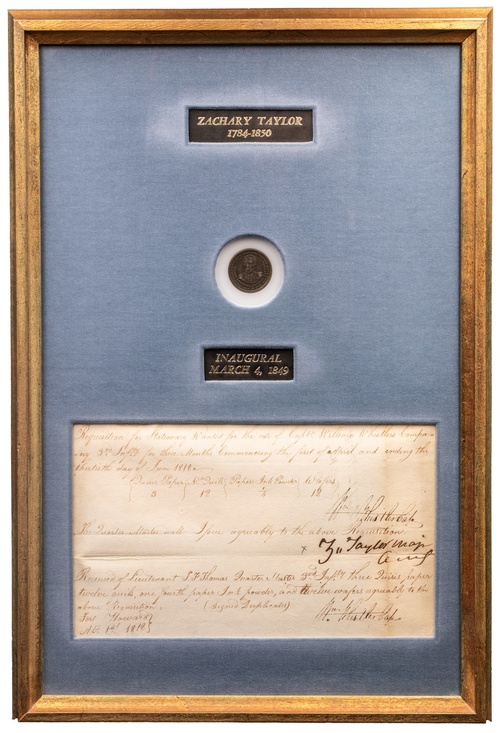
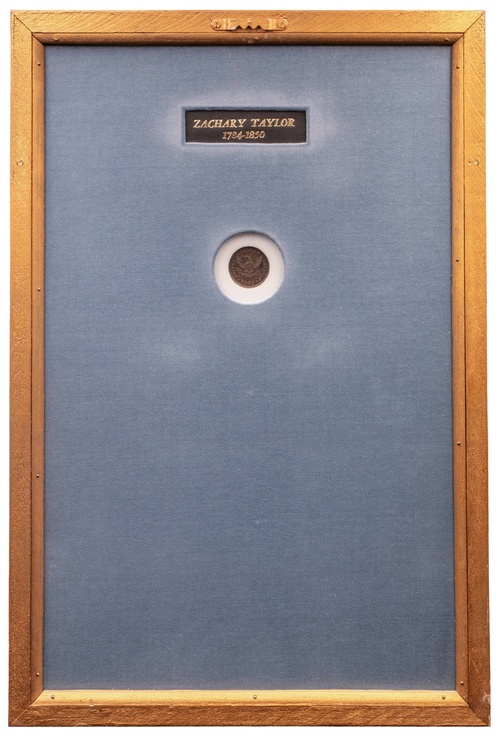
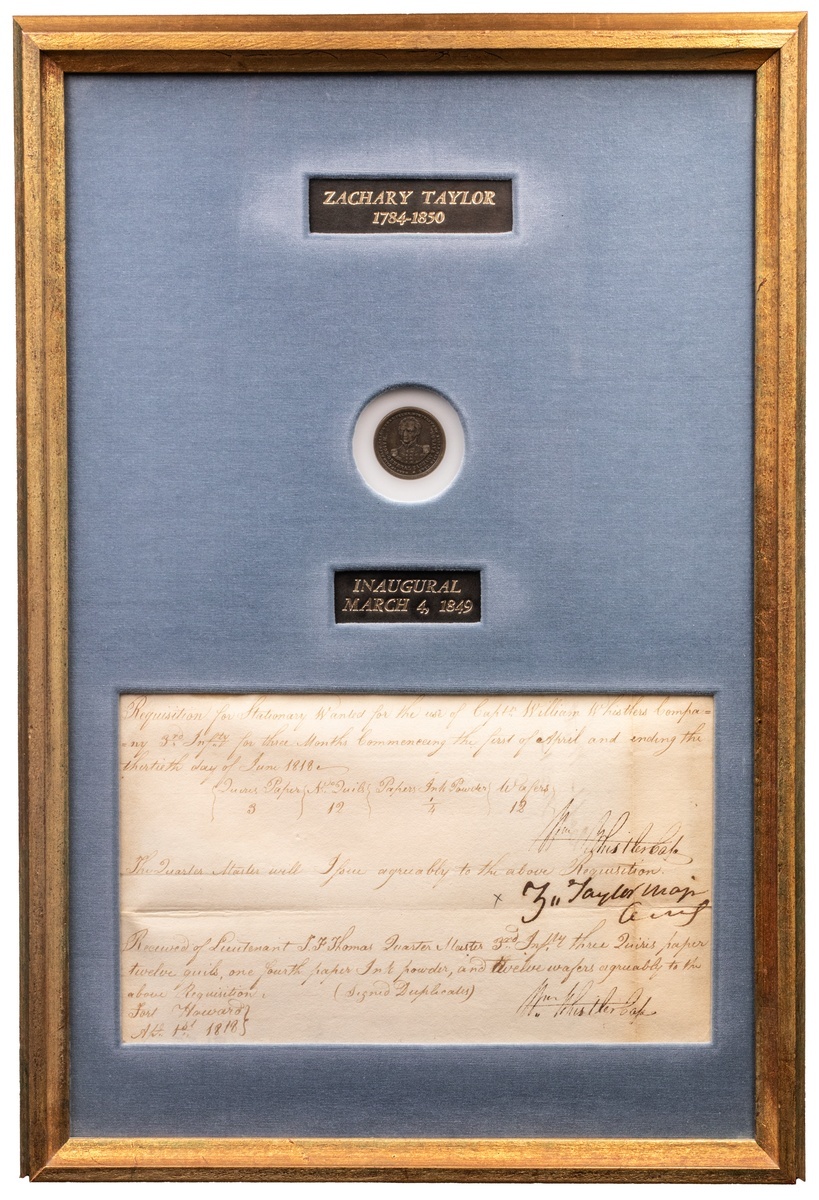
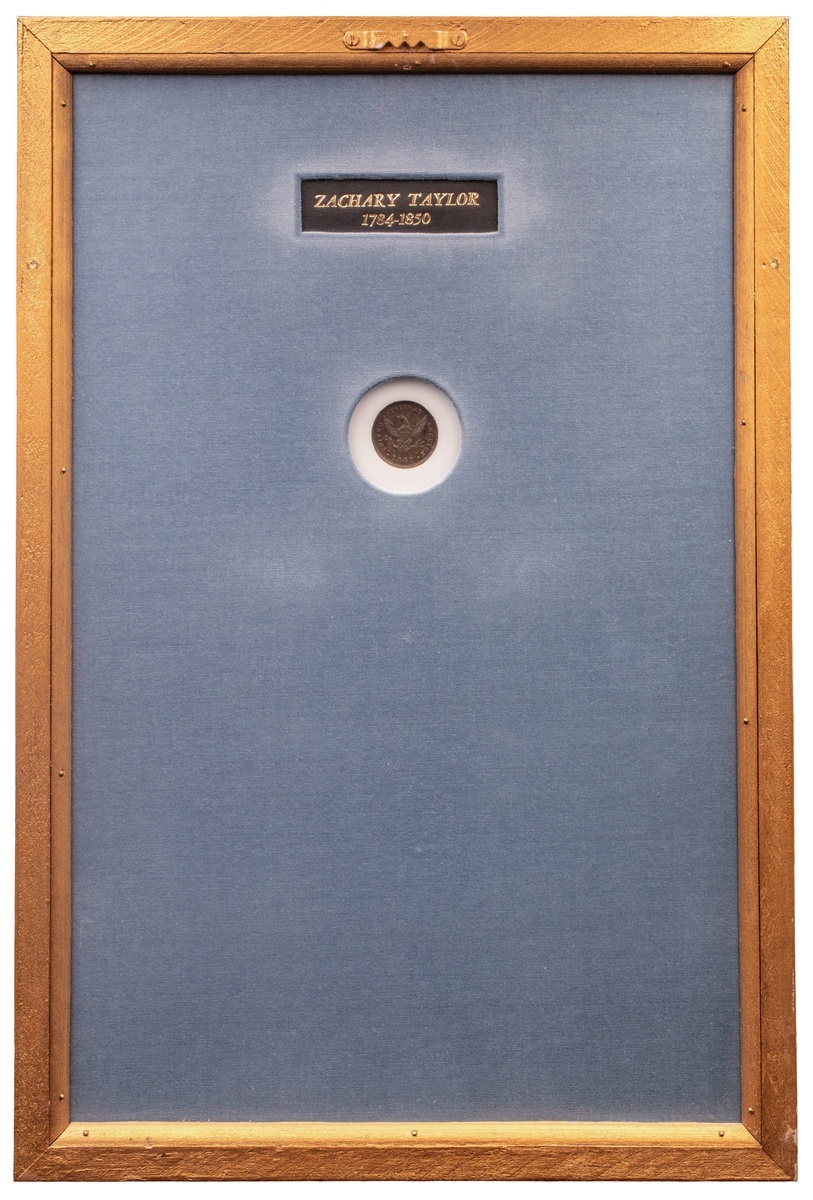
(x) Commanders-in-Chief, ZACHARY TAYLOR, 12th President of the United States (March 4, 1849 - July 9, 1850), Political Campaign, Brass Token, 1847, unsigned, uniformed bust facing, legend around rev. UNITED STATES OF AMERICA 1847, heraldic eagle, 25mm (ZT 1848-21), very fine, with, his signature "Taylor Majr Genl", as Major General in the U.S. Army on "Requisition of Stationary" document, dated 1 April 1818. Also signed "Wm Whistler Capt", mounted in frame, 267mm x 395mm
Not inspected outside of the frame. Sold as is.
Provenance
Presented to His Royal Highness Prince Bandar bin Sultan Al Saud, Saudi Arabian Ambassador to the United States (1983-2005), by James Addison Baker III, 67th Secretary of the Treasury and 10th White House Chief of Staff to President Ronald Reagan.
James Addison Baker III also served as 16th White House Chief of Staff and 61st Secretary of State to President George H. W. Bush.
Born in Virginia and raised almost from infancy on the Kentucky frontier, Taylor had little formal schooling and instead built an entire identity out of forty years in uniform, commissioned in 1808 and rising slowly through a career spent almost entirely on the country's shifting military edges.
He served in the War of 1812 and, during the Black Hawk War of 1832, commanded a young lieutenant named Jefferson Davis, who three years later eloped with Taylor's own daughter Sarah Knox Taylor against her father's wishes; she died of malaria only three months into the marriage, and Taylor and Davis remained estranged for years afterward before an eventual reconciliation, a family connection that would look considerably stranger in hindsight once Davis went on to lead the Confederacy his father-in-law's own presidency had worked to head off.
Taylor made his reputation in the long, grinding Second Seminole War of the 1830s, winning at Lake Okeechobee and earning the nickname "Old Rough and Ready" for a famously plain, unmilitary appearance that endeared him to the soldiers under him. The Mexican-American War made him a national hero outright: his victories at Palo Alto, Resaca de la Palma, and Monterrey were capped in 1847 by Buena Vista, where a heavily outnumbered American force broke Santa Anna's army outright, and the newspaper coverage that followed turned a career soldier who had, by most accounts, never bothered to vote in a Presidential election into the most talked-about man in the country.
The Whigs, having learned from Harrison's success eight years earlier that a war hero with no fixed political record could be shaped into almost anything a party needed, nominated him in 1848 with Millard Fillmore as his running mate, and he won a three-way race against Democrat Lewis Cass and Martin Van Buren's insurgent Free Soil campaign.
What followed surprised almost everyone who had assumed a Louisiana slaveholder would defend slavery's expansion as a matter of course. Taylor instead pushed for California and, eventually, New Mexico to skip the territorial stage entirely and enter the Union directly as states, letting their own Constitutions settle the slavery question and sidestepping the fraught congressional wrangling that would define the Compromise of 1850, a position that put him at open odds with Southern colleagues who had assumed his loyalties lay with them, and that reportedly extended to a private vow to personally lead troops against Texas if it tried to seize disputed New Mexican territory by force.
Had he lived, it is a fair question whether the sectional crisis of 1850 would have played out very differently under a President willing to threaten his own section with the army rather than negotiate it into a compromise. He never got the chance to find out. After sitting through a long, sweltering Fourth of July ceremony in Washington in 1850, he came down within days with severe gastrointestinal illness, treated by his doctors with ipecac, calomel, opium, and repeated bleedings, treatments modern medicine recognizes as having done him more harm than his actual illness, and died on July 9, just sixteen months into his term.
The official diagnosis, "cholera morbus," was a Victorian catch-all for acute gastroenteritis, and rumours that he had in fact been poisoned by proslavery interests eager to install the more conciliatory Fillmore persisted long enough that in 1991 his descendants agreed to a rare Presidential exhumation, cutting through his cast coffin at a Louisville cemetery so that hair, nail, and tissue samples could be tested for arsenic at Oak Ridge National Laboratory.
The results showed nothing beyond ordinary background levels, ruling out poisoning fairly conclusively, and the medical examiner's best judgment fell back on the same explanation that has since attached itself to Harrison and Polk as well: a mid-century Washington whose water supply sat perilously close to the city's own open sewage, and a President whose death likely owed less to cherries and iced milk than to whatever else was quietly circulating through the pipes of the house he had just moved into.
The recipient of this cover was William Whistler (1780 - December 4, 1863), a career Army Veteran that began with his commission as 2nd Lieutenant in June 1801, and concluded with his retirement as Colonel of the 4th Infrantry in October 1861 - marking one of the longest tenures in the history of the United States Army. He fought in the Wars of 1812, Seminole and the Mexican-American War.
By his younger brother George Washington Whistler (so named in homage to the late President at the time of his birth in 1800), he became uncle to the celebrated bohemian and 'art for art's sake' painter James Abbott McNeill Whistler. The artist's most celebrated work "Arrangement in Grey and Black No. 1" - but colloquially known to scholarship as "Whistler's Mother" after its sitter - Anna McNeill - was our career Colonel's sister-in-law.
Subject to 5% tax on Hammer Price in addition to 20% VAT on Buyer’s Premium.
Estimate
$400 to $500
Starting price
$280
Watch, listen and bid as if you were in the room. Now available for auctions worldwide.
Click here to bid live
An exclusive and confidential service for the discerning collector or vendor.
View the Gallery
Download every Spink catalogue on your iPad, iPod or iPhone using free Spink app.
Download From iTunes© 2026 Spink & Son. All rights reserved.