
Auction: 26776 - America 250th Anniversary Sale Ft. Coins, Medals, Banknotes, Objets de Vertu & Ephemera
Lot: 70
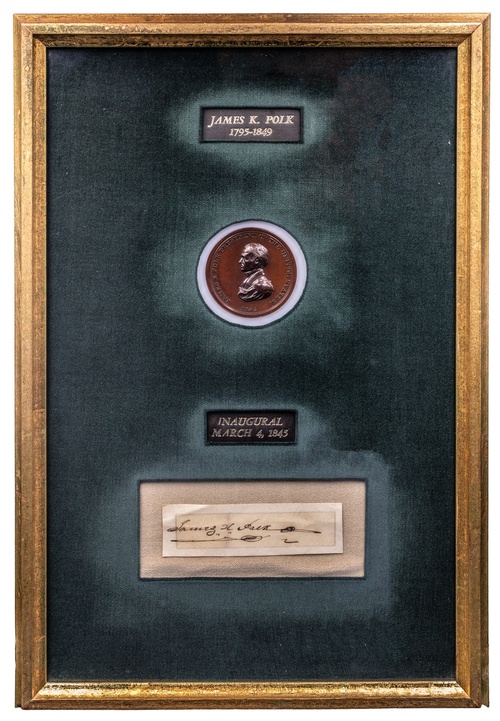
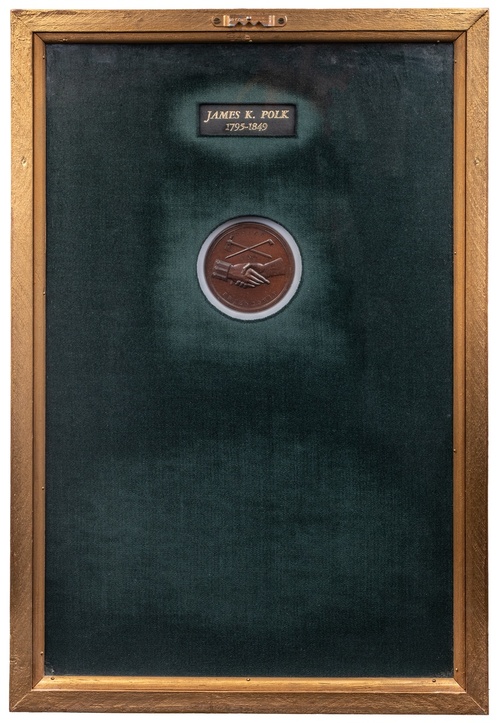
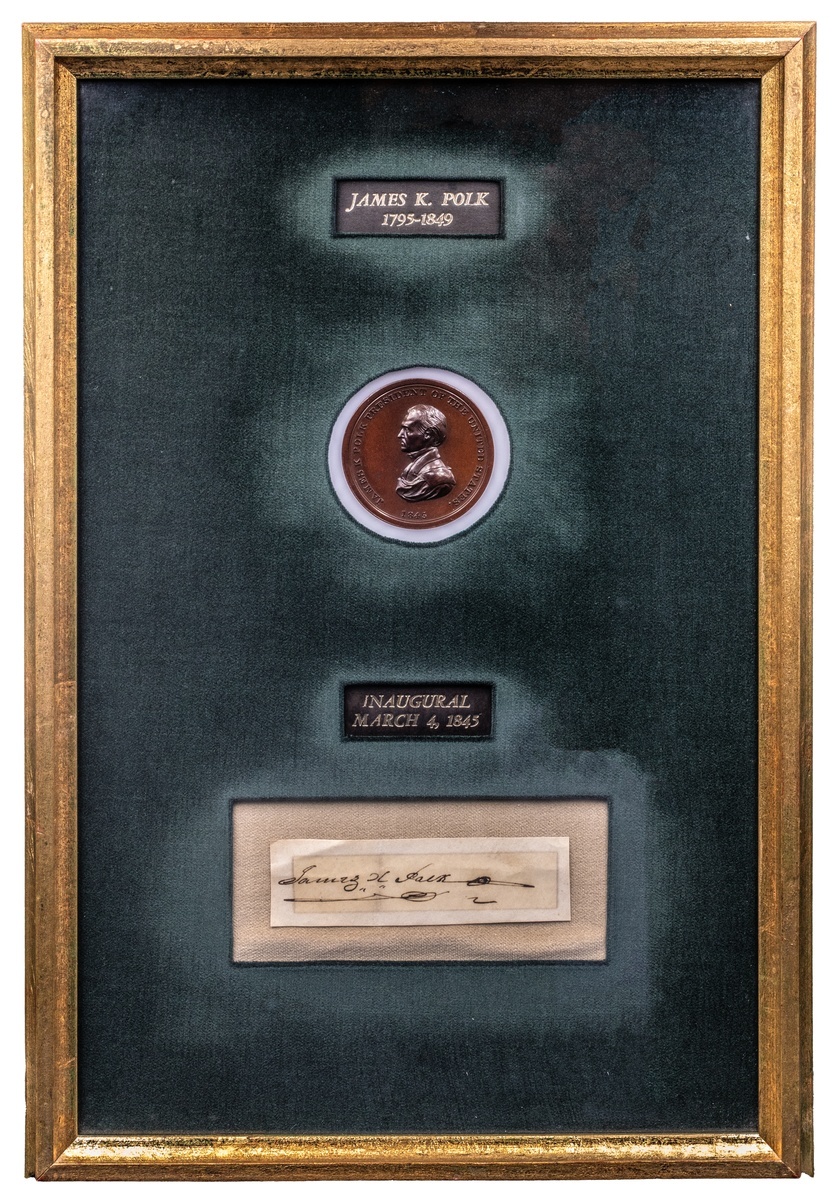
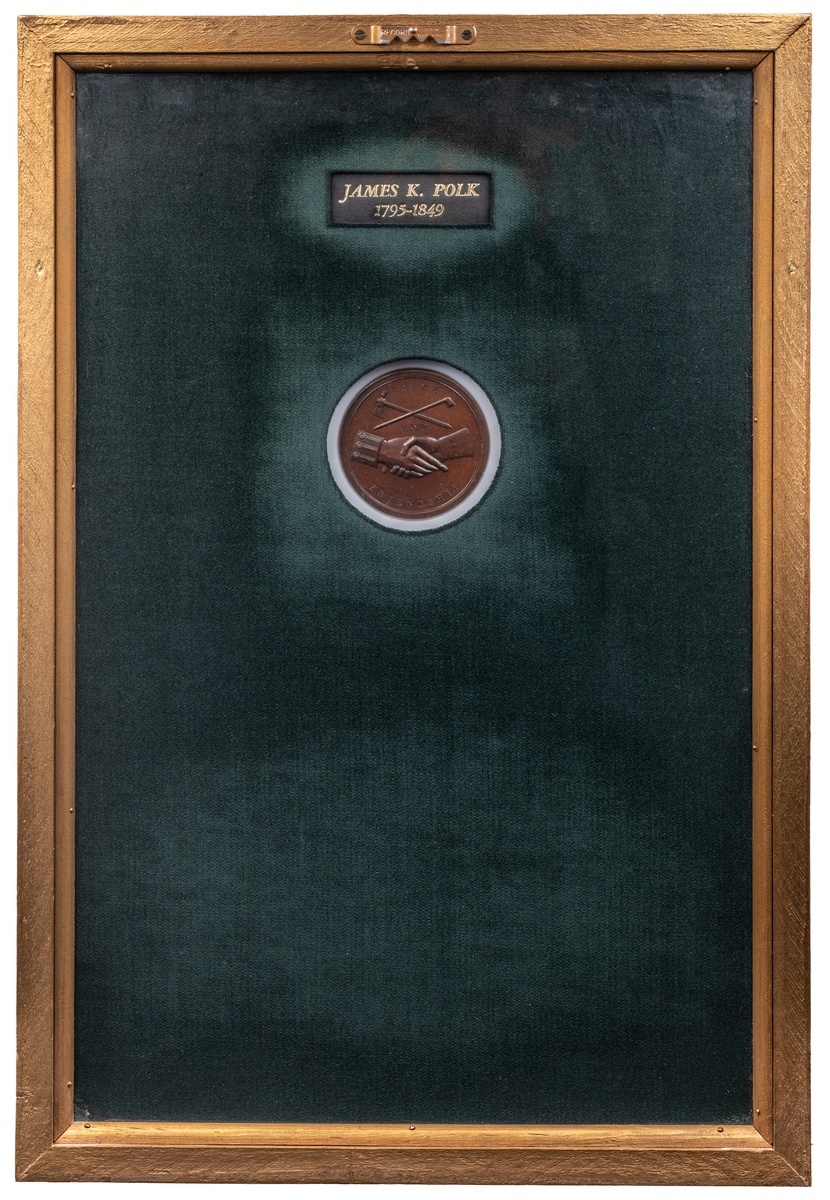
(x) Commanders-in-Chief, JAMES K. POLK, 11th President of the United States (March 4, 1845 - March 4, 1849), Indian Peace, AE Restrike Medal, dated 1845, by John Gadsby Chapman, JAMES K POLK PRESIDENT OF THE UNITED STATES., draped bust left, rev. PEACE AND FRIENDSHIP, between clasped hands, c.51mm, pleasing brown surfaces, extremely fine; with, cut signature "James K Polk", mounted in frame, 267mm x 395mm
Not inspected outside of the frame. Sold as is.
Provenance
Presented to His Royal Highness Prince Bandar bin Sultan Al Saud, Saudi Arabian Ambassador to the United States (1983-2005), by James Addison Baker III, 67th Secretary of the Treasury and 10th White House Chief of Staff to President Ronald Reagan.
James Addison Baker III also served as 16th White House Chief of Staff and 61st Secretary of State to President George H. W. Bush.
Born in Mecklenburg County, North Carolina, and raised on the family's move to Tennessee's Duck River valley, Polk was a sickly child whose life very nearly turned on a single ordeal: at seventeen, suffering from urinary stones, he underwent an operation without anesthesia at the hands of a frontier doctor, a procedure some historians believe left him sterile, since he and his wife had no children.
He recovered to earn a degree from the University of North Carolina, read law, and was admitted to the Tennessee bar in 1820, entering politics almost immediately as a protégé of Andrew Jackson, whose fierce discipline and combativeness Polk absorbed so thoroughly that he was known for the rest of his career as "Young Hickory."
In 1824 he married Sarah Childress, a woman of unusual education for her time and place, who became his closest political adviser and, during his presidency, effectively his chief of staff, reviewing his correspondence and, by her own strict Presbyterian conviction, banning dancing and card playing from the White House.
He served seven terms in the U.S. House starting in 1825, rising to chair the Ways and Means Committee and then to the Speakership itself in 1835, becoming Jackson's most reliable lieutenant in the long fight over the Bank of the United States. He left Congress to win the Tennessee governorship in 1839, then lost it twice in a row, and arrived at the 1844 Democratic convention with his career seemingly behind him.
The convention itself was deadlocked between Martin Van Buren, who opposed annexing Texas, and several rivals, and on the ninth ballot delegates turned to Polk as a compromise nobody had seriously considered a week earlier, the first true dark horse nominee in American presidential history.
Running on unapologetic territorial expansion, he narrowly defeated the Whig standard bearer Henry Clay that November. Polk took office with a short, explicit list of goals, reportedly dictated to his Treasury Secretary and future biographer George Bancroft on his first night as president: lower the tariff, restore an independent federal treasury outside private banks, settle the Oregon boundary, and acquire California from Mexico.
He achieved all four within a single term, a rate of accomplishment matched by very few presidents before or since. The Walker Tariff (1846) cut duties substantially; the Independent Treasury Act, repealed under the Whigs, was reinstated that same year; and the Oregon Treaty fixed the border with British Canada at the forty-ninth parallel, a compromise that quietly abandoned the expansionist slogan "Fifty-four forty or fight" his own supporters had campaigned on.
The fourth goal came at far greater cost. Polk moved troops into disputed territory along the Rio Grande, and when a skirmish followed, he asked Congress for a declaration of war on the grounds that Mexico had shed American blood on American soil, a justification a young Whig Congressman named Abraham Lincoln would later challenge point by point, demanding Polk identify the exact spot. The Mexican-American War that followed ended in 1848 with the Treaty of Guadalupe Hidalgo, by which Mexico ceded California, Nevada, Utah, and most of Arizona and New Mexico for $15 million, territory that, added to Texas annexation and the Oregon settlement, expanded the United States by roughly a third within a single presidential term, an achievement historians rank alongside the Louisiana Purchase for its sheer scale, and one many contemporaries, and Polk's own general Ulysses Grant in later memoirs, regarded as a war of aggression dressed up as self-defense.
The territory's arrival also reopened the question the country least wanted to face: whether slavery would follow the flag westward, a debate crystallized by the Wilmot Proviso, which Polk opposed and which failed in the Senate but set the terms of the sectional argument that would consume the 1850s.
He had promised at his nomination to serve a single term, and he kept that promise, one of the very few Presidents to leave voluntarily at the height of his power. The work had cost him visibly: he left office in March 1849 exhausted and aged beyond his fifty-three years, having rarely left Washington for four years running. He returned to Tennessee, fell ill on the journey home, and died at Nashville that June, just over three months after leaving the Presidency, the shortest retirement of any President in American history.
Sarah outlived him by more than four decades, preserving their home, Polk Place, as a kind of shrine and refusing ever to remarry. He is remembered, somewhat awkwardly, as one of the most effective one-term presidents the country has had and one of the more consequential causes of the war that followed a decade after his death.
Subject to 5% tax on Hammer Price in addition to 20% VAT on Buyer’s Premium.
Estimate
$300 to $500
Starting price
$210

Watch, listen and bid as if you were in the room. Now available for auctions worldwide.
Click here to bid live
An exclusive and confidential service for the discerning collector or vendor.
View the Gallery
Download every Spink catalogue on your iPad, iPod or iPhone using free Spink app.
Download From iTunes© 2026 Spink & Son. All rights reserved.