
Auction: 26776 - America 250th Anniversary Sale Ft. Coins, Medals, Banknotes, Objets de Vertu & Ephemera
Lot: 69
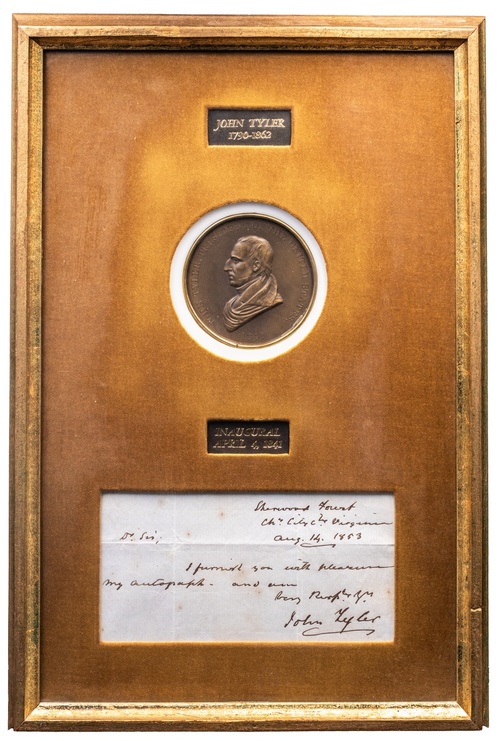
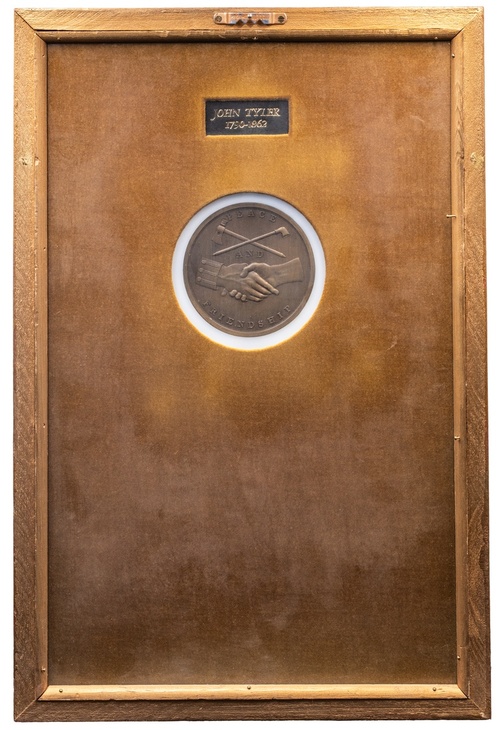
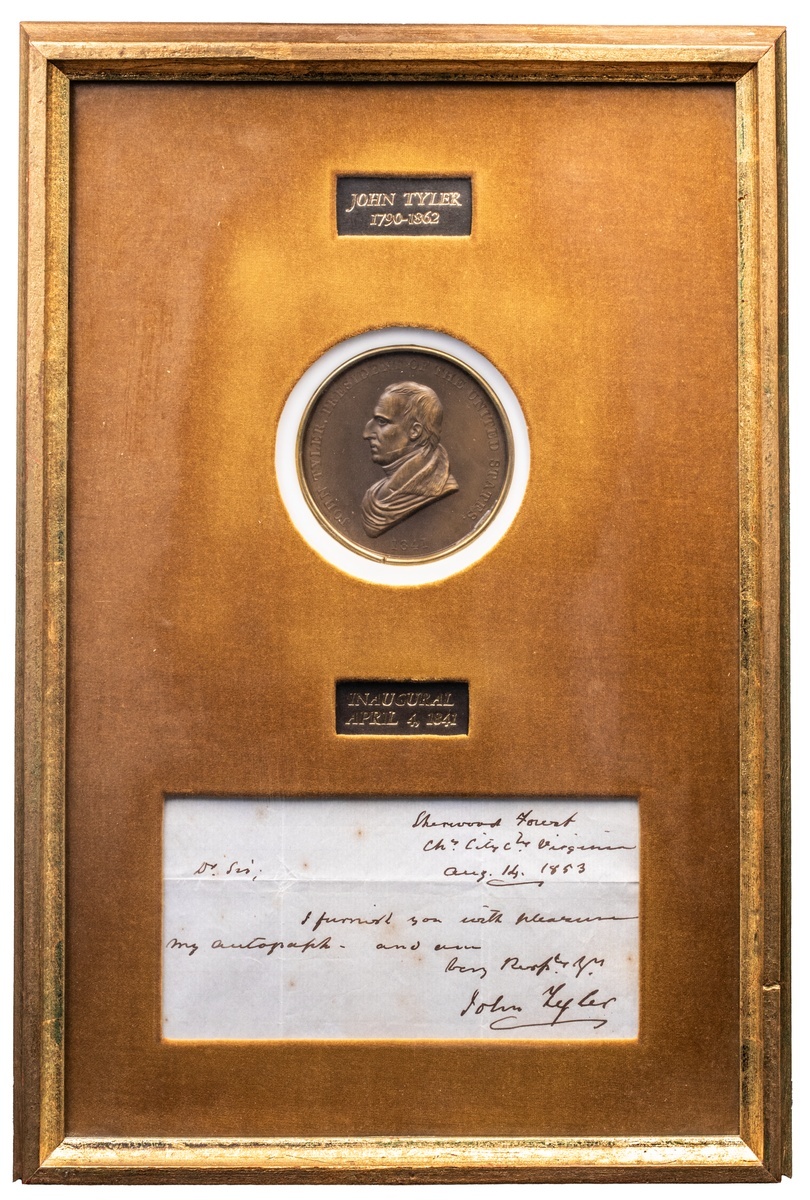
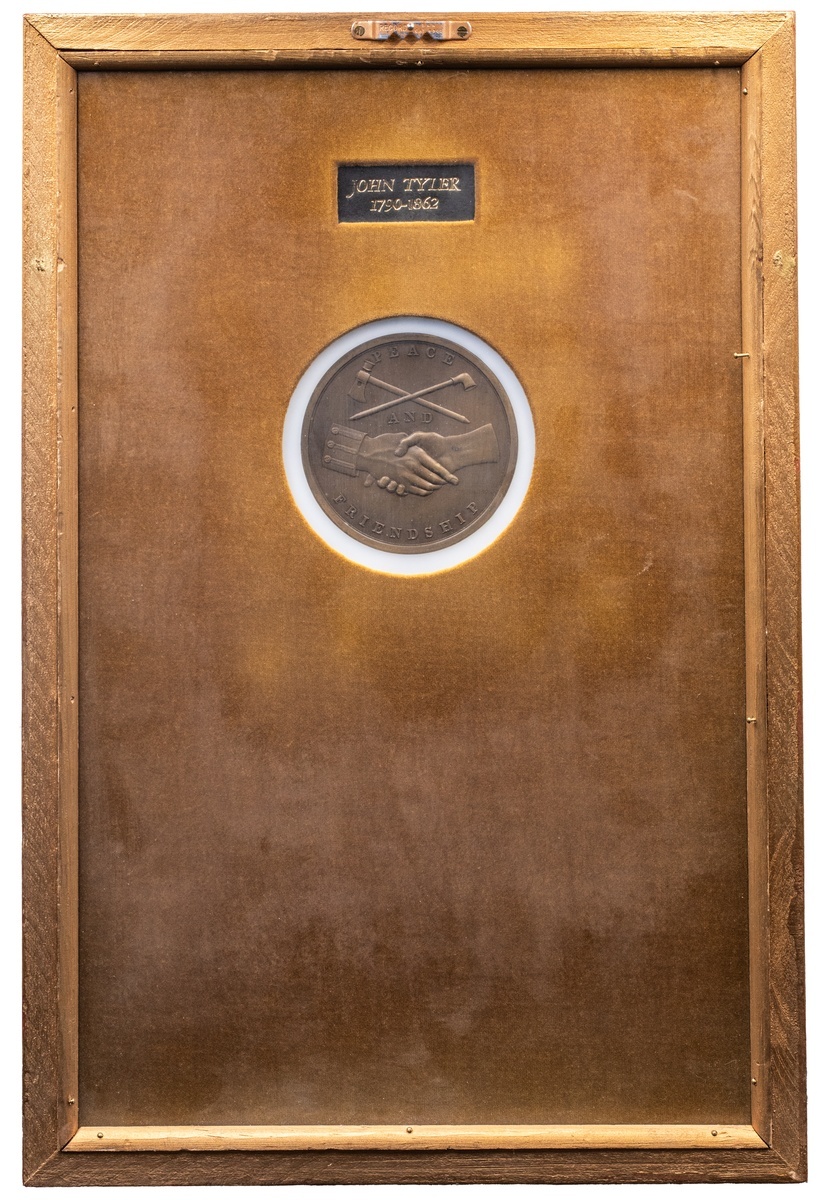
(x) Commanders-in-Chief, JOHN TYLER, 10th President of the United States (April 4, 1841 - March 4, 1845), Indian Peace, AE Restrike Medal, dated 1841, by Ferdinand Pettrich and John Reich, JOHN TYLER PRESIDENT OF THE UNITED STATES, draped bust left, 1841 below, rev. PEACE | AND | FRIENDSHIP, clasped hands, 75mm, ring mounted, otherwise much as issued; with, his signature "John Tyler" on signed letter, dated August 14, 1853, written from his home Sherwood Forest, Charles City County, Virginia, mounted in frame, 267mm x 395mm
Not inspected outside of the frame. Sold as is.
Provenance
Presented to His Royal Highness Prince Bandar bin Sultan Al Saud, Saudi Arabian Ambassador to the United States (1983-2005), by James Addison Baker III, 67th Secretary of the Treasury and 10th White House Chief of Staff to President Ronald Reagan.
James Addison Baker III also served as 16th White House Chief of Staff and 61st Secretary of State to President George H. W. Bush.
Born at Greenway plantation in Charles City County, Virginia, not far from the Harrison family seat at Berkeley, to a Virginia Governor and judge who had roomed with Thomas Jefferson at William and Mary, Tyler followed the same well-worn Tidewater path into law, the state legislature, the U.S. House, the Governorship, and finally the Senate, all as a Jacksonian Democrat of an unusually rigid strict-constructionist bent.
That rigidity eventually turned him against Jackson himself: opposed on Constitutional grounds to the Force Bill during the Nullification Crisis even though he also rejected nullification outright, Tyler resigned his Senate seat in 1836 rather than obey Virginia's legislature and vote to expunge a Senate censure of Jackson from the record, a matter of pure principle that cost him his office and pushed him toward the Whigs, a party whose economic nationalism he never actually shared.
The Whigs added him to William Henry Harrison's 1840 ticket purely for regional balance, hoping a Virginia states-rights man might pull disaffected Southern Democrats away from Van Buren, a marriage of convenience that would prove almost immediately unworkable once circumstance made Tyler President in his own right.
Harrison's death barely a month into office, handed the country its first succession crisis, and Tyler resolved the ambiguity by simply behaving as though none existed, taking the full title, salary, and authority of the Presidency rather than accepting the lesser status of "Acting President" that many in Congress assumed was all a Vice President could inherit.
Critics mocked him as "His Accidency," but the precedent held by unbroken custom for over a century before the Twenty-Fifth Amendment finally wrote it into law. It did nothing, however, to smooth his relationship with the party that had elected him: when he vetoed Henry Clay's bills to revive a national bank, not once but twice, his entire cabinet resigned in protest within days except for Secretary of State Daniel Webster, who stayed on only long enough to finish a treaty, and the Whigs formally expelled their own president from the party, leaving Tyler to govern the rest of his term with a cabinet of conservative Democrats and almost no party of his own at all.
He still managed real achievements from that isolation, most notably the Webster-Ashburton Treaty settling the long-disputed Maine-Canada border in 1842, and, in his final days in office, the annexation of Texas, pushed through by a simple joint resolution of Congress after a formal treaty had failed to win the two-thirds Senate vote it needed, the single accomplishment Tyler seems to have cared about proving as his legacy more than anything else in the term.
His domestic life carried its own firsts and its own considerable scale. His first wife, Letitia Christian, died in the White House in 1842, the first Presidential spouse to do so, and two years later Tyler became the first sitting President to marry in office, taking as his second wife Julia Gardiner, a New York socialite thirty years his junior, in a private New York ceremony.
Between both marriages he fathered fifteen children, the most of any American President, the last of them born when Tyler himself was seventy, and the age gaps compounded strangely down the generations: one of those children, Lyon Gardiner Tyler, was himself in his seventies when his own sons were born in the 1920s, which meant that a grandson of a President inaugurated in 1841 was, remarkably, still alive in the twenty-first century. That last living grandson, Harrison Ruffin Tyler, a chemical engineer who spent much of his life restoring the family's Sherwood Forest estate, died only in May 2025, closing a direct, three-generation chain of memory that had somehow stretched, unbroken, across two hundred and thirty-five years of American history.
His final political act was his darkest. As secession loomed in early 1861, Tyler chaired a peace conference in Washington aimed at averting war, and when that failed, he chose the Confederacy outright, winning election to its House of Representatives, the only former American President ever to hold office in a Government at war with the United States.
He died in January 1862, in Richmond, before he could take his seat, and the Federal Government of the day, treating a man it now regarded as a traitor, issued no official acknowledgment of the former President's death at all, a silence with no real precedent before or since.
Subject to 5% tax on Hammer Price in addition to 20% VAT on Buyer’s Premium.
Estimate
$400 to $500
Starting price
$280
Watch, listen and bid as if you were in the room. Now available for auctions worldwide.
Click here to bid live
An exclusive and confidential service for the discerning collector or vendor.
View the Gallery
Download every Spink catalogue on your iPad, iPod or iPhone using free Spink app.
Download From iTunes© 2026 Spink & Son. All rights reserved.