
Auction: 26776 - America 250th Anniversary Sale Ft. Coins, Medals, Banknotes, Objets de Vertu & Ephemera
Lot: 68
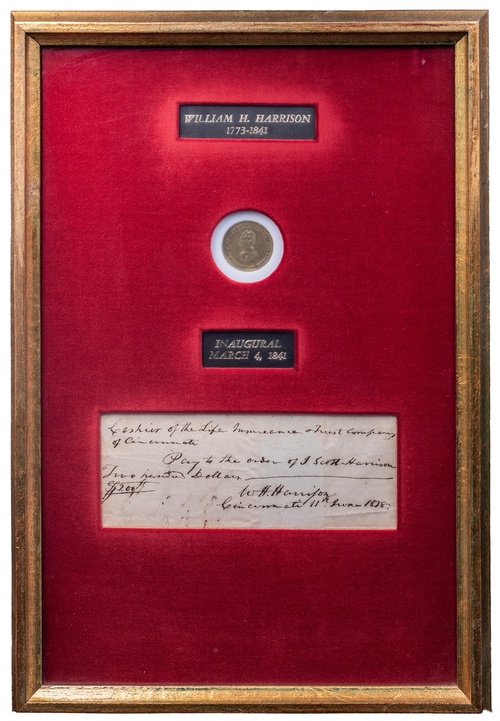
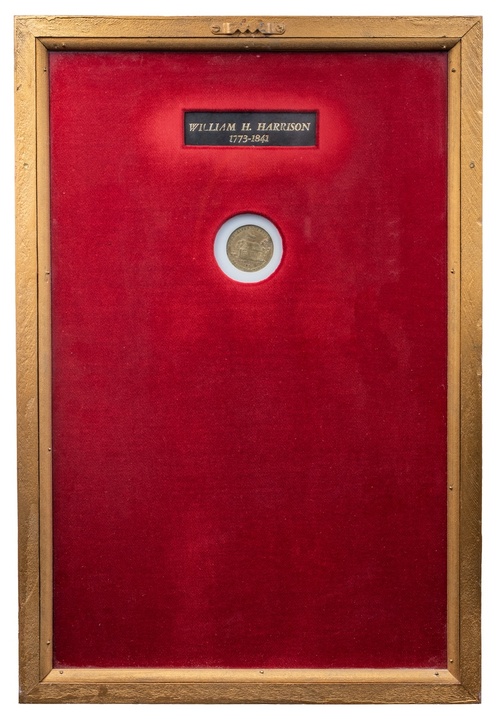
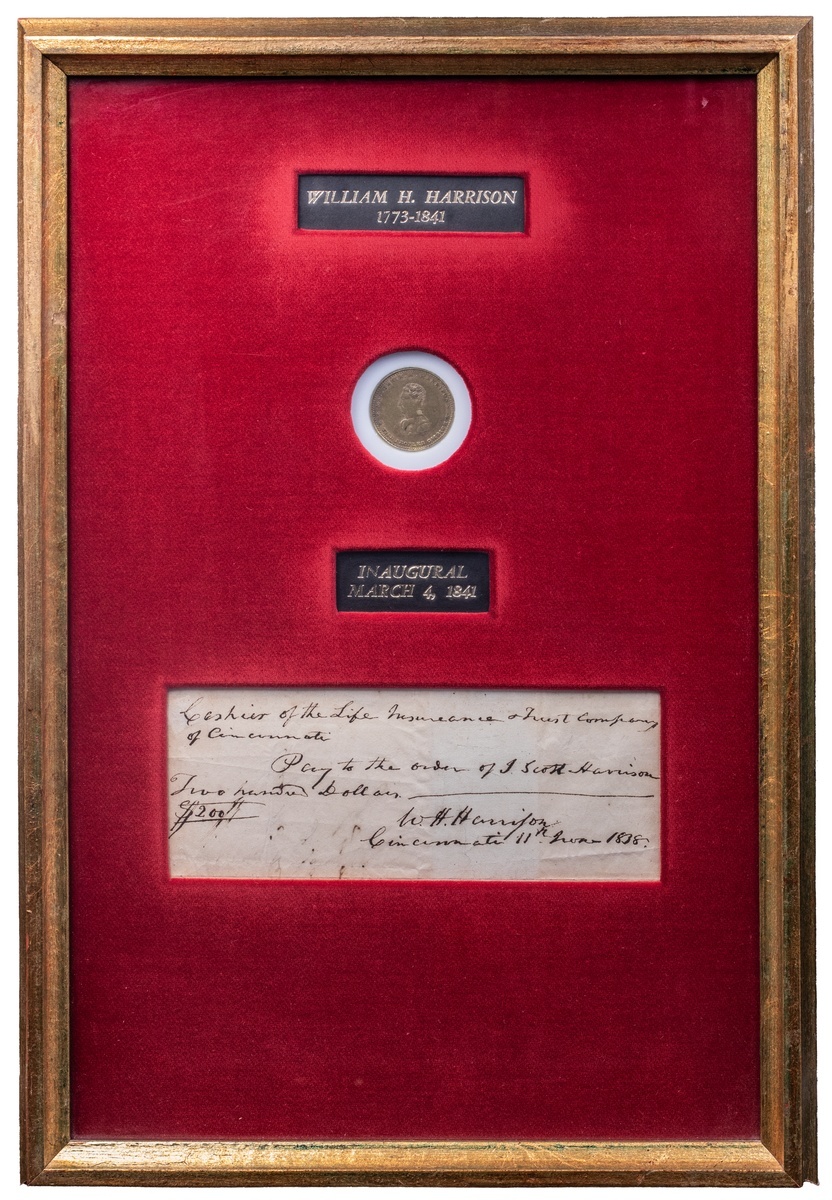
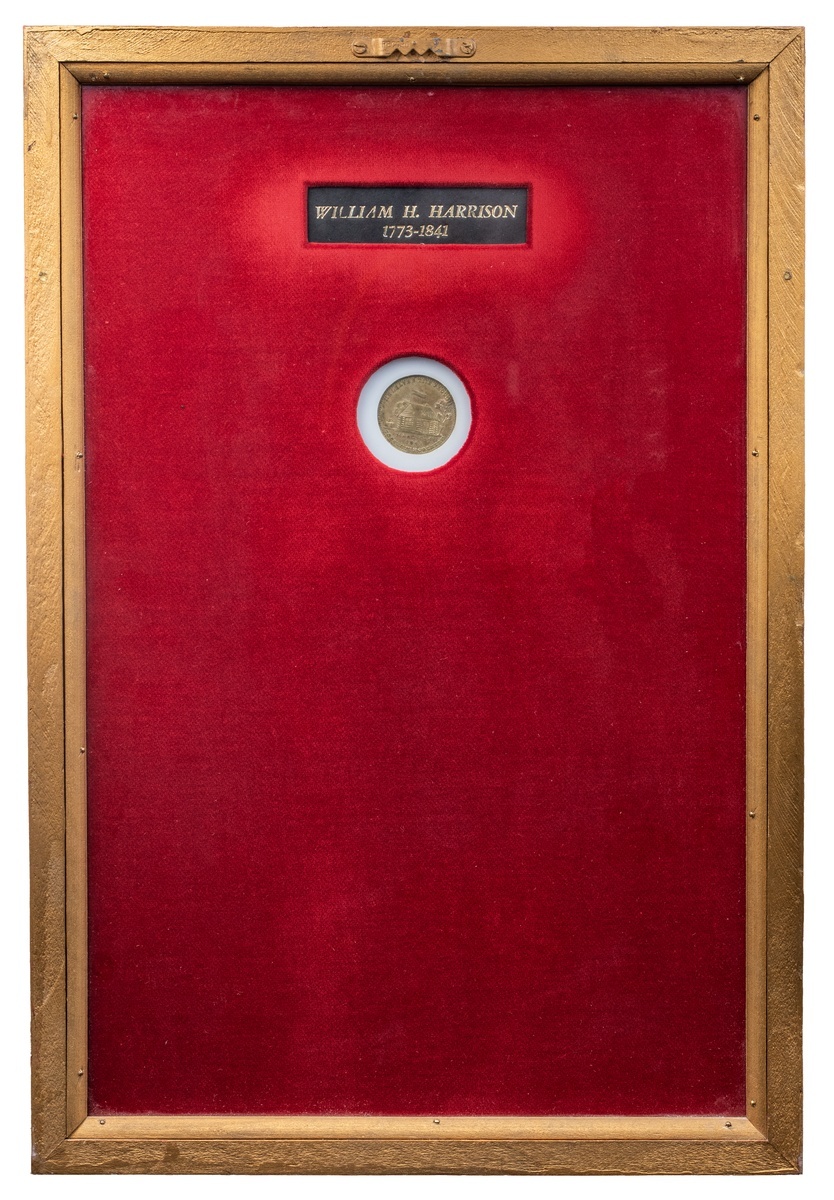
(x) Commanders-in-Chief, WILLIAM HENRY HARRISON, 9th President of the United States (March 4, 1841 - April 4, 1841), Election Campaign, Brass Token, 1841, unsigned, MAJ. GEN. W. H. HARRISON | THE PEOPLES CHOICE, uniformed bust left, rev. HE LEAVES HIS PLOUGH | TO SAVE HIS COUNTRY | MARCH 4 | 1841, view of farmstead, c.25mm (WHH 1840-23), with some lustre, good very fine, with, his signature "W. H. Harrison" on handwritten cheque, dated 11 November 1838, Cincinnati, sum of $200, issued to his son John Scott Harrison, mounted in frame, 267mm x 395mm
Not inspected outside of the frame. Sold as is.
Provenance
Presented to His Royal Highness Prince Bandar bin Sultan Al Saud, Saudi Arabian Ambassador to the United States (1983-2005), by James Addison Baker III, 67th Secretary of the Treasury and 10th White House Chief of Staff to President Ronald Reagan.
James Addison Baker III also served as 16th White House Chief of Staff and 61st Secretary of State to President George H. W. Bush.
The Ohio Life Insurance and Trust Company was a banking institution based in Cincinnati, Ohio, which existed from 1830 to 1857. It collapsed in 1857 after the closure of the company's New York City branch due to bad investments largely in agricultural-related business as well as fraudulent management by staff.
Born at Berkeley Plantation on the James River, the son of a Virginia Governor and a signatory of the Declaration of Independence, Harrison began adult life about as far from a log cabin as the Virginia planter class allowed, studying medicine at Hampden-Sydney and then under the eminent Dr. Benjamin Rush in Philadelphia before his father's death redirected him toward the Army in 1791.
He served under General "Mad Anthony" Wayne at the Battle of Fallen Timbers in 1794, which broke Native resistance in the Northwest Territory and led to the Treaty of Greenville, and rose from there to become the territory's Secretary, its Congressional delegate, and in 1801 the first Governor of the newly created Indiana Territory, a post he held for over a decade from his own built estate at Vincennes, Grouseland. As Governor he negotiated a long series of land cession treaties, the Treaty of Fort Wayne among them, that pushed enormous tracts of Native land into American hands through methods historians now judge considerably more coercive than the era's own accounts admitted. That expansion provoked the resistance of Tecumseh's Confederacy, and in 1811, with Tecumseh away recruiting allies, Harrison led an inconclusive but politically useful attack on the movement's base at Prophetstown, a fight remembered ever after as the Battle of Tippecanoe.
He commanded the Army of the Northwest in the War of 1812 and won more decisively at the Battle of the Thames in 1813, where Tecumseh himself was killed, cementing the military reputation his later political career would run on almost entirely.
After the war he cycled through the U.S. House, the Ohio Senate, the U.S. Senate, and a brief, unhappy stint as Minister to Colombia before the Whigs, having lost to Van Buren in 1836 by splitting their support across several regional candidates, united behind him in 1840 as their single, electable option. The campaign that followed, run under the ticket slogan "Tippecanoe and Tyler Too", became one of the more calculatedly cynical spectacles in American political history: Harrison, in fact born to Virginia aristocracy, was marketed to voters as a humble frontiersman content with a log cabin and a jug of hard cider, an inversion of Van Buren's actual tavern-keeper origins that the Whigs found far more useful as fiction than the Democrats had found the truth.
It worked. Harrison won in a landslide, and at sixty-eight became, at the time, the oldest man ever elected President, a record that stood until Reagan broke it a century and a half later.
He is remembered now for the manner of his leaving almost more than for anything he did in office, which was very little: he delivered the longest inaugural address in American history, some two hours in cold, wet weather, reportedly bareheaded and without an overcoat in an effort to project a vigour his age had called into question, and died a month later, on April 4, 1841, the shortest presidential term in the country's history and the first death of a sitting President, a constitutional gap that his Vice President John Tyler filled by simply asserting the full title and authority of the office himself, a precedent that held by custom for well over a century before the Twenty-Fifth Amendment finally wrote it into law.
The long-accepted story, that the chill caught giving that speech killed him, has not held up well under modern scrutiny: a 2014 re-examination of his physician's own case notes, published in the journal of Clinical Infectious Diseases, found that Harrison's symptoms did not appear until three weeks after the inauguration, far too late for a respiratory infection caught that day, and argued instead for enteric fever contracted from Washington's contaminated water supply, since the city's sewage in that era drained into a marsh just a few blocks upstream of the White House's own source.
The same researchers noted, rather grimly, that both James Polk and Zachary Taylor suffered comparable gastrointestinal illness while living in the same house within the following decade, Polk surviving his and Taylor, in 1850, dying of what was very possibly the identical cause.
He left behind, from his marriage to Anna Tuthill Symmes, ten children and, two generations later, a grandson, Benjamin Harrison, who would occupy the same office himself, the only grandfather and grandson to do so in American history.
And Grouseland, the Governor's mansion he built at Vincennes long before either Presidency was imaginable, found its own small afterlife in George H. Lovett's Presidential Residence medal series, struck at the same thirty-six millimeters as the rest of that Civil War-era run, a brick house on the Indiana frontier immortalized in bronze and white metal beside the grander estates of men who had actually lived to enjoy their own retirements.
Subject to 5% tax on Hammer Price in addition to 20% VAT on Buyer’s Premium.
Estimate
$260 to $300
Starting price
$180
Watch, listen and bid as if you were in the room. Now available for auctions worldwide.
Click here to bid live
An exclusive and confidential service for the discerning collector or vendor.
View the Gallery
Download every Spink catalogue on your iPad, iPod or iPhone using free Spink app.
Download From iTunes© 2026 Spink & Son. All rights reserved.