
Auction: 26776 - America 250th Anniversary Sale Ft. Coins, Medals, Banknotes, Objets de Vertu & Ephemera
Lot: 67
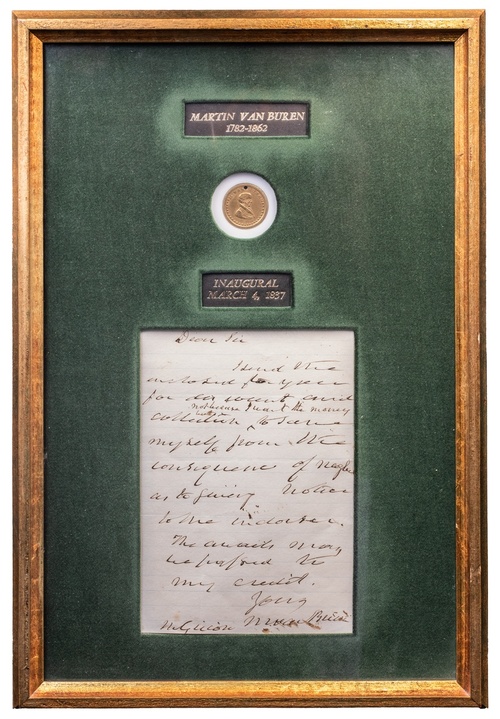
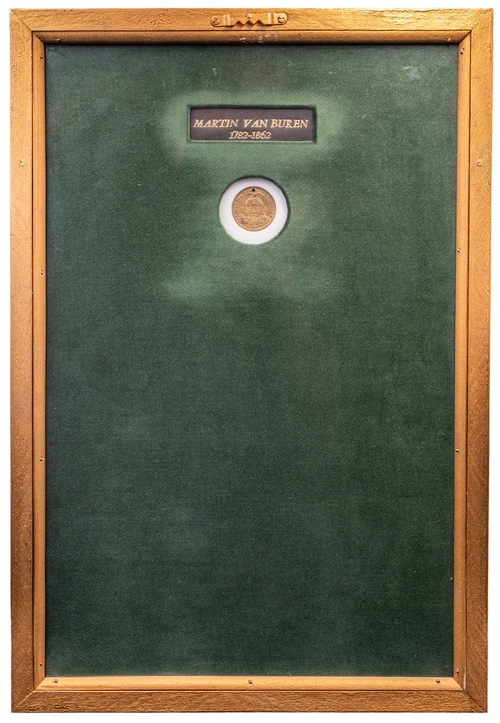
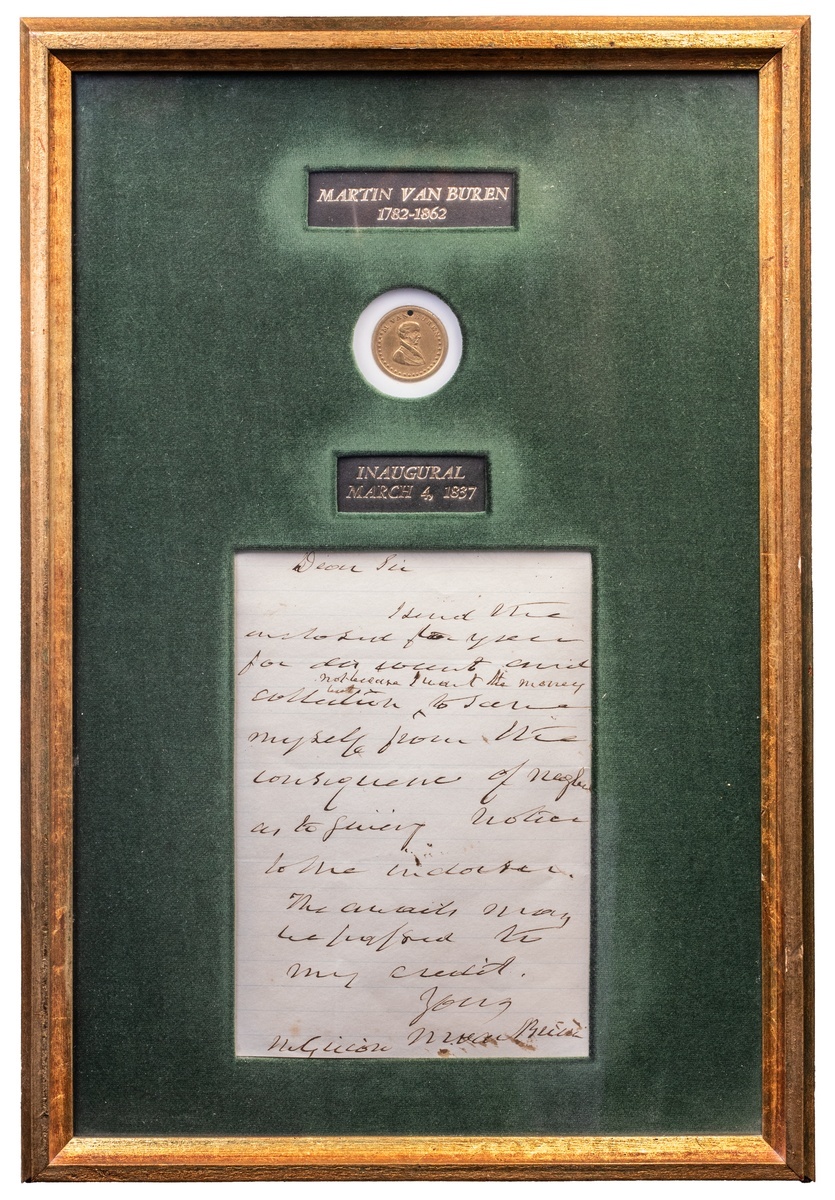
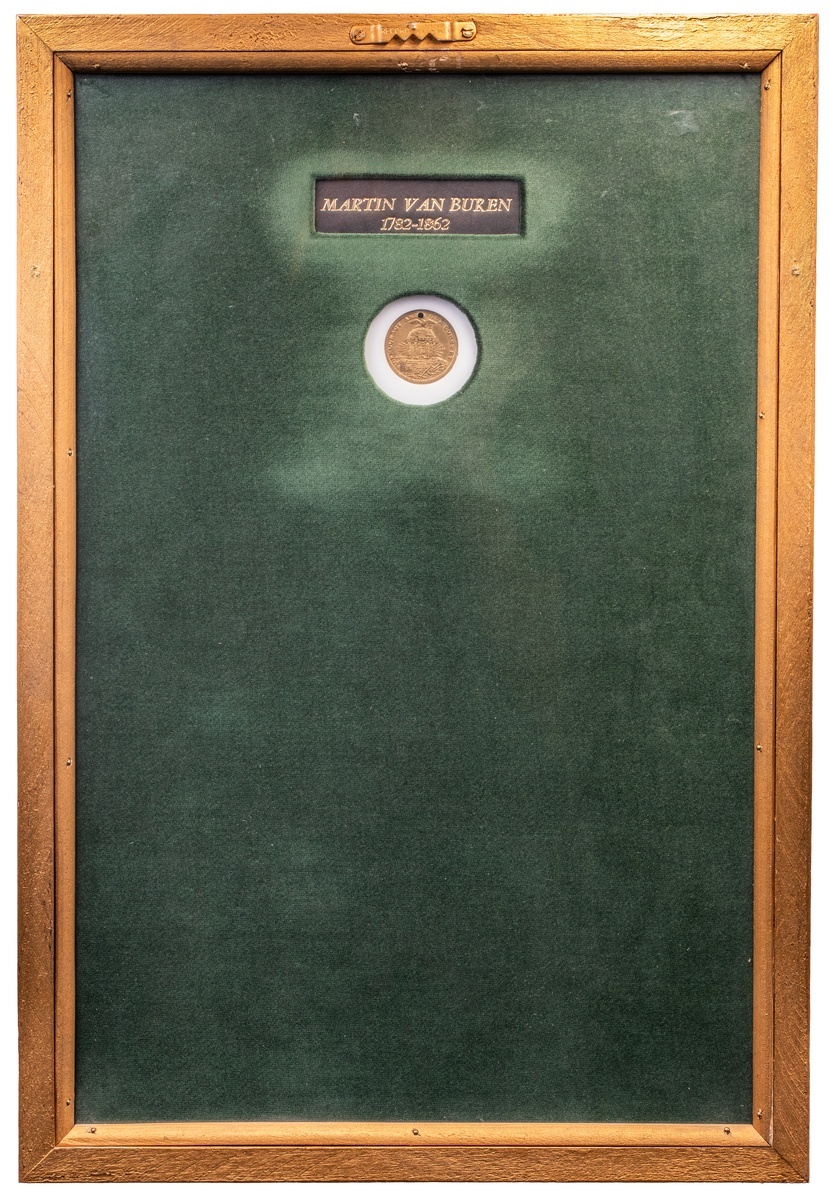
(x) Commanders-in-Chief, MARTIN VAN BUREN, 8th President of the United States (March 4, 1837 - March 4, 1841), Gilt Brass Hard Times Token, 1836, M. VAN BUREN, draped bust right, rev. DEMOCRACY AND OUR COUNTRY, Temple of Liberty, 26mm (DeWitt MVB 1836-4; HT-78, R-4), pierced as usually encountered, general surface wear, very fine, a noted rarity with perhaps 200 known; with, his signature "M Van Buren" on signed letter, mounted in frame, 267mm x 395mm
Not inspected outside of the frame. Sold as is.
Provenance
Presented to His Royal Highness Prince Bandar bin Sultan Al Saud, Saudi Arabian Ambassador to the United States (1983-2005), by James Addison Baker III, 67th Secretary of the Treasury and 10th White House Chief of Staff to President Ronald Reagan.
James Addison Baker III also served as 16th White House Chief of Staff and 61st Secretary of State to President George H. W. Bush.
Born in the small Dutch-settled village of Kinderhook, New York, to a tavern keeper of modest means, Van Buren grew up speaking Dutch as his first language, the only President in American history who did not learn English as his native tongue, and he remains, by an accident of the calendar, the first President born a United States citizen rather than a British subject, arriving five weeks after the surrender at Yorktown ended the fighting.
Sent to work as a law clerk at fourteen to help the family finances, he was admitted to the bar in 1803 and built, alongside his legal career, one of the most disciplined political organizations of the early republic, the "Albany Regency", a New York machine run on patronage and party loyalty that made Van Buren himself synonymous with a whole style of practical, almost technical politics, earning him the nicknames "the Little Magician" for his tactical skill and "the Red Fox of Kinderhook" for the copper-colored hair and reputed cunning that went with it.
He served in the U.S. Senate through the 1820s, engineered much of Andrew Jackson's 1828 coalition from behind the scenes, and resigned a freshly won governorship of New York after only a few months to become Jackson's Secretary of State, quickly becoming the most trusted member of the "Kitchen Cabinet" and Jackson's chief defender in the social war fought over Peggy Eaton, a fight Van Buren, conveniently a widower with nothing personal at stake in it, helped resolve in Jackson's favour by engineering a full cabinet reshuffle.
His nomination as Minister to Britain was rejected by the Senate in 1831 on a tie-breaking vote cast personally by Vice President John Calhoun, an act of political spite Jackson reportedly predicted would "kill him, sir, kill him dead," since it made Van Buren a sympathetic martyr rather than a diminished one and helped carry him onto Jackson's ticket as vice president the following year.
He won the Presidency in his own right in 1836, riding Jackson's coattails into an office that turned to crisis within weeks of his inauguration: the Panic of 1837, brought on partly by Jackson's own war against the national bank and the hard-money Specie Circular that preceded it, collapsed banks and land speculation across the country and settled over Van Buren's entire term, earning him the derisive nickname "Martin Van Ruin."
His signature response, the Independent Treasury System divorcing Federal funds from private and state banks entirely, was sound in principle and politically costly in practice, since it offered the public no relief from a depression his opponents were happy to blame entirely on him. His administration also inherited, and badly mishandled by the standards of the man who would argue the opposite side a few years later, the case of the Amistad captives, with Van Buren's Justice Department pressing for their return to Spanish custody rather than their freedom, a position the courts ultimately rejected and that former President John Quincy Adams, arguing for the Africans himself, helped defeat before the Supreme Court in 1841.
He lost his 1840 re-election bid to William Harrison in a campaign built almost entirely on inverted biography: Harrison, in fact the son of a wealthy Virginia planter, was marketed by the Whigs as a humble log-cabin frontiersman fond of hard cider, while Van Buren, who had genuinely grown up over his father's tavern, was painted as an aristocratic dandy indifferent to the depression gripping the country, an early and remarkably effective triumph of image over biography in American politics.
One piece of that campaign has outlasted almost everything else about it: Van Buren's supporters, rallying around his old nickname "Old Kinderhook," organized "O.K. Clubs" in 1840, and that abbreviation is one of the strands historians credit, alongside a slightly earlier Boston newspaper joke, with helping fix "OK" permanently into American English.
He sought the Democratic nomination again in 1844 and lost it over his opposition to annexing Texas, then ran a third time in 1848 as the candidate of the anti-slavery Free Soil Party, winning no electoral votes but siphoning enough from the Democratic nominee in New York to hand Zachary Taylor the Presidency, a spoiler's role Van Buren accepted as the price of a position he had come to hold with real conviction.
Widowed since 1819, when his wife Hannah died of tuberculosis years before he reached national office, he never remarried, and in 1839, while still sitting in the White House, he purchased a farm outside Kinderhook that he renamed Lindenwald after the linden trees lining its approach, moving in only after Harrison defeated him in 1841 and running both his later campaigns from its grounds.
He died there in July 1862, having lived long enough to watch the Union he had helped hold together through the Jacksonian years come apart into the war he'd spent his last campaign trying to head off. Lindenwald itself found its way onto the same medal series that carried Montpelier, Oak Hill, and Springfield: George H. Lovett's Presidential Residence issue included Van Buren's estate. However this accompanying medallet here, is an election token for Martin Van Buren when he was Vice President. With Andrew Jackson's support he succeeded in his goal of becoming the 8th Commander in Chief.
Subject to 5% tax on Hammer Price in addition to 20% VAT on Buyer’s Premium.
Estimate
$400 to $600
Starting price
$300

Watch, listen and bid as if you were in the room. Now available for auctions worldwide.
Click here to bid live
An exclusive and confidential service for the discerning collector or vendor.
View the Gallery
Download every Spink catalogue on your iPad, iPod or iPhone using free Spink app.
Download From iTunes© 2026 Spink & Son. All rights reserved.