
Auction: 26776 - America 250th Anniversary Sale Ft. Coins, Medals, Banknotes, Objets de Vertu & Ephemera
Lot: 64
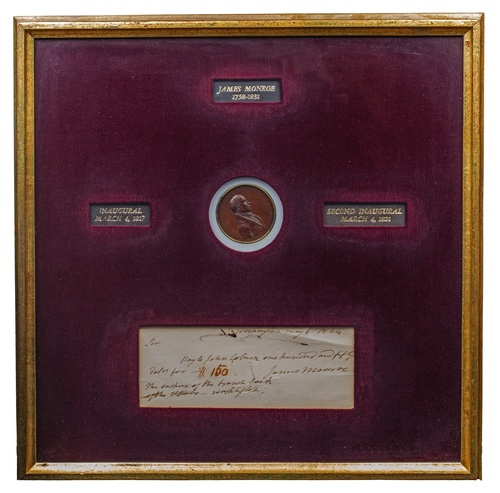
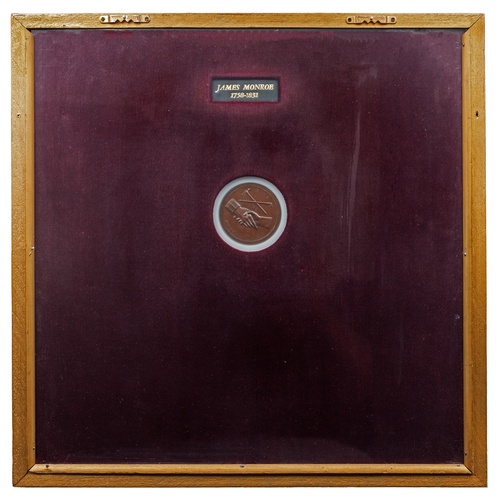
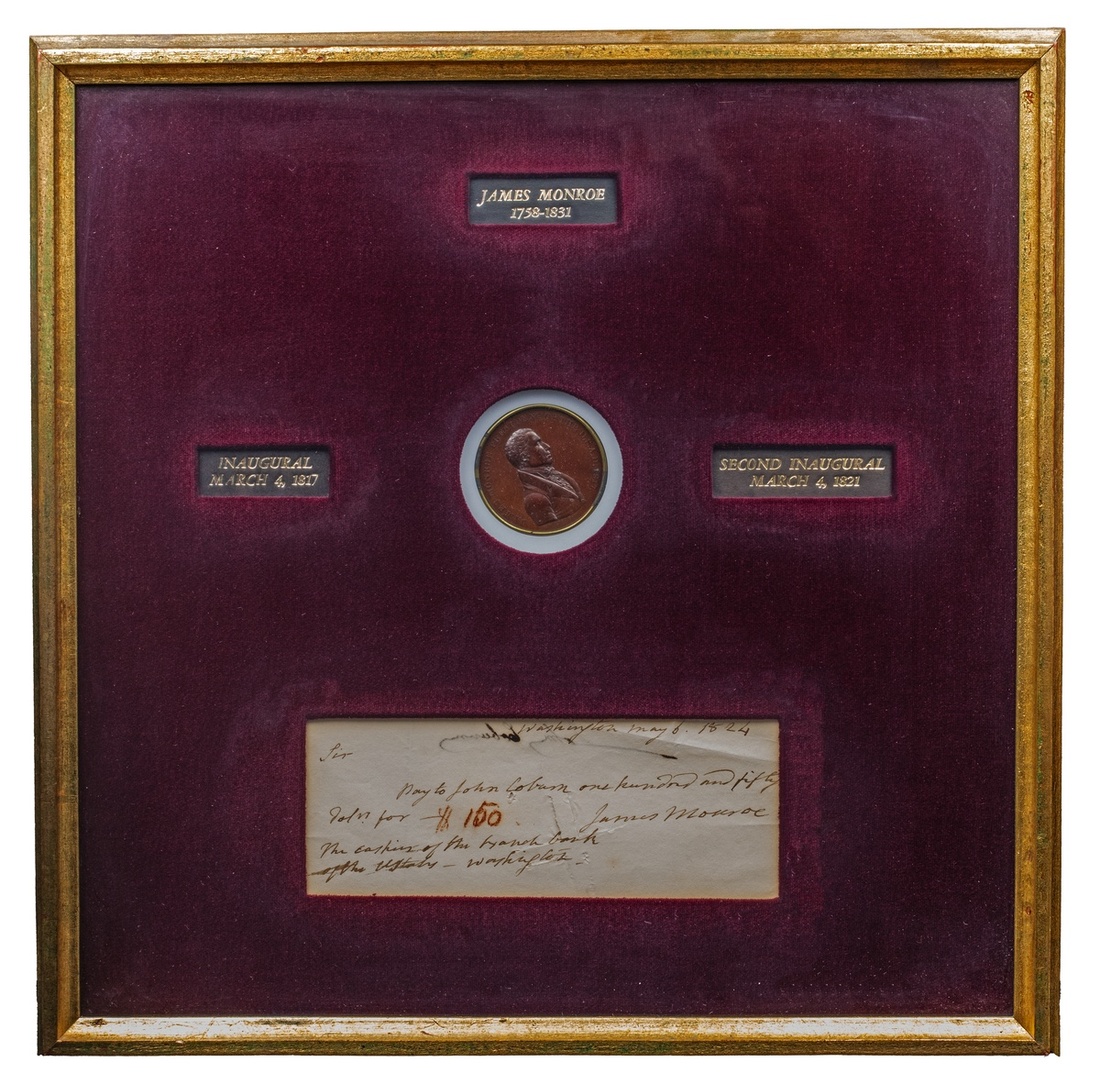
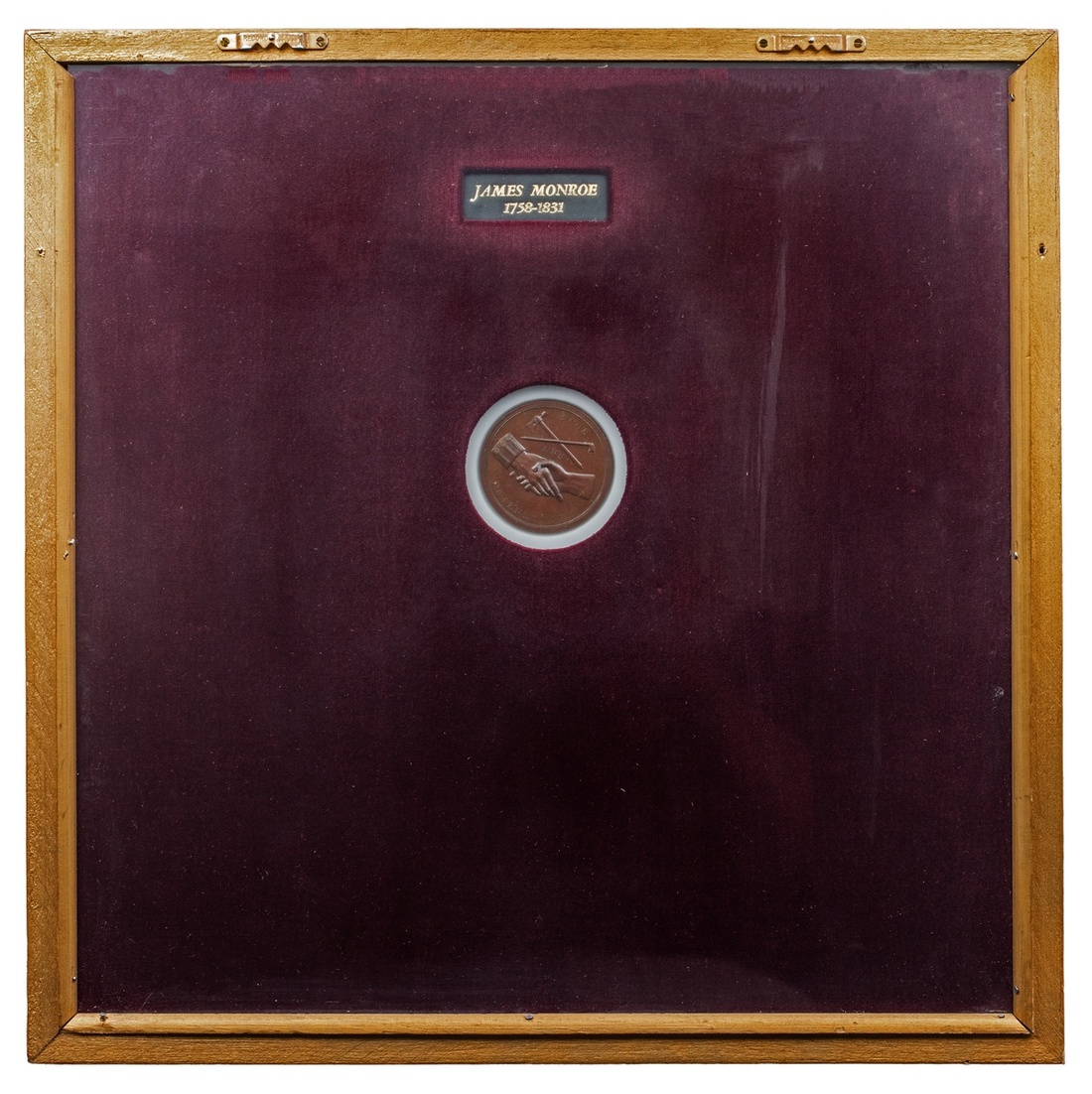
(x) Commanders-in-Chief, JAMES MONROE, 5th President of the United States (March 4, 1817 - March 4, 1825), Indian Peace, AE Restrike Medal, dated 1817, by M. Furst, JAMES MONROE PRESIDENT OF THE U.S.A. D. 1817, draped bust right, rev. PEACE | AND | FRIENDSHIP, clasped hands, c. 51mm, couple of deposits, otherwise pleasing red-brown surfaces, much as issued; with, his signature "James Monroe" on handwritten cheque, dated May 6, 1824, issued to John Coburn, sum of $150, mounted in frame, 395mm x 395mm
Not inspected outside of the frame. Sold as is.
Provenance
Presented to His Royal Highness Prince Bandar bin Sultan Al Saud, Saudi Arabian Ambassador to the United States (1983-2005), by James Addison Baker III, 67th Secretary of the Treasury and 10th White House Chief of Staff to President Ronald Reagan.
James Addison Baker III also served as 16th White House Chief of Staff and 61st Secretary of State to President George H. W. Bush.
Born in Westmoreland County, Virginia, to a family of modest but respectable planters, Monroe left the College of William and Mary before finishing to join the Continental Army at eighteen, a decision that nearly killed him within the year. At the Battle of Trenton on Christmas night, 1776, he led a small detachment against a Hessian cannon position and took a musket ball through the shoulder, an injury a passing surgeon happened to be on hand to treat, severing an artery that would otherwise have finished him. He carried the ball in his shoulder for the rest of his life.
After the war he read law under Thomas Jefferson, beginning an alliance and, later, friendship that shaped nearly everything that followed, and entered Virginia and then national politics as one of the more committed Anti-Federalists of his generation, worried enough about the Constitution's silence on individual rights that he ran against Madison himself for a House seat in 1789 and lost, an episode the two men managed to set aside for the following four decades of partnership.
His diplomatic career was as consequential as it was occasionally embarrassing. Sent to France as Minister in 1794, he embraced the Revolutionary Government with an enthusiasm that alarmed Washington's cabinet and got him recalled two years later, still convinced he had been right. Jefferson sent him back to Paris in 1803 with instructions to negotiate for New Orleans alone, and Monroe, working with Robert Livingston, found himself instead closing on the entire Louisiana Territory when Napoleon, needing cash and abandoning his American ambitions, offered the whole of it.
He went on to serve as Minister to Britain, where a treaty he negotiated on neutral shipping rights and impressment struck Jefferson as too weak to even submit to the Senate, a rejection that stung Monroe badly enough to nearly end his usefulness to the administration. Under Madison, as Secretary of State and, after the British burned Washington in 1814, simultaneously Secretary of War as well, he became the only person to hold both cabinet posts at once, managing the country's finances and defense in the war's chaotic final year largely by the force of his own energy.
He won the Presidency easily in 1816, and his two terms coincided with what contemporaries themselves called the "Era of Good Feelings", a stretch of single-party calm following the Federalists' effective collapse as a national force. It did not want for substance. The Adams-Onís Treaty of 1819 secured Florida from Spain; the Missouri Compromise of 1820 admitted Missouri as a slave state and Maine as a free one while drawing a line across the remaining Louisiana Territory north of which slavery would be barred, a fix that held the Union together for a generation while settling nothing about the underlying quarrel.
The Panic of 1819, the country's first true financial crash, tested his administration's economic footing without producing any comparable legislative response, since neither Monroe nor Congress yet had the tools or the appetite for one. His most lasting act came in 1823, when, worked out closely with Secretary of State John Quincy Adams, he declared to Congress that the Western Hemisphere was closed to further European colonisation, a policy that took his name and long outlived any power the United States of 1823 actually had to enforce it.
His 1820 reelection came within a single electoral vote of unanimity, and it has long been said, though historians treat the story with some caution, that the lone New Hampshire elector who broke ranks did so deliberately, to preserve Washington's distinction as the only President ever chosen without dissent.
At home, his wife Elizabeth Kortright Monroe, a New York merchant's daughter he had married at seventeen while stationed there during the war, brought a French formality to the White House that some Washington society found chilly next to Dolley Madison's warmth, a stiffness their daughter Eliza compounded by insisting on European court etiquette at official functions.
Monroe himself left the presidency in worse financial shape than he entered it, having spent heavily from his own pocket on diplomatic postings the government reimbursed slowly and incompletely; he spent years afterward petitioning Congress for relief and was eventually forced to sell his beloved Highland plantation, next door to Jefferson's Monticello, to cover his debts.
He retired instead to Oak Hill, a house in Loudoun County he had begun building during his first term, succeeded Madison as rector of the University of Virginia, and after Elizabeth's death in 1830, moved to New York to live out his last months with his daughter. He died there on July 4, 1831, the third President, after Jefferson and Adams five years earlier, to die on the nation's own anniversary, a coincidence that struck contemporaries as more than a little uncanny.
Subject to 5% tax on Hammer Price in addition to 20% VAT on Buyer’s Premium.
Estimate
$500 to $600
Starting price
$320
Watch, listen and bid as if you were in the room. Now available for auctions worldwide.
Click here to bid live
An exclusive and confidential service for the discerning collector or vendor.
View the Gallery
Download every Spink catalogue on your iPad, iPod or iPhone using free Spink app.
Download From iTunes© 2026 Spink & Son. All rights reserved.