
Auction: 26776 - America 250th Anniversary Sale Ft. Coins, Medals, Banknotes, Objets de Vertu & Ephemera
Lot: 63
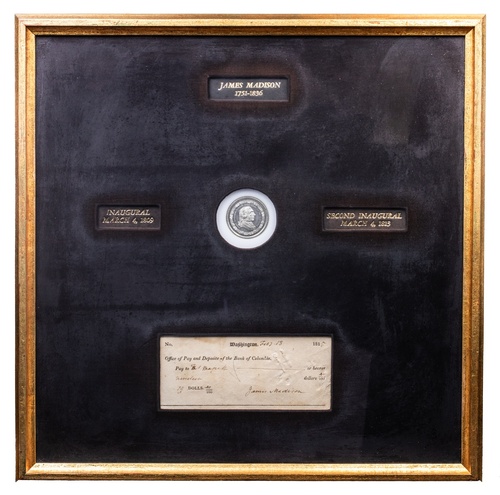
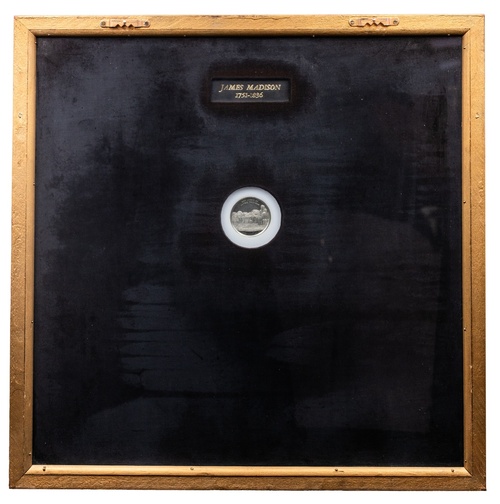
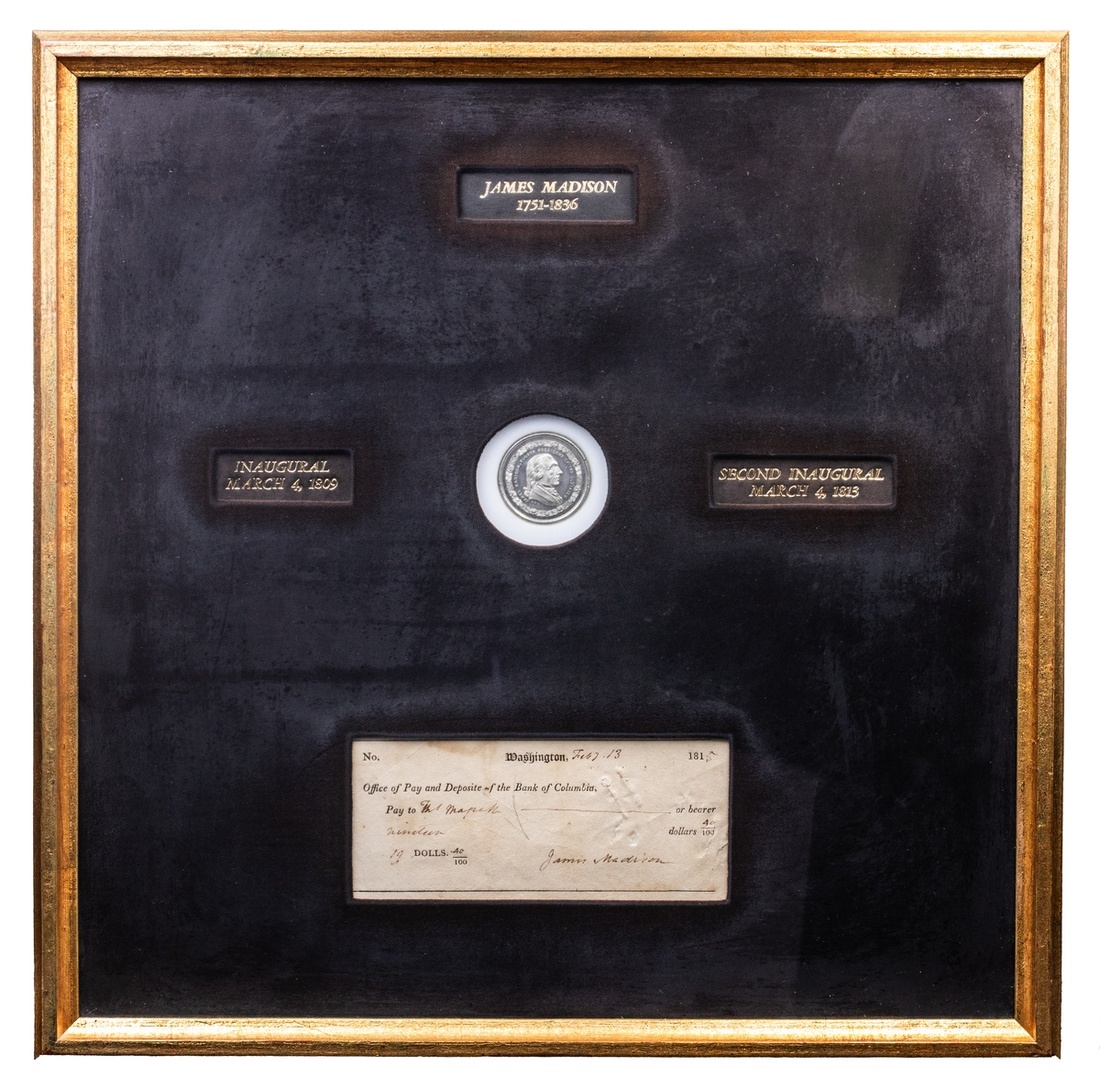
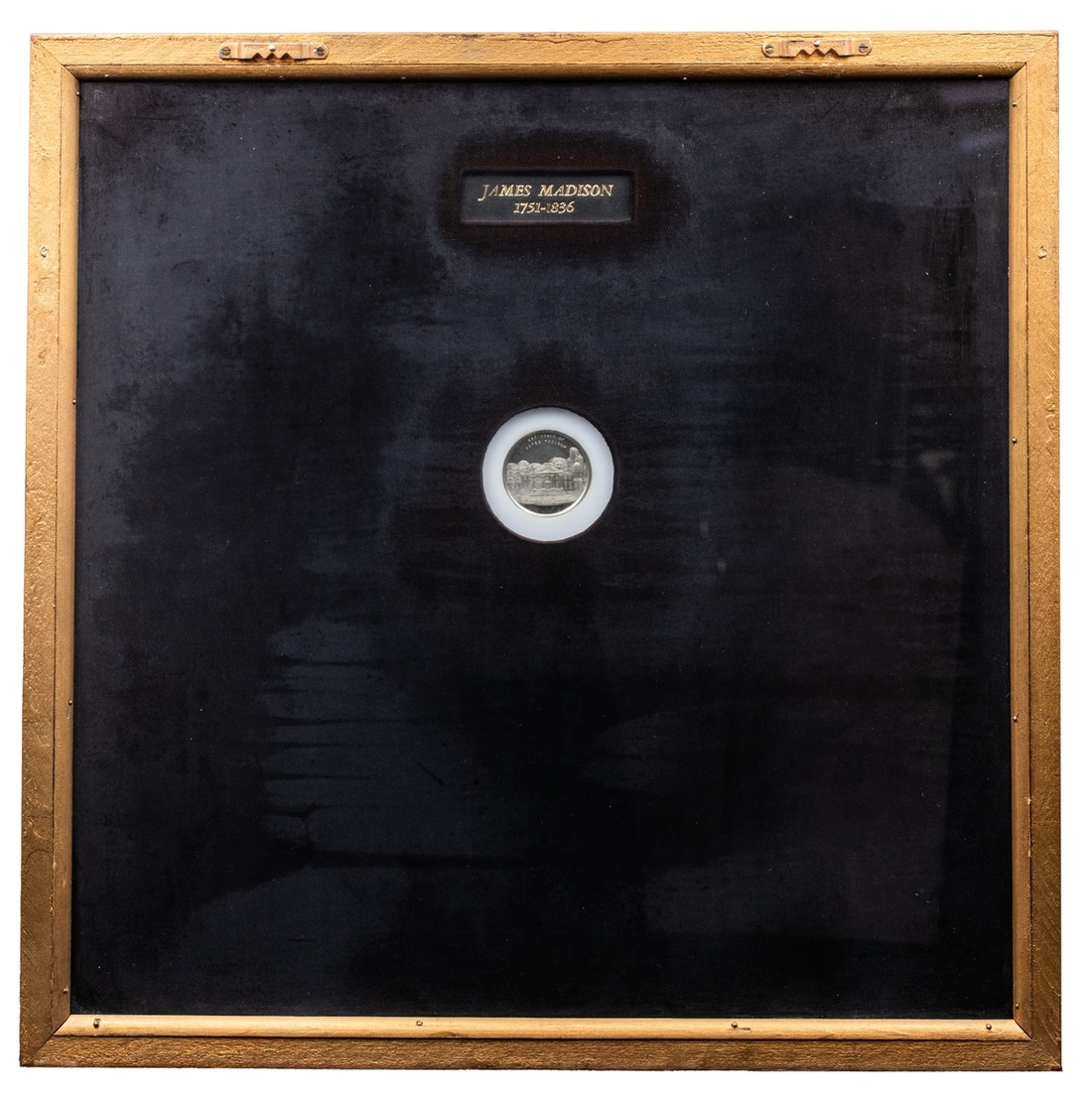
(x) Commanders-in-Chief, JAMES MADISON, 4th President of the United States (March 4, 1809 - March 4, 1817), "Presidential Residences", White Metal Medal, (c. 1861), by George Hampden Lovett (New York City), JAMES MADISON, FOURTH PRESIDENT OF THE U. STATES, draped bust right, within wreath, rev. RESIDENCE OF | JAMES MADISON, façade of the Montpelier Estate, Virginia, 35mm (NMAH NU.245615), pleasing surfaces, extremely fine, one of a series of sixteen produced after Lincoln's inauguration; with, his signature "James Madison" on Office of Pay and Deposite of the Bank of Columbia cheque, dated February 13, 1815, issued to Ths. [Maper], sum of $19.40, mounted in frame, 395mm x 395mm
Not inspected outside of the frame. Sold as is.
Provenance
Presented to His Royal Highness Prince Bandar bin Sultan Al Saud, Saudi Arabian Ambassador to the United States (1983-2005), by James Addison Baker III, 67th Secretary of the Treasury and 10th White House Chief of Staff to President Ronald Reagan.
James Addison Baker III also served as 16th White House Chief of Staff and 61st Secretary of State to President George H. W. Bush.
Small enough that contemporaries measured him against the room rather than the man (standing barely 5 foot 4 inches and rarely more than a hundred pounds), afflicted for most of his life by what he called "sudden attacks, somewhat resembling epilepsy," and temperamentally so reserved that he was nearly inaudible on the floor of debates he was quietly winning, Madison built a public career almost entirely on the strength of preparation.
Born on 16 March, 1751, he was raised at Montpelier, the family plantation in Orange County, Virginia. He studied with such ferocity at Princeton, compressing what should have been a longer course of study into a shorter one, that he graduated in 1771 half ruined in health, a pattern of overwork and collapse that recurred through much of his life.
His public life began in the Virginia Conventions of the Revolution, where in 1776, he helped strengthen George Mason's draft of the State's Declaration of Rights, changing its language on religion from mere toleration to the full free exercise of conscience, a distinction that mattered enormously to Madison and that he would spend the next decade defending. In the Virginia Assembly of the 1780s he partnered with Jefferson to disestablish the state church, writing his own "Memorial and Remonstrance Against Religious Assessments" in 1785 to defeat Patrick Henry's plan for public support of Christian teachers.
It was preparation for a far larger task. Having helped engineer the Annapolis Convention that led to it, Madison arrived in Philadelphia in 1787, having read more deeply into the history of failed Confederacies than any other delegate, drafted the Virginia Plan that became the framework for the debates, and kept the most complete private notes of the convention's proceedings, the record historians still rely on for what was actually said in that room.
He went on to write twenty-nine of the eighty-five essays later collected as The Federalist, and in the First Congress, despite earlier doubts about whether a Bill of Rights was even necessary, drafted the amendments that became one, a reversal characteristic of a mind that treated its own earlier positions as provisional rather than sacred.
That same pragmatism governed his break with Alexander Hamilton, whose Treasury programme of assumed debts and a national bank Madison came to see as a dangerous concentration of Federal and financial power. The quarrel, conducted largely through Madison and Jefferson's alliance in the 1790s, hardened into the nation's first opposition party, and it was as that party's leader, and as Jefferson's Secretary of State through two terms, that Madison spent the sixteen years before his own Presidency, managing the Louisiana Purchase's diplomacy, the Barbary conflicts, and the mounting crisis over neutral shipping rights that Napoleon's wars forced on every American administration of the period.
He was, fittingly for a man so associated with the Constitution's fine print, also the defendant of record in Marbury v. Madison (1803), sued for withholding a minor judicial commission in a case that established a far larger principle than either party had intended.
In 1794, at forty-three, he married Dolley Payne Todd, a twenty-six-year-old widow whose social warmth was the near-opposite of his own reticence and who became, first as a Senator's and then as a President's wife, one of the most effective political hostesses Washington ever had. He entered the Presidency in 1809 already worn by the diplomatic problem he could not solve: neither Britain nor France would respect American neutral trade, and by 1812, over the seizure of ships and the impressment of American sailors into the Royal Navy, Madison asked Congress for a declaration of war against the stronger of the two. The war went badly enough, and long enough, that in August 1814, British troops marched into Washington and burned the Capitol and the President's House, Madison having fled the city while Dolley, by her own later account, stayed just long enough to save the Gilbert Stuart portrait of Washington and a set of state papers before escaping herself.
The tide turned that autumn at Baltimore, where the defence of Fort McHenry gave Francis Scott Key the sight that became "The Star-Spangled Banner," and the war closed on ambiguous terms with the Treaty of Ghent that December, a peace that changed no borders but that Americans, helped by news of Andrew Jackson's lopsided victory at New Orleans arriving just afterward, chose to remember as a vindication. February 13, 1815, the very date tha Madison signed this cheque, news reached America that the Treaty of Ghent had been ratified - the War of 1812 was concluded.
At home, a rump of New England Federalists gathered at the Hartford Convention to air grievances against the war so far short of the secession talk feared at the time that the episode mainly finished off what remained of their party. Madison closed his second term by chartering a Second Bank of the United States, an almost complete reversal of the position he had held against Hamilton twenty years earlier, and by vetoing, on his last full day in office, a bill for federally funded roads and canals he judged the Constitution did not authorise, a consistency of principle that cost him a policy he otherwise favoured.
He retired to Montpelier in 1817 and spent much of his remaining two decades as Jefferson's partner once more, helping found the University of Virginia and succeeding him as its rector, while quietly preparing his convention notes for the posthumous publication that would make them the standard record of 1787.
He died there in June 1836, at eighty-five, the last surviving member of the Constitutional Convention, having outlived nearly every man he had argued with or alongside. The estate he left behind told a harder story than his public one: heavily mortgaged, worked by more than a hundred enslaved people whom his will did not free, and burdened by the gambling debts of Dolley's son, obligations that eventually forced her to sell both Montpelier and most of the people enslaved there just to survive her widowhood. The architect of the country's founding document on liberty left its most basic contradiction unresolved in his own household, a fact his admirers have never quite folded comfortably into the rest of the record of the man widely hailed as the 'Father of the Constitution'.
Subject to 5% tax on Hammer Price in addition to 20% VAT on Buyer’s Premium.
Estimate
$500 to $600
Starting price
$320
Watch, listen and bid as if you were in the room. Now available for auctions worldwide.
Click here to bid live
An exclusive and confidential service for the discerning collector or vendor.
View the Gallery
Download every Spink catalogue on your iPad, iPod or iPhone using free Spink app.
Download From iTunes© 2026 Spink & Son. All rights reserved.