
Auction: 26776 - America 250th Anniversary Sale Ft. Coins, Medals, Banknotes, Objets de Vertu & Ephemera
Lot: 65
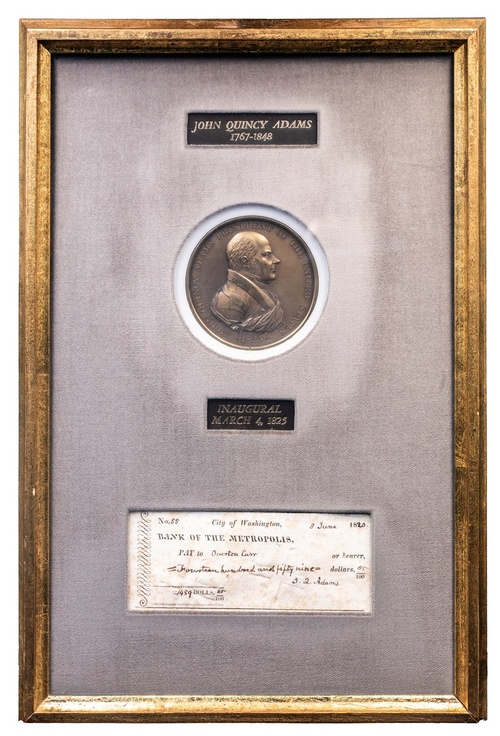
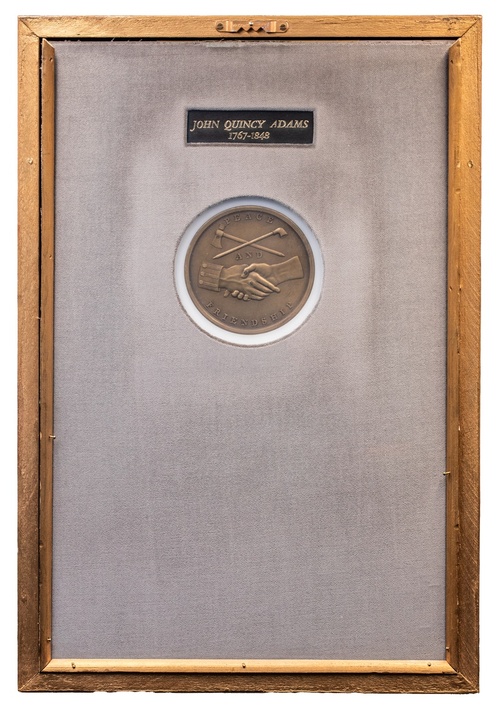
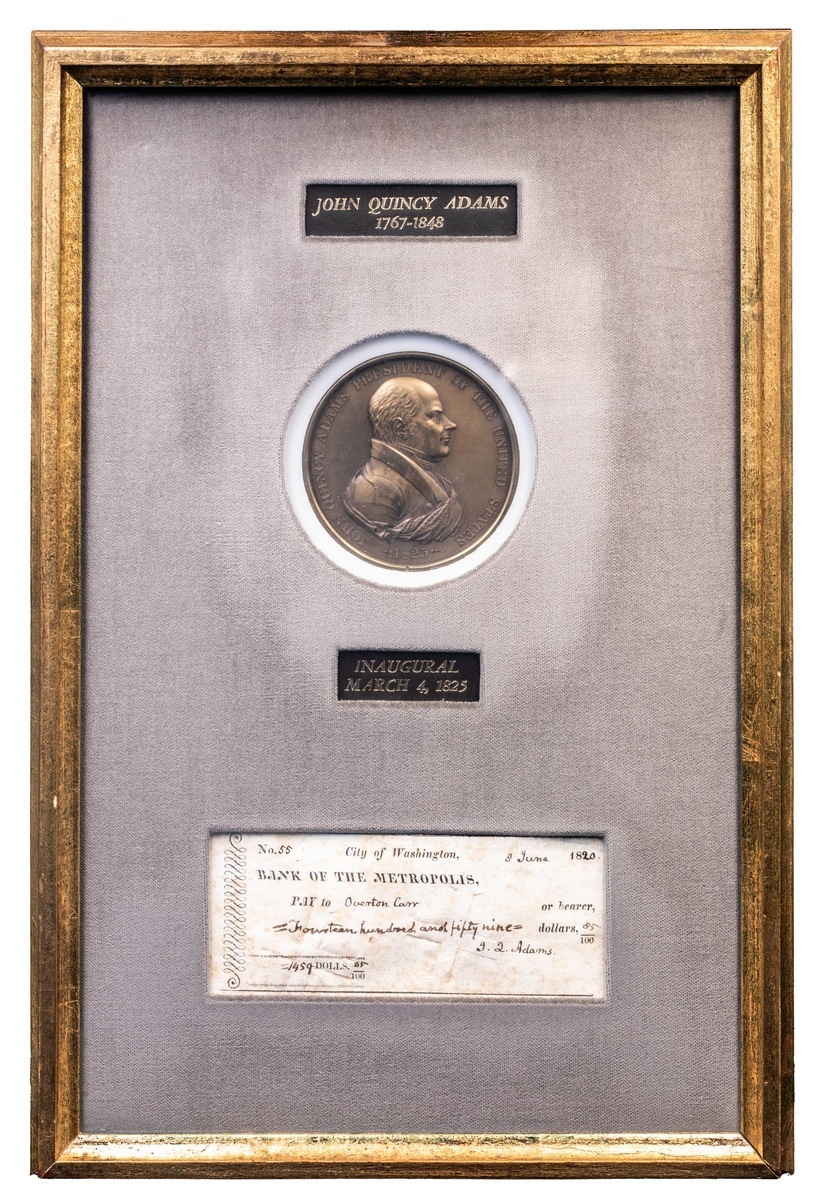
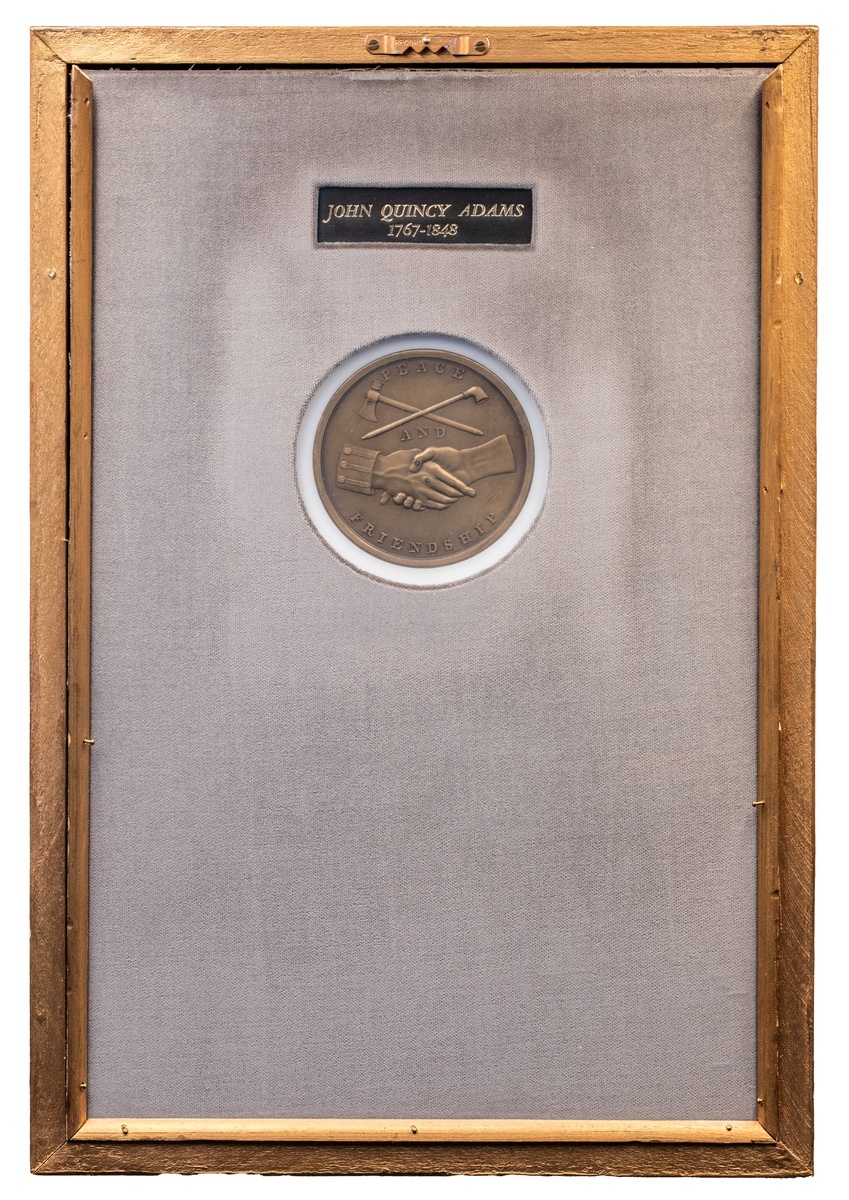
(x) Commanders-in-Chief, JOHN QUINCY ADAMS, 6th President of the United States (March 4, 1825 - March 4, 1829), Indian Peace, AE Restrike Medal, dated 1825, by Moritz Fürst and John Reich, JOHN QUINCY ADAMS PRESIDENT OF THE U. STATES 1825, draped bust right, rev. PEACE AND FRIENDSHIP, clasped hands, c. 74mm, some spots of discolouring, otherwise extremely fine; with, Bank of the Metropolis, City of Washington (Founded 1814), Cheque [No. 55], dated June 8, 1820, PAY to Overton Carr [or bearer] = Fourteen hundred and fifty nine = dollars, 85/100 cents [$1,459.85], the paper lightly foxed but rather fresh, with official double accounting 'cancellation' cross potent marking slits, a pleasing very fine, and OF NATIONAL SIGNIFICANCE, mounted in frame, 267mm x 395mm, damage to frame
Not inspected outside of the frame. Sold as is.
Provenance
Presented to His Royal Highness Prince Bandar bin Sultan Al Saud, Saudi Arabian Ambassador to the United States (1983-2005), by James Addison Baker III, 67th Secretary of the Treasury and 10th White House Chief of Staff to President Ronald Reagan.
James Addison Baker III also served as 16th White House Chief of Staff and 61st Secretary of State to President George H. W. Bush.
Son of the Second President and raised, by his own account, watching the smoke of Bunker Hill from a hilltop near the family farm. Adams had an apprenticeship in statecraft before most boys his age had finished grammar school: taken to Europe at ten to accompany his father's diplomatic missions, serving as an interpreter and Secretary to the American Minister in Russia by fourteen, fluent in French and Dutch and reading several other languages besides.
He studied at Leiden, and then Harvard, was admitted to the Massachusetts bar in 1790, and was in the diplomatic service himself within a few years, appointed Minister to the Netherlands by Washington, and then to Prussia by his own father. This appointment John Adams later admitted had been made partly to spite his political enemies.
A term in the US Senate as a Federalist gave way to growing independence from the party, and Madison sent him to St. Petersburg in 1809, where he was still posted when Napoleon's invasion of Russia unfolded around him.
He led the American delegation that negotiated the Treaty of Ghent ending the War of 1812, then served as Minister to Britain before returning home to what many historians still consider the most accomplished tenure any Secretary of State has had, negotiating the Adams-Onís Treaty that secured Florida from Spain and drew the first American boundary clear to the Pacific, and drafting the substance of what became known, somewhat unfairly to him, as the Monroe Doctrine.
The Presidency itself came to him by a route almost as contested as Garfield's. In the four-way election of 1824, Andrew Jackson won more popular and electoral votes than anyone else but fell short of a majority, throwing the decision to the House of Representatives, where Speaker Henry Clay's support delivered the Presidency to Adams; Clay's subsequent appointment as Secretary of State let Jackson's supporters brand the whole affair a "corrupt bargain," a wound that never healed and that Jackson avenged decisively four years later.
Adams's term was ambitious on paper and frustrated in practice: he proposed a National University, a naval academy, and a federally funded network of roads and canals, along with an astronomical observatory he hoped would be among the "lighthouses of the skies," and Congress, controlled by an opposition already maneuvering for Jackson's return, blocked most of it.
A punishing protective tariff did pass in 1828, alienating the South without buying him any lasting Northern gratitude, and he lost his own re-election bid that November by a wide margin.
What followed was without precedent and has remained so: in 1830, at sixty-three, Adams ran for and won a seat in the U.S. House, the only former President ever to return to Congress after high office; where he would serve until his death. He used the position as a platform for opposing slavery's grip on national politics with an intensity his Presidency had never shown on the subject.
He spent years fighting the House's "gag rule," which automatically tabled anti-slavery petitions without hearing, needling it session after session until he finally forced its repeal in 1844, and in 1841 argued, without fee, before the Supreme Court on behalf of the captive Africans of the Amistad, helping win their freedom in a case that stands among the most consequential pro bono arguments in American legal history.
He collapsed at his desk on the House floor on February 21, 1848, was carried to the Speaker's Room, and died there two days later, the Capitol itself serving as his deathbed, reportedly murmuring some version of "This is the last of earth, I am content" as he went.
For approximately 68 years, he obsessively diarised. From adolescence to his final weeks, his meticulous autobiography is one of the richest continuous documentary records any American public figure has left behind, and his entry from 8 June, 1820, written while he was still Secretary of State, catches him at full tilt: managing State Department minutiae, entertaining Russian diplomats, and personally chasing down the fine print of a Washington real estate deal, all within the same few paragraphs.
His entry reads: "June 8, 1820: Hickey called here this Morning with a Deed executed by Overton Carr, Cashier of the Patriotic Bank; assigning to me Edwards’s and Boyd’s titles to the House and Lot Square 173. I called at the Bank and took up Edwards’s Note there. To complete the title I must have a Deed in fee from J. P. Van Ness and his wife; about which he makes captious difficulties. I met him at the Metropolis Bank, and he told me he had got an opinion of Walter Jones his Attorney, which he had sent to Edwards to be shewn to me. Mr Sim was at my house, with proposals for building a stable and Coach house, at and for the house which I have purchased in F. Street"
Our cheque is not just an untraceable financial transaction therefore, but the exact purchase instruction for the residence at 1333 F Street NW, Washington, D.C. (historically referred to as Plot 173 in the L'Enfant and Ellicott city register). Adams moved there in the fall of 1820, while serving as Secretary of State. His wife, Louisa Catherine, remained in the home until she died in 1852. The F Street home was the site of the famous "Adams Ball" in 1824, which celebrated the anniversary of the Battle of New Orleans and honoured Andrew Jackson. Prior to Adams residence, it was also the temporary home of President Madison after the British torched the White House in August 1814. The original residential structure was demolished around 1880, firstly to make way fro an ornamental iron-fronted building, and then in 1926 by another Adams building. In 1939, the new premises were acquired by Webb & Knapp, Inc for $548,235.
The accompanying medal is a later echo of his Presidency. Thomas McKenney of the Bureau of Indian Affairs engaged Moritz Fürst to model the portrait, and Adams sat for him in May and June of 1825, only to have the trial strikes rejected and re-fought over for months before the finished medal was finally delivered that December. Family tradition holds that Adams's relatives disliked two of the three trial designs Fürst submitted, complaining that they made the President look heavier than he was and exaggerated his nose, leaving only the adopted portrait to survive intact.
The clasped hands, pipe, and tomahawk on the reverse were not new to Adams's medal at all, but to a pre-existing John Reich design, first adopted for Indian Peace Medals in 1809, and retained in service through 1849, ultimately explaining why both engravers' names pair together on a medal that Reich himself had no hand in cutting. The original dies stayed in the Mint's hands long after his term ended and were struck repeatedly for the collector trade well into the following century, with most surviving specimens documented as later restrikes.
Subject to 5% tax on Hammer Price in addition to 20% VAT on Buyer’s Premium.
Estimate
$700 to $800
Starting price
$480
Watch, listen and bid as if you were in the room. Now available for auctions worldwide.
Click here to bid live
An exclusive and confidential service for the discerning collector or vendor.
View the Gallery
Download every Spink catalogue on your iPad, iPod or iPhone using free Spink app.
Download From iTunes© 2026 Spink & Son. All rights reserved.