
Auction: 26776 - America 250th Anniversary Sale Ft. Coins, Medals, Banknotes, Objets de Vertu & Ephemera
Lot: 62
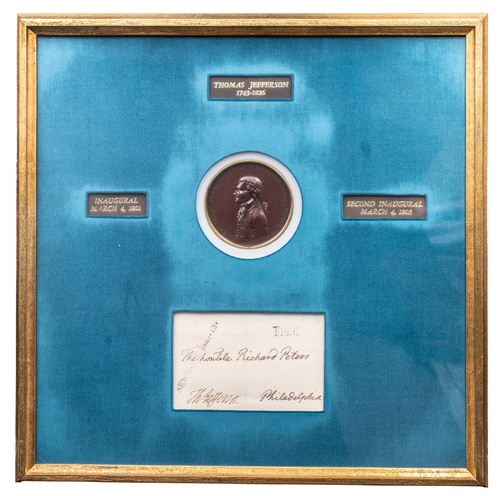
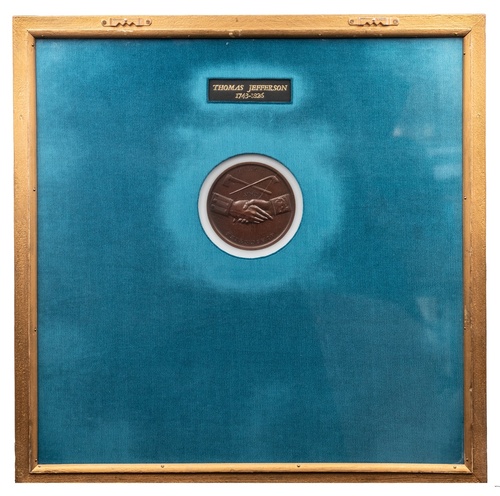
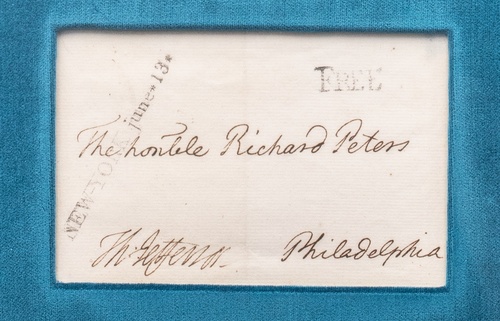
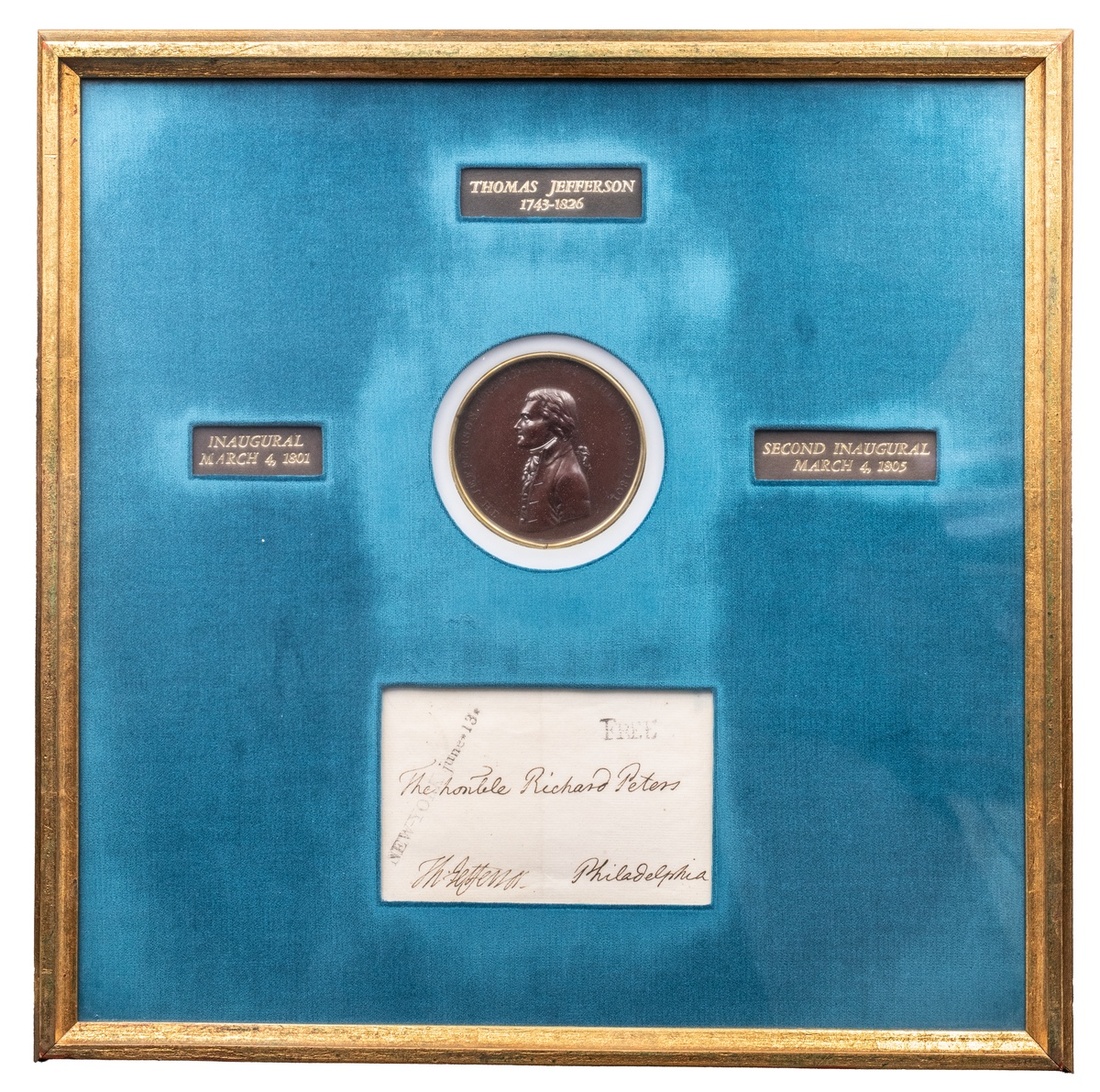
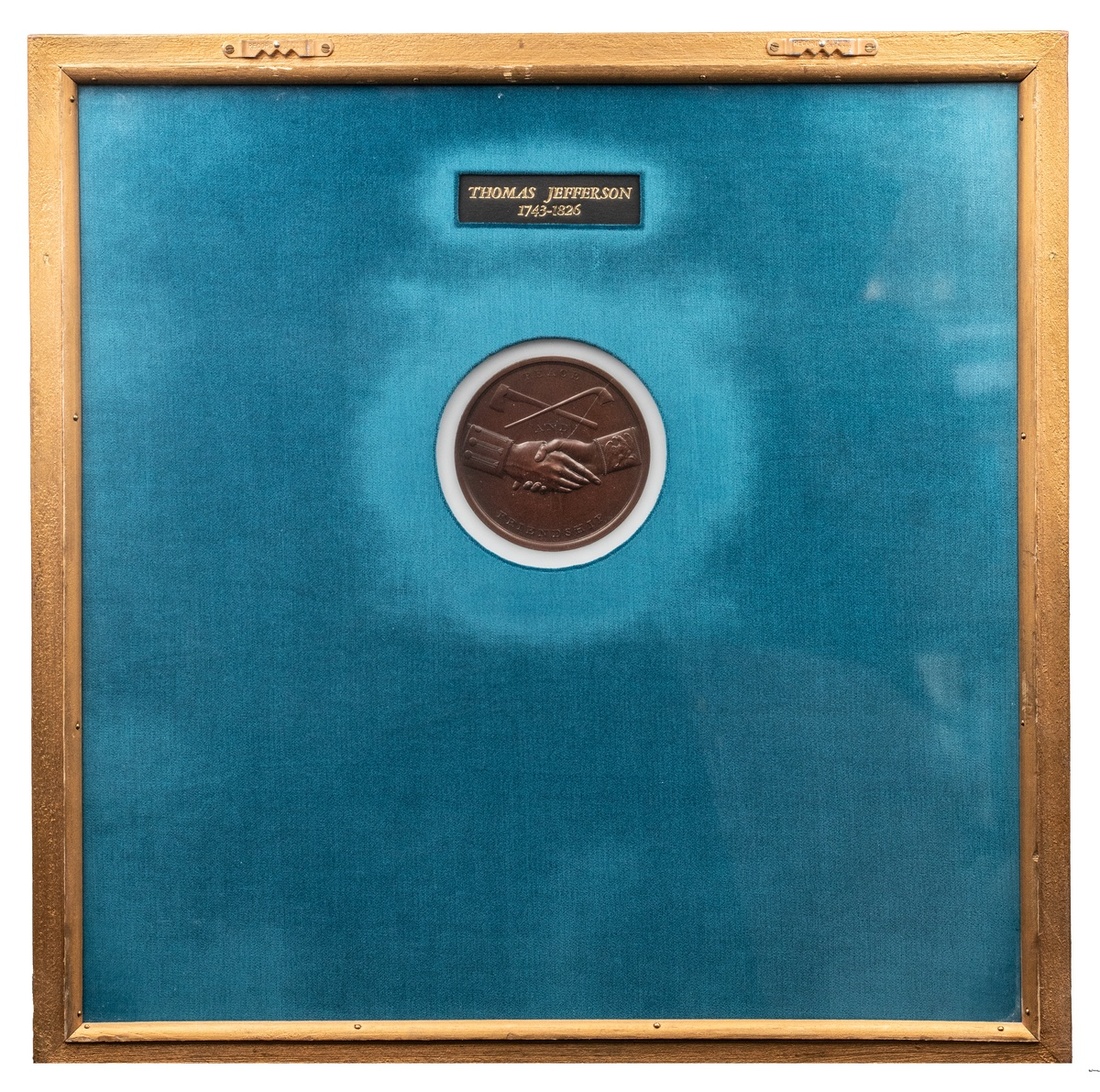
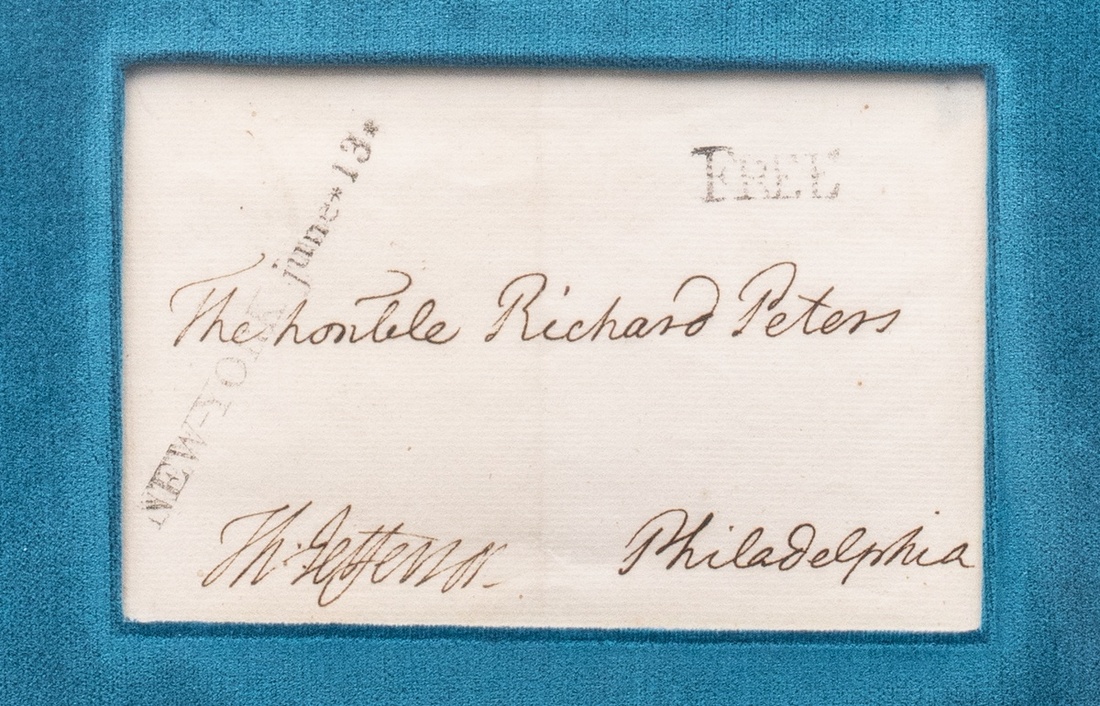
(x) Commanders-in-Chief, THOMAS JEFFERSON, 3rd President of the United States (March 4, 1801 - March 4, 1809), Bronzed Copper Restrike Indian Peace Medal, dated 1801, by John Reich, TH. JEFFERSON PRESIDENT OF THE U. S. A. D. 1801, draped half-length portrait left, rev. PEACE AND FRIENDSHIP, clasped hands, 75mm, often encountered die flaw to reverse, pleasing chocolate brown surfaces, much as issued; with, Postal Cover, dated NEW-YORK june 13*, addressed to the Honble Richard Peters, Philadelphia, from Th: Jefferson , in his characteristic colon-stopped abbreviation, mounted in frame, 395mm x 395mm
Not inspected outside of the frame. Sold as is.
Provenance
Presented to His Royal Highness Prince Bandar bin Sultan Al Saud, Saudi Arabian Ambassador to the United States (1983-2005), by James Addison Baker III, 67th Secretary of the Treasury and 10th White House Chief of Staff to President Ronald Reagan.
James Addison Baker III also served as 16th White House Chief of Staff and 61st Secretary of State to President George H. W. Bush.
Born to a prosperous Virginia planter and surveyor father and a mother from the well-connected Randolph family, Jefferson trained at William and Mary and under the tutelage of the great Virginia jurist George Wythe before beginning, at twenty-five, the lifelong architectural project that consumed him more than almost anything else he built: Monticello, redesigned and rebuilt in phases across four decades, eventually fitted with a dumbwaiter concealed in a fireplace, a revolving bookstand for reading several volumes at once, and a great clock whose cannonball weights tracked the days of the week down through a hole cut in the floor into the room below.
He married Martha Wayles Skelton in 1772, and her death a decade later, after repeated pregnancies had left her fatally weakened, devastated him badly enough that he reportedly promised her on her deathbed never to remarry, a promise he kept, and burned nearly all of their correspondence afterward. He fathered, the modern historical consensus now holds, several children after her death with Sally Hemings, a woman he enslaved and who was also, through a earlier generation, related to his late wife, a fact largely confirmed by DNA testing in 1998 after two centuries of public denial and private rumour, and one impossible to separate cleanly from the roughly six hundred people he held in bondage over the course of his life.
His political rise ran through the Virginia House of Burgesses and the Continental Congress, where in 1776, at thirty-three, he was given the primary task of drafting the Declaration of Independence, a text Congress trimmed and edited despite his private objections, most painfully by striking his passage condemning the slave trade.
A difficult wartime Governorship of Virginia, during which a British raid very nearly captured him at Monticello, gave way to a formative stint as Minister to France, where he watched the opening acts of the French Revolution, and then to a bruising term as Washington's Secretary of State, locked in constant, increasingly personal warfare with Alexander Hamilton over the direction of the young Republic's finances and foreign sympathies, a rivalry that hardened into the country's first opposition party.
Elected Adams's Vice President in 1797 under the original system of the Runner-up gaining the second office of state regardless of party, he spent the term at odds with the administration he nominally served, secretly authoring the Kentucky Resolutions against the Alien and Sedition Acts, an argument for state nullification of federal law whose logic would return with far graver consequences six decades later.
The election of 1800 nearly capsized itself entirely: Jefferson and his own running mate Aaron Burr tied in the electoral count under the Constitution's original, unamended design, throwing the contest into the House of Representatives, where thirty-six ballots and Hamilton's grudging intervention against Burr finally secured Jefferson the Presidency, a favoor that helped set Hamilton and Burr on the path to their fatal duel four years later.
Jefferson called his own election the "Revolution of 1800," the first peaceful transfer of power between rival parties the country had managed, and he governed accordingly, slashing military spending, eliminating the whiskey tax, and paying down the national debt. His defining act came in 1803, when Napoleon, needing cash and abandoning his American ambitions, offered the entire Louisiana Territory rather than just the New Orleans access Jefferson's negotiators had been sent to secure; Jefferson, who harboured real constitutional doubts about whether the Federal government had any enumerated power to acquire foreign territory at all, briefly considered a Constitutional amendment before deciding the opportunity could not wait, and closed the purchase that doubled the country's size for $15 million.
He dispatched Meriwether Lewis and William Clark to map the new territory and press on to the Pacific, fought the First Barbary War rather than continue paying tribute to the piratical states of North Africa, and watched his own administration's stonewalling of a minor judicial appointment produce, almost by accident, Marbury v. Madison and the doctrine of judicial review.
His second term soured considerably: he pursued treason charges against his former Vice President Burr over an alleged scheme to carve a personal empire from the western territories, only to see him acquitted under a standard so exacting that Chief Justice Marshall himself had set it, and his Embargo Act of 1807, an attempt to punish British and French interference with American shipping by simply halting American trade with both, gutted New England's economy and was repealed just before he left office, one of the more unambiguous failures of his presidency.
He retired to Monticello, founded the University of Virginia in 1819, personally designed its "Academical Village" campus, and served as its first rector, all while sliding steadily deeper into a debt his lavish building and entertaining had never stopped compounding, and one that would eventually force the sale of Monticello and the people he enslaved there within a year of his death.
His late-life reconciliation and rich correspondence with John Adams, following decades of estrangement after the bitterness of 1800, is among the more moving epistolary friendships in American history, and it closed on a note neither could have scripted better: both would die within hours of each other on July 4, 1826, the fiftieth anniversary of the Declaration. Adams's last words reportedly invoked Jefferson's survival, even though Jefferson had, unknown to him, died a few hours earlier that same day. James Monroe would die on the same date five years later, giving the country's first five Presidents an oddly clustered relationship with the Fourth of July that three of them shared outright.
The peace medals Lewis and Clark carried west remain one of the more evocative artifacts of his Presidency. Jefferson's was the first Indian Peace Medal ever struck bearing an American President's own face, a break from the earlier colonial practice of more generic imagery, its reverse showing an American soldier and a Native leader clasping hands beneath a crossed peace pipe and tomahawk, a design whose authorship numismatists still argue over, credited by some to the engraver John Reich and by Smithsonian records to Robert Scot instead.
Struck in three sizes graded to a Chief's perceived rank, and made as two thin embossed silver discs joined by a rim rather than a single solid strike, since the Philadelphia Mint's press of the day couldn't manage anything heavier, the medals traveled with the Corps of Discovery in the specific count of three large, thirteen medium, and sixteen small, and were handed out some eighty-seven times in all across the expedition's two years on the trail. Native reactions varied as widely as the tribes themselves, received with real pleasure by some leaders and, among the Hidatsa, deliberately regifted to rival nations in the hope of passing along bad luck rather than good.
Only a handful of the original Expedition medals are confirmed to survive today, one recovered from a burial site in Washington state and eventually returned to the Confederated Tribes of the Umatilla Reservation under federal repatriation law in 2009, a small, late act of restitution for an object that had once been offered as a promise of a friendship the following century did a great deal to break.
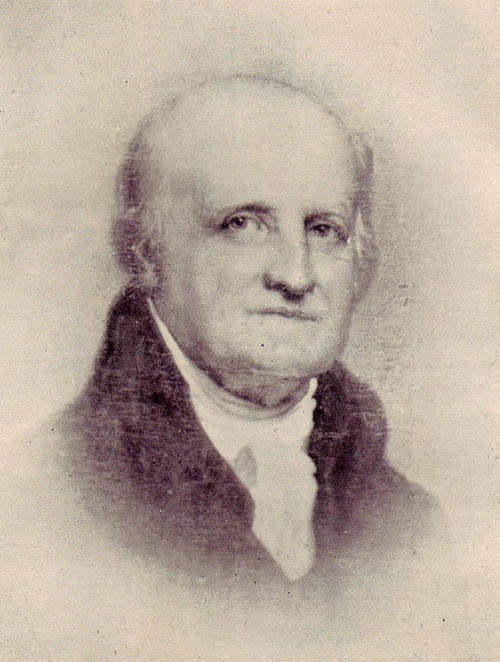
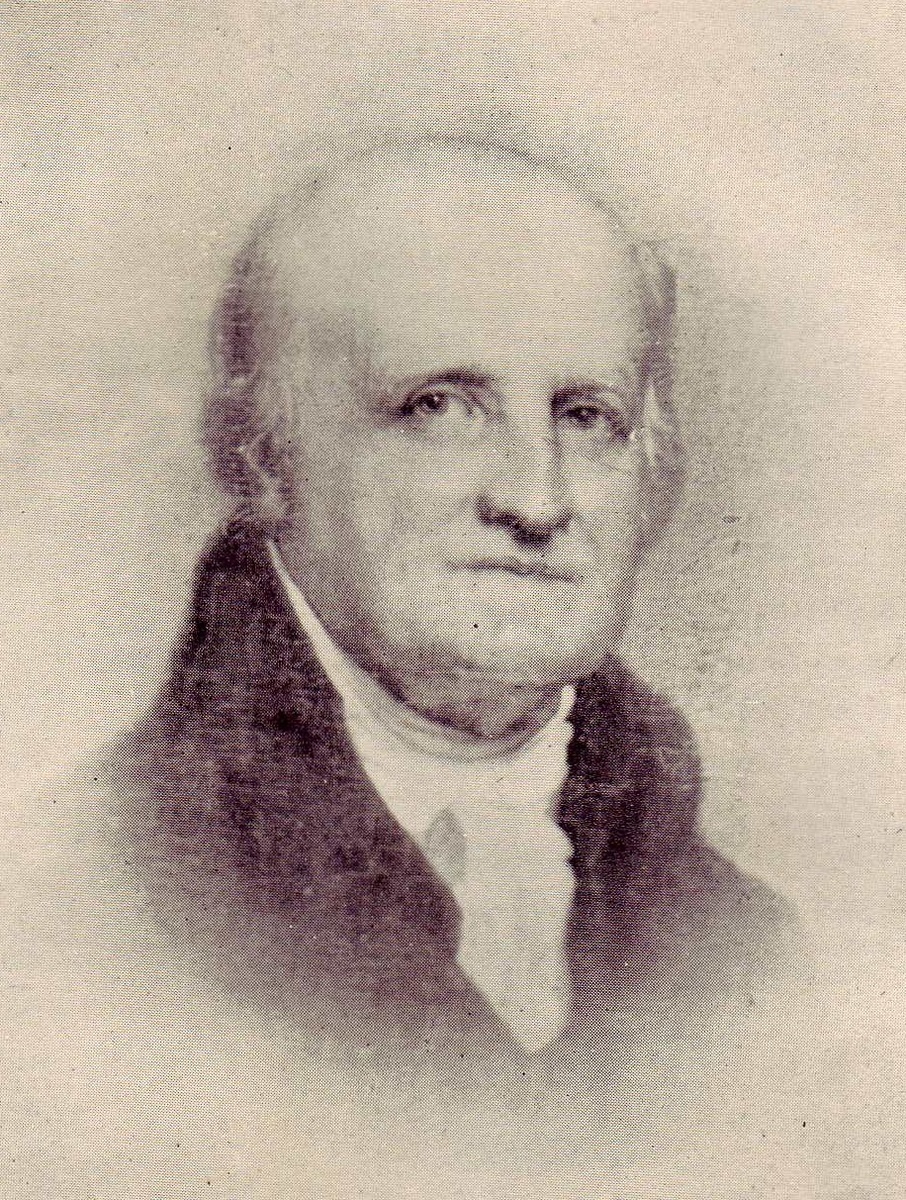
Jefferson's letter here was addressed to his long-time friend, the Honorable Richard Peters (1744–1828). On June 30, 1791, Jefferson wrote to Petes: "call on me, in your turn, whenever you come to town: and if it should be about the hour of three, I shall rejoice the more. You will find a bad dinner, a good glass of wine, and a host thankful for your favor, and desirous of encouraging repetitions of it without number, form or ceremony. I shall certainly feel often enough the inducements to Belmont, among the chief of which will be your society and the desire of becoming acquainted with Mrs. Peters. …When Madison returns you will often find him here without notice and always with it: and if you complain again of not seeing him, it will be that the place of rendezvous does not enjoy your favour." A career lawyer, jurist, and statesman from Pennsylvania, he heralded from a prominent Philadelphia family, going on to serve as Secretary of the Continental Board of War during the American Revolution,alongside George Washington on military administration and supply. He represented Pennsylvania in the Continental Congress in the 1780s and later became active in state and national agricultural and scientific societies. In 1792, President Washington appointed him a Federal Judge for the U.S. District Court for the Eastern District of Pennsylvania, a position he held for the rest of his life, presiding over several notable early federal cases.
Peters, alongside Jefferson, was one of the contributors to a notable joint publication, "Letters on Agriculture from His Excellency George Washington... to Arthur Young... and Sir John Sinclair, with Statistical Tables and Remarks by Thomas Jefferson, Richard Peters, and Other Gentlemen," which gathered the agricultural correspondence and observations of Washington and his circle for a British readership hungry for accounts of American farming practice.
Peters, who helped found the Philadelphia Society for Promoting Agriculture in 1785 and led it from 1805 until his death, corresponded with Jefferson directly on the subject for decades; another surviving letter from Jefferson to Peters dated March 6, 1816, thanks him for a copy of his "Discourse on Agriculture" and finds Jefferson admitting, with characteristic modesty, that he shared Peters's love for the art without ever matching his skill, having been, in Jefferson's own self-assessment, only ever an amateur at it.
Peters kept up the correspondence into Jefferson's retirement, writing him in 1817 with his usual dry humor about local agricultural conditions and, at seventy-three, his own surprisingly good health for what he called an old biped. Jefferson also appears to have received official circulars from the Agricultural Society itself under Peters's presidency, at least one of which survives as a franked broadside posted from Philadelphia.
On November 8, 1775, Congress had resolved, "That all letters to and from the delegates of the United Colonies, during the sessions of Congress, pass, and be carried free of postage, the members having engaged upon their honour not to frank or enclose any letters but their own." This controversial privilege was extended to many others beyond the Confederation period. During all the years that Thomas Jefferson held Federal office, and during his retirement from public service, he was able to enjoy the franking privilege. Unsurprisingly abuse of the free franking benefit abounded, and, in time, a national scandal raged. Newspapers serialised that members of Congress “routinely franked laundry home and gave their signatures to family and friends for personal use.” A Senator even attached a frank to his horse’s bridle to send it back to Pittsburg. In response, on January 31, 1873, Congress passed legislation abolishing the free frank, effective July 1, 1873.
Subject to 5% tax on Hammer Price in addition to 20% VAT on Buyer’s Premium.
Estimate
$1,000 to $1,200
Starting price
$700
Watch, listen and bid as if you were in the room. Now available for auctions worldwide.
Click here to bid live
An exclusive and confidential service for the discerning collector or vendor.
View the Gallery
Download every Spink catalogue on your iPad, iPod or iPhone using free Spink app.
Download From iTunes© 2026 Spink & Son. All rights reserved.