
Auction: 26776 - America 250th Anniversary Sale Ft. Coins, Medals, Banknotes, Objets de Vertu & Ephemera
Lot: 61
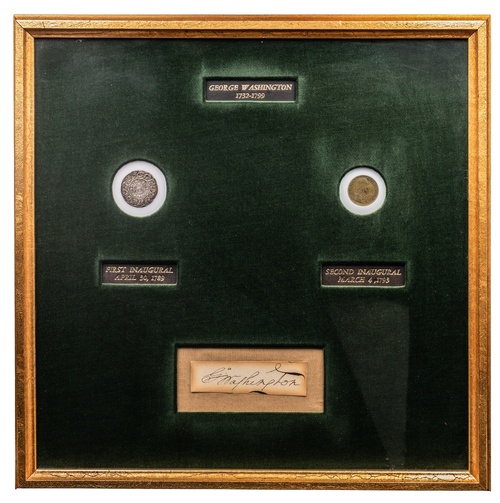
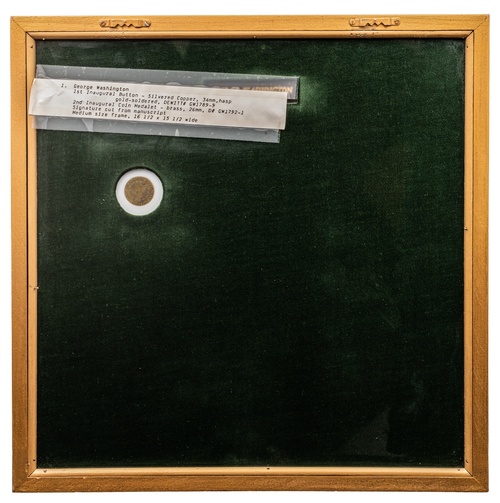
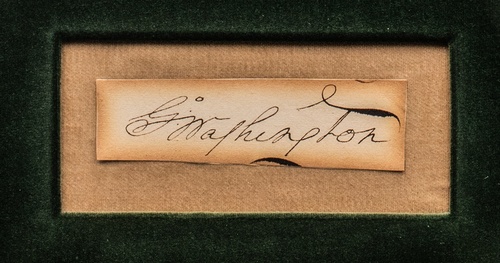
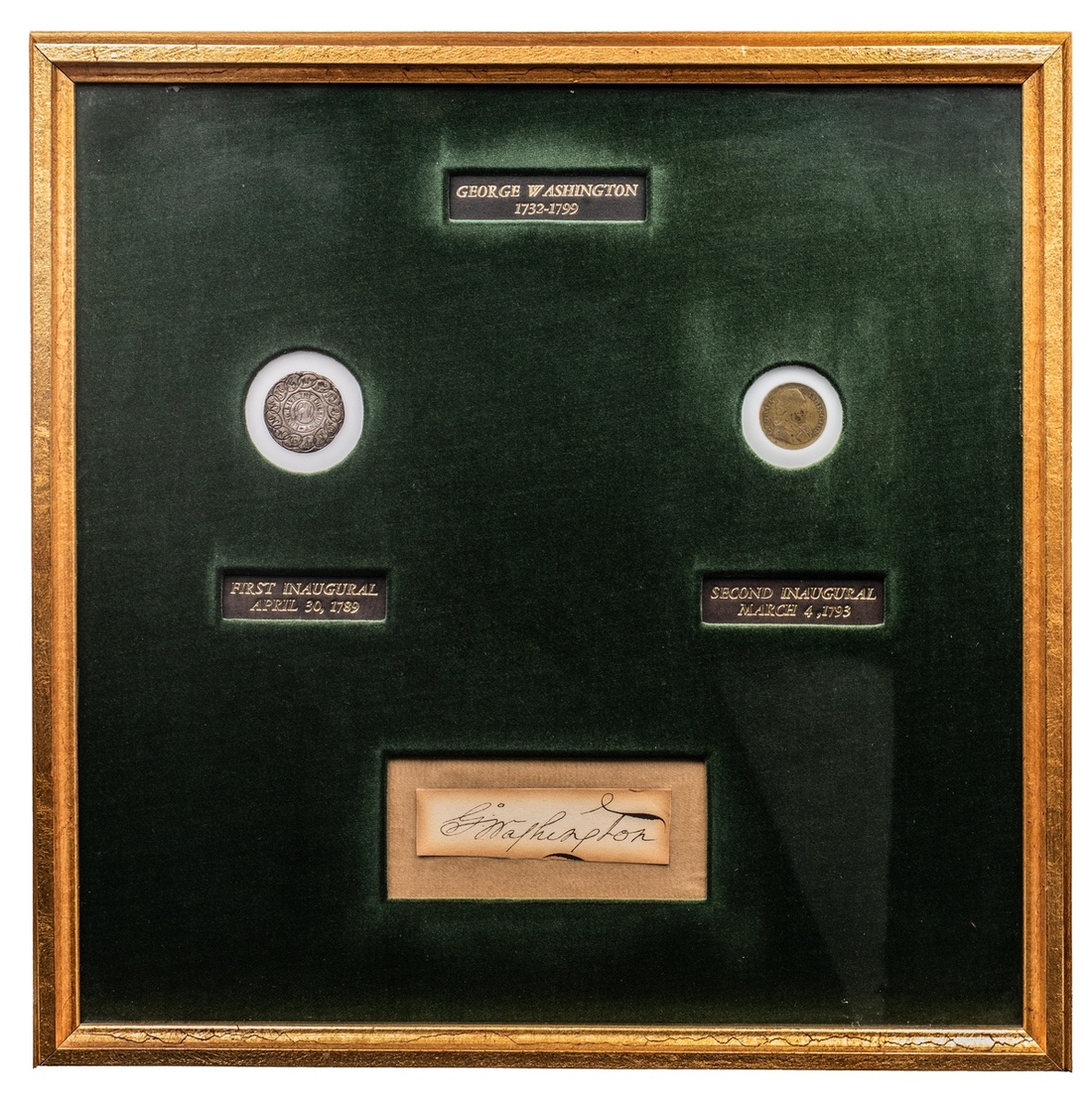
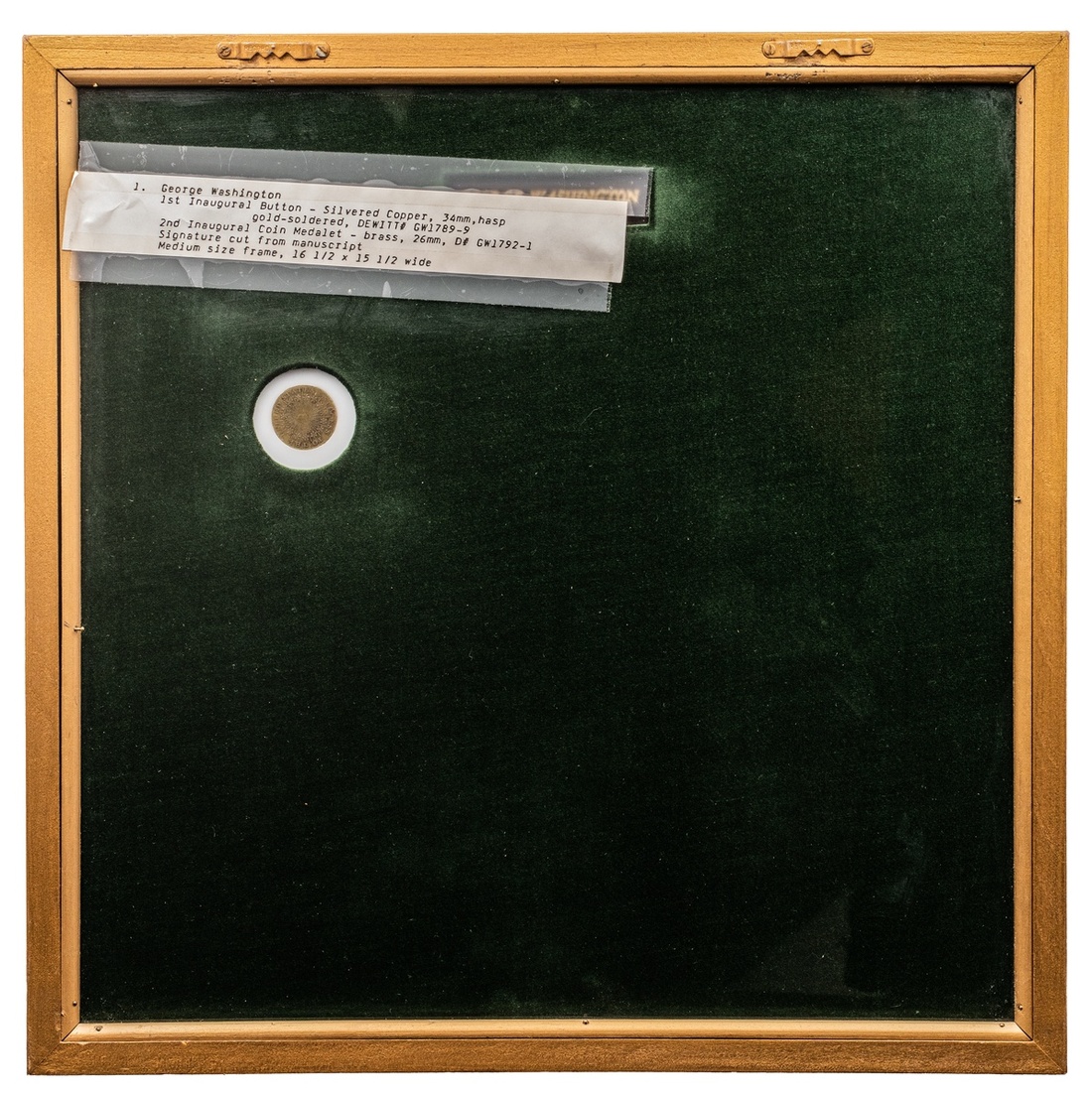
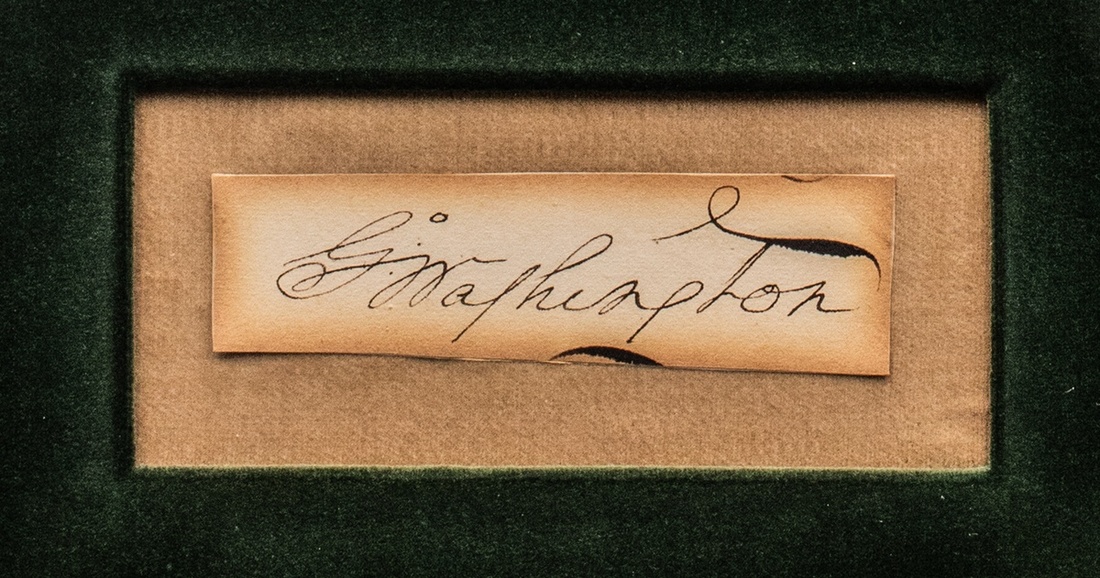
(x) Commanders-in-Chief, GEORGE WASHINGTON, 1st President of the United States (April 30, 1789 - March 4, 1797), First Inauguration Button, 1789, Silvered-Copper, LONG LIVE THE PRESIDENT encircling GW initials, interlinked state abbreviations in outer border, 34mm (DeWitt GW-1789-9; Baker 1003), some loss of gilding to peripheries, otherwise toned, generally very fine, scarce and highly sought after early example; and Post-Colonial, WASHINGTON, Brass 'Success' Token, c. 1792, GEORGE WASHINGTON, uniformed bust right, rev. SUCCESS TO THE UNITED STATES, radiant all-seeing eye at centre, with 15 stars around, 26mm (DeWitt GW-1792-1), very fine for type; with cut signature "G Washington", mounted in frame, 395mm x 395mm
Not inspected outside of the frame. Sold as is.
Provenance
Presented to His Royal Highness Prince Bandar bin Sultan Al Saud, Saudi Arabian Ambassador to the United States (1983-2005), by James Addison Baker III, 67th Secretary of the Treasury and 10th White House Chief of Staff to President Ronald Reagan.
James Addison Baker III also served as 16th White House Chief of Staff and 61st Secretary of State to President George H. W. Bush.
A man who needs no introduction, perhaps, though the icon, fixed early by Gilbert Stuart and multiplied ever since onto currency and marble, has done its subject a certain disservice: it has flattened a life considerably stranger, and less serene, than the face suggests.
Orphaned of a father at eleven and denied the schooling his elder half-brothers received in England, Washington trained instead as a surveyor, mapping the Virginia frontier for Lord Fairfax before he was out of his teens.
At twenty-one, Governor Dinwiddie sent him into the Ohio Country to deliver an ultimatum to French forces; the skirmish that followed on his return, in which his small party ambushed a French detachment at Jumonville Glen, is credited by more than one historian with lighting the fuse of a war that would eventually span three continents. Two years later he survived Braddock's catastrophic defeat near Fort Duquesne with two horses shot from under him and four bullet holes through his coat, emerging unscathed and already, in some quarters, marked as a man of destiny.
He resigned his colonial commission in 1758, married the wealthy widow Martha Custis, and might have remained a Virginia planter had the imperial crisis not called him back: to the House of Burgesses, to the Continental Congress, and in 1775 to command of the Continental Army, a post given partly for its symbolism, a Virginian placed at the head of what was then a largely New England force.
The war he waged was, by his own admission, mostly a war of survival: defeat in New York, retreat across the Jerseys, then the Christmas crossing of the Delaware and the victory at Trenton that kept the Revolution from expiring in its second winter. Valley Forge, the French alliance, and finally Yorktown in 1781 brought it to a close.
What followed mattered more to contemporaries than any battle: in 1783, with his officers on the edge of mutiny at Newburgh, he defused the crisis with an unplanned gesture, pausing to put on spectacles and remarking that he had grown gray in his country's service, which reportedly moved hardened men to tears; then, months later, he voluntarily surrendered his sword and commission to Congress, an act of self-abnegation so unusual in a victorious general that George III is said to have remarked that if Washington truly gave up power, he would be the greatest man in the world.
He presided over the Constitutional Convention in 1787 more as guarantor than participant, and was elected President unanimously, twice, the only man ever to hold that distinction. As President he governed less by decree than by precedent: he assembled the first cabinet, backed Hamilton's financial program (assumption of state debts, the founding of the First Bank of the United States) over Jefferson's constitutional objections, and signed the Judiciary Act establishing the Federal courts.
He personally led militia into western Pennsylvania to suppress the Whiskey Rebellion in 1794, the only sitting President ever to command troops in the field, and issued the Neutrality Proclamation of 1793, asserting an executive prerogative over foreign affairs that has echoed ever since.
His Farewell Address, published rather than spoken, warned against permanent foreign entanglements and the "baneful effects" of party spirit, this from a man whose own cabinet had already split into the factions that would become the first party system.
The private man was less marmoreal than the myth. He never lived in the White House, still unfinished when he left office; his famous dentures were not wood but an uncomfortable arrangement of human teeth (some purchased from the enslaved people at Mount Vernon), animal ivory, and metal springs.
He held over three hundred enslaved people in bondage by the time of his death, the labour on which Mount Vernon's prosperity depended, and was alone among the Virginia framers in ordering, by will, the emancipation of those he legally could free.
He died in December 1799 after a sudden throat infection, weakened rather than cured by his physicians' repeated bleedings, which may have taken nearly half his blood. What endures is less any single act of office than the pattern of relinquishment: the sword surrendered in 1783, the Presidency vacated after two terms in 1797, each a choice available to him and refused.
It is this restraint, more than any policy, that later generations have found hardest to emulate, and impossible to forget.
Subject to 5% tax on Hammer Price in addition to 20% VAT on Buyer’s Premium.
Estimate
$1,500 to $2,000
Starting price
$1000

Watch, listen and bid as if you were in the room. Now available for auctions worldwide.
Click here to bid live
An exclusive and confidential service for the discerning collector or vendor.
View the Gallery
Download every Spink catalogue on your iPad, iPod or iPhone using free Spink app.
Download From iTunes© 2026 Spink & Son. All rights reserved.