
Auction: 26066 - Historical Documents, Autographs and Ephemera
Lot: 1161
England
Royalty
Edward III (1312 - 1377)
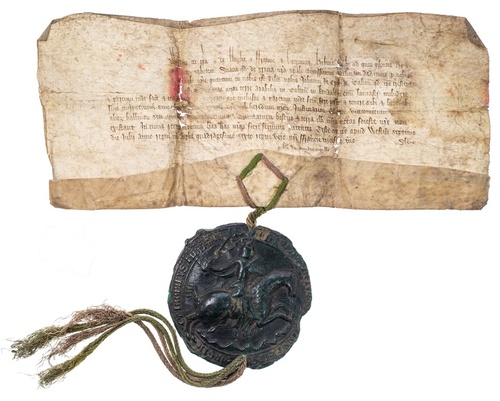
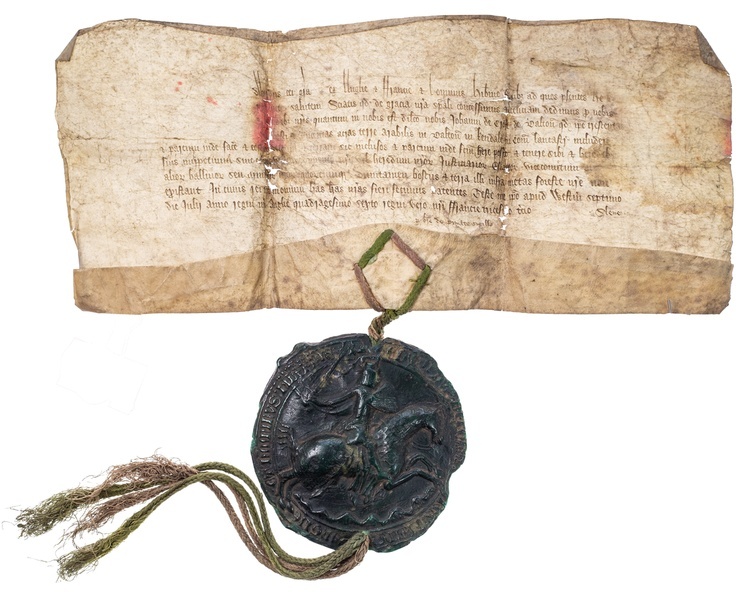
1373 Vellum Patent Roll with a complete wax seal of King Edward III attached (11.3cm in diameter). Decreed the 7 July 1373, the document concerns the grant of land in Kendale, Dalton from King Edward III to John de Croft of Dalton. Attached is the Fourth Great Seal (of Presence) in use from 1341-60 and 1370-73 (36.1cm x 15.3cm), the legend reads 'EDWARDVS: DEI: GRACIA: REX: FRANCIE/ ET: ANGLIE: ET: DOMINUS: HIBERNIE', with interwoven cords of green and gold thread attached to obverse of seal (22cm), overall delicate condition, minor vellum loss and tears in folds, with ink and water staining, despite some minor wear to seal on edge, details remain. (36cm x 15cm unfolded)
A rare surviving example of the Great Seal.
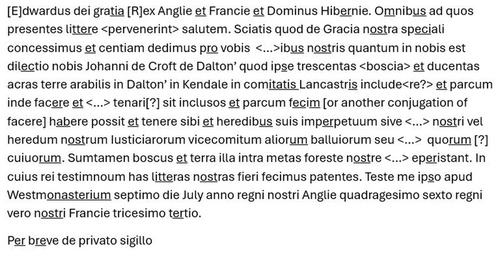
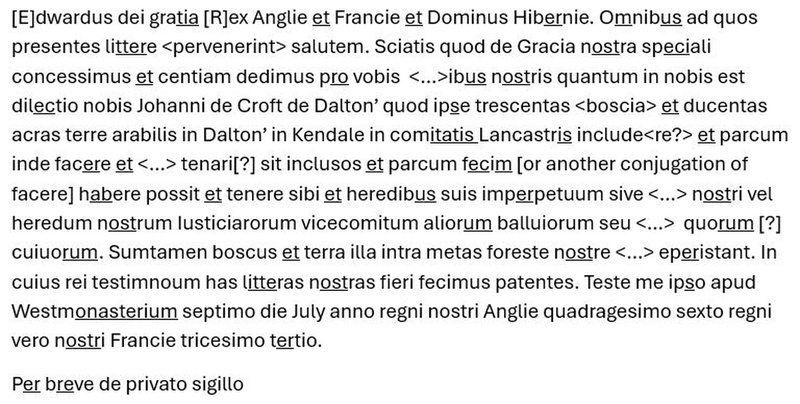
Palaeography of the Medieval Latin, Anglicana script provided as image.
A loose translation goes as follows:
Edward, by the grace of God, King of England and France and Lord of Ireland, to all those to whom these present letters will come. Greetings. Let it be known that due to our particular understanding that we relinquish and give to you… the esteemed John de Croft of Dalton, that he [be given] three hundred acres [of woodland and two hundred acres] of arable land in Dalton in Kendale in the county of Lancaster… from which, to make and enclose a park… and we make it so that he can have and hold it for himself and his future heirs in perpetuity without [interference] from us or our heirs from justices, sheriffs, and other bailiffs… Crucially, they insist the wood and land remain inside our forest. In witness of which we have caused these our letters to be made patent. Witnessed by myself at Westminster on the seventh of July, in the forty-sixth year of our reign in England and the thirty-third year of our reign in France.
By writ of the privy seal.
On this document, it is important to note the legend reading 'REX FRANCIE ET ANGLIE', is a common feature of Great Seals from the reign of Edward III, specifically from the 1340s and the launching of the Hundred Years War. Please also note the omission of the 'DVX AQVITANNIE' which was removed after the duchy was lost in 1369 when the treaty of Bretigny was broken. This is emblematic of the turbulent times in which this document was produced, just as the Hundred Years War was renewed once more.
Sir John de Croft was born in 1355 into the Croft family, a landowning gentry local to Lancashire who were first mentioned in historical records from the late 12th century. Croft inherited his estates from his father in circa 1371 and the following year received this very royal licence to enclose a woodland and arable farm in some 500 acres of his land. By this time, he was serving as a royal tax collector before then being promoted crown commissioner. His land was extensive, and stretched from his manor at Leghton, to Yealand Conyers and Over Kellet as well as owning properties in Farleton, Westmorland. The History of Parliament Online estimates his income to have been around at least £40 per year, although it likely exceeded this.
Croft was an important tenant of John of Gaunt, who was the son of Edward III and uncle to Richard II, who served as the Duke of Lancaster from 1362 - 1399. After Croft was knighted in 1384, he travelled to Portugal the following year to carry out an important diplomatic appointment likely concerning Gaunt's claim to the throne of Castille. Upon his return, in 1386 he was promoted Chevalier and in 1388 he took his seat in the House of Commons for the first time. Fifteen years after assuming his inheritance, Croft's influence had grown considerably. In 1390, he was sent to Berwick-upon-Tweed, a famously turbulent garrison post against the Scottish raiders. This, however, earnt him favour with the young king, as in March the following year, Croft was made a retainer at an annual fee of £10 payable for life.
However, over the course of the 1390s, the tide was turning for Richard II, and the Lords Appellant (a group of angry, discontented noblemen) grew tired the king's increasing tyranny. To survive Richard's deposition from Bolingbroke, Croft had to be wise and use his connections to Gaunt. After Henry IV's usurpation, the newly appointed king trusted in Croft's valuable experience and appointed him captain of the castle of Marck, a vital English outpost in the marches of Calais during the Hundred Years' War. Croft served here from 1402-05, after which he was replaced by the Earl of Arundell. While holding office, he worked as an ambassador during the peace negotiations with Flanders. Once again proving his loyalty to the king, he raised troops for Henry during the Glyndwr rebellion in August 1405.
Remarkably, Croft lived until circa 1419, dying at the age of around 70 years old. He was survived by his second wife and children, with his eldest son Nicholas inheriting the majority of the lands and responsibilities. Croft served four kings in his lifetime and lived through some of the most turbulent times the Middle Ages had to offer.
Further reading:
1. The Great Seals of England, Wyon, 1887.
2.https://www.historyofparliamentonline.org/volume/1386-1421/member/croft-sir-john-141920
3.https://croftfamilyhistory.weebly.com/dalton--claughton.html#:~:text=John%20de%20Crofte%20succeeded%20his,died%20in%20or%20around%201371
With thanks to Ben Oldam, MPhil, MA (Cantab), University of Birmingham Cadbury Research Library (Special Collections) for his help with the palaeography.
Subject to 20% VAT on Buyer’s Premium. For more information please view Terms and Conditions for Buyers.
Estimate
£1,800 to £2,000
Starting price
£1500
Watch, listen and bid as if you were in the room. Now available for auctions worldwide.
Click here to bid live
An exclusive and confidential service for the discerning collector or vendor.
View the Gallery
Download every Spink catalogue on your iPad, iPod or iPhone using free Spink app.
Download From iTunes© 2026 Spink & Son. All rights reserved.