
Auction: 26022 - The Hambleden Hoard: The Most Important Trove of Black Death Coins Ever Found
Lot: 1484
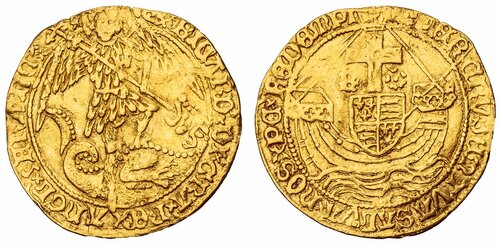
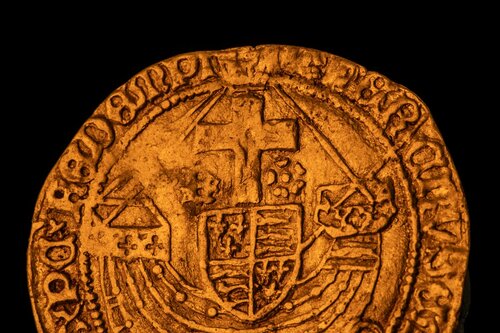
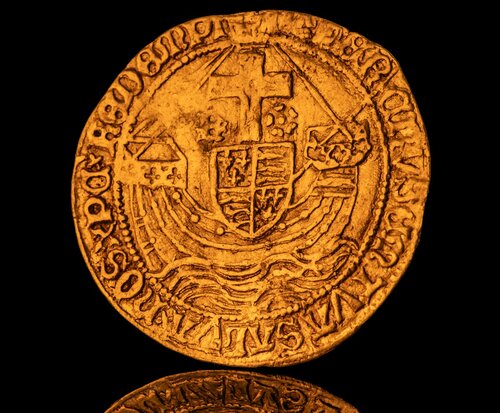
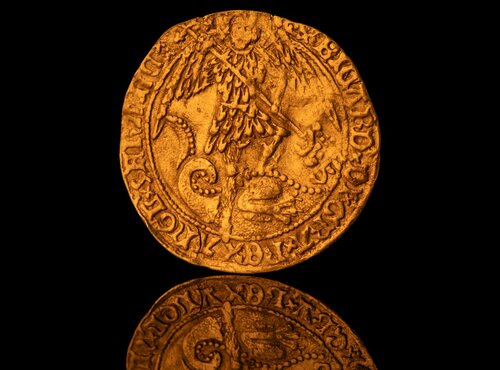
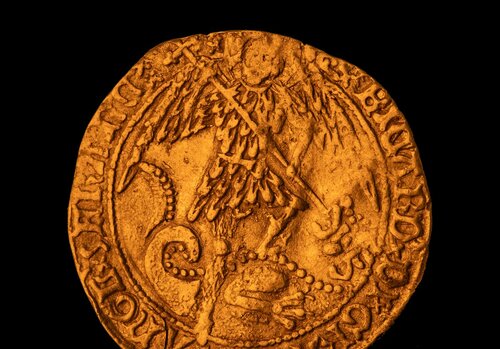
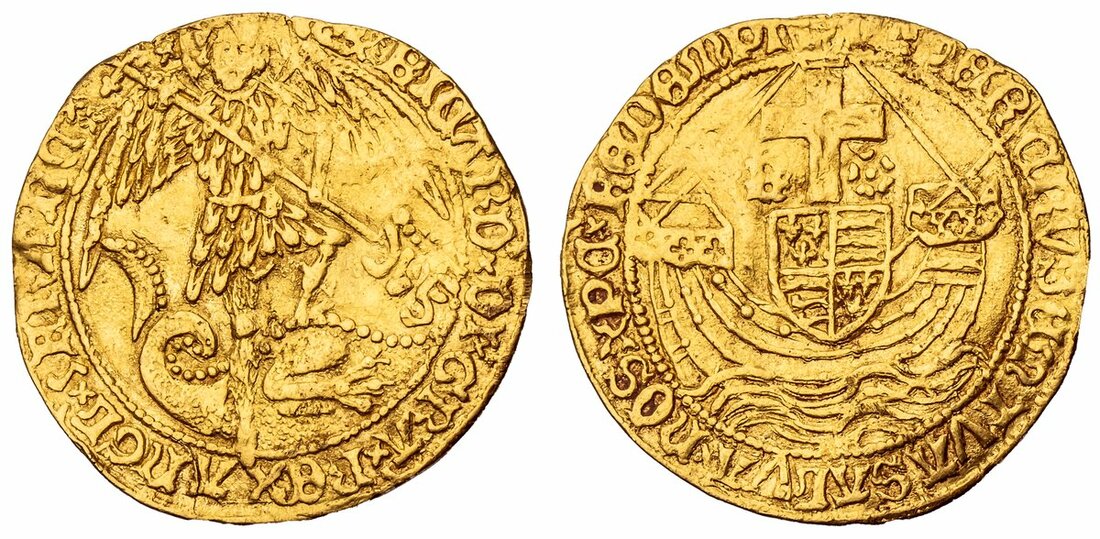
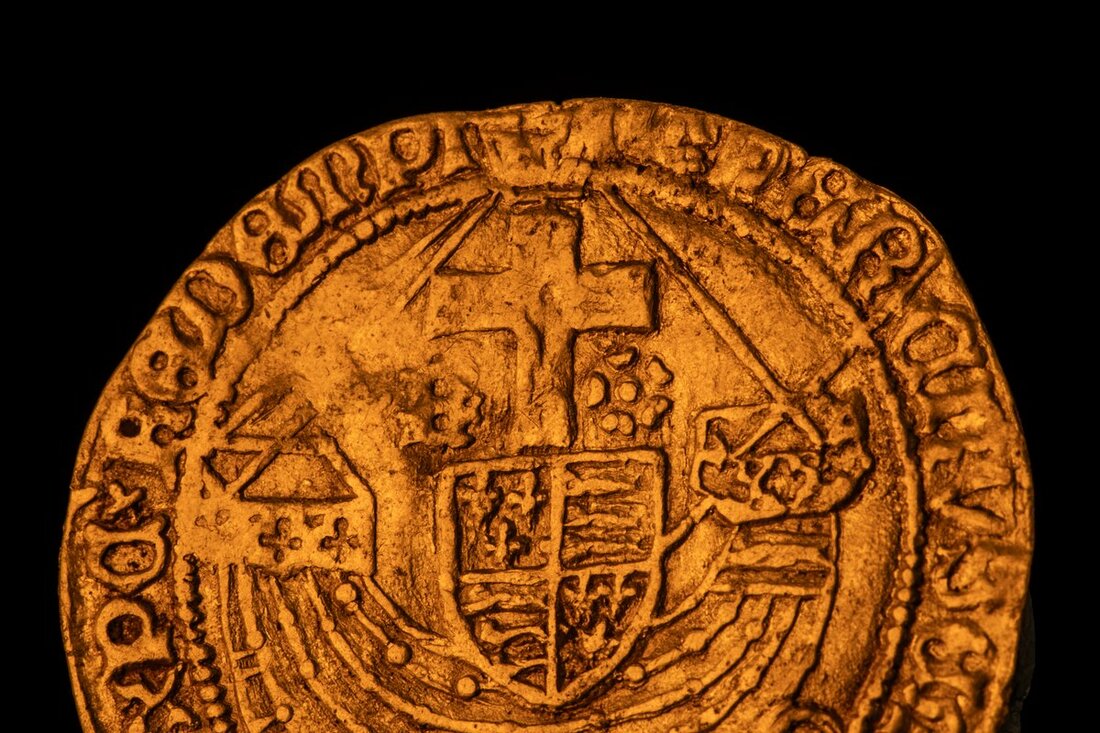
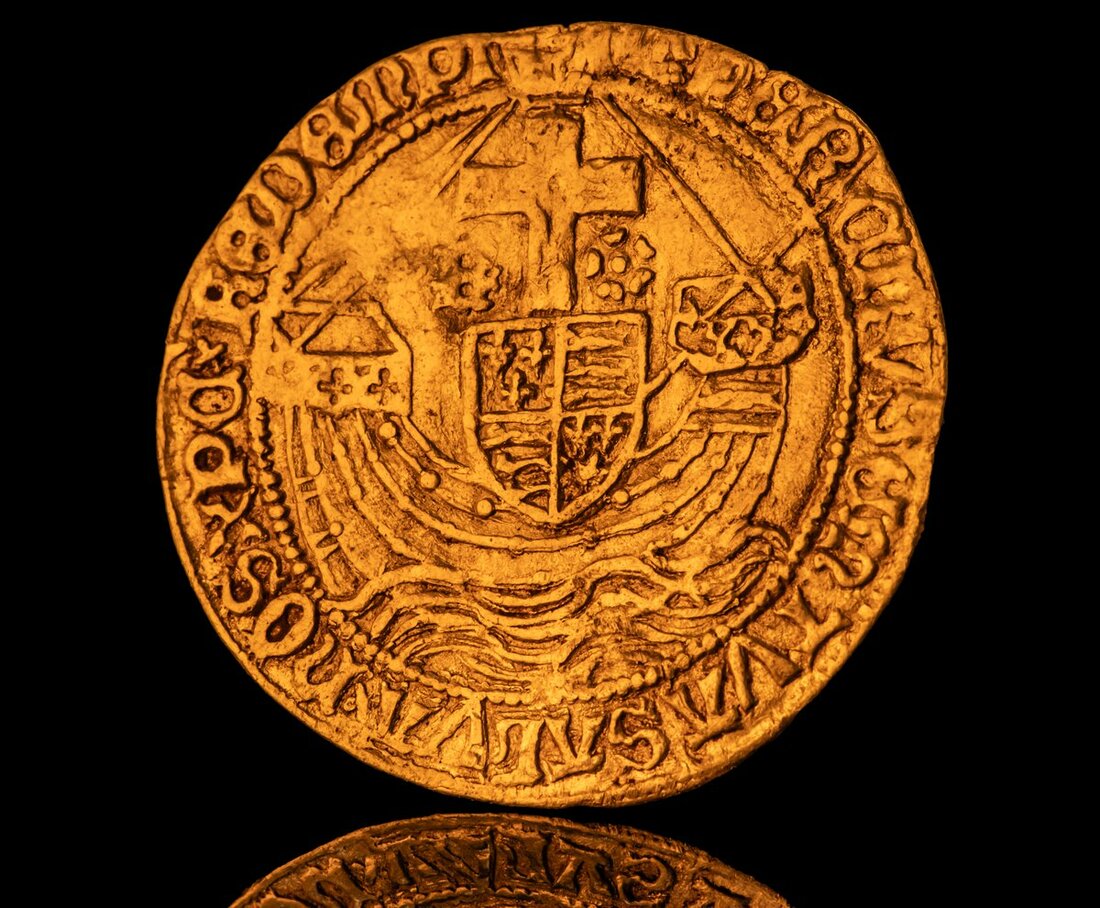
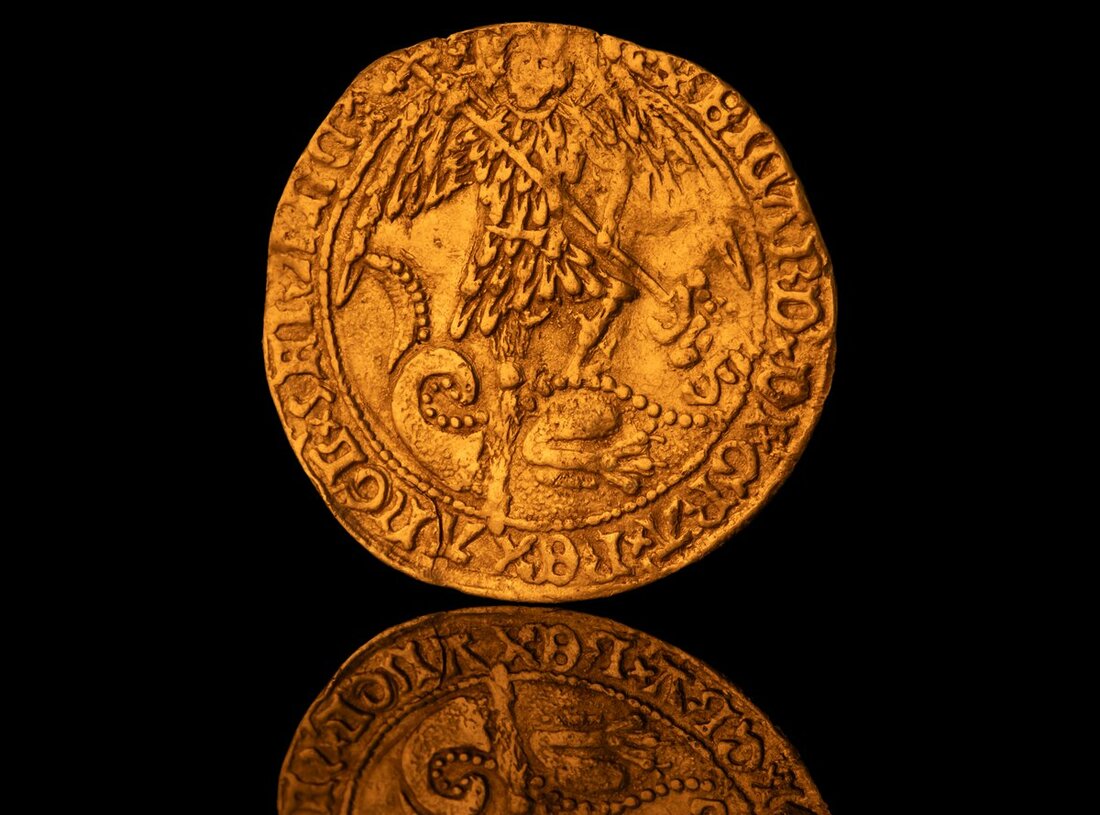
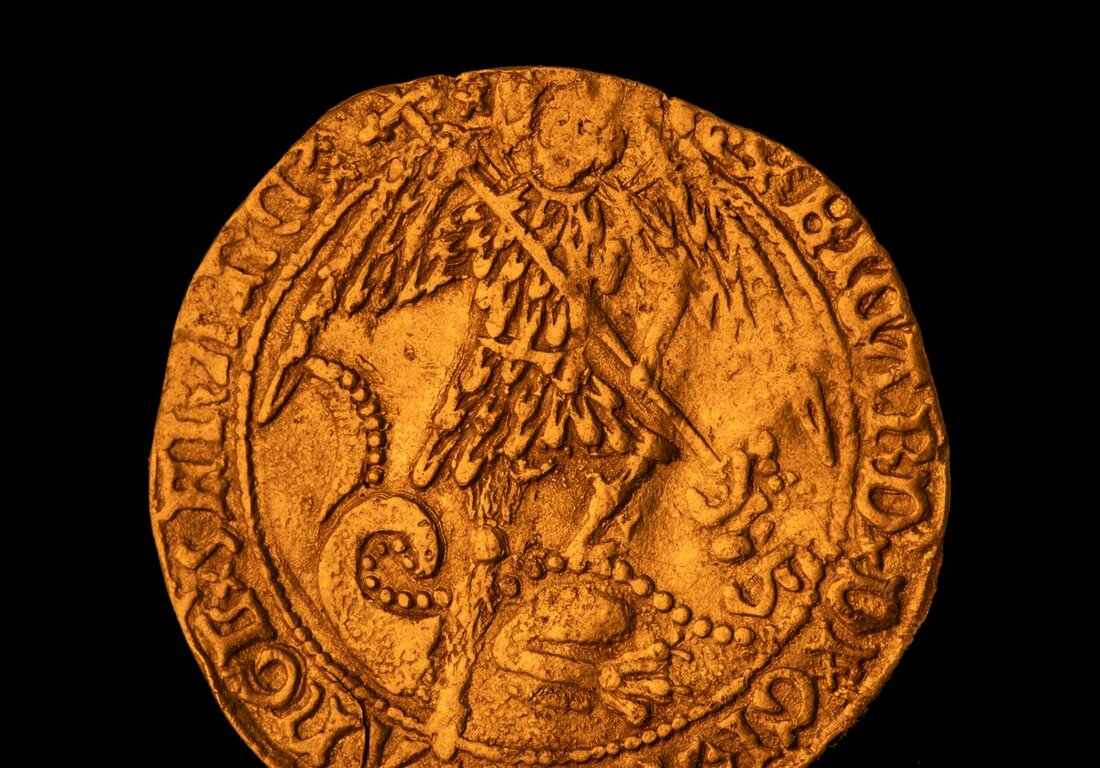
Richard III (1483-1485), Angel, Type 2b, struck 20 July 1483 – June 1484, Tower (London), (m.m) : RICARD .' DI .' GRA .' REX AnGL .' Z FRAnC :, RIC of RICARD over misplaced ...nC of FRANC, saltire stops, including abnormal double before RIC, St. Michael vanquishing Dragon, rev. (m.m.) PER | CRVSEM TVA ' SALVA x NOS XPE x' REDEMPT, saltire stops, ship surmounted by square-topped shield and mast dividing R [over Rose] and Rose, 5.01g [77.31grns], 11h, m.m. BH2 over SR1 [on reverse] (BM 2025 T586, no. 2 this coin; Winstanley, Pl. I, no. 7 and 8 same dies; Webb Ware, dies O4/R8; Lockett V, 4037 same dies [cf. II, 1654 = Beresford-Jones 19 same reverse die, ; Schneider I, 489 same dies; North 1676; Spink 2151), struck softly on portrait on account of an aging obverse die, otherwise on a broad if subtly crimped planchet, the die-sinker's double errors wonderfully clear, as too is the regnal name, strictly very fine, but a celebrated Medieval rarity, especially so in a secure 'Hoard' context
Provenance
~ Found at Silverton (Devon), 20 April 2025 ~
Recorded with the British Museum, ref. PAS DEV-330561
~ Disclaimed under the Treasure Act (1996) ~
This intriguing pair of dies has confounded numismatists for decades, especially in regard to the interpretation and sequencing of the pyx marks and posited overmarks at the beginning of each legend. Drawing on the observations that both RIC of RICARD and the R over the reverse cypher are overpunched, E J Winstanley interpreted such varieties in the seminal thesis on the matter for the BNJ (1942, pp. 179-189 and Pls. I-II).
Sadly, his observations on these dies resulted in a now 'mythic' distinction, his (Pl. I, 7) derived from the Lockett Collection (English Sale IV, lot 4037*) invented a radial die flaw through CRVSEM not actually visible on the Lockett plate nor more importantly the coin itself, as well interpreting the reverse design as plainly 'i.m. BH2 and R over Rose'. Conversely, his (Pl. I, 8), from the Richard Manley-Foster cabinet (1903, lot 66*) was described as "S & R over B.H.2 and R over Rose".
In his analysis, Winstanley postulated: "Mr. Lockett's Angel, the Manley Foster coin, and an Angel in the Ashmolean Museum, all three struck from the same pair of dies, are not early coins. The obverse initial mark on them is B.H.2, but the initial mark on the reverse is difficult to distinguish with certainty."
He continued: "There is the appearance on nos. 7 and 10 of B.H. 2, but there is also something very like S. & R. struck perhaps over the B.H. 2. The reverses of these two Angels are struck from the same die as the reverse of an Angel in the second Roth sale of 1918, lot 207 (no. 5 in my list), but with this difference, that on the reverse of the Roth Angel no S. & R. is visible over the B.H. 2; it was added to the die later.
This remarkable overstrike affords convincing evidence of a second and later use of the Sun and Rose mark and justifies the illustration of both coins (PI. I, 7 & 8). The initial mark on the reverse of the Ashmolean Angel is not clearly struck up. It seems to me that these three coins should be placed in my sequence at the end of the run of B.H. 2/B.H. 2, immediately before the B.H. 2/S. & R. 2 mules."
The R on the reverse has been struck over something, but it is plainly not an R as the Manley Foster catalogue claims it to be. Not only would this be unlikely at this stage of Richard's reign, but as Mr. Whitton points out in his paper on "Die Links between Edward IV, Edward V, and Richard III", published in this number of our Journal, the R appears to be struck over a Rose that perhaps the engraver had placed at first on the wrong side of the cross."
Whilst Winstanley was correct to identify this die match, he appears incorrect to draw a distinction between his nos. 7 and 8; both being over-struck pyx marks, not a "before and after" as he summised from the black and white plate illustrations at the time. To compound the confusion, the sequencing of the marks seems entirely contradictory, in that the "overmark" is usually indicative of the alteration, not of the prototype coin. Ordinarily this revision would sit atop the earlier mark, but in this case, and as evidenced by the Boar's Head unseating part of the topmast, it appears to have been struck shallower than the original mark, leaving parts of the dimidiated Sun and Rose visible within plain parts of the Boar's jaw. This essentially means that the Boar's Head was punched over the Sun and Rose, and not, as concluded before vice-versa. This would also account for the muling of this reverse die with the Boar's Head 1 obverse noted by Winstanley as part of the Bernard Roth collection.
Today that coin is Schneider I, 486 (Type 2a, Webb Ware, dies O1'/R8 [recte]) and with the benefit of in-hand inspection by this cataloguer, conclusively confirms that this and Schneider I, 489 share the same reverse die, and critically the same reverse die state. Given that the earlier coin exhibits a pairing with the Boar's Head 1 transitional pyx mark, the die is presumed to have been in operation shortly after the onset of King Richard's reign proper, but as it is also found paired with Type 3 (SR2, cf. Schneider I, 496), it evidently saw use for most of the 26 months of the King's infamous reign. This cataloguer has little doubt however that the reverse bears an overmark of the Boar's Head 2 with the Sun and Rose 1 pyx mark. Prior to this obversation only one pairing of BH2/SR1 had been identified. This aids in sequencing the positioning of this coin towards the middle of the reign, and not as perhaps has been previously assumed to the transition and 'damnatio memoriae' of the unlucky King Edward V.
Subject to 20% VAT on Buyer’s Premium. For more information please view Terms and Conditions for Buyers.
Sold for
£13,000
Starting price
£8000

Watch, listen and bid as if you were in the room. Now available for auctions worldwide.
Click here to bid live
An exclusive and confidential service for the discerning collector or vendor.
View the Gallery
Download every Spink catalogue on your iPad, iPod or iPhone using free Spink app.
Download From iTunes© 2026 Spink & Son. All rights reserved.