
Auction: 26019 - Stamps and Covers of Great Britain
Lot: 1023
(x) Great Britain
Postal History
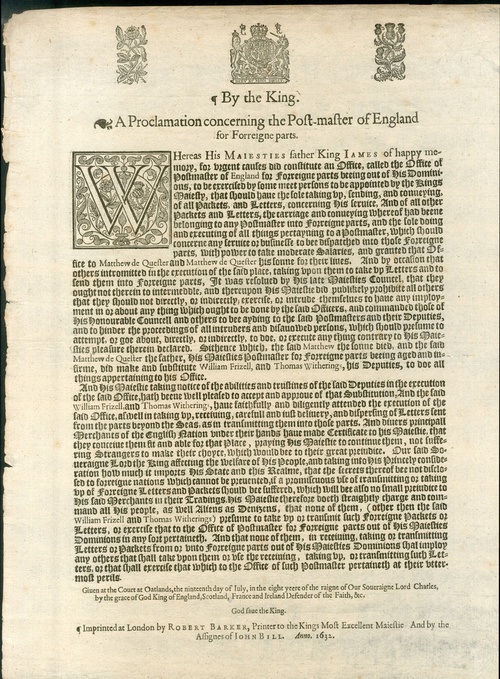
King Charles I Proclamation for 'Foreign Posts' - the Establishment of a Royal, State Mail Service
1632 (19 July) printed proclamation issued from "the Court at Oatlands" imprinted by Robert Barker, London and by the Assignes of John Bill, on laid paper (c.310x405mm.).
Titled "By the King. A Proclamation concerning the Post-master of England for Forreigne parts." concerning the role of Postmaster which had been given by the late King James I to Matthew de Quester and Matthew de Quester, his son although "others introcomitted in the execution of the said place, taking upon them to take up Letters and to send them into foreigne parts, It was [therefore] resolved by his late Majesties Councel, that they ought not therein to intermeddle, an thereupon his Majestie did publikely prohibite all others that they should not directly, or indirectly exercise or intrude themselves to have any imployment in or about any thing which ought to be done by the said Officers, and commanded those of his honourable Councell and others to bee ayding to the said postmasters and their Deputies, and to hinder the proceedings of all intruders and disavowed persons, which should presume to attempt, or goe about, directly, or indirectly, to doe, or execute any thing contrary to his Majesties pleasure therein declared. Sithence which, the said Matthew the sonne died, and the said Matthew de Quester the father, his Majesties Postmaster for foreigne parts beeing aged and infirme, did make and substitute William Frizell, and Thomas Witherings, his Deputies, to doe all things appertaining to his Office."
Frizell and Witherings had clearly acquitted themselves well and "have faithfull and diligently attended the execution of the said Office, as well in taking up, receiving, carefull and just Delivery, and Dispersing of Letters sent from the parts beyond the Seas, as in transmitting them into those parts ... Our said soveraigned Lord the King affecting the welfare of his people, and taking into his Princely consideration how much it imports his State and this Realme, that the letters thereof bee not disclosed to foreigne nations which cannot be prevented, if a promiscuous use of transmitting or taking up of Foreign Letters and Packets would be suffered ... his Majesty therefore doeth straightly charge and command all his people, as well Aliens and Denizens, that none of the, (other then the said William Frizell and Thomas Witherings) presume to take up or transmit such foreigne Packets or Letters, or exercise that to the Office of Postmaster for foreigne parts out of his Majesties Dominions in any sort pertaineth. And that none of them, in receiving, taking or transmitting Letters or Packets from or unto Foreigned parts out of his Majesties Dominions shall imploy any others that shall take upon them or bee the receiving, taking up or transmitting such letters, or that shall exercise that which the Office of such Postmaster pertaineth at their uttermost perils".
Some wear to the edges and slight fragility in the paper as to be expected of a large document of this age. A most important philatelic and historical document, unique outside of institutional collections, establishing the official, State Postal Service for foreign mail.
"Notes: King James I had appointed Mathew De Queser Postmaster for England and Foreign Parts in 1619; he and his son, Mathew would hold this position until 1632. This new, official service looked to formalise the network of private messengers exclusively used up until this point, especially for foreign mails, and reflected the increase in international trade between England and Europe.
The implementation of King James' foreign posts was certainly not efficient or smooth; in face, from the moment of De Quester's appointment he was opposed by other claimants to the position who felt it should be theirs. Moreover, those who had previously carried foreign mails privately saw James' proclamation as a form of state monopoly and, strangely, in 1626 the Privy Council issued an order licensing all merchant companies to send letters overseas using their own messengers; only then to about turn in October and permit only the Merchant Adventurers this role. In January of the following year, the Council then issued an order "prohibiting all persons from conveying letters to or from foreign parts, except such as should be employed by Matthew De Quester".
Conversations, disputes, proclamations and orders of this nature, in favour of one then the other, and a general confusion over the role pervaded the De Quester's tenure, and may ultimately have hindered any efforts to improve the service. Historians of this period have characterised his methods as somewhat haphazard relying on a group of messengers, as well as friends of his and existing postal networks throughout Europe. The terms of employment often sketchy, and the weather proving a consistent obstacle. In addition, it is clear that the service remained costly: packets sent by ordinary mail to Paris, Madrid, Zurich, The Hague and Constantinople for example cost 20/- each; express deliveries ranged from £10 to £60
De Quester's final days in office must have been difficult, having survived his son who he must have hoped could continue the family business after him, and having suffered much criticism through his years. In Spring of 1632, he retired and old his interest to his two deputies, Willia Frizell and Thomas Withering. In the document offered here, King Charles I officially appoints them both and give them his approval. The decision did not, of course, come without its critics. Sir John Cooke noted that mail had not arrived from Germany, the Hague and Brussels, laying the fault on messengers who were accused of "minding their won pedalling traffic more than the service of merchants", but ultimately believed that Frizell and Witherings would reform the service.
Frizell and Witherings mortgaged their positions as Postmasters and raised capital of £1,000 from Thomas Howard, Earl of Arundel in order to fund the overhaul of the system required. Initially beset with issues, the pair put into place a series of practical measures to improve the service including setting exact places and timings for the drop-off of mail and ensuring their prompt forwarding on arrival on foreign coasts, all while saving the Crown £2,000 a year in the costs of express mails. In doing so, they put into motion the "New Post", and a service that much more closely mirrors that of a modern-day postal service.
While at first the service improve greatly, all would not be plain sailing, and by 1640 a proclamation was announced that dismissed Witherings for "divers abuses and misdemeanours committed" - he was charged on accusations of inefficiency, corruption and breach of agreement. Throughout his tenure he was accused of using his position for personal gain and there is evidence of some 'sharp' business practice that seems to have lined his pockets well. Despite all this though, it is widely agreed that Witherings acquitted himself well and vastly improved the service. This document, unique in private hands, marks an important turning point in the modern posts. The National Library of Scotland records only five copies, all in institutional collections: British Museum, Public Record Office, Privy Council, Society of Antiquaries, Bibl. Lindes.
Reference to: 'Thomas Witherings and the Reform of the Foreign Posts, 1632-40', Kevin Sharpe, Bulletin of the Institute of Historical Research, Volume 57, Issue 136, November 1984, Pages 149–164
Subject to 5% tax on Hammer Price in addition to 20% VAT on Buyer’s Premium.
Estimate
£10,000 to £15,000
Starting price
£7500
Watch, listen and bid as if you were in the room. Now available for auctions worldwide.
Click here to bid live
An exclusive and confidential service for the discerning collector or vendor.
View the Gallery
Download every Spink catalogue on your iPad, iPod or iPhone using free Spink app.
Download From iTunes© 2026 Spink & Son. All rights reserved.