Auction: 26003 - Orders, Decorations and Medals
Lot: 243
(x) 'Sir, On behalf of myself and crew, I beg leave to express to you the heartfelt gratitude we feel for the assistance you rendered to us when, on the 5th instant [December 1839], the vessel I commanded, the Scotia, bound from Quebec to Greenock, being waterlogged, and myself and my people worn out with continual exertion (and still, unfortunately, unable to keep her free), you promptly consented to take us off, and thereby rescued us from certain death. For all the kindness and generous treatment we have subsequently received from you, we thank you from our hearts, and in the prayers of ourselves and families you never can be forgotten.'
So wrote Captain Jeans of the Scotia to Captain Collins.
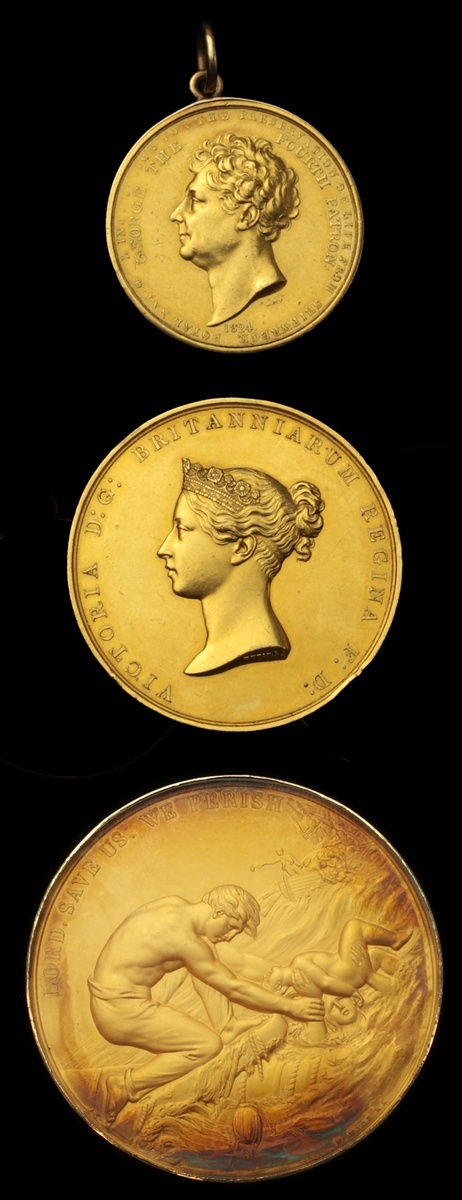
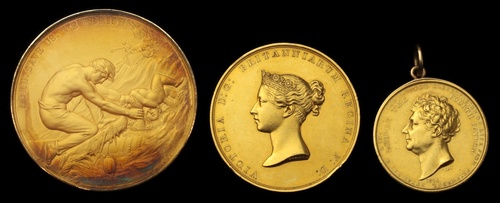
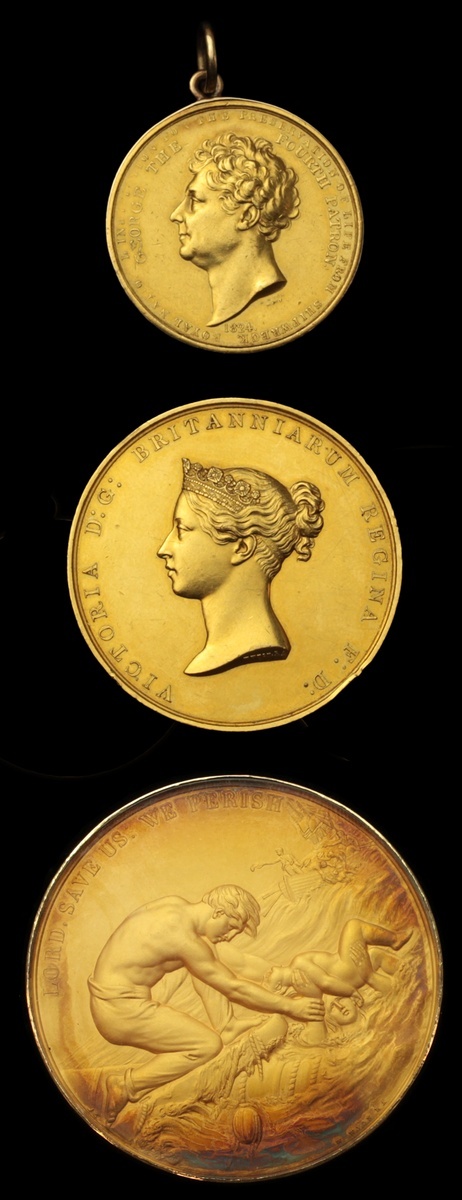
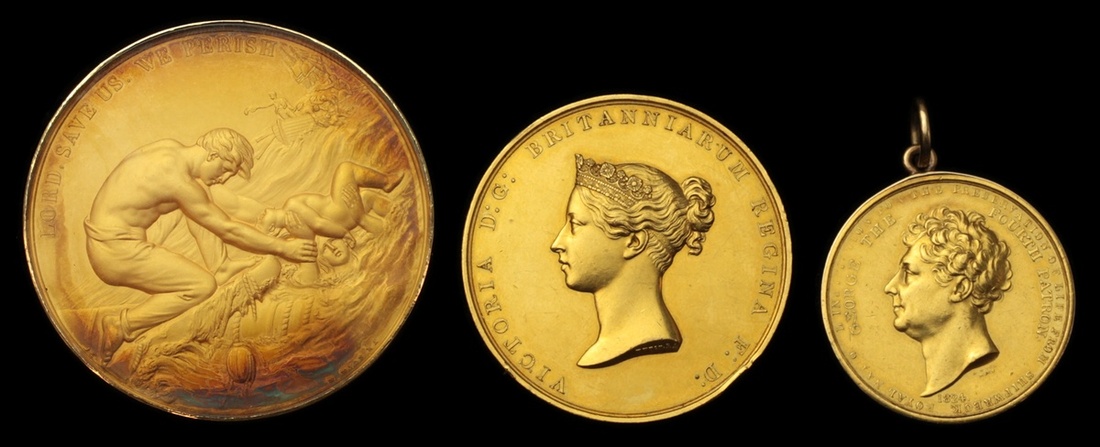
The remarkable and unique 1839 S.G.M., R.N.L.I. and L.S. & H.S. group of three gold medals awarded to Captain J. Collins, American Merchant Marine - the recipient of the first Liverpool Shipwreck and Humane Society Gold Medal
Sea Gallantry Medal (Foreign Services), first large type (1842-49), gold, 45mm, with specially struck reverse ‘From the British Government to Captain John Collins of the American Packet Ship Roscius 1839'; Royal National Institute for the Preservation of Life from Shipwreck, G.IV.R., gold (Captn. John Collins. Voted 8 Jany. 1840.), fitted within a thin gold frame bearing the naming details and loop for ring suspension as usual; Liverpool Shipwreck and Humane Society, Large Gold Medal, 56mm, gold with lunettes, all housed within a damaged custom fitted leather case of issue by A. Rumrill & Co., 264 Broadway, New York, good very fine (3)
Total weight - 247.9g (S.G.M. - 65.3g; R.N.L.I. - 40.5g; L.S. & H.S. - 142.1g). S.G.M. & R.N.L.I. both test at around 97% purity.
Originally conceived in 1839, the Sea Gallantry (Foreign Services) Medal was first awarded in 1842, in gold, silver and bronze to foreigners for saving the lives of British subjects at sea. In this first period each medal had a specially die-struck reverse but, due to the enormous cost of doing this, it was decided in 1849 that two standard reverses would be used: ‘For Saving the Life of a British Subject’, and ‘For Assisting a British Vessel in Distress’. This large size (1.78 inches) remained in use until 1854 when it was reduced in size to 1.27 inches. It is not known how many large gold medals of the earlier type (1842-49) were awarded but a total of 96 gold medals were awarded prior to being down-sized in 1854, the awards becoming more frequent in the latter years of this period. It may be fair to assume that perhaps 25 or less gold awards were made with special inscriptions, although the true number may be significantly fewer; given the rise in gold bullion values in the last century many must also have been considered to have fallen to the smelters pot. No example held in National Maritime Museum or Royal Navy Museum.
R.N.L.I. Gold Medal voted on 8 January 1840, as recorded in Lifeboat Gallantry:
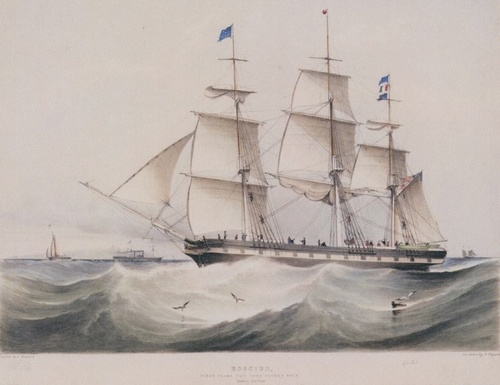
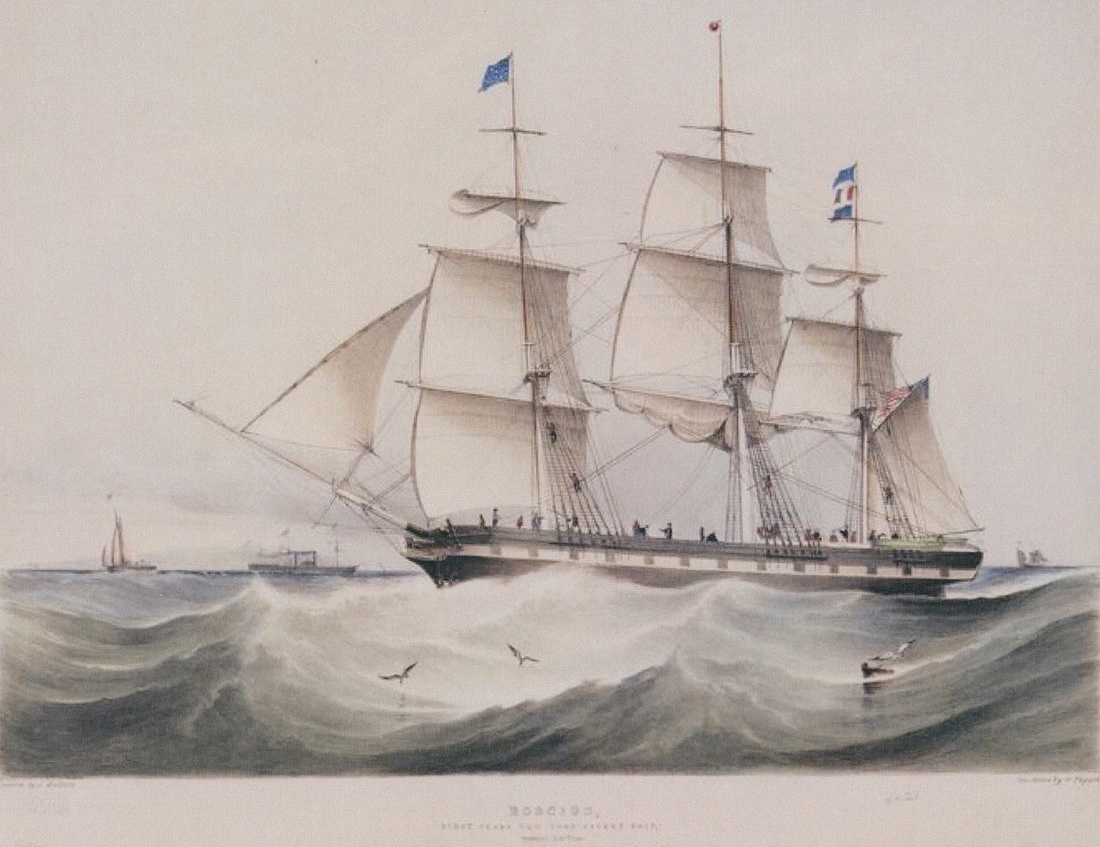
'5 December 1839: The American packet ship Roscius, at position 46° North, 33° West, 1000 miles east of Newfoundland, fell in with the 600-ton timber ship Scotia, which had been en route from Quebec to Glasgow. The ship was lying waterlogged with 17 feet of water in her hold but, as Captain Collins tried to get near, the wreck pitched so heavily and staggered under the influence of the heavy sea that his command was seriously endangered. Drawing clear, he picked up all of the survivors from their own boats and succeeded in rescuing the Master and 23 men who were landed safely at Liverpool.
This medal was awarded in recognition of 'his admirable conduct on the occasion'.'
The Liverpool Shipwreck and Humane Society was founded in April 1840, after the sum of £3,291. 6s. 3d. was transferred to the formation of the Society. Its first awards covered the period from April 1839 to that date. The objects of the Society were clearly laid out in its first Report:
'First - The Preservation of Life from Shipwreck.
Second - The providing of Relief for the immediate necessities of the unfortunate Sufferers wrecked on the shores contiguous to the Port of Liverpool.
Third - The Reward of Persons instrumental in rescuing Life from Shipwreck.'
It was thus reported that the award to Captain Collins was the first Gold Medal to be listed for his acts of bravery in the rescue of the Scotia. The Report notes with great excitement that Wyon, without a doubt the finest medallist of the era, was to prepare the dies for them but that '...it is not expected that they will be ready for some months.'
It may be speculated that due to the busy nature of Collins, he was soon back to sea and was unable to await the engraving of the Medal once it was prepared for the Society. With the kind assistance of Tony Jones, Trustee of Liverpool Shipwreck and Humane Society, it has been possible to examine both the first Silver Medal to Thomas Bourne and a later Large Gold Medal to Chief Officer Loudon - both of these named. The Medals of Collins & Bourne both exhibit the same frosted finish, whilst that of Loudon has a polished finish from a later manufacturer.
John Collins was a scion of the family who ran the famous Collins Line of vessels across the Atlantic. His vessel Roscius, a 1,100 ton packet ship had been launched in 1838. She was named after the Roman actor Quintus Roscius and operated by the shipping enterprise founded by Edward Knight Collins. She came to prominence the following year, an act which saw her Captain take three Gold Medals for his bravery in saving life at sea. The events are summarised by the official citations but the best account at length comes from Dr Madder, a passenger on the Roscius, who wrote for The Sun on 16 December 1839:
'Fifth of December, p.m., fell in with the wreck of the Scotia, bound from Quebec to Glasgow, burden 600 tons, loaded with timber, water-logged, in latitude 46, longitude 32 30. (On seeing signals of distress flying, we altered our course and bore down on her, and on the Roscius approaching her, Captain Collins hailed her the answer was, "We are water-logged-seventeen feet water in her hold!"
The prompt reply of Captain Collins was, "If you want to come on board put out your boats." A cheer from the people of the sinking vessel followed; such a cry as men in desperate circumstances alone could utter, and that thrilling cry went up as the simultaneous shout of men in the extremest peril suddenly restored to life and hope, and instantly every hat and cap was seen waving on the crowded poop.
An effort was now made to approach us, but the water-logged vessel was utterly unmanageable-she pitched heavily, as if she would have gone down head-long, the seas swept over her, and as she rose poured through her broken ports. Her mizentop mast, and fore and maintop gallant masts had been cut away to ease her, and the poop deck where the crew were congregated seemed the only place of safety left them.
In attempting to near us she came staggering down on us, and we were compelled to make sail to get out of her way. The sea was very heavy we again lay to, and were then about a mile from the Scotia. Night came on, and no boats were seen the unfortunate Scotia was then lost sight of altogether. About six o'clock Captain Collins hoisted a lantern, and the light was immediately answered by the Scotia; it was the opinion of Captain Collins that one of their boats had put off and had been swamped in attempting to reach us, and that the survivors had determined to wait till morning before another attempt was made. It seemed, indeed, doubtful in the extreme if any small boat could live in such a sea. It is impossible sufficiently to commend the conduct of Captain Collins, his anxiety to reach Liverpool before the steamer which was to have sailed six days after us made every moment of importance, we had moreover 70 steerage passengers and 21 in the cabin, and to forego taking advantage of a fair wind, and to lay to for a night in a heavy sea, with every appearance of a heavy gale, was a determination which I greatly fear many a master of a ship would have found great difficulty in coming to.
Captain Collins, however, made this resolution promptly, and without any expression of impatience at the detention it occasioned. His only observation was "We must stay by the poor devils at all events till morning-we can't leave them to perish there, din it." May we not hope when "the accusing spirit flew up to Heaven's chancery with the oath, and blushed as he gave it in, the recording angel as he wrote it down, dropped a tear upon the word, and blotted it out for ever."
At seven p.m. cheering was heard in the direction of the Scotia; the people, we supposed, had taken to the boats, and had then left the sinking vessel. In the course of an hour, or rather less, the long-boat of the Scotia, filled with men, was on our lee quarter. By the admirable arrangements which were then made by Captain Collins for rescuing them, the men were taken on board without the least accident. This boat: brought 18; the Captain and five men had still remained on board, and were preparing to put off in the jolly boat. No little anxiety was felt for the safety of this small boat; in the course of half an hour however she was seen, and with two oars only she gained the Roscius, and the Captain and his fivemen were soon taken on board. To the credit of the poor master of the Scotia, be it observed, that he, Captain Jeans, was the last man to leave the sinking ship. The anxiety expressed by the men who came in the first boat for the safety of their Captain; and, indeed, the terms in which the whole of his people, then and subsequently spoke of Captain Jeans, showed how highly he was respected and esteemed by his crew, and if he had not been so, he would probably not have kept his ship afloat so long as he had done. Nor was the anxiety of Captain Jeans for the safety of his crew, less manifest; the first question he asked on coming on board the Roscius was, "Are all my people safe?" The captain and crew were all Scotch, and their conduct throughout reflected no discredit on their country.
When they came on board they were worn out with continual exertion. The men had been night and day at the pumps since the previous Tuesday, but, exhausted as they were, they immediately turned to, and with one accord went on deck and did duty with our crew; and no sooner were the boats cast adrift, than there was ample occasion for their services- a violent gale from the north-east set in, which must rendered it utterly impossible utterly impossible tor the people to have taken to their boats, and the violence of which on the following day must have been inevitably fatal, for it would have been impossible to have kept the pumps going and the sea already, even before the gale from the north-east set in, was making a clear breach over her, and threatening to carry away her poop-cabin, the last place of refuge left the poor people of the Scotia, except the top, where they had already stowed water and provisions, in the momentary expectation of being compelled to abandon the deck-and thus providentially were twenty-four human beings preserved from a watery grave.'
Similar reports were reported in many other newspapers. Besides his medallic rewards, a silver pitcher engraved to the recipient from the Cabin Passengers is now held in the collection of the Mystic Seaport Museum, Connecticut. Collins was again to the fore in the rescue of the Erin-go-Bragh in December 1841; sold together with copied research.
Subject to 5% tax on Hammer Price in addition to 20% VAT on Buyer’s Premium.
Estimate
£25,000 to £30,000
Starting price
£24000
Watch, listen and bid as if you were in the room. Now available for auctions worldwide.
Click here to bid live
An exclusive and confidential service for the discerning collector or vendor.
View the Gallery
Download every Spink catalogue on your iPad, iPod or iPhone using free Spink app.
Download From iTunes© 2026 Spink & Son. All rights reserved.