Auction: 26003 - Orders, Decorations and Medals
Lot: 242
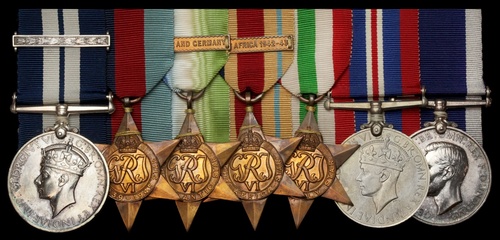
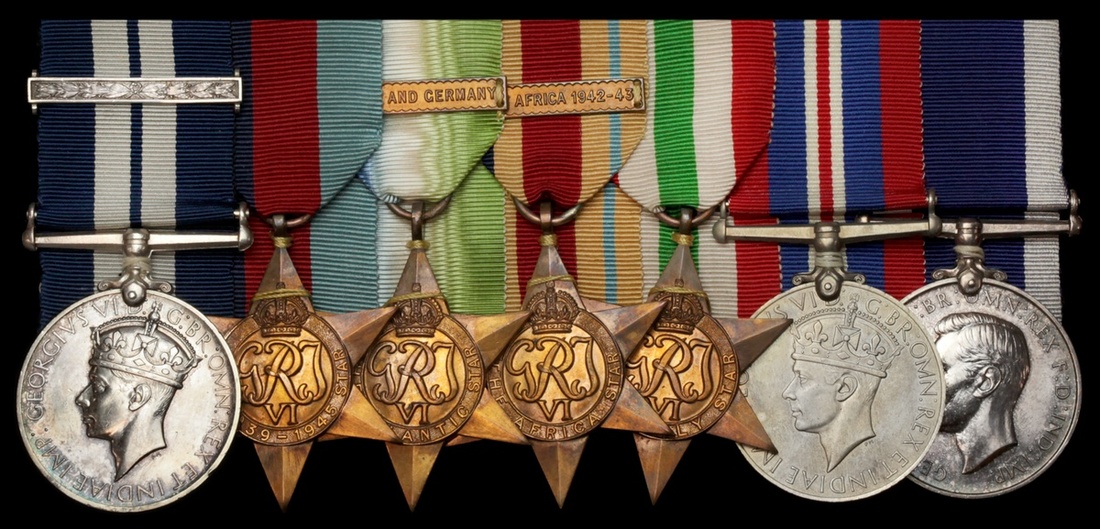
A fine Second War D.S.M. and Bar group of seven awarded to Able Seaman R.W. Clapton, Royal Navy, a Higher Submarine Detector who was thrice decorated in encounters with U-Boats whilst serving in H.M.S. Pelican, a successful anti-submarine sloop which also saw action at Narvik
Distinguished Service Medal, G.VI.R., with Second Award Bar (J. 106185. R.W. Clapton. A.B.); 1939-45 Star; Atlantic Star, 1 clasp, France and Germany; Africa Star, 1 clasp, North Africa 1942-43; Italy Star; War Medal 1939-45; Royal Navy L.S. & G.C., G.VI.R. (J. 106185. R.W. Clapton. A.B. H.M.S. Defender.), mounted court style for wear by Spink & Son Ltd, minor contact marks, very fine (7)
D.S.M. London Gazette 19 October 1943, the original recommendation states:
'Coolness and skill as H.S.D. operator in carrying out attacks which led to the very probable destruction of a U-Boat on 6th May and to the certain destruction of a U-Boat on 14th June 1943.'
D.S.M. Second Award Bar London Gazette 24 October 1944, the original recommendation states:
'Coolness, skill and devotion to duty in action against U-Boats, which has resulted in one being damaged on 1st September 1943 and in the certain destruction of another on 14th April 1944. Clapton gained, and maintained contact with the latter U-Boat under very difficult conditions for over three hours until it was finally destroyed, Pelican throughout the period being the only ship in contact.'
M.I.D. London Gazette 3 November 1942, the original recommendation states:
'Able Seaman Clapton was Asdic Operator in all Pelican's three encounters with U-Boats on 11th, 12th and 14th July 1942: during the many attacks he held contact with calm assurance and skill, often in difficult circumstances, and he has never failed to give a quantity of accurate and reliable information. On 12th July when a shallow pattern had damaged the Asdic transmittal panel, Clapton discovered a defect and repaired it and was again in contact with the U-Boat 12 minutes later.'
Roy William Clapton was born at Chipping Norton on 12 January 1906 the son of William and Alice Clapton of 20, Middle Row. He was working as a farm boy when he enlisted in the Royal Navy as a Boy 2nd Class on 8 September 1922. He trained on HMS Impregnable at Devonport and on HMS Calliope. He then joined the crew of the light cruiser HMS Dunedin on 31 August 1923 and was made an Ordinary Seaman when he turned 18 and served aboard her until May 1924. Spells aboard the cruisers Chatham and Southampton were followed by training at the shore base Pembroke, where he was made up to an Able Seaman. Between November 1924 and December 1925 he served on the destroyer HMS Whitley in reserve at Rosyth. On 7 April 1926 he joined the crew of HMS Enterprise, a newly commissioned Emerald Class light cruiser. After several months in home waters, Enterprise served with the British 4th Cruiser Squadron in the East Indies her first commission ending in December 1928.
He left the ship in January 1929 and spent time serving ashore and on depot ships. In April 1932 he joined the crew of the destroyer HMS Keith, serving with her in the 4th Destroyer Flotilla in the Mediterranean, until the ship returned to Chatham for a re-fit in September 1933. His next ship was the patrol sloop HMS Kingfisher which had been commissioned in 1934 and was with her to July 1935. Home on leave in December 1934 he had married Ruby Roberts, from Moreton-in-Marsh, in Portland. He joined the flotilla leader HMS Campbell and then the C class destroyer HMS Kempenfelt in 1936 and 1937. At the outbreak of war in September 1939 he was serving aboard HMS Pelican an Egret class sloop.
She was involved in convoy defence duties in the North Sea. In April 1940 Pelican took part in the Norwegian Campaign and was badly damaged in an air raid off Narvik. After repairs Pelican returned to local escort work but spent much of 1941 under repair following enemy action and accidental damage.
In January 1942 Pelican was assigned to 45 Escort Group escorting OS/SL convoys to and from West Africa. In July 1942 she took part in the destruction of U-136 while escorting convoy OS 33. In October she was part of the escort force for Operation Torch. After repairs and a refit Pelican was appointed senior officer's ship to 1st Support Group, tasked with reinforcing convoys under attack. In May 1943 the group joined the battle around convoy ONS 5, sinking U-438. In June with ONS 10, Pelican sank U-334. In the autumn of 1943 1SG worked on the Gibraltar route, but saw little action. Roy Clapton was awarded the Distinguished Service Medal in October 1943 for bravery and resourcefulness on active service at sea.
In March 1944 after a further refit Pelican was assigned to 7 EG patrolling outside the Bay of Biscay; there she took part in the destruction of U-448. In June 1944 Pelican was part of Operation Neptune, escorting troops and supplies to and from Normandy until withdrawn for refit prior to joining the British Pacific Fleet. On 24 October 1944 he was awarded a bar to his DSM for actions at sea. HMS Pelican was accidentally damaged at Aden en route to Australia and spent the remainder of the war in various dockyards under repair.
Able Seaman Clapton finished the war at HMS Golden Hind a shore base near Sydney. After returning home towards the end of the war he was awarded the Distinguished Service Medal and Bar at an Investiture held by King George VI at Holyrood House in Edinburgh. He died in 1979 aged 73; sold together with copied research, his original M.I.D. certificate and copy Admiralty recommendations for all awards.
Subject to 20% VAT on Buyer’s Premium. For more information please view Terms and Conditions for Buyers.
Estimate
£1,800 to £2,200
Starting price
£1400
Watch, listen and bid as if you were in the room. Now available for auctions worldwide.
Click here to bid live
An exclusive and confidential service for the discerning collector or vendor.
View the Gallery
Download every Spink catalogue on your iPad, iPod or iPhone using free Spink app.
Download From iTunes© 2026 Spink & Son. All rights reserved.