
Auction: 26003 - Orders, Decorations and Medals
Lot: 244
Sold by Order of the Family
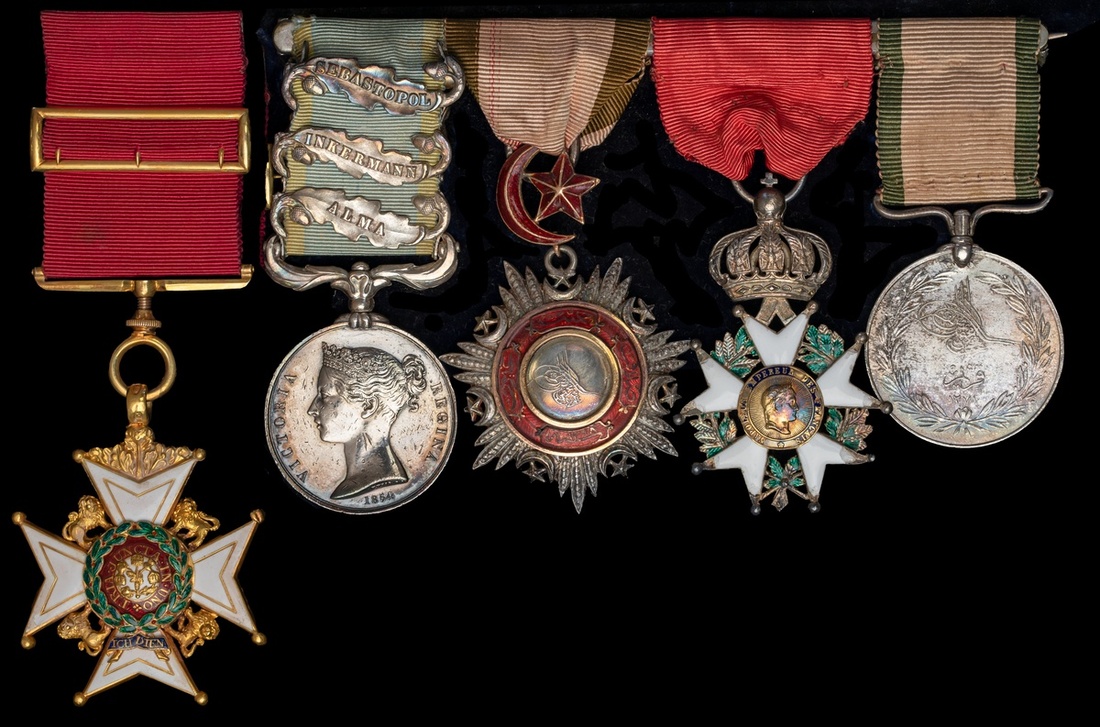
The fine C.B. group of five awarded to Lieutenant-General, C. Adams, 49th (Princess Charlotte of Wales's) (Hertfordshire) Regiment of Foot, whose impressive 45-year career saw him serve throughout the Crimea (where he was wounded during the Battle of Inkermann) and later as commander of Belgaum, Bombay and Gibraltar
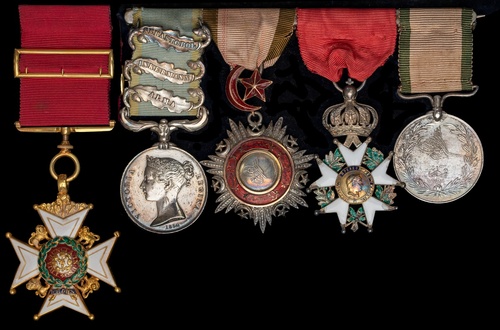
The Most Honourable Order of the Bath, Companion's (C.B.) Military breast Badge, gold and enamel, hallmarks for London 1870, fitted with swivel-ring suspension and riband buckle, mounted individually for wear; Crimea 1854-56, 3 clasps, Alma, Inkermann, Sebastopol (Captn. C. Adams. 49th Reg.); Turkey, Ottoman Empire, Order of the Medjidie, 5th Class breast Badge, silver and enamel; France, Second Empire, Legion of Honour, Chevalier's breast Badge, gold, silver and enamel; Turkish Crimea 1855, Sardinian die, fitted with replacement suspension, the latter four mounted together for wear, housed behind glass in an attractive wooden case, C.B. with two finial balls slightly bent, heavy contact wear to Crimea Medal, Legion of Honour with extensive enamel damage and bent finials, otherwise very fine throughout (5)
C.B. London Gazette 24 May 1873.
Cadwallader Adams was born on 6 May 1825 at Ansty Hall in Warwickshire, one of eight children born to High Sheriff Henry Cadwallader Adams and his wife Emma Curtis. He entered the Army in 1845 at the age of 20, and quickly progressed through the ranks to be promoted Captain in 1851.
Adams served with the 49th (Princess Charlotte of Wales's) (Hertfordshire) Regiment of Foot throughout the Crimea campaign; his older brother, Henry William, also served in the campaign as Brigadier-General in command of the 2nd Brigade, 2nd Division. The two brothers saw action together at the Battle of the Alma (20 September 1854) where the 49th were part of the elder Adams' Brigade and positioned on the British right flank. With the burning village of Bourliouk blocking their advance, the battalion divided to march in fours around the inferno. Fortunately for Cadwallader and his men, the resulting column of smoke screened their movements from Russian artillery on Telegraph Hill and casualties were relatively light. However, the 49th saw heavy action at the Battle of Inkerman a couple of months later: the infamous "Soldier's Battle" was fought on 5 November under heavy cover of fog, with the men of the battalion ordered to hold Home Hill until given the order to advance on the Russians. The opposing sides met in the valley and the Russians were forced into a disadvantageous position by the bottleneck formation of the landscape: the British fired a volley into the advancing Russian column and charged in with bayonets, swiftly driving their enemy back to Shell Hill.
Both Adams brothers were wounded during the battle and, whilst Cadwallader recovered from his injuries, sadly Henry did not. The elder brother had, in addition to his wound, had his horse killed from under him and was rescued by Sergeant George Walters (earning the NCO the Victoria Cross, one of three to the regiment for the Crimea); being sent to Scutari Hospital, Henry died there a week later and his body was repatriated to England to be interred in the family vault.
Having recovered from his wounds, the younger Adams next saw action at the siege and fall of Sebastopol and was involved in two attacks on the Redan, on 18 June and 8 September respectively (the first date deliberately chosen as the 40th anniversary of Waterloo), for which he was mentioned in dispatches.
At the end of the Crimea campaign Adams and his men returned home and, in 1869, the now-Colonel Adams was appointed commander of the Belgaum district of Bombay. Whilst in India, on 18 July 1871 he was married to Anna Catherine Elizabeth Stopford, daughter of Brigadier-General James Stopford C.B., at Bombay. The couple went on to have issue of two sons and two daughters; one son, George Adams Stopford, would follow his father into the army and was a Major in the famous Lancashire Fusiliers when he was sadly killed in action at Gallipoli on 11 May 1915. The Adams' two sons were born in Bombay in 1872 and 1873, with a daughter born the following year in Sussex when the couple returned to England.
In 1875, Adams was appointed to the command of the 4th Brigade Depot at Richmond in Yorkshire, with the family settling at The Hall in Spennithorne. He held this role until being appointed commander at Gibraltar in 1881, a post he held until 1883. Whilst still in Gibraltar, Major-General Adams was promoted to Lieutenant-General (23 October) and he finally retired from the Army in 1889 after an impressive 45 years of service.
After his retirement, the family had moved to Budden Green in Cuckfield, East Sussex by 1891. Adams spent the rest of his life in Cuckfield, where he died whilst residing at Butlers Green House in Haywards Heath on 10 February 1893 at the age of 67. A wealthy man, upon his death he left his widow Anna an estate of £22,367 - worth in excess of £3 million today. There is a memorial to Lieutenant-General Adams in St. James Church at Ansty; sold together with copied research.
For the recipient's General Officer's pattern sword, please see Lot 385; for the Russian bugle found on the field at Inkermann and brought home as a trophy, please see Lot 386.
Subject to 20% VAT on Buyer’s Premium. For more information please view Terms and Conditions for Buyers.
Estimate
£1,800 to £2,200
Starting price
£1400
Watch, listen and bid as if you were in the room. Now available for auctions worldwide.
Click here to bid live
An exclusive and confidential service for the discerning collector or vendor.
View the Gallery
Download every Spink catalogue on your iPad, iPod or iPhone using free Spink app.
Download From iTunes© 2026 Spink & Son. All rights reserved.