
Auction: 26003 - Orders, Decorations and Medals
Lot: 241
'Over the R./T., Lieutenant Buller, the C.O. of M.T.B. 666, called up Gemmell. His plight was desperate, yet he spoke casually and seemed so unconcerned that it sounded as if he was telephoning a friend ashore. On the bridge we listened to him (the message was amplified for all to hear) reporting in his usual matter-of-fact tone, "I'm in a bad way, with all engines disabled. I've lost some men over the side and am preparing to abandon ship. I've destroyed the CBs [Confidential Books]. I've got one of the blighters snooping around my stern, and another steaming up the starboard side … ".'
Able Seaman Randall Tomlinson recounting the desperate plight of M.T.B. 666 on the night of 4-5 July 1944; see Dog Boats at War, by Leonard C. Reynolds, O.B.E., D.S.C.
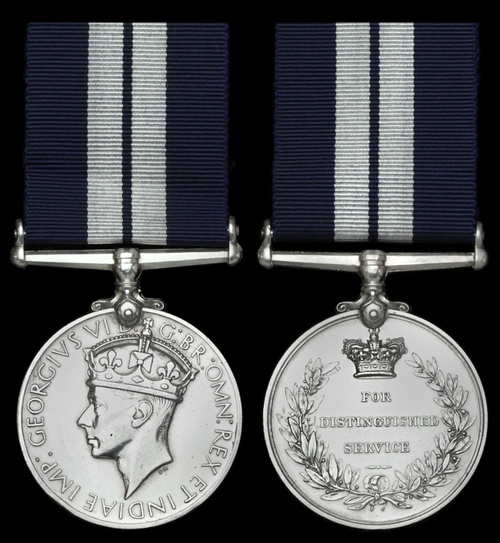
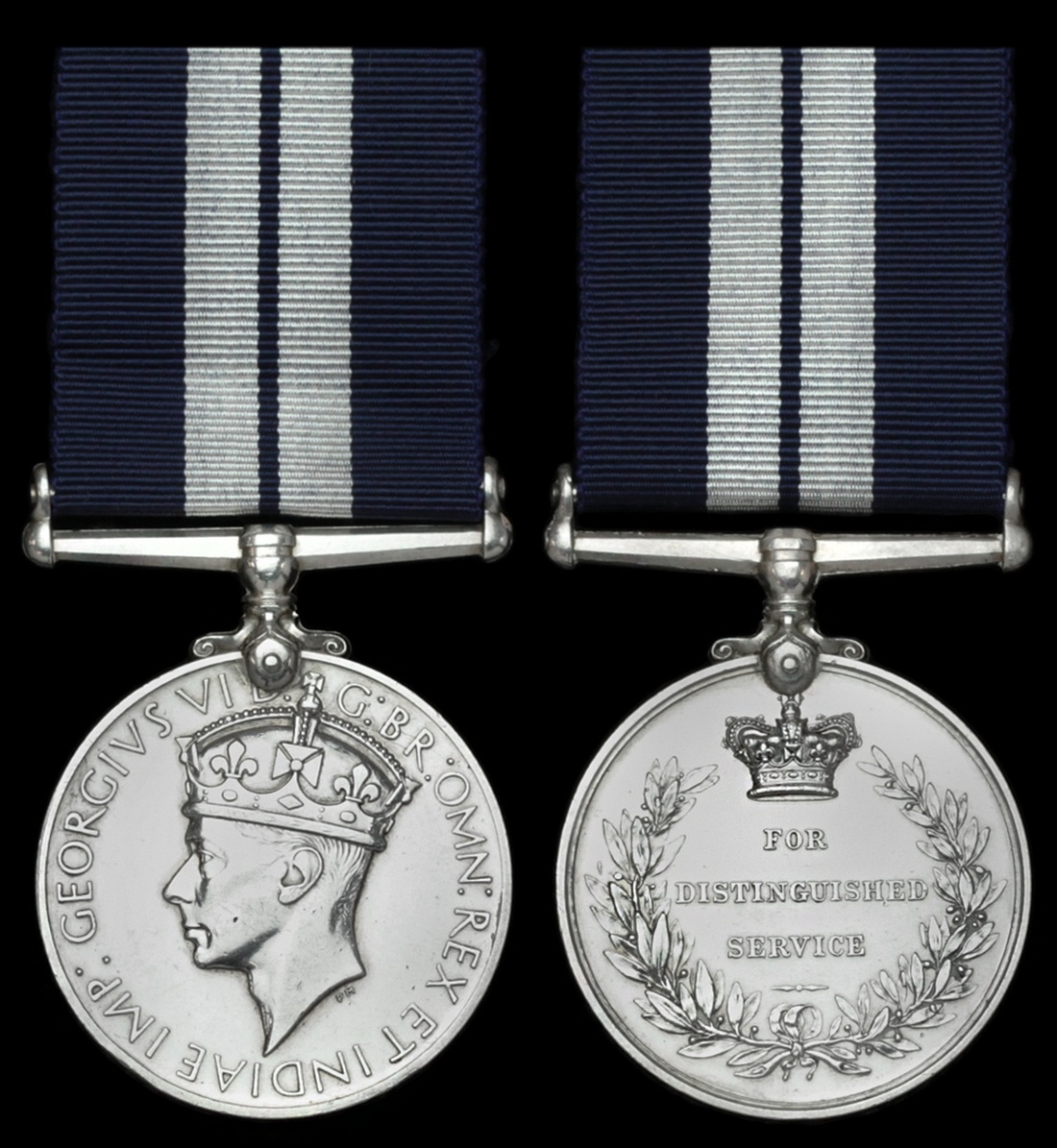
The fine Second World War 'Coastal Forces' D.S.M. awarded to Able Seaman A. Hastie, Royal Navy, who won his award for several actions in M.T.B. 666 off the Dutch coast in June 1944, he later became a Prisoner of War when M.T.B. 666 was sunk off the Dutch coast on 5 July 1944
Distinguished Service Medal, G.VI.R (A.B. A. Hastie. C/JX.407420), officially engraved naming, pitting, slight edge bruise, overall nearly very fine
D.S.M. London Gazette 19 September 1944, official recommendation states:
'For outstanding courage, coolness and devotion to duty in action against strong enemy forces on the nights of 9/10th, 14/15th and 26/27th June. During the second action, an incendiary shell fell in the gun casing. This rating recovered it with his hands and threw it overboard with complete disregard for his own personal safety.'
Archibald Hastie from Craigmillar, Edinburgh enlisted in the Royal Navy and was posted to Coastal Forces. At the time of his award, he was serving in MTB 666.
Norwegian waters - Cloak and Dagger - Christmas trees
Dog Boats at War, by Leonard C. Reynolds, O.B.E., D.S.C., takes up the story:
'Another of the 58th Flotilla boats to arrive early at Lerwick was M.T.B. 666, commanded by Lt. D. N. Buller. On 13 December [1943], there was an urgent call for a boat to carry out a clandestine operation (known in the boats as 'cloak and dagger'), and as no other boat was available, Buller found himself plunged in at the deep end on his first patrol in these waters. One-boat operations were, in fact, rare. It was a complete success: he landed fuel and radio equipment to agents and brought back ten refugees.'
Reynolds continues:
'The weather and winter seas were still the greatest threats in the minds of the crews. One morning in February 1944, M.T.B. 666 had been on patrol with M.T.B. 625 of the Norwegian Flotilla. They left the coast after an uneventful night in the Inner Leads, but were met by an appalling north-easterly gale and the boats were separated. A few miles off the Norwegian coast, 625's keel was broken, and her forward compartments began to flood. Torpedoes were fired and ammunition thrown overboard to lighten the boat. During the night that followed the R.A.F. station at Sumburgh Head (the most southerly point of Shetland) recorded the amazing wind velocity of 130 m.p.h. 625 struggled westward and, kept afloat by the partially empty fuel tanks, hardly manoeuvrable and with only one engine running, she was beached in Shetland. She was wrecked in a salvage attempt some days later.
Meanwhile 666, leaking very badly, had managed to make Shetland and had found shelter in a tiny, sheltered anchorage north of Lerwick; next day she was helped back to base. Her return passage had taken twenty-four hours longer than usual.'
On another occasion, after lying under camouflaged nets for 24 hours, 666 returned to Lerwick with a brace of Christmas trees lashed to her deck: they were a gift from the Norwegian Resistance, one of them intended for the young princesses Elizabeth and Margaret and the other for Winston Churchill.
Home Waters - D.S.M.
In March 1944, 666 and the 58th Flotilla came south to Lowestoft, and commenced a flurry of patrols off the Dutch coast. One such patrol occurred on the night of 9-10 June. In the company of her consorts, 666 fought a major action against four armed trawlers and a gun coaster off Egmond. Of the six torpedoes fired by the flotilla, four found their mark, but 681 was hit by return fire and sank with a loss of three men. Nonetheless, with four enemy vessels destroyed, the action was deemed a success.
Similar actions occurred on the 14-15 June and on 26-27 June, boats from the 58th Flotilla including 666 were in action against a patrol of four armed trawlers off Walcheren. MTBs 684 and 687 each made a torpedo hit and sink a trawler.
These cumulative actions resulted in the award of the D.S.M. to Hastie.
However, as cited above, 666's luck finally ran out in a ferocious firefight off Ymuiden on the night of 4-5 July 1944, when she was hit by a 37mm. shell in her engine room and set alight - stopped, helpless and with no power for her gun turrets - she was then raked by 88mm. fire at point blank range: The CO gave the order to abandon ship and, in common with his crew, some of them wounded, Hastie was fortunate indeed to be picked up by an enemy armed trawler becoming a prisoner of war.
The revenge of 666 by Stan Cross published in the Coastal Forces Heritage Trust newsletter of November 2014.
'MTB 666 was lost off the Dutch coast on the night of 4/5 July 1944. She was part of the 58th MTB Flotilla operating out of Lowestoft on the East Coast and the time of her last action was shortly after the Normandy Landings had begun. The flotilla left Lowestoft around 1900 on the evening of 4 June and proceeded to the coast of Holland in search of enemy convoys in what was fertile hunting grounds for the Royal Navy's MTBs. A convoy was spotted just after midnight near the Dutch port of Ijmuiden and the flotilla attacked with torpedoes, sinking three enemy ships. This was followed by an intense exchange of gunfire both from a shore battery and from two heavily armed trawlers, one on each side of MTB 666. They were using a lot of their new anti-personnel shells and 666 was hit several times. All engines had stopped, there was a fire in the engine room, and we were getting an increasing list to port. Our guns were also out of action owing to lack of power from the engine room.
After what appeared to be ages, but must have been only minutes, the trawlers ceased firing, but they held their stations. When two of our flotilla tried to reach us to give us aid, the German trawlers left to meet them and presumably to join in the fray. The respite must have given our Skipper Lieutenant- Commander D.N. Buller time to ascertain casualties and damage. With at least fourteen men requiring hospital treatment, some very urgent, and a boat that could not defend itself and which appeared to be sinking while also being on fire, the order 'abandon ship' was given. It seemed like a lifetime in the water before we were picked up by a German armed trawler. It was cold, I will never forget but the Germans did what they could for us while they also had a lot of their own wounded to attend to. It was while on board the German trawler that I saw Lieutenant Clive MacIntryre RN; he with Lieutenant James Linley RNVR had been onboard MTB 666 just for a trip on a 'safe boat'. I'm afraid we let them down especially as I understand that Lieutenant MacIntryre had just been passed fit for sea after being ill and was going on leave as soon as he got back.
At that moment he was lying on a top bunk in the seaman's mess with a hole the size of a saucer in his back. What beat me was that he was still as cheerful as if he had just cut a finger. Eventually he was to be in the same hospital as myself and survivors and at times he had us in fits of laughter. By the time we reached Ijmuiden it was daylight. Those who were able to walk were taken away, I believe to an empty school room. The remainder of us were put into the back of lorries with straw to lie on, a most uncomfortable journey to hospital. The German hospital staff looked after us reasonably well. It was the guards that I did not care for. They were from the Herman Göring Regiment. When the order to abandon ship had been given the crew had set scuttling charges that were meant to sink the boat 20 minutes after the charges were set thereby preventing it from falling into enemy hands. Something clearly went wrong, the explosions never happened and soon the Germans boarded the 666 and took her in tow while another enemy ship picked up the crew. By this time the rest of the flotilla was heading back to Lowestoft but not without further loss of life. A New Zealand officer on the bridge of the Leader's boat was killed when a shell hit the boat, and the skipper of the MTB 723, Archie MacDougal, was killed as an enemy shell hit the bridge of his boat and another officer was wounded.
The New Zealander was buried at sea a few days later, just outside the port of Lowestoft, with the base Padre holding the ceremony. Meanwhile, the Germans had towed the 666 into the Dutch port of Ymuiden blissfully unaware of the unexploded scuttling charges, and as the boat entered the harbour some of the explosions occurred sinking the 666 in shallow water. The Germans had treasured the capture of the boat and were determined to salvage it and ordered the harbourmaster, a Dutchman, to lift the boat with a crane and secure it in one of the Pens that they used to shelter their own boats from Allied bombing. Like the rest of the Dutch people the harbour- master was reluctant to assist the German occupiers of his country, but in the circumstances had no alternative. He ordered the crane operator to lift the boat out of the water and place it in a Pen. In doing so the crane operator managed to inflict further damage to the boat, but she was put in a pen where she was locked up. What the Germans seemed to have forgotten was that these types of MTBs carried five thousand gallons of 100 octane gasoline, the most volatile gasoline there was. In addition, the fuel was leaking due to the damage done by the shell which, had penetrated the engine room during the action. About 0700 the next morning someone switched on a light in the Pen and blew the 666 to pieces. The explosion also destroyed the other Pens and the German torpedo boats that were located therein. The Pens were never used again, and the 666 had had its revenge.
About 30 years later the harbourmaster told this story to his son who urged him to write the event down and that is how we came to know the full story about the revenge of the MTB 666.
There was a further bizarre twist to this story. On the day of our departure for this operation MTB 666 was to have been put in a boatyard in Lowestoft for repairs. Skipper had ordered that the boat be taken up the river to the yard. When we had reached the yard, the crew were ordered to remove the guns from the boat. One of our seamen had a dog on board and when they tied up at the boat-yard jetty the dog went ashore and was running around the boatyard. About an hour later the Skipper returned to say that the flotilla was going to sea that night and he wanted 666 to go with them and he ordered that the guns be reinstalled. However, when the time came to leave the owner of the dog attempted to get him back onboard, but he refused to leave the yard, and no amount of coaxing would change its mind. It was the custom in Lowestoft that when a flotilla left to go to sea the senior officer in charge of the base would stand at the end of the jetty and salute the boats as they left. This night was to be a little different, the officer was there saluting the flotilla alright and standing beside him was the dog'.
Stan's oral history has been preserved for posterity at the Imperial War Museum, catalogue number 31344.
References:
Catalogue number 31344 is an oral history of R.S. Cross a British seaman served aboard MTB 666, Coastal Forces in GB coastal waters and North Sea, 1943-1944 including sinking, 5/7/1944; POW in Netherlands and at Westertimke and Marlag and Milag Nord, Germany, 1944- 1945.
Dog Boats at War, by Leonard C. Reynolds, O.B.E., D.S.C.
Subject to 20% VAT on Buyer’s Premium. For more information please view Terms and Conditions for Buyers.
Estimate
£2,000 to £3,000
Starting price
£1600

Watch, listen and bid as if you were in the room. Now available for auctions worldwide.
Click here to bid live
An exclusive and confidential service for the discerning collector or vendor.
View the Gallery
Download every Spink catalogue on your iPad, iPod or iPhone using free Spink app.
Download From iTunes© 2026 Spink & Son. All rights reserved.