
Auction: 26001 - Orders, Decorations and Medals
Lot: 278
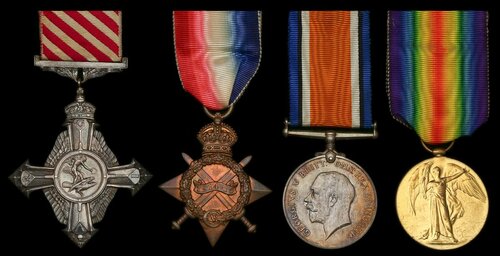
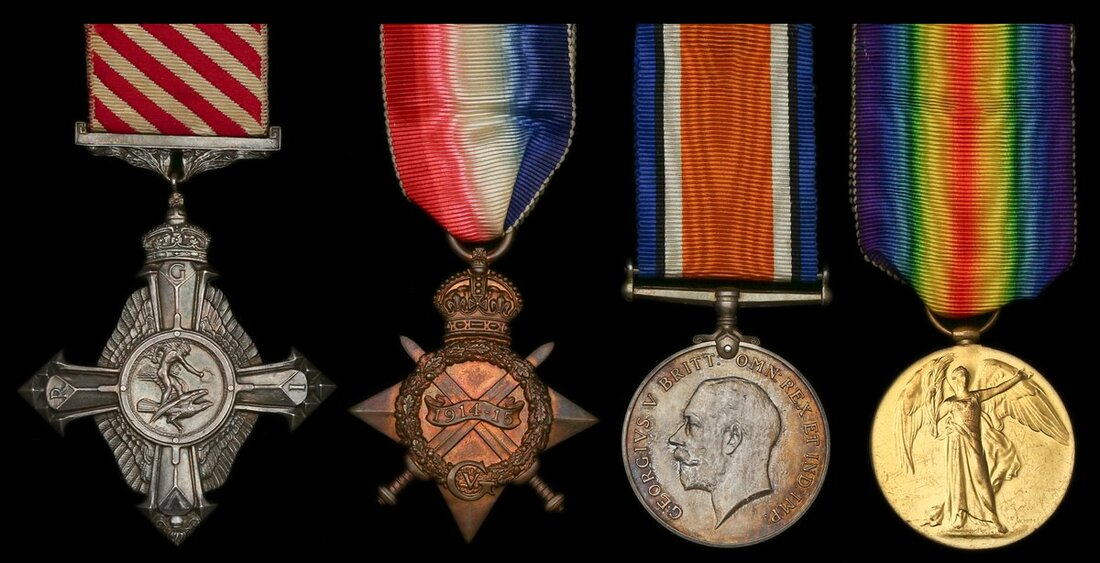
The Great War A.F.C. group of four awarded to Major W. T. F. Holland, Royal Air Force, late 21st Lancers (Empress of India's)
Air Force Cross, G.V.R. unnamed as issued, in it's John Pinches case of issue; 1914-15 Star (Lieut. W. T. F. Holland. 21-Lrs.); British War and Victory Medals (Major W. T. F. Holland. R.A.F.), good very fine (4)
A.F.C. London Gazette 1 January 1919.
Walter Thomas Forrest Holland was born at Worcester on 1 June 1893 and the family moved to Little Coxwell, Farringdon, Berkshire. He was educated at Eton and won the match against Harrow in 1910 with a brilliant catch at first slip when Harrow needed just a few runs to win. Holland then went to R.M.A. Sandhurst and was commissioned into the 21st Lancers as a Second Lieutenant on 3 September 1912, and was promoted to Lieutenant on 4 July 1914.
Entering the war in France on 10 March 1915 with his regiment he underwent pilot training at the Beatty School based at Hendon. He gained his Royal Aero Club Certificate (No.1408) on 5 July 1915 and was posted to No. 4 Reserve Aeroplane Squadron on 4 July 1915 before being seconded to the military wing of the Royal Flying Corps as a Flying Officer on 5 October 1915 seeing service on the Western Front. There Holland was wounded in action on 27 October 1915 and was sent home to recover.
Assigned to No.1 Reserve Squadron at South Farnborough on 24 March 1916 he saw home service being assigned as a Flying Officer to join the Experimental Station at Orford Ness, Suffolk from 5 January 1917. Holland was made a Flight Commander and promoted Captain on 23 February 1917 and was then posted to No.100 Squadron. This Squadron was formed on 23 February 1917 and was the first squadron formed specifically as a night bombing unit and comprised elements of the Home Defence Wing.
Its commanding officer was Major G. Christie. The unit was mobilised and crossed over from Portsmouth on 21 March 1917 to France and was first based at St. Andre-aux-Bois, where it received 12 Royal Aircraft Factory F.E.2Bs. These particular aircraft had been withdrawn from other units where they had operated in daylight, so modifications were required to adapt them for No.100 Squadron's operational role.
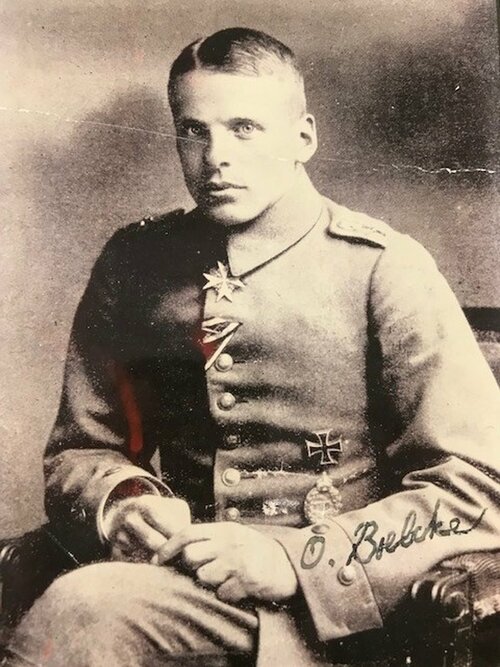
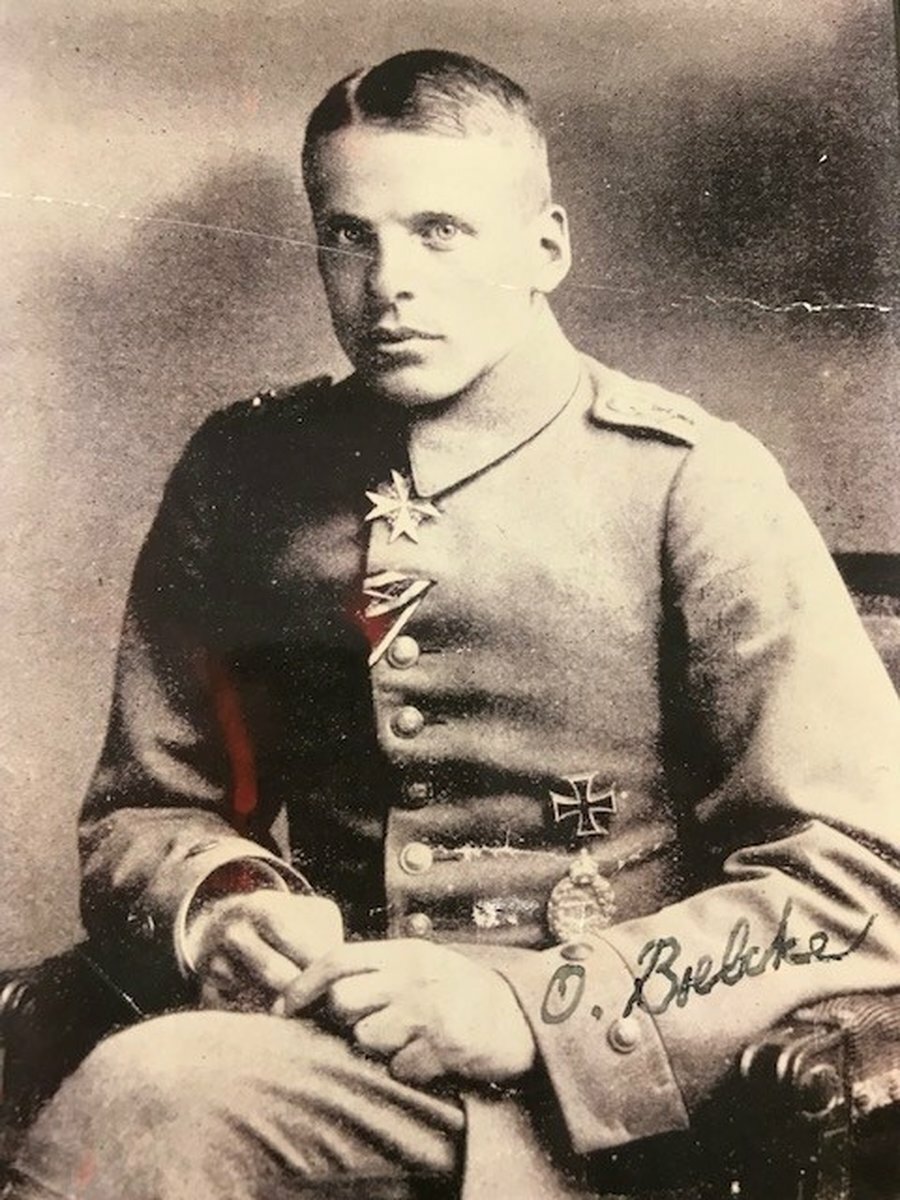
On 1 April 1917, the unit moved to Izel-le-Hameau and took a further four aircraft on complement, in the form of B.E.2es. The squadron began operations on the night of 5/6 April 1917, when 11 FE2b aircraft attacked La Brayelle Airfield at Douai, where Manfred von Richtofen's 'Flying Circus' was based. Richtofen referred to this raid in his book 'Der Rote Kampfflieger'. A total of 128 x 20lb and 4 x 40lb bombs were dropped, a reported four aircraft hangars were reported as having been set on fire and one of the attacking aircraft was lost.
Holland appears in 'The British at War in the Air 1914-1918' concerning an incident on 23 July 1917, which states:
'Later that evening around 2230 Captain Walter Thomas Forrest Holland from 10 Squadron RFC was attempting to bomb an enemy aerodrome in his BE2e A1872 when he was hit by anti-aircraft fire. He struggled back home and wrecked the craft on landing wounding himself in the process'.
In France his plane was hit by ground fire and caught fire, falling into a shell hole. Captain Holland climbed out of his machine in flames and fell into another shell hole full of water which extinguished the flames. Also killed on that day as a result of anti-aircraft fire was the 30 victory German ace Leutnant Karl Allmenroder from Jasta 11. He had just been made commander of Jasta 11 after Manfred von Richtofen had been posted to lead Jagdgeschwader 1. Holland was promoted Major on 16 July 1918 and was assigned to No.39 Squadron whilst still out in France on 7 November 1918. He relinquished his commission on 5 June 1919 and returned to Army duty on 30 December 1919. Holland relinquished the temporary rank of Major on transferring as a Captain to the Administrative Branch on 5 March 1919, but then relinquished his commission on ceasing to be employed on 5 June 1919, with his ultimate rank being corrected to Flight Lieutenant on 30 December 1919.
He rejoined his old regiment and was promoted to Captain in the 21st Lancers on 8 June 1920 but was placed on the half pay list on account of ill health caused by wounds on 10 June 1920, but was restored to the establishment on 14 June 1921 as a result of his health improving and he finally retired on 14 December 1921 and joined the Reserve of Officers. With the outbreak of the Second World War he appears to have served with the Royal Military Police and is likely to be further entitled to Defence and War Medals 1939-45. He was finally given the rank of Hon. Lieutenant Colonel when he reached the age limit for the Reserve of Officers on 2 September 1945. Holland was to become a National Hunt Stewards Secretary from 1949, a post he held until 1960 when he moved to Scotland. He died in 1976.
Subject to 20% VAT on Buyer’s Premium. For more information please view Terms and Conditions for Buyers.
Sold for
£2,200
Starting price
£1800

Watch, listen and bid as if you were in the room. Now available for auctions worldwide.
Click here to bid live
An exclusive and confidential service for the discerning collector or vendor.
View the Gallery
Download every Spink catalogue on your iPad, iPod or iPhone using free Spink app.
Download From iTunes© 2026 Spink & Son. All rights reserved.