
Auction: 26001 - Orders, Decorations and Medals
Lot: 272
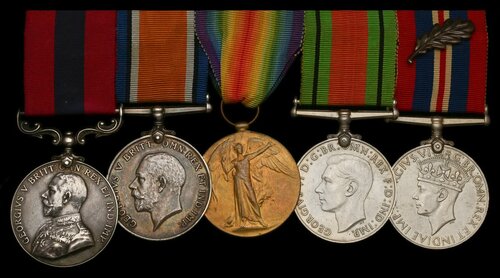
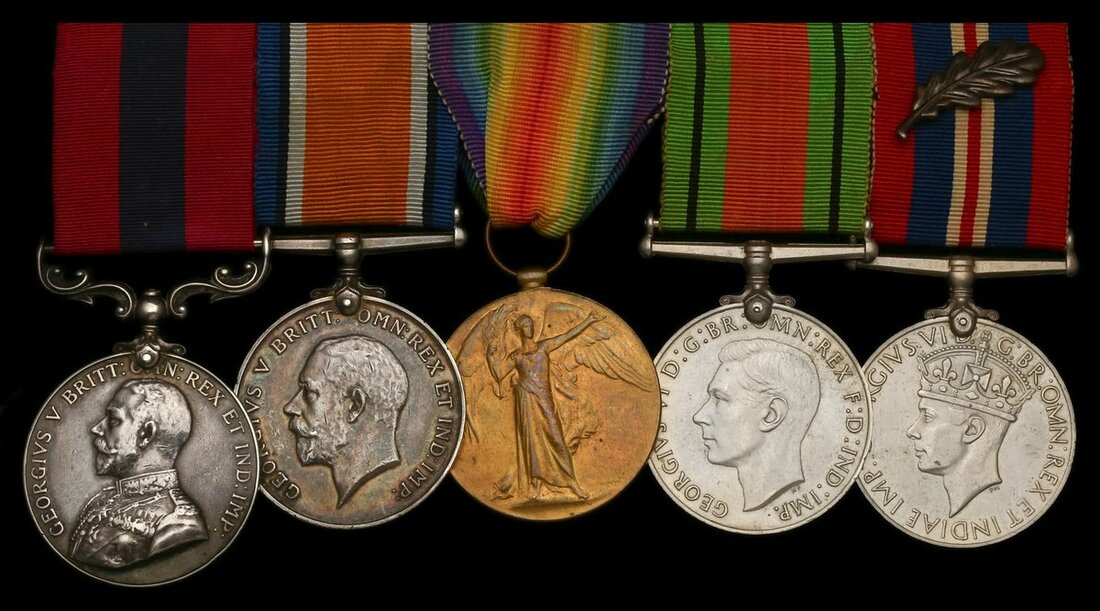
The superb Royal Flying Corps D.C.M. group of five awarded to Flight Lieutenant A. W. Cant, Royal Air Force, late Royal Flying Corps, who flew on no less than 87 operational sorties between March-August 1917 with No. 43 Squadron, of which no less than fifteen were with Major W. Sholto Douglas, the Commander-in-Chief of the Royal Air Force
During this period he was involved in several aerial combats with 'The Red Baron's' - Manfred von Richtofen's - Flying Circus (Jasta 17) over Vimy, as well as a combination of driving down enemy aircraft, low-level strafing, reconnaissance and photographic work, and on one occasion supported the Canadian Corps at Hill 70 in the attack made on 15 August 1917; he was latterly commissioned and 'mentioned'
Distinguished Conduct Medal, G.V.R. (77690 1.CL: A.M. A. W. Cant. 10/Wing 43 Sq: R.F.C.); British War and Victory Medals (77690. 1.A.M. A. W. Cant. R.F.C.); Defence and War Medals 1939-45, with M.I.D. oak leaf, mounted as worn, very fine (5)
Approximately 92 Distinguished Conduct Medals awarded to members of the Royal Flying Corps.
D.C.M. London Gazette 26 January 1918, the original citation states:
'For conspicuous gallantry and devotion to duty on reconnaissance and offensive patrols. He has on more than one occasion caused great confusion and many casualties amongst hostile infantry by attacking them with his machine gun at a low altitude and on two occasions has shot down hostile machines which attempted to interfere with his photographic work.'
M.I.D. London Gazette 1 January 1942.
Arthur William Cant was born at Uppingham, Rutlandshire in 1898 and by 1911 was working as an errand boy in a private house in Uppingham. He later worked as a gardener and then as a grocer. With the outbreak of the Great War he enlisted into the British Army on 2 September 1915. Cant entered the Great War in France serving from 25 June 1916-20 March 1917, when he transferred into the Royal Flying Corps as a 2nd Class Air Mechanic on 21 March 1917. He was posted as a miscellaneous Air Gunner to join No. 43 Squadron as part of 10th Army Wing as one of the original Northolt crews dating from the formation of the Squadron back in December 1916. He passed as an Air Gunner by 15 April 1917, and by then already had one 'kill' to his name.
Flying in a Sopwith 1 1/2 Strutter two seater fighter, it was during Bloody April 1917 that Cant had a true baptism of fire when engaged with Jasta 17, known as von Richtofen's Flying Circus after the Red Baron, with whom Cant would soon find himself engaged. He was part of a patrol of six aircraft of No. 43 Squadron when on 2 April on a photo Op to the east of Vimy, they were engaged by enemy aircraft at 1100hrs. One of the aircraft in the flight was to become von Richtofen's 34th victory. Back in the air on 3 April, he conducted a line patrol between Hulloch and Scarce, flying as the Observer to a Lieutenant Kitto, his regular Pilot. On 5 April he performed a special mission, and his aircraft suffered engine trouble, from which it only made it back over friendly lines, and his aircraft crashed on landing at Maison Bouche airfield. Then on 8 April they were on a patrol when they were attacked by eight hostile aircraft of the Flying Circus, but the shoe was on the other foot this time, with one enemy aircraft being driven down completely out of control, having been shot down by Cant South of Lens.
The combat report reads as follows:
'Whilst on patrol between Lens and Arras we were attacked by eight hostile scouts. After manoeuvring for about a minute, five hostile aircraft got on my tail. I put the machine in a spinning nosedive, and pulled out after about 2,000 feet, thinking I had shaken off the Huns. As I had not I again spun the machine, and succeeded in shaking off the remaining machines. Before I started to spin, my observer fired a drum at one of the hostile aircraft. The machine was seen to stall, and fall over sideways. The observer followed it down, turning over and over, until it disappeared in the clouds'.
However No. 43 Squadron also lost an aircraft at the time of this engagement to von Richtofen, this being his 38th victory. On 9 April, Cant flew two patrols, the first with his pilot Kitto, and the second with his pilot being Major Douglas, later Air Marshal Sir. W. Sholto Douglas, and Commander-in-Chief of the Royal Air Force. During this second patrol, his aircraft had to make a forced landing north west of Arras, the petrol tank having been shot through by anti-aircraft fire. Then on 13 April whilst engaged in a low sortie to the east of Vimy Ridge, Cant is recorded as having fired from a few hundred feet at a column of troops near Lens, which he disorganised. Then on 30 April:
'...whilst on a photographic patrol, he shot down one enemy aircraft east of Douai, which had attempted to interfere with the photographic work. At the same time, he made valuable reconnaissance of Dorigny aerodrome, and submitted a reliable and useful sketch of it.'
On 1 May, when flying as observer to Captain D. C. Rutter east of Douai, he was engaged in another aerial combat with Albatros Scouts, the combat report reading:
'When returning from Douai, Captain Rutter was fired on by an Albatross Scout. His observer fired a drum at it, and both pilot and observer saw it start to spin and then fall out of control. Full report later, as Captain Rutter was compelled to land near Arras, his tail plane being almost entirely shot away'.
This occurred during the second sortie of the day, having already flown a photographic sortie and line patrol, he then performed another detail, and his aircraft made a valuable reconnaissance of Doriginies aerodrome and Douai aerodrome. After the successful engagement with the Hun aircraft, his own aircraft was hit by anti-aircraft fire - though another account stated by an enemy aircraft, having been so badly hit, losing the greater part of his tail, Rutter successfully landed his aircraft at Villers au Bois. After this sortie a congratulatory message was received from the General Officer Commanding the Royal Flying Corps. Subsequent reports actually state that the enemy aircraft shot down was in fact shared with Captain Keen of No.40 Squadron. Back with Kitto, Cant flew a line and photographic patrol on 2 May, and once again had a close shave, suffering an engine failure mid air, and having glided down, the aircraft crashed on landing. On 3 May he flew a special mission with Kitto, during which they opened fire on trenches at Neuvireuil. A subsequent note as to Cant's services during this sortie reads:
'...took part in some valuable work of low flying in the neighbourhood of Oppy, and fired a great number of rounds on the troops in the trenches at Neuvireuil at 300 feet whilst under heavy hostile machine gun fire'.
On 4 May he flew another photographic and line patrol with Kitto, and another on 9 May, when the formation was attacked by five enemy aircraft. Then on 11 May he flew another photographic and line patrol, during which his aircraft had to make a forced landing west of Mazingarbe with the propellor shot away. Engaged in the air on 15 June, his patrol was once again attacked during a patrol by 10 enemy aircraft on 2 July when flying with Kitto. During a photo and line patrol on the 9 August, with Kitto at the controls, both he and Cant succeeded in taking 14 photographs of the enemy positions. Then on 13 August they flew a special mission in conjunction with Canadian troops, and the force of three aircraft were attacked by 8 enemy aircraft which were driven off. Then on 15 August he flew a special mission in conjunction with Canadian troops, in which the aircraft of 43 Squadron fired 5,000 rounds at troops, trenches and batteries, and attacked a battalion and a half of German infantry on the march in open order and put them to rout.
They reported this to the Canadian Corps who successfully stopped a counter-attack with their artillery. Kitto and Cant's aircraft is noted as having been one of those dived on the German troops, and later on their return also fired into the Bois de Dixhuit during the fight for Hill 70 in the Third Battle of Ypres. This day was the date of the Canadian attack on Hill 70, and therefore it is clear that the sortie performed on 13 August, was a reconnaissance for the attack. Flying in support of the Canadians at Hill 70 on 16 August, Kitto and Cant once again noted slight activity in the Bois de Dixhuit. On 17 August Kitto and Cant flew a line patrol, during which Kitto's aircraft engaged two enemy aircraft, one being driven down by Cant apparently out of control at port-a-Vendin at 7.45 p.m., the other being destroyed by his pilot.
The combat report reads as follows:
'Whilst patrolling line between La Bassee to Lens were attacked by one Albatross Scout at 7.45 p.m.. I fired about 100 rounds into same and forced him to land behind Henin-Lietard. We then carried on with the patrol, until 7.50 p.m. when we were attacked by three Albatross Scouts. I fired into same until I got a stoppage with my gun and my pilot carried on with the combat, and sent one down apparently out of control, near Pont-a-Vendin. Afterwards four other enemy machines joined the two, and attacked the remainder of our formation. We then returned to aerodrome, owing to shortage of ammunition and gun being out of action'.
The engagement on 17 August in which Kitto and Cant successfully engaged enemy aircraft, was the last claim made on Sopwith Strutters by 43 Squadron, as soon after the unit was then re-equipped with single seater Sopwith Camels, and Cant then found himself surplus to requirements with 43 Squadron. Cant nevertheless flew a lone patrol with Kitto on the 20 August, in which they were attacked by 7 enemy aircraft over Vitry and a 43 Squadron machine was shot down. During his period at the front with 43 Squadron between 24 March and 21 August 1917, Cant is recorded as having flown 87 operational sorties, 67 of these with Lieutenant Kitto, and 15 with Major W. Sholto Douglas. Cant is not mentioned as flying with the Squadron after 21 August 1917. He had been promoted to 1st Class Air Mechanic on 1 May 1917, and on 9 August 1917 he was recommended for the award of the Military Medal by the commanding officer Major W. Sholto Douglas.
However the recommendation for an immediate award of the D.C.M. was put forward by the Brigadier-General Commanding the 1st Brigade, Royal Flying Corps on 17 August 1917.
Cant was posted home on 25 September 1917 and he spent the remainder of the war on home service, he was posted firstly to No. 41 Training Squadron and then to No. 72 Training Squadron on 26 January 1918, he transferred into the Royal Air Force on its formation on 1 April 1918 as a Private 1st Class, and with the end of the war was eventually discharged on 4 July 1919, having been purely employed in ground duties since August 1918.
He was recalled and commissioned with the outbreak of the Second World War and saw home service with the rank of Flying Officer within the Administrative and Special Duties Branch, being stationed at No.1 Ground Defence Gunnery School during 1941, service for which he was 'mentioned'. Cant was promoted to Flight Lieutenant on 1 September 1942. He died on 25 January 1963 at Thornton Heath, Surrey; sold together with comprehensive copied research.
Subject to 20% VAT on Buyer’s Premium. For more information please view Terms and Conditions for Buyers.
Sold for
£6,000
Starting price
£5800
Watch, listen and bid as if you were in the room. Now available for auctions worldwide.
Click here to bid live
An exclusive and confidential service for the discerning collector or vendor.
View the Gallery
Download every Spink catalogue on your iPad, iPod or iPhone using free Spink app.
Download From iTunes© 2026 Spink & Son. All rights reserved.