
Auction: 26001 - Orders, Decorations and Medals
Lot: 271
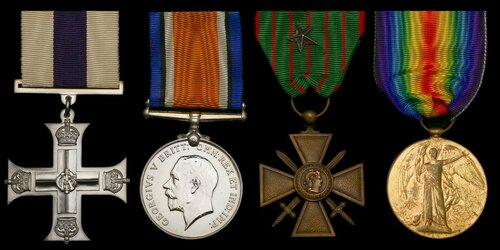
The Great War Flying Ace's M.C. group of four awarded to Captain R. P. Harvey, Royal Flying Corps, late 5th (Royal Irish) Lancers and Norfolk Regiment, who was additionally awarded a French Croix de Guerre
Shot down by the German fighter ace Oswald Boelcke on 20 October 1916, he successfully pulled off a crash-landing over British lines despite having lost the use of his legs
Military Cross, G.V.R. (Captain R. P. Harvey. 5th Lancers & R.F.C. Oct. 17. 1916. Somme.) engraved on reverse; British War and Victory Medals (Capt. R. P. Harvey. R.F.C.); France, Republic, Croix de Guerre, reverse dated '1914-1918', with silver Star upon riband, very fine (4)
M.C. London Gazette 14 November 1916, the original citation states:
'For conspicuous gallantry in action. He attacked four hostile machines with great courage and skill, his observer shooting one of them down. He has on many previous occasions done very fine work.'
France, Croix de Guerre London Gazette 26 November 1919.
Robert Parsons Harvey was born at Dublin, Ireland on 14 May 1896 and was the son of Colonel Robert John Harvey and Florence Harvey and was originally from an old Norfolk military family. As a child at the age of seven he was said to be the youngest trumpeter in the British Army as he acted as trumpeter to the squadron of the Norfolk Yeomanry which at the time was commanded by his father.
When his father was appointed to command the 4th Norfolks, the younger Harvey then aged 14 became of the battalion buglers. In 1913 whilst still at school he became a Second Lieutenant in the 4th Battalion Norfolk Regiment and was with them when they were mobilised, under the command of his father at the outbreak of the Great War. He was promoted Lieutenant in November 1914 and Captain in September 1915. Transferring to the Royal Flying Corps he gained his Royal Aero Club Aviators' Certificate (No.2766) at the Military School, Shoreham, Sussex on 10 April 1916. Harvey went to the front with No.11 Squadron, flying operationally in F.E.2b two-seater fighter and reconnaissance aircraft.
Taking two kills on 9 September 1916, he shot down an Aviatik and then a Roland. On 15 September he shot down one aircraft causing it to land in a field north of BAPAUME, this was followed with an Aviatik where tracers were seen to kill the pilot before the aircraft was observed crashing into a field. A combat on 25 September 1916 saw him attack 3 enemy aircraft which dived away however a Roland came over the top of him and 2 drums were emptied into the machine causing it to glide down and land N.E. of BAPAUME. On the 30 September, another Roland received half a drum of ammunition at close quarters, this resulted in it crashing to earth at THILLOY. He shot down an aircraft on 10 October which was part of a group of four attacking Martinsydes, emptying a drum at close range it went into a steep spiral, the exact fate unknown as he was attacked by other enemy aircraft. It was during this action that he was recommended for his Military Cross.
Finally on 20 October 1916 his F.E.2b left the aerodrome at 07.51 a.m. for a Photography and Reconnaissance Patrol. It was attacked by enemy aircraft led by the German fighter ace Oswald Boelcke. Firing into Harvey's aircraft and hit him, resulting in a bullet striking his spine. His observer fell to his death out of the aircraft whilst it was still behind German lines, but miraculously Harvey, despite his having lost the use of his legs, managed to evade the four pursuing German aircraft. Guiding it back over British lines where it crashed west of Agny, coming down in the British third line trench there, where he was pinned beneath the wing of his machine and trapped in the wreckage. He was dug out but for a long time his recovery was despaired of, and he would spend many months in hospital, where he was personally presented his M.C. by H.M. King George V. Despite serving with the Royal Flying Corps, he had applied for a commission in his father's old regiment the 5th Lancers and had actually been gazetted to them as a Second Lieutenant but his wound while still in the Royal Flying Corps prevented him from seeing any active service with them. He was later given the rank of captain in the Lancers and of Flight Commander in the Royal Flying Corps.
Whilst he survived this he remained crippled and suffered from his injuries for the rest of his life. Harvey died at Marlow, Buckinghamshire on 3 December 1937 as a result of his wounds.
Sold together with a detailed folder of photocopied research to include Combats in the Air etc.
Subject to 20% VAT on Buyer’s Premium. For more information please view Terms and Conditions for Buyers.
Sold for
£3,800
Starting price
£2400
Watch, listen and bid as if you were in the room. Now available for auctions worldwide.
Click here to bid live
An exclusive and confidential service for the discerning collector or vendor.
View the Gallery
Download every Spink catalogue on your iPad, iPod or iPhone using free Spink app.
Download From iTunes© 2026 Spink & Son. All rights reserved.