
Auction: 26001 - Orders, Decorations and Medals
Lot: 224
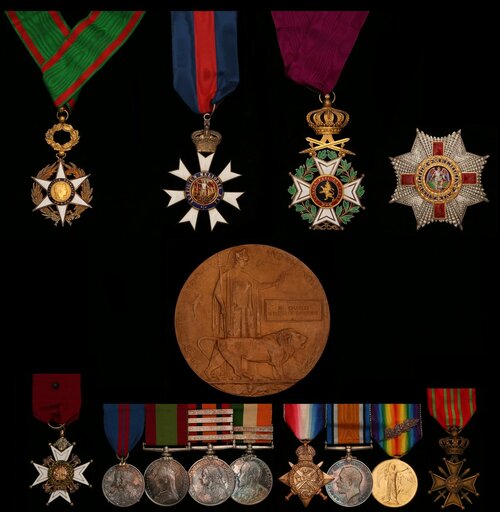
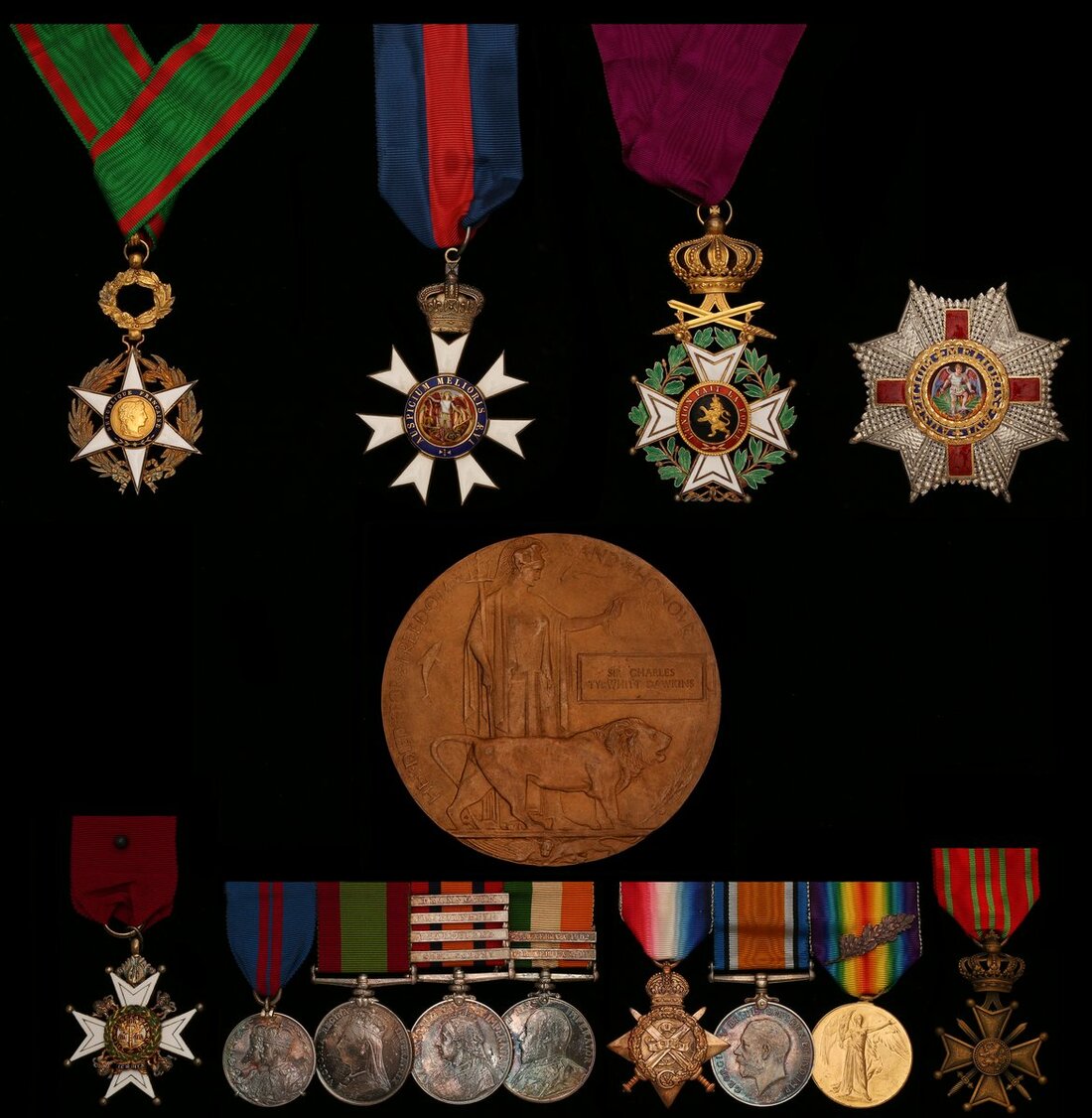
The outstanding K.C.M.G., C.B. group of thirteen awarded to Major-General Sir C. T. Dawkins, King's Shropshire Light Infantry, who was seven times 'mentioned' during a distinguished career which spanned some four decades which saw service in Afghanistan, South Africa and on the Western Front
He died on account of illness contracted on active service and is buried under a C.W.G.C. headstone, one of fifteen Officers of his rank to lose their life to the effects of the Great War following the Armistice
The Most Distinguished Order of St. Michael and St. George, K.C.M.G., Knight Commander's set of Insignia, by Garrard & Co. Ltd., comprising neck Badge, silver-gilt and enamel; breast Star, silver with appliqué centre in gold and enamel, with full length neck riband, with the case of issue, this additionally embossed 'Major General Sir C. T. Dawkins, K.C.M.G., C.B.'; The Most Honourable Order of the Bath, C.B. (Military) Companion’s Badge, by Garrard & Co. Ltd., breast Badge, silver-gilt and enamel, converted for neck wear as appropriate, with the case of issue, this additionally embossed 'Major General Sir C. T. Dawkins, K.C.M.G., C.B.'; Coronation 1911; Afghanistan 1878-80, no clasp (2nd. Lt. C. T. Dawkins. 85th Foot.); Queen's South Africa 1899-1902, 4 clasps, Cape Colony, Paardeberg, Driefontein, Transvaal (Major C. T. Dawkins. C.M.G. 2/Shrops. L.I.); King's South Africa 1901-02, 2 clasps, South Africa 1901, South Africa 1902 (Lt. Col. C. T. Dawkins. C.M.G. Shrop. L.I.), these last four mounted cavalry-style as worn, with space for the C.B. previously worn upon the breast, housed in a fitted leather case by Spink & Son, this additionally embossed 'Major General Sir C. T. Dawkins, K.C.M.G., C.B.'; 1914 Star (Col: C. T. Dawkins. C.M.G.); British War and Victory Medals, with M.I.D. oak leaves (Maj. Gen. C. T. Dawkins.), these last three mounted for wear and housed in a fitted case by A & N.C.S. Ltd., Westminster, this additionally embossed 'Major General Sir C. T. Dawkins, K.C.M.G., C.B.'; France, Republic, Order of Agricultural Merit, neck Badge, by Lemaitre, in its case of issue, this additionally embossed 'Major General Sir C. T. Dawkins, K.C.M.G., C.B.'; Belgium, Kingdom, Order of Leopold, Commander's neck Badge, by Lemaitre, in its case of issue, this additionally embossed 'Major General Sir C. T. Dawkins, K.C.M.G., C.B.'; Belgium, Kingdom, Croix de Guerre, in a custom fitted case of issue, this additionally embossed 'Major General Sir C. T. Dawkins, K.C.M.G., C.B.'; Great War Bronze Memorial Plaque (Sir Charles Tyrwhitt Dawkins), in its card envelope of issue, good very fine (Lot)
K.C.M.G. London Gazette 28 December 1917.
[C.M.G.] London Gazette 22 June 1897 (Military Secretary to the Governor of the Cape of Good Hope).
C.B. London Gazette 16 February 1915, thus likely stemming from his part in the 1914 campaign.
French Order of Agricultural Merit London Gazette 7 October 1919.
Belgian Order of Leopold London Gazette 14 February 1917.
Belgian Croix de Guerre London Gazette 11 March 1918.
[Russian Order of St Anne] London Gazette 1 June 1917.
[Russian Order of St Vladimir] London Gazette 25 August 1915.
M.I.D. London Gazette 10 September 1901, 29 July 1902, 19 October 1914, 22 June 1915, 15 June 1916, 4 January & 11 December 1917.
Charles Tyrwhitt Dawkins was born on 22 November 1858. A good biography is offered from an online source:
'He was educated at Rugby School, Warwickshire (1874-76) and made a Gentleman Cadet at the Royal Military College, Sandhurst. Commissioned into the 85th Regiment of Foot (Bucks Volunteers) as a 2nd Lieutenant on 1 May 1878 (2nd Battalion the King's Shropshire Light Infantry under the Cardwell reforms of 1881). Promoted to Lieutenant on 1 Jul 1881, to Captain on 13 September 1886, to Major on 23 March 1898, to Lieutenant-Colonel on 19 August 1905, to Colonel on 19 August 1909 and to Major-General on 3 June 1915. He joined the 85th Foot in Mooltan, India. He served in the Afghan War in 1879-80 with the Koorum Division, including the Zaimusht Expedition (29 November–16 December 1879) under Brigadier-General John Tyler, and the assault of Zawa. He was Adjutant of the 2nd Battalion in England from February 1882-February 1884. Thence posted as A.D.C. to the Governor and Commander in Chief Cape of Good Hope, Sir Hercules Robinson, from March 1884-September 1886 and then Military Secretary from September 1886-April 1889. He was Adjutant of the Militia Jan 1892-Apr 1895. He returned as Military Secretary to the Governor and Commander in Chief Cape of Good Hope May 1895-March 1897 and took his C.M.G. in 1897.
He was serving with the 2nd Battalion when they were deployed to South Africa for the Second Anglo Boer War on 7 November 1899. After their arrival they were employed for two months on the lines of communication in Western Cape Colony. They were then put into the 19th Brigade under Major General Smith-Dorrien and were part of the main army advance from the Modder River to Bloemfontein and Pretoria. They fought in the Battle of Paardeberg (18-27 February 1900). After Pretoria had been occupied the Brigade guarded the railway for some distance south of the capital, the headquarters of the Shropshire Light Infantry being at Rhenoster, in Orange River Colony. They were employed for some time in garrison duties, beating off many Boer attacks. The Battalion formed part of the garrison of Belfast when it was attacked on the night of 7 January 1901. For the remainder of the campaign they were chiefly employed in the Eastern Transvaal. The headquarters were generally at Belfast or Carolina, and one-half of the Battalion was almost always out on Column work. He commanded the Battalion in the latter part of the campaign, was severely wounded, was twice mentioned in despatches, promoted to Brevet Lieutenant Colonel (Queen's and King's South Africa Medals with six clasps).
He was Assistant-Quartermaster-General, Eastern Command, from April 1910-April 1914. With the outbreak of the Great War, he served in the General Headquarters Staff in Montreuil-sur-Mer, and was made a temporary Brigadier-General in October 1914 and a Major-General in June 1915. He was five times mentioned, made a C.B. and advanced K.C.M.G., and showered with foreign decorations.
He remained in France following the Armistice of 11 November 1918 and in April 1919, he was placed on retirement pay due to illness contracted on active service in France. Six months later, he died from his illness at Queen Alexandra Military Hospital, Westminster, London.'
The good General is buried in the St. Mary the Virgin Churchyard, Chipping Norton, Oxfordshire, under a C.W.G.C. headstone. For his miniature dress medals and pieces of insignia, please see Lots 282 and 299.
Subject to 20% VAT on Buyer’s Premium. For more information please view Terms and Conditions for Buyers.
Sold for
£3,400
Starting price
£3200
Watch, listen and bid as if you were in the room. Now available for auctions worldwide.
Click here to bid live
An exclusive and confidential service for the discerning collector or vendor.
View the Gallery
Download every Spink catalogue on your iPad, iPod or iPhone using free Spink app.
Download From iTunes© 2026 Spink & Son. All rights reserved.