
Auction: 26001 - Orders, Decorations and Medals
Lot: 225
'Sir, I have the honour to request that I may be supplied with an artificial leg from the Government Depot at Roehampton.
In support of the case I enclose my Record of Service by which it will be seen that I lost my leg in 1894 on active service and did no allow this disability to prevent me to continue to serve.
Hitherto I have always provided myself with a leg at my own expense amounting to a sum of over £200 spread over the twenty six years.
Whilst serving in Italy my artificial leg was badly damaged by falling into a trench and is now in need of replacement...'
Major Wake writes to the Director of Artificial Limb Supplies in the Ministry of Pensions, May 1920
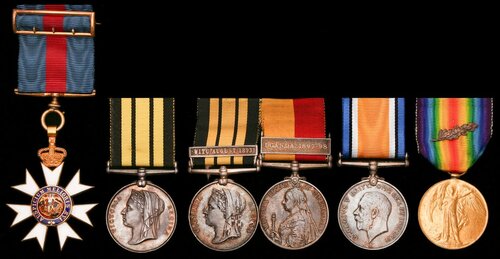
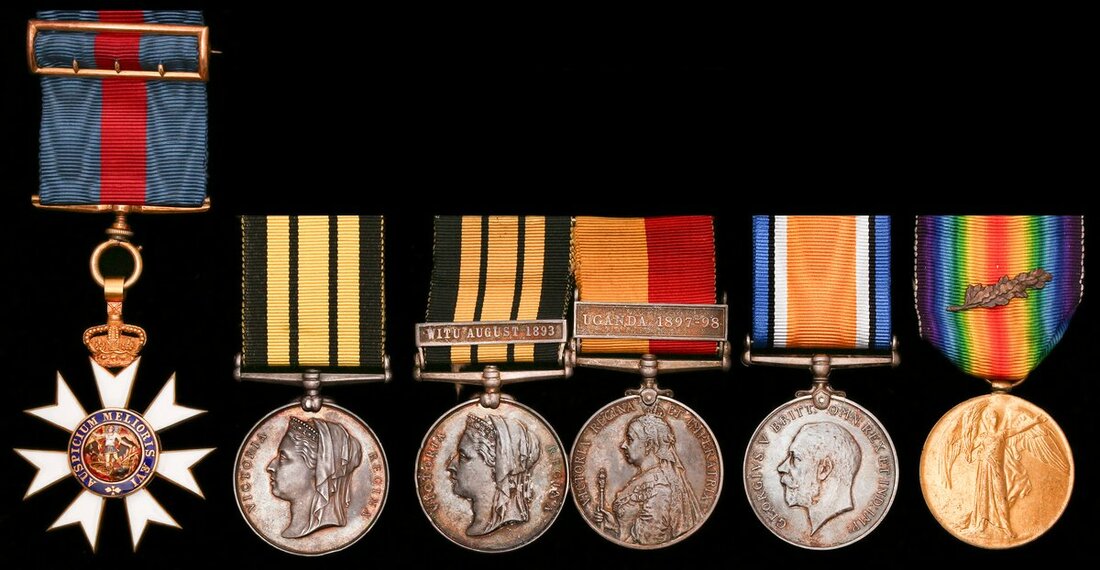
The rare Uganda 1897-98 C.M.G. group of six awarded to Major C. St A. Wake, East African Rifles, a gallant one-legged soldier who saw nearly four decades of active service
Having failed to enter the Royal Navy, he begun his career with the Devonshire Regiment before being made a Lieutenant for the Sultan of Zanzibars Forces, going into action in Witu 1893 and losing his leg in a hot action at Saferah in June 1894; he did not let his disability hold him back
Wake was thence present for the Mwele operations of 1895-96 and during the Uganda campaign of 1897-98, taking a C.M.G. for his troubles in commanding a force of East African Rifles troops and being noted for his work on the Foweria-Fatiko Road
Commanding the Kalyera Expedition against Chief Krruri in the Kikuyu country in 1901, Wake returned to the fold during the Great War and thence briefly served in the Auxiliary Division of the Royal Irish Constabulary
The Most Distinguished Order of St. Michael and St. George, (C.M.G.), Companion's breast Badge, gold and enamel, with riband buckle; East and West Africa 1887-1900, for Mwele 1895-6, 1 clasp, Witu August 1893 (Lieut. C. St. A. Wake Mwele 1895-6), the rank privately impressed; East and West Africa 1887-1900, for Mwele 1895-6 (Chas. Wake. Vice Consul. Mwele 1895-6); East and Central Africa 1897-99, 1 clasp, Uganda 1897-98 (Capt. C. St. Aubyn. Wake. E. African Rifles.); British War and Victory Medals, with M.I.D. oak leaves (Major C. St. A. Wake.), good very fine (6)
C.M.G. London Gazette 23 January 1899:
'In recognition of services in the Uganda Protectorate - Charles St. Aubyn Wake, Garrison Adjutant and Quartermaster at Mombasa.'
M.I.D. London Gazette 6 January 1919 (Italy)
Charles St Aubyn Wake was born on 9 February 1861 at Stoke Damerel, Devon, the son of Admiral Charles and Emma Wake. Having been educated at Felsted School, Scotland, he failed to pass to get into the Royal Navy and thus enlisted into the Dorsetshire Regiment as a Private soldier in April 1884. It is sometimes stated that he served on the Gordon Relief Expedition but his Service Record confirms otherwise.
Severe wounds - leg amputation
Buying his discharge as a Sergeant in March 1893, Wake thence found himself an appointment in East Africa, landing at Zanzibar in April 1893 via the Kola, taking a commission as Second-in-Command of the Sultan of Zanzibar's Forces. Colonel G. P. Hatch was the commanding officer and together with Wake, they shared in the operations in Witu that same year (Medal & clasp). It was to be on 30 June 1894, during the action and storming of the stockade at Safareh that he would be severely wounded in the right leg. Removed to the Swallow, which happened to have been the command of his brother Drury, that leg would be amputated. He would be removed to Cape Town for further treatment and recovery, further finding a suitable wooden prosthetic.
Returned to East Africa, Wake was appointed Vice Consul at Mombasa in August 1895 and arrived in Zanzibar in November 1895 to join Captain E. G. Harrison at Sokoki, in time to depart for Kalifi. He was returned to Mombasa June 1896 - having earned the right to add 'Mwele 1895-6' to his Medal - and confirmed Garrison Adjutant & Quartermaster Mombasa in April 1897. A humorous tale is referred in Kenya Diary:
'I heard an amusing story from Mann. 3 years ago [1899] he was serving in Jubaland with Jenner the Civil Officer, who was afterwards murdered by the Somali, and the soldier was Wake. Now Jenner had a complete set of false teeth, Wake had a wooden leg, and Mann has but one eye. They were all three presiding at a big and important meeting at Kismayu on a particularly hot day. The proceedings got tedious so Jenner, feeling uncomfortable about the mouth, removed his teeth and placed them with a rattle on the table. The Somalis stared but said not a word. Soon afterwards Wake unscrewed his wooden leg and laid it beside Jenner's teeth on the table. As time went on, Mann found his false eye causing him discomfort, and removed it, tossed it in the air and put it in his pocket. This was too much for the savage Somalis, who rose to a man and fled from the white men who could thus play about with their teeth, legs and eyes.'
East African Rifles, Uganda - C.M.G.
Departing Machakos for Uganda in February 1898, Wake was made an Hon. Lieutenant with the East African Troops in Uganda at Foweira in July 1898. He shared in the operations to deny northern Uganda to a fast approaching French column from Senegal under Jean-Baptiste Marchand - the whole while coming under the fire of mutinous Soudanese troops. Wake himself was posted with '...a force of coast Soudanese' (The Times, July 1898, refers) to march up from the coast and enter the scene of action (Medal & clasp). He was further praised for his efforts in August 1898 for the reconnaissance made with Lieutenant Dyke, 1st Baluchis, along the Foweria-Fatiko Road (Equatorial Provences Expedition Times, December 1898). It was also reported:
'Some Uganda Rifles and Swahilis under Captain Wake have been also attacked by Sudanese, assisted by some Waganda and Wangoro tribesmen, and both sides suffered slight losses.'
With the campaign complete and a C.M.G. for his laurels, which was reported as '...a Reward for Gallantry', Wake took leave in June 1899 and was confirmed as a Captain with the East African Rifles on 1 January 1900.
Further exploits
Given command of the Kalyera Punitive Expeditionary Force into Kikuyuland in April & May 1901, Wake was accompanied by Civil Officer McLellan and John Boyes as Guide & Intelligence Officer. Lasting some seven weeks in hostile country, they executed their operations against Chief Krruri and his forces that opposed the expedition.
Various periods of leave followed, after which Wake departed the scene for the final time in May 1903. In the decade or so in which he shared served in East Africa, few others might have seen so many operations or expeditions as the gallant Wake.
Further campaigns
Posted to the Reserve of Officers in 1906, he was removed on account of age by 1911 and found work as Recruiting Officer in Bristol. It is widely reported in various sources that Wake thence joined the Turkish Army in order to share in their conquest of Libya in the conflict with the Italian Army. Returned from this final foray to Africa, Wake joined the Instructional Staff of the Ulster Volunteers and joined the Royal Irish Rifles as a Captain with the 14th Battalion in November 1914. As recalled in The Irish Regiments in the Great War:
'Other veteran officers proved a severe embarrassment. During December 1914, Captain Charles St Aulwyn Wake reported for service with the 14th Royal Irish Rifles. Wake had lost his leg on active service and proved himself to be in no condition to train men. Following a route march, Capt. Wake gave the command 'Halt!', as the men had been 'Marking Time', Capt. Wake's next command was 'Fall out the Gentlemen.' For some unknown reason he then fell off his horse.
He lay where he fell, apparently unhurt. He made no attempt to rise. He then gave the final command, 'Battalion Dis-miss', whereupon the parade did a Right Turn, saluted and then dispersed. Only then did Capt. Wake get up, and hand his mount over to the groom, who was waiting.'
He eventually saw active service as a Major with the Suffolk Regiment in Italy from 5 September 1917, aged 56 and added a 'mention' to his laurels. Clearly not content with his lot, Wake was appointed to the Auxiliary Division of the Royal Irish Constabulary and appears to have served in 'Z' Company. It was to be a short-lived appointment but his personal recruitment by General Crozier raised a number of questions.
The good Major died at Sidmouth, Devon on 21 November 1938.
Subject to 20% VAT on Buyer’s Premium. For more information please view Terms and Conditions for Buyers.
Sold for
£4,600
Starting price
£3500
Watch, listen and bid as if you were in the room. Now available for auctions worldwide.
Click here to bid live
An exclusive and confidential service for the discerning collector or vendor.
View the Gallery
Download every Spink catalogue on your iPad, iPod or iPhone using free Spink app.
Download From iTunes© 2026 Spink & Son. All rights reserved.