
Auction: 26001 - Orders, Decorations and Medals
Lot: 222
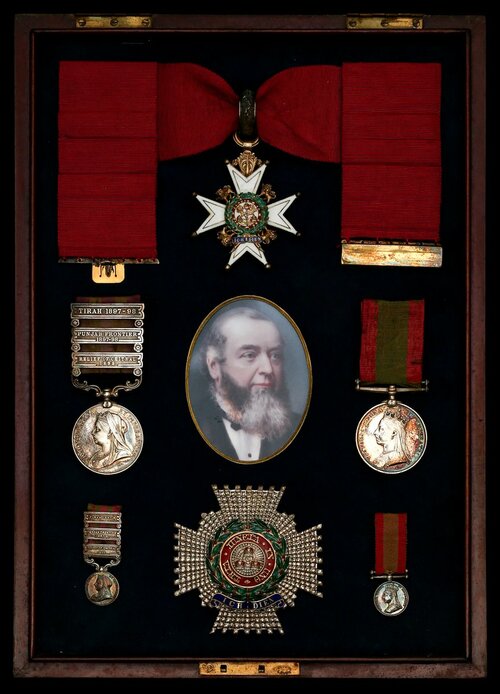
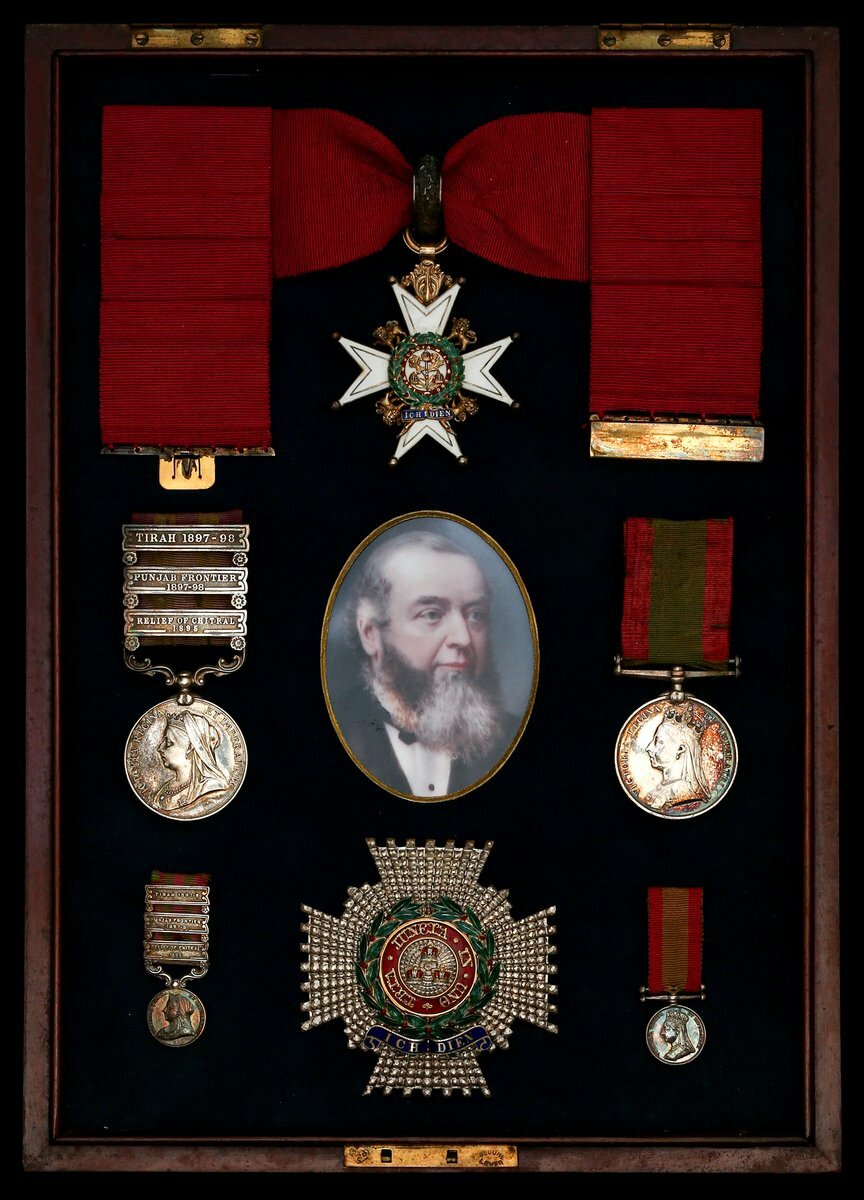
A rare Tirah Expedition K.C.B. group of four awarded to Surgeon-Colonel Sir G. Thomson, Indian Medical Service, as Principal Medical Officer of the Chitral Relief Force who was twice 'mentioned' for his services on the North-West Frontier
The Most Honourable Order of the Bath, K.C.B. (Military) Knight Commander’s set of insignia, comprising neck badge, silver-gilt and enamel, and breast star, silver, with gold, silver-gilt and enamel centre; Afghanistan 1878-80, no clasp (Surgn. G. Thomson, M.B., 1st Punjab Cavy.); India General Service 1895-1908, 3 clasps, Relief of Chitral 1895, Punjab Frontier 1897-98, Tirah 1897-98 (Surgn. Col. G. Thomson, I.M.S.), sold together with related dress miniature medals for the last two, the whole contained in an old display case, enamel work on the first slightly chipped in places, otherwise generally good very fine (6)
George Thomson was born in Aberdeen in May 1843 and was educated at Marischal College and Aberdeen University, where he obtained the degrees of M.B. and C.M. before entering the Indian Medical Service as an Assistant Surgeon in October 1865. Thus commenced a long and distinguished career in India where, among other appointments, he served as Medical Adviser to H.H. the Maharajah of Patiala, G.S.C.I.
He first witnessed active service as a Surgeon-Major in medical charge of the 1st Punjab Cavalry during the Second Afghan War 1878-80, when early patients included three Sowars wounded in the action at Takht-i-pul on 4 January 1879; so, too, as C.O. of the Native Base Hospital at Quetta after the first campaign, services for which he received the Thanks of the Government of India.
Having been advanced to Surgeon-Colonel in April 1893, Thomson served as Principal Medical Officer (P.M.O.) on the Lines of Communication in the Relief of Chitral operations of 1895, and was mentioned in despatches (G.G.O. No. 998 of 1895 refers), and awarded the C.B. (London Gazette 21 January 1896 refers).
Next appointed P.M.O. of Lahore (Military) District, he witnessed further active service as P.M.O. of the Tirah Expeditionary Force in operations on the North West Frontier 1897-98, in the temporary rank of Surgeon-Major-General, gaining another "mention" (G.G.O. No. 244 of 1898 refers), and elevation to K.C.B. (London Gazette 20 May 1898 refers).
In his despatch covering the Tirah operations for the period November 1897 to January 1898, General Sir W. S. A. Lockhart described the work of the Indian Medical Service in glowing terms:
'The Department has, at a time of pressing emergency, been able to comply with the heavy demands made upon it. The extent of these demands may be best realized from the statement that it was necessary to provide hospital accommodation for 12 per cent of troops and followers. On this basis 6,526 beds were made available, including 36 Field Hospitals. The accuracy of this forecast may be gauged from the fact that on 20 December 1897 the number of sick in hospital, then at its highest, was 11.16 per cent of the force. The results obtained in the treatment of the sick, and especially in surgical cases of wounds, have been most satisfactory.'
Lockhart further stated: 'Surgeon-Major-General G. Thomson, C.B., Indian Medical Service, has been my Principal Medical Officer in the Field, and I desire to express my indebtedness to him and to the other officers of the Department, of which he has been in charge, for the high state of efficiency in which it has been maintained, often under very unfavourable conditions.' Placed on the Retired List in July 1898, Thomson settled in Upper Norwood, London, and died in December 1903, aged 61 years.
His obituary in the British Medical Journal on 2 January 1904 states:
'We regret to record the death, on December 21" of Sir George Thomson, K.C.B., an Indian Medical Service officer of great distinction. Although he went on the retired List some five years ago and had then put in full thirty years of active service, Sir George Thomson was only 61 years of age, and his death was sudden and unexpected. He was a native of Aberdeen, where he received both his professional and General education; about a year after obtaining the degrees of M.B., C.M, and in October, 1865 he entered the Indian Medical Service, winning a high place in the competitors' list. In India his service was mainly in the military department, but he was also for some years Civil Surgeon in the Punjab and Medical Adviser to the Maharajah of Patiala. He was for some time Principal Medical Officer of the Lahore military district. He had a great deal of war service to his credit. It was mainly to his work with troops on active service that he owed the distinctions he acquired. Thus he took part in the Afghan campaign of 1878-9 and in 1895 was P.M.O. of the Chitral Relief Force. Two years later he was with the Malakand Field Force, and later in the same year served as P.M.O. of the Tirah Expeditionary Force. This it was which brought him the Knight Commandership of the Bath, the companionship of the same Order having been awarded him for his services in the Chitral expedition. All his war services indeed must have been valuable, for he was three times mentioned in dispatches. Sir George Thomson had a brother who is a major in the same service. He leaves a widow and three sons, one of whom has entered the army.'
Subject to 20% VAT on Buyer’s Premium. For more information please view Terms and Conditions for Buyers.
Sold for
£2,800
Starting price
£1900
Watch, listen and bid as if you were in the room. Now available for auctions worldwide.
Click here to bid live
An exclusive and confidential service for the discerning collector or vendor.
View the Gallery
Download every Spink catalogue on your iPad, iPod or iPhone using free Spink app.
Download From iTunes© 2026 Spink & Son. All rights reserved.