
Auction: 26001 - Orders, Decorations and Medals
Lot: 219
(x) 'We sail Sunday night and goodness knows when we will be back. Take care of yourselves and never be out after dark or in lonely places. Your loving Dad.'
Edgar Moulton closes his last letter to his daughters, Win, Joan and Edna, written aboard the S.S. Arandora Star at Liverpool on 28 June 1940
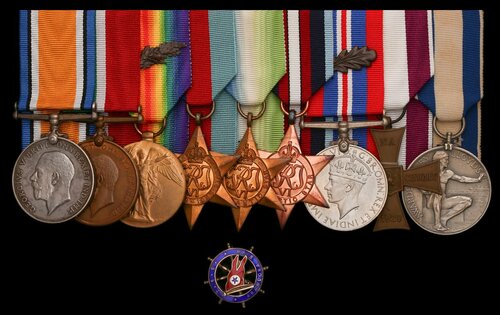
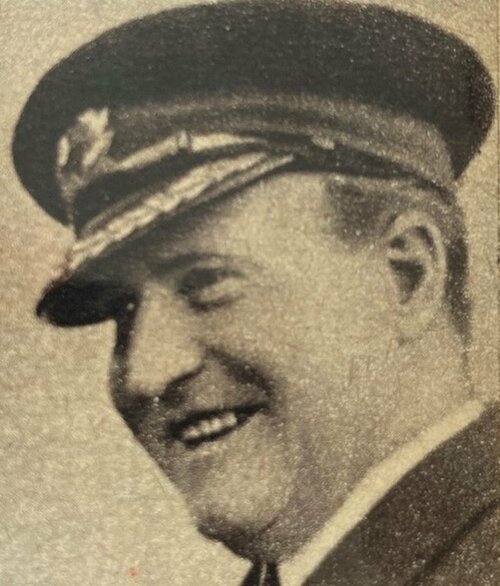
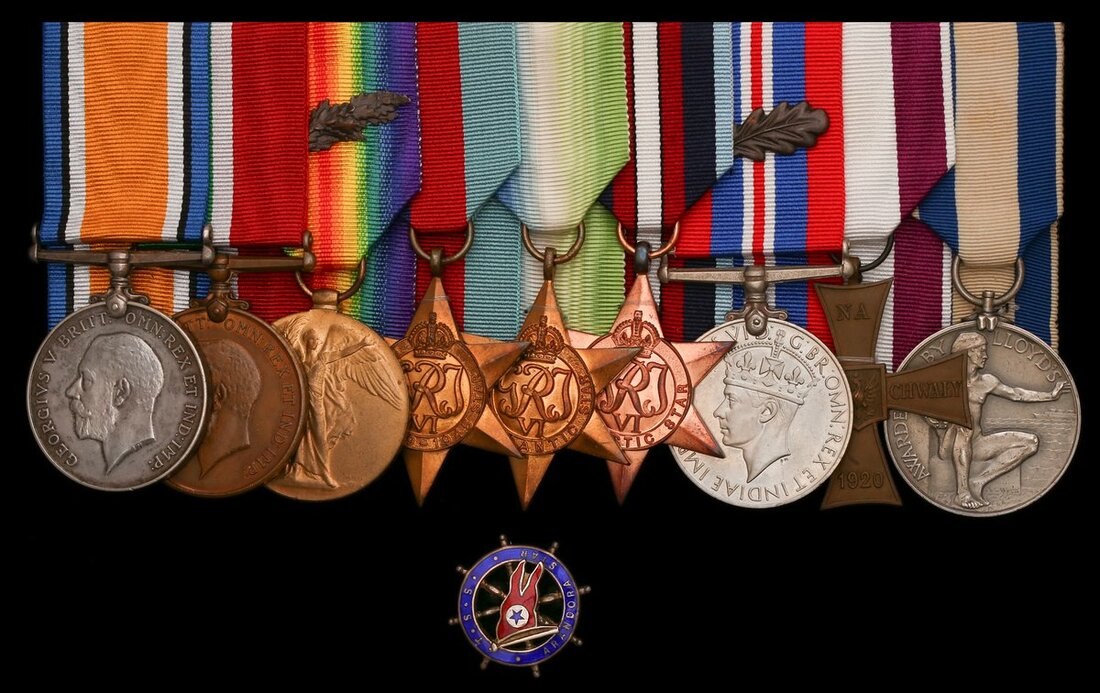
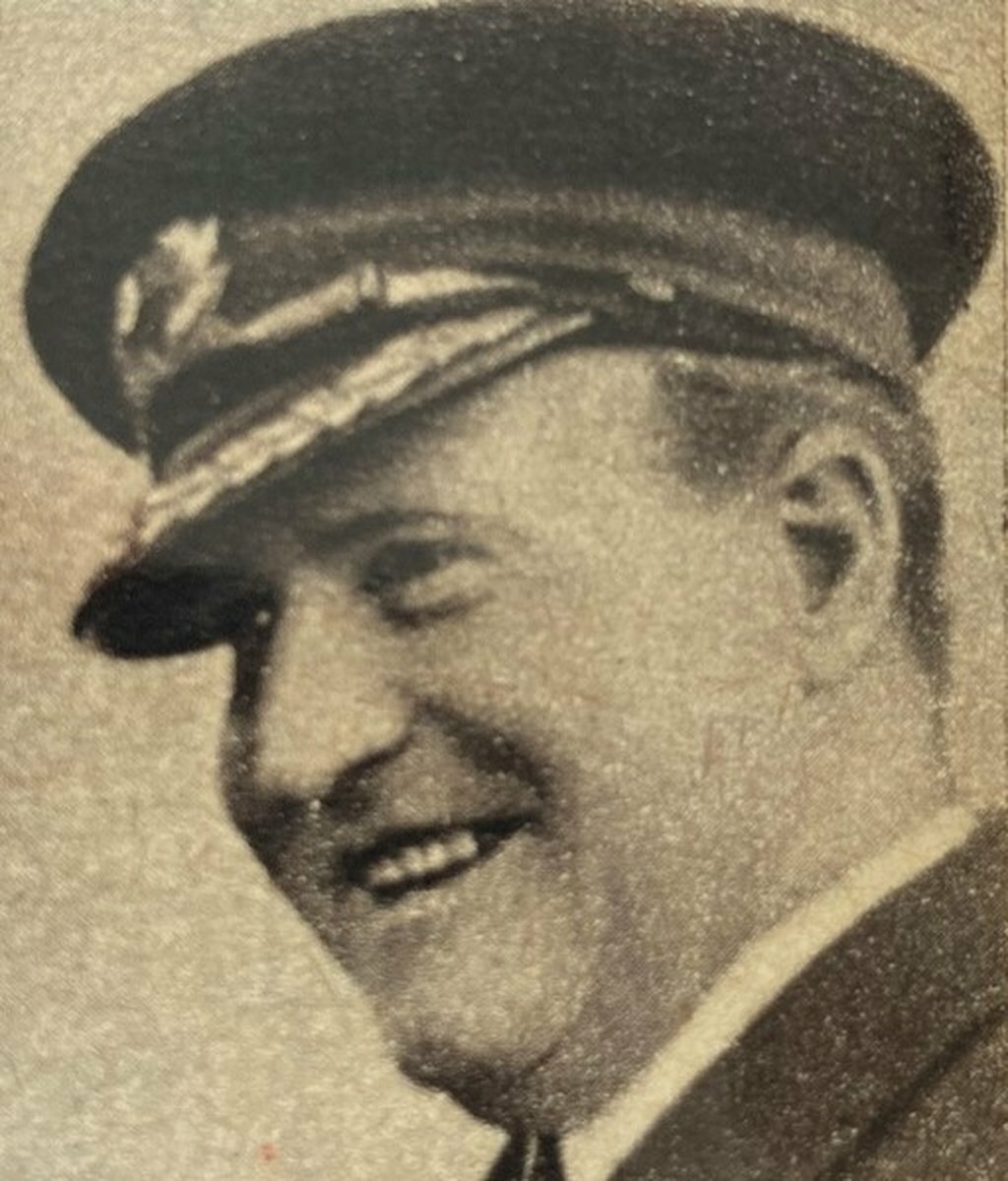
The emotive Second World War posthumous King's Commendation and Lloyd's War Medal for Bravery at Sea group of nine awarded to Captain E. W. Moulton, Merchant Navy, late Royal Indian Marine, the commanding officer of the ill-fated Arandora Star and one of 'the bravest men who ever trod a deck'
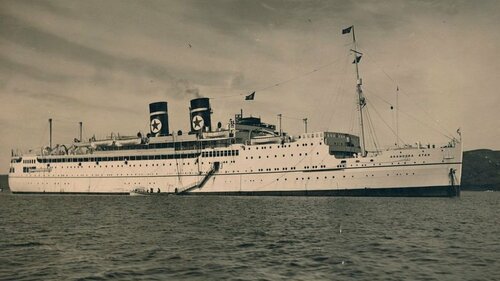
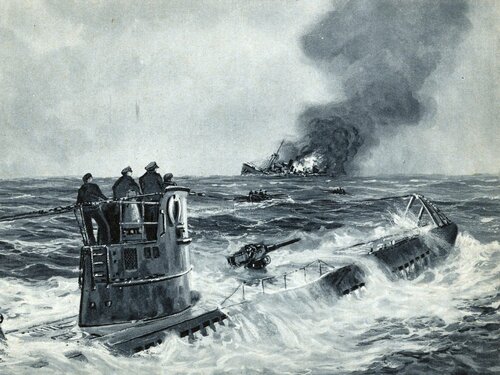
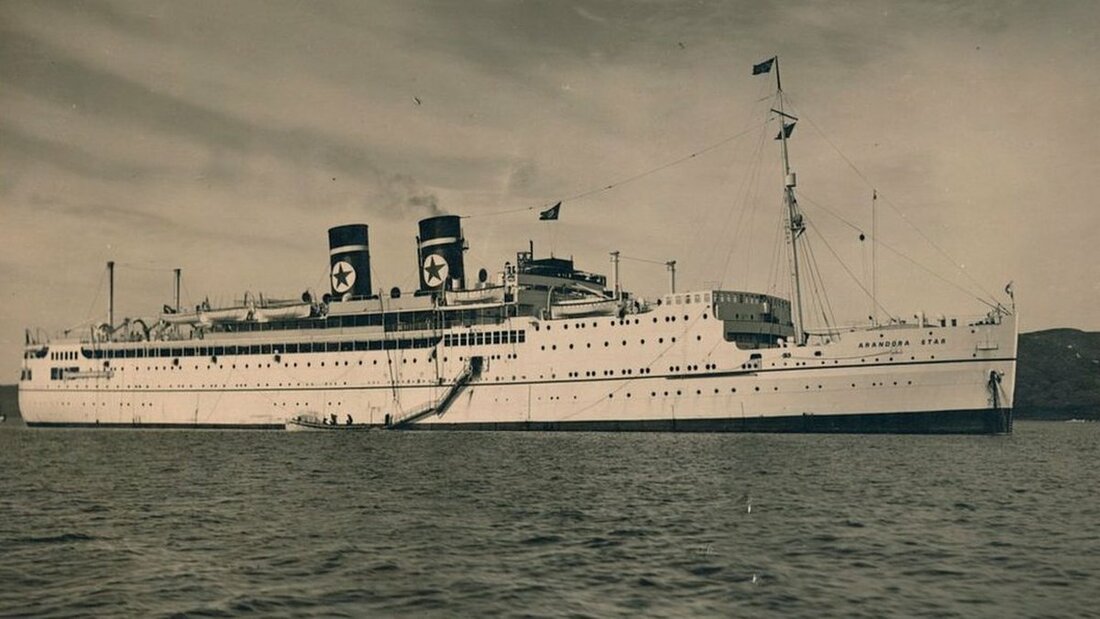
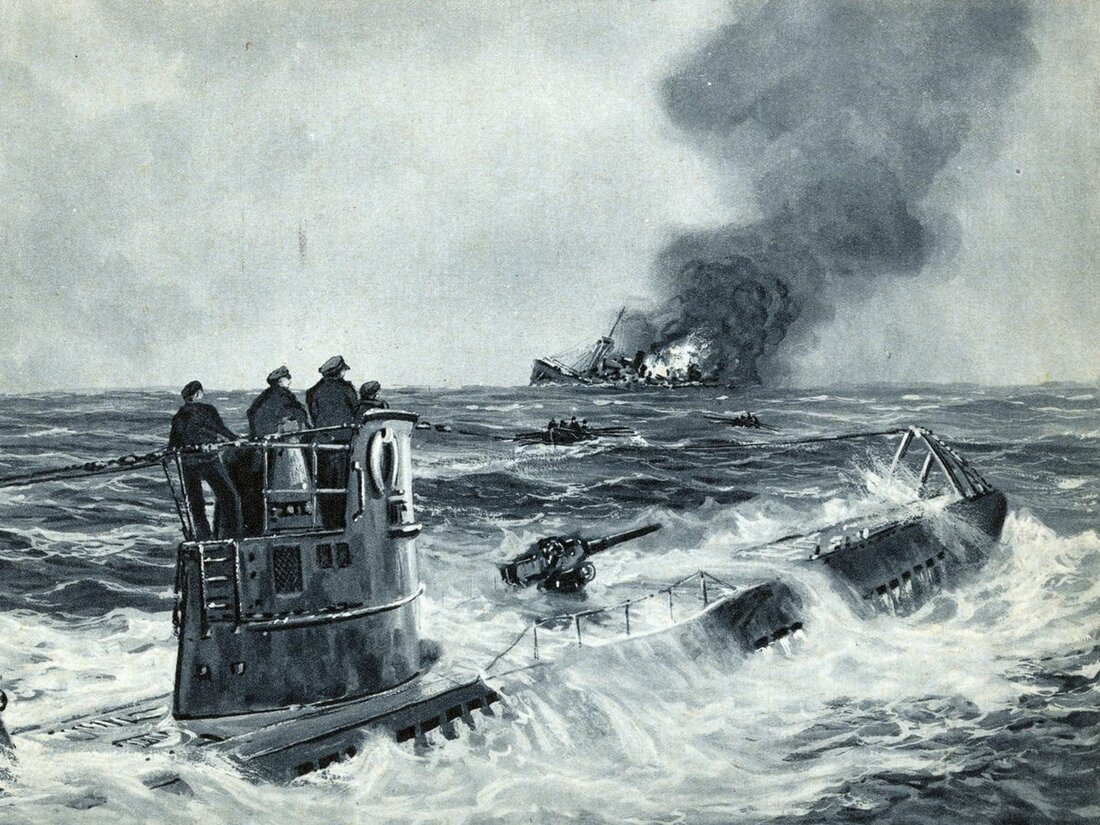
A victim of Gunther Prien and the U-47 - of Royal Oak notoriety - the ex-Blue Funnel liner was conveying hundreds of German and Italian internees to Canada when torpedoed with heavy loss of life off Ireland on 2 July 1940
British War Medal 1914-20 (Lieut. E. W. Moulton, R.I.M.); Mercantile Marine War Medal 1914-18 (Edgar W. Moulton); Victory Medal 1914-19, with M.I.D. oak leaves (Lieut. E. W. Moulton, R.I.M.); 1939-1945 Star; Atlantic Star; Arctic Star; War Medal 1939-45, with oak leaf for King's Commendation; Poland, Republic, Cross of Valour; Lloyd's War Medal for Bravery at Sea (Captain E. W. Moulton, S.S. "Arandora Star" 2nd July 1940.), together with an enamelled S.S. Arandora Star lapel badge, one or two minor edge bruises, good very fine (10)
King's Commendation for Brave Conduct London Gazette 28 October 1940:
'For good services when their ships encountered enemy submarines, aircraft or mines.'
Lloyd's War Medal for Bravery at Sea Lloyd's List and Shipping Gazette 13 May 1941:
'The Master, First, Second and Fourth Officers, after having done all they could to save life and having no boat or raft to save themselves, took to the water as the vessel sank, and all, with the exception of the Chief Officer, were drowned.'
Polish Cross of Valour London Gazette 21 October 1941:
'In recognition of their gallant conduct during the withdrawal of Polish troops from France in June 1940.'
Edgar Wallace Moulton was born in West Derby, Lancashire, on 18 June 1886 and first went to sea as a 16-year-old apprentice.
He subsequently obtained certificates of competency as a Second Mate in February 1907, First Mate in September 1908 and Master in October 1910.
Royal Indian Marine - Mesopotamian 'Mention'
By the outbreak of war in August 1914, he was serving in the Liverpool-registered S.S. La Blanca, and he remained likewise employed until being commissioned as a Sub. Lieutenant in the Royal Naval Reserve in May 1915. That commission, however, was cancelled a month later, as he 'wished to remain in transport', and in consequence he accepted a commission in the Royal Indian Marine.
Appointed First Officer of the S.S. Van Stirum, he undertook troop transport duties to France, but on Christmas Day 1915, on a return trip to Liverpool from Rouen, the ship was shelled, torpedoed and sunk by the U-24.
Moulton next served in the Royal Indian Marine River Fleet - Inland Water Transport - during the Mesopotamian campaign, working alongside the Royal Navy in support of the Indian Expeditionary Force. The River Fleet - which comprised 138 self-propelled vessels, of which four were hospital ships, 134 barges and 95 motor-boats - lent valuable service as our forces advanced up the Tigris in 1917, a string of victories culminating in the capture of Kut and Baghdad. And that valuable support continued in the Samarrah offensive, on the Euphrates and Diyala rivers.
Moulton - who attained the temporary rank of Commander - was mentioned in despatches 'for distinguished and gallant service and devotion to duty' in Mesopotamia in Lieutenant-General Maude's despatch, dated 2 November 1917.
Returning to the merchant service after the war, he became a highly experienced captain in the Blue Star Line and, by the renewal of hostilities in September 1939, was in command of the S.S. Arandora Star.
France and Norway 1940 - Polish Cross of Valour
Quickly requisitioned for war service, she sailed unescorted from the U.K. for New York carrying $14,000,000 in gold and 440 citizens of the U.S.A., anxious to return home.
On her return, the Arandora Star was laid up in the River Dart for about three months, being deemed too top-heavy for conversion to the role of an Armed Merchant Cruiser. But she was fitted out as a troopship, with experimental torpedo nets, and undertook trials out of Southampton in March-April 1940.
At the end of the following month, after the Norwegian capitulation, Moulton took the ship to Harsted as part of Operation 'Alphabet', in which she embarked 1,600 R.A.F. personnel and some French and Polish troops.
Later, in June, she was instrumental in rescuing further Polish troops from Saint-Jean-de-Luz in France. In fact, Arandora Star embarked around 3,500 men, including the Polish staff, and departed just as the Luftwaffe arrived on the scene. In writing to his daughters about the event, Moulton described how he gave up his cabin for mothers and children to use:
'They had been chased for days and had lost everything. We brought back 3,500 Polish troops and refugees and to move around you had to walk on bodies.'
He also described how the ship had been attacked:
'The Second Officer saw a plane coming down the river where we were anchored. It was flying so low that being by itself he thought it was one of ours. He dropped his bomb though, which according to the Second Officer fell 12 yards astern. The concussion was terrific and we were literally shaken out of our beds. My first night in bed for 28 days … '
Moulton was awarded the Polish Cross of Valour.
Tragedy - posthumous King's Commendation and Lloyd's Bravery Medal
On 1 July 1940, Arandora Star set sail unescorted from Liverpool, bound for St. John's, Newfoundland, after Canada had reluctantly agreed to take Italian and German internees from Britain. Around 1,600 men were crammed on board, of whom some 730 were Italians and 480 Germans.
The ship wasn't displaying the International Red Cross symbol to signify civilians were on board and access to lifeboats was obstructed by heavy wire mesh, which was in place to keep the internees from taking over the ship.
The day following her departure from Liverpool, Arandora Star was torpedoed and sunk by the U-47, about 75 miles west of Bloody Foreland in Co. Donegal. Hocking's A Dictionary of Disasters at Sea states:
'The liner was under the command of Captain Moulton and carried 1,178 German and Italian internees proceeding to Canada, the remainder consisting of 176 crew and 254 troops charged with the duty of guarding the prisoners. Immediately the torpedo exploded there was panic among the Germans and Italians, who fought each other with ferocious savagery. In attempting to rush the boats, scores were forced overboard and drowned …'
Sergeant Norman Price, a survivor, later recalled:
'I could see hundreds of men clinging to the ship. They were like ants and then the ship went up at one end and slid rapidly down, taking the men with her … Many men had broken their necks jumping or diving into the water. Others injured themselves by landing on drifting wreckage and floating debris near the sinking ship … '
And in respect of the gallant deeds of Moulton and his officers, Those in Peril on the Seas, by David Masters, adds:
'She was so badly shattered by the explosion that the passengers had only a poor chance. Captain Moulton, the Chief Officer, F. B. Brown, the Second Officer, S. Ransom and the Fourth Officer, R. Liddle, strove without the slightest thought of self to get the people into the boats. They were indefatigable in their efforts, but the ship was foundering swiftly and they had little time. Yet in the short time vouchsafed to them they launched every boat and raft on the liner.
There was nothing left for them, no boat or raft to ensure their own safety. As the ship went down, they jumped into the sea, four of the bravest men who ever trod a deck. Captain E. W. Moulton, Second Officer Stanley Ransom and Fourth Officer Ralph Liddle all sacrificed their lives for their fellow men and the courage of all four won the award of the Lloyd's Medal.'
Moulton and his officers were last seen 'walking off the bridge into the sea.'
The final death toll amounted to 613 internees, 91 soldiers and 57 crew.
For two months after the tragedy, bodies of the victims continued to wash up on the north coast of Ireland and the west coast of Scotland. Identification proved extremely difficult and some were buried in unmarked graves.
Moulton has no known grave and is commemorated on the Tower Hill Memorial, London.
The Liverpool Maritime Museum holds a photograph album and other items relating to his career, including his last letter to his daughters; sold with a quantity of copied research, an old picture postcard of the Arandora Star and a related newspaper cutting.
For his wife's awards, please see Lot 137.
Subject to 5% tax on Hammer Price in addition to 20% VAT on Buyer’s Premium.
Sold for
£6,000
Starting price
£2600

Watch, listen and bid as if you were in the room. Now available for auctions worldwide.
Click here to bid live
An exclusive and confidential service for the discerning collector or vendor.
View the Gallery
Download every Spink catalogue on your iPad, iPod or iPhone using free Spink app.
Download From iTunes© 2026 Spink & Son. All rights reserved.