
Auction: 26001 - Orders, Decorations and Medals
Lot: 218
'He is rather silent about it, his mother told me today but we do know it was for gallantry on HMS Campbell when it recently sank an E Boat'
Mrs Ward referring to the action on the 24th & 25th October 1943 when HMS Campbell was part of the escort of Convoy FN1160 when it came under attack by a full Wolfpacks. The escort managed to drive off the attacks with only the trawler William Stephen being sunk
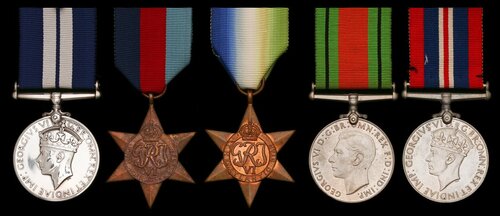
The 1944 D.S.M. group of five awarded to Temporary Leading Seaman K. R. Ward, Royal Navy, who was the leader of the radar team on H.M.S. Campbell, his service culminating in the defence of Convoy FN-1160 in 25 October 1943, one of the biggest E-Boat battles of the entire Second World War
Distinguished Service Medal G.VI.R. (Temp.L/S. K. R. Ward, P/JX.189097); 1939-1945 Star; Atlantic Star; Defence and War Medals 1939-45, all but extremely fine (5)
D.S.M. London Gazette 8 June 1944. The official recommendation, dated 28 January 1944, states:
'Has rendered over three years of zealous and arduous service as a radar operator. A reliable and brilliant operator, he has always shown remarkable guts, tenacity, tirelessness and devotion to duty, often under conditions of great strain and long hours in fog and bad weather, and has frequently been of prime assistance in preserving the safety of the ship. As leader of the radar team, he has set a splendid example at all times.'
Kenneth Royston Ward was born in Withington, Manchester on 29 January 1916. Educated at Chorlton High School he was a cotton industry clerk when he enlisted in the Royal Navy. He spent the war on-board H.M.S. Campbell.
Campbell was an Admiralty type flotilla leader (also known as the Scott-class) of the British Royal Navy. Built by Cammell Laird, Douglas commissioned in December 1918, just after the end of the First World War. During the Second World War, Campbell mainly served as a convoy escort, particularly on the East Coast of the United Kingdom and Arctic convoys. She survived the war, and was sold for scrap in 1947.
Following the outbreak of the Second World War, Campbell underwent a refit which continued until February 1940, when she took part in convoy escort operations in the North Sea and the Western Approaches. In April 1940, Campbell was diverted to Scapa Flow as a result of the German invasion of Norway, landing troops at Molde on 23 April Campbell took part in evacuation operations from Harstad and Andfjorden between 3 and 12 June 1940, before returning to convoy escort duties, supplementing them by anti-invasion patrols.
On 20 June 1940, the German submarine U-122 torpedoed and sank the cargo ship SS Empire Conveyor. Campbell rescued the 38 survivors from Empire Conveyor, landing then at Liverpool on 21 June. On the night of 19/20 November, Campbell and the Hunt-class destroyer Garth were on patrol east of Lowestoft when they encountered three Schnellboot (S-boats or German motor torpedo boats), S38, S54 and S57. S38 was sunk by ramming.
On the night of 19/20 November 1941, Campbell, along with Garth and the destroyer Vesper formed a support group for Convoy FS650, consisting of 59 merchant ships, which also had a close escort of two destroyers and two corvettes, when the convoy was attacked by four S-boats off Great Yarmouth. Three merchant ships, Aruba, Waldinge and War Mehtar were sunk, with one S-boat sunk. When responding the attack, Campbell mistook Garth for a German ship and fired on her, hitting Garth with six pom-pom shells. These shells seriously damaged Garth, causing loss of all steam and electrical power and immobilising the ship (which had to be towed back to port), and killed two men.
Campbell was one of six destroyers that were ordered to reinforce Dover Command on 3 February 1942, in anticipation that the German battleships Scharnhorst and Gneisenau and heavy cruiser Prinz Eugen would attempt to return from Brest in German occupied France to Germany. On the night of 11/12 February, the German ships left Brest to pass through the British blockade, in what became known as the Channel Dash, but were undetected by the British owing to a combination of German jamming and British technical failures.The six destroyers (Campbell, Vivacious, Worcester, Mackay, Whitshed and Walpole, under the command of Captain Captain C. T. M. Pizey aboard Campbell) were exercising off Harwich when the Germans were finally detected, and were ordered to intercept the German fleet off the mouth of the River Scheldt, steering a course through a German minefield to allow the interception to take place. One destroyer, Walpole was forced to turn back due to mechanical trouble, but the remaining five destroyers reached the German force at 15:42 hr. They launched torpedoes at a range of 2,400-4,000 yards (2,200-3,700 m), but none hit, while Worcester was heavily damaged by German shells. On 12 March 1942, Campbell collided with the destroyer Vesper, and was under repair at the Southampton shipyard of Thornycroft until 25 April that year. From 2 to 7 September 1942, Campbell formed part of the escort of the Arctic convoy PQ 18 on its initial leg from Loch Ewe to Iceland.
Campbell continued on East coast escort duty through the rest of 1942 and into 1943. She was refitted at London from February to April 1943. On the night of 24/25 October 1943, Campbell was part of the escort (consisting of 5 destroyers, 6 Motor Gun Boats and two Motor Launches) of Convoy FN1160 when it came under attack by 32 S-boats. The escort managed to drive off the attacks with only the trawler William Stephen being sunk, while the S-boat S63 was sunk by the destroyer Mackay and S88 was sunk by Motor Gun Boats.
In June 1944, Campbell took part in Operation Neptune, the naval operations supporting the Allied Invasion of Normandy. On 4 June, the landings, planned for 5 June, were postponed for a day due to poor weather forecasts. Campbell was at sea when the postponement signal was sent out, and observed a group of minesweepers (the 14th Minesweeper Flotilla) in the process of sweeping mines. In the belief that the minesweepers had not received the postponement signal (in fact it had been received, but the commander of the minesweepers had decided to continue clearing the mines from the swept channel before returning to port) Campbell and the sloop Hind closed with the minesweepers to signal them by semaphore (strict radio silence had been imposed). Campbell soon found herself in the middle of a field of floating mines and had to be extricated by the minesweepers. Campbell continued convoy escort operations in the Channel in support of the landings until July, when she returned to East coast convoy operations.
Campbell continued on escort operations along the east coast and English Channel until the end of the war in Europe. On 13 May 1945, Campbell formed part of the escort for the cruiser Devonshire and the fast minelayers Apollo and Ariadne as they carried the Norwegian Government-in-Exile and Crown Prince Olav home from exile to Oslo.
Ward died in Chorlton in January 1998 age 81.
Sold together with copied research and newspaper clippings.
Further entitled to the Arctic Star.
Subject to 20% VAT on Buyer’s Premium. For more information please view Terms and Conditions for Buyers.
Estimate
£1,000 to £1,400
Starting price
£900
Watch, listen and bid as if you were in the room. Now available for auctions worldwide.
Click here to bid live
An exclusive and confidential service for the discerning collector or vendor.
View the Gallery
Download every Spink catalogue on your iPad, iPod or iPhone using free Spink app.
Download From iTunes© 2026 Spink & Son. All rights reserved.