
Auction: 26001 - Orders, Decorations and Medals
Lot: 110
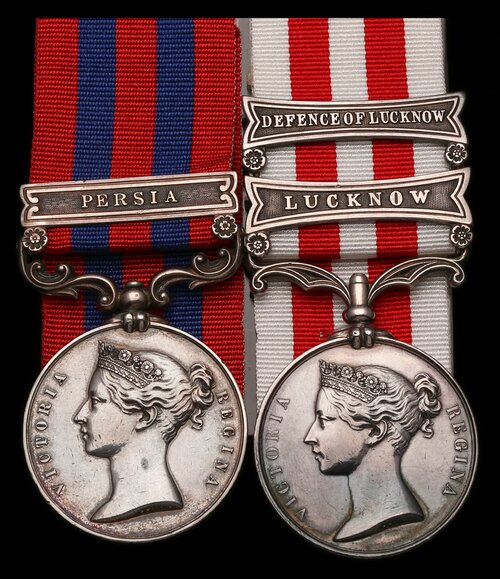
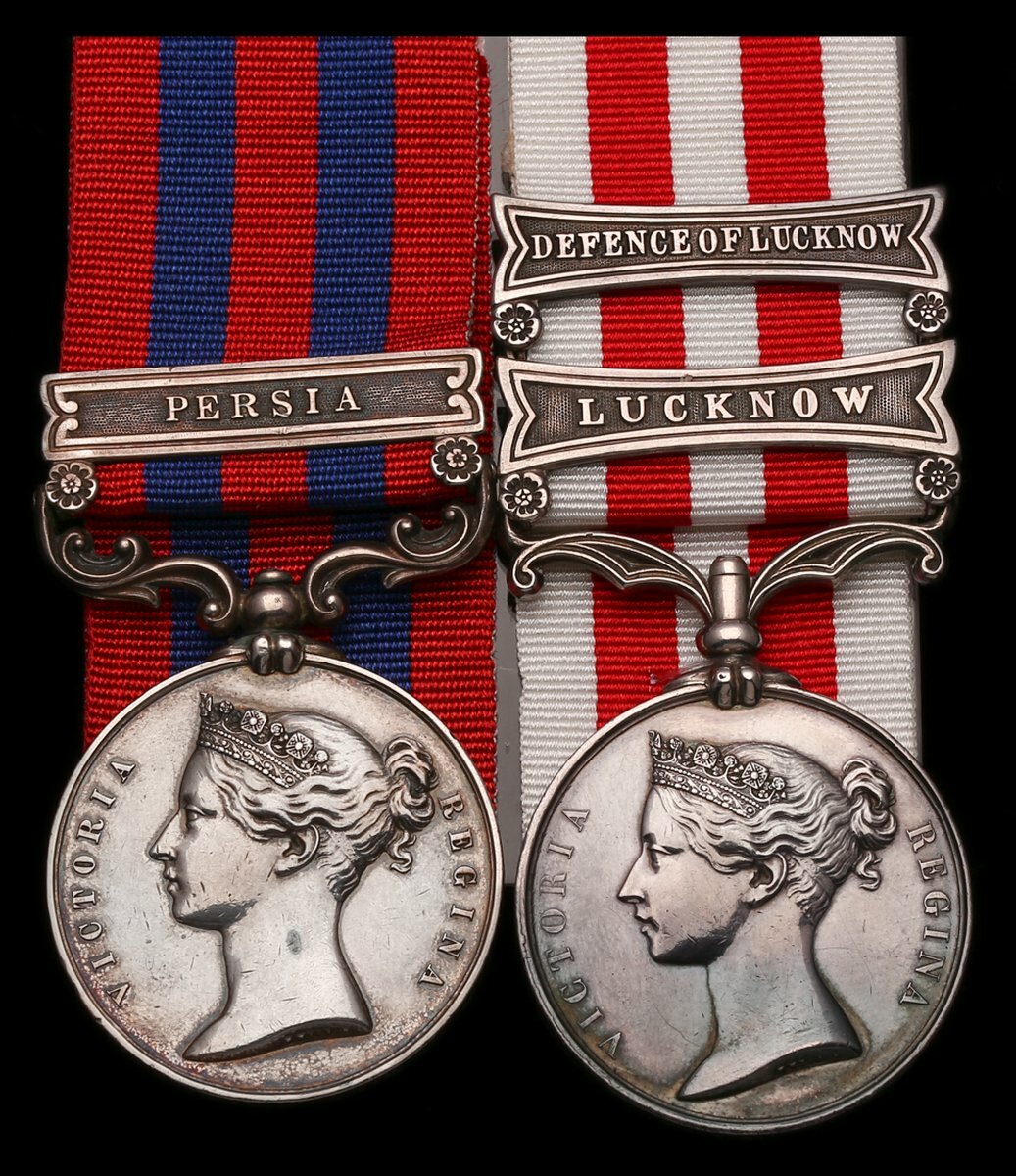
Pair: Sergeant B. Park, 78th (Highland Light Infantry) Highlanders
India General Service 1854-95, 1 clasp, Persia (Corpl B. Park, 78th Highlanders); Indian Mutiny 1857-58, 2 clasps, Lucknow, Defence of Lucknow (Serjt B. Park, 78th Highlanders), light contact marks, very fine (2)
Boswell Park was born at Glasgow and was a labourer before he enlisted at Chatham, Kent on 2 December 1850. He embarked at Gravesend on 21 August 1851 on the Earl Hardwick to join the Service Companies of the regiment. On 2 January 1852 he joined a detachment of the regiment at Bombay, India and in January of the following year joined the rest of his regiment. From 1 April 1853 he served with the regiment and was stationed at Poona and during this time was promoted to Corporal on 18 January 1854. The regiment left Poona in April 1857 and Park saw service at Mohmand, Persia, at sea and Benares (now Varanasi). The Muster roll for July - August 1857 shows him serving at Lucknow. Park was promoted to Sergeant on 8 September 1857 and the Muster roll for October - December 1857 has him based at Alum Bagh near Lucknow. By early 1859 he was based at Camp Mhow and embarked for Home on 18 May 1859 landing on home soil on 11 September 1859. Park was then stationed at Fort George in Scotland, however he was absent without leave on 4 November 1859, was found later the same day and was placed in solitary confinement between 4-7 November 1859. He was subsequently tried on 8 November 1859 and reduced to the rank of Private and was put on furlough between 22 December 1859 - 31 January 1860. The regiment moved to Edinburgh Castle on 24 January 1860 and Park was on detachment in February and March 1860. He was on further detachment at Greenlaw in parts throughout 1860 and into 1861 and during this time he was restored Good Conduct Pay at 1d per day from 9 November 1860. He was discharged at Edinburgh on 7 December 1860. He appears in various street entries after leaving the army and lived at 98 Burnside Street, Glasgow working as a marble cutter.
The 78th returned to India in May 1857 to help supress the Indian Rebellion. Under the command of General Sir James Outram the Regiment took part in the recapture of Cawnpore in July 1857 and then in the relief and defence of Lucknow.
Outram and the 78th recaptured Cawnpore on 15 September 1857 where they met with a scene marked by horror and death. From Cawnpore Outram commissioned General Sir Henry Havelock to command the Lucknow relief force, which numbered 3,179 men composed of six British and one Sikh battalions, with three artillery batteries and 168 volunteer cavalry.
Their advance towards Lucknow continued on 18 September. The rebels did not make any serious stand in the open country, even failing to destroy some of the vital bridges. On the 23rd September Havelock's force drove the rebels from the Alambagh, four miles south of the Residency at Lucknow. Leaving the baggage with a small force in the Alambagh, the main force began the final advance to Lucknow on 25 September 1857.
The advance met heavy resistance while trying to cross the Charbagh Canal but eventually succeeded with some difficulty. Then then turned to their right and followed the west bank of the canal. The 78th Highlanders took a wrong turning, but were able to capture a rebel battery fighting the force reached the Machchhi Bhawan by nightfall. Outram proposed to halt and reach the defenders of the Residency by tunnelling and mining throughout the intervening buildings. However, Havelock insisted on an immediate advance as he feared the defenders of the Residency were so weakened they might be overwhelmed by a last-minute rebel attack. The advance was made through heavily defended narrow lanes which left the troops vulnerable. Brigadier General James George Smith Neill was one of many killed by rebel musket fire in the approach. The garrison at Lucknow was finally reached after 90 days of siege on 25 September 1857. The relief force campaign had resulted in losses of 535 men out of 2,000, many occurring in the last rush.
It was obvious Havelock's depleted force was not strong enough to break the siege but could only provide further defence of the garrison until more help arrived. The 78th Highlanders bravely defended the Residency for a further 53 days of siege until they were relieved by Sir Colin Campbell. The regiment had won eight Victoria Crosses in the campaign and were hailed as the 'saviour of British India' and feted for their conduct at Lucknow. General Havelock was knighted and promoted for his force's efforts but did not have long to enjoy his new titles, gravely ill with dysentery he died on 24 November 1857.
Sold with assorted photocopied research.
Subject to 20% VAT on Buyer’s Premium. For more information please view Terms and Conditions for Buyers.
Sold for
£1,700
Starting price
£600
Watch, listen and bid as if you were in the room. Now available for auctions worldwide.
Click here to bid live
An exclusive and confidential service for the discerning collector or vendor.
View the Gallery
Download every Spink catalogue on your iPad, iPod or iPhone using free Spink app.
Download From iTunes© 2026 Spink & Son. All rights reserved.