
Auction: 26001 - Orders, Decorations and Medals
Lot: 109
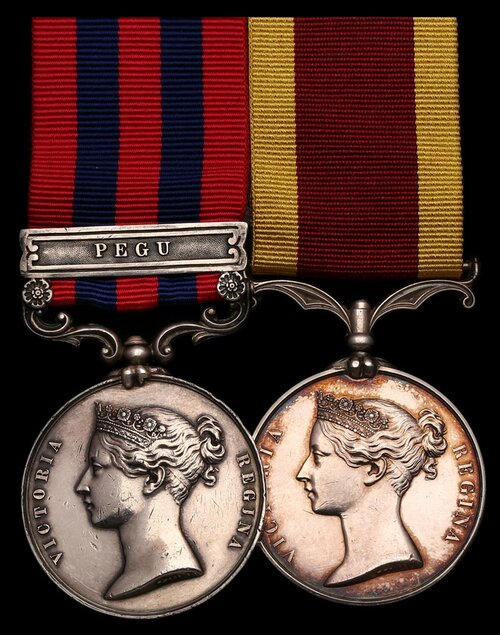
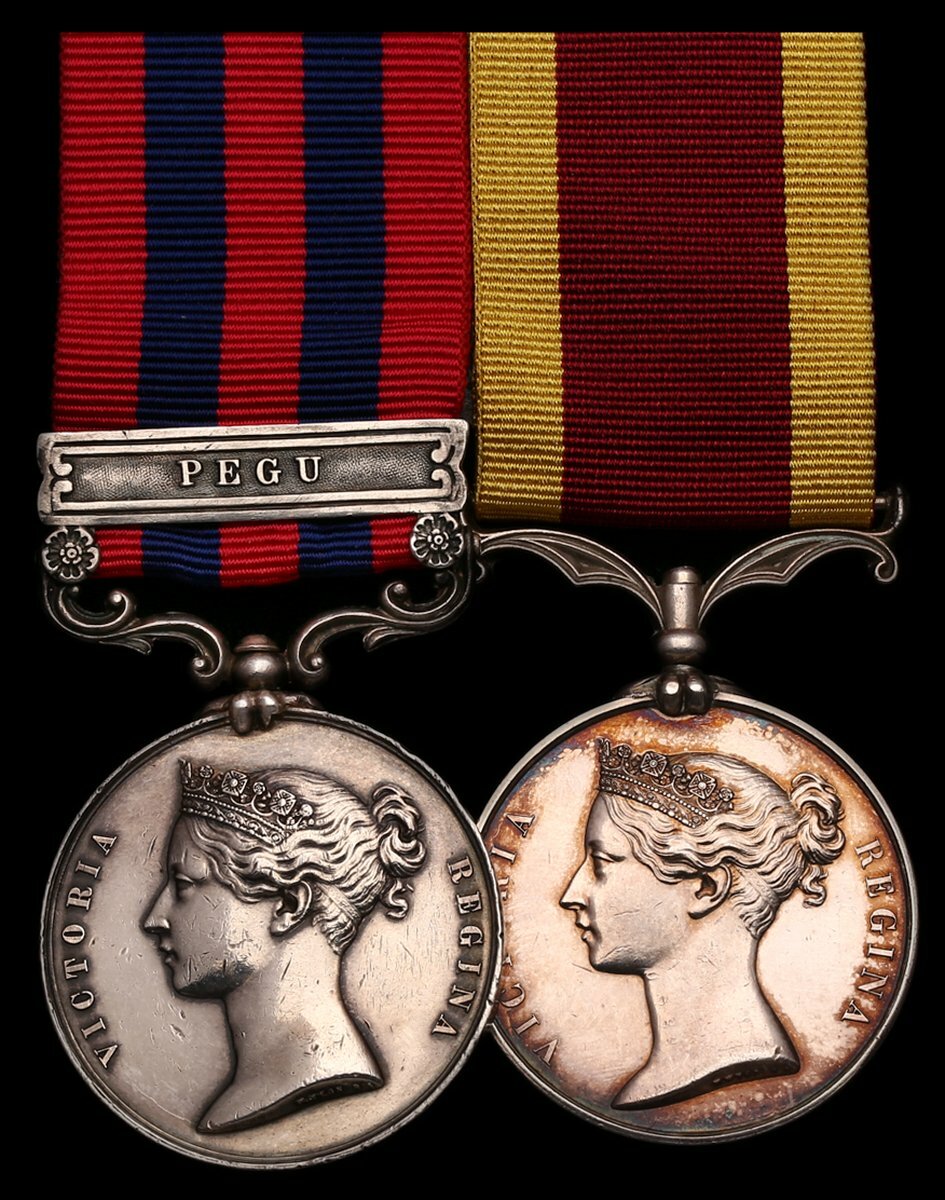
(x) Pair: Chief Officer H. Lock, H.M. Coastguard late Royal Navy
India General Service 1854-95, 1 clasp, Pegu (Hy Lock. A.B. "Winchester"); China 1857-60, no clasp, unnamed as issued light contact marks and mild edge bruising to both otherwise very fine (2)
Henry Lock (or Locke) was born in Longparish, Hampshire and was the son of Thomas Locke and Mary Ann Brackstone. At the age of 14, under the alias John Lock he was appointed a Boy 2nd Class on 1 January 1845 in the Royal Navy, stating he was born on 4 August 1830. Some records however record his birth year as 1833, which would make him closer to 12 when he enlisted and he was assigned to Espiegle.
The Espiegle reached the Straits of Banca after a four-month voyage, attempting to find shipwrecked crews at Kerguelen's Island. Serving in the East Indies Station under Captain Thomas Pickering Thompson it took part in the post war action at Canton China. This operation which took place on 2 - 3 April 1847 and was in response to Chinese attacks on British subjects near Canton after the war had officially ended with the Treaty of Nanking in 1842. In August 1847 the Espiegle was commanded by Commander F. A. Campbell and they performed anti-slavery duties near Cuba, showing its service in protecting British interests and suppressing the slave trade.
After returning to England in February 1849, the young Lock was paid off, however he re-joined Tweed a 28-gun, sixth-rate frigate. This ship was commanded by Commander Francis John Russell and actively served on the South-East Coast of America station. Between 6 - 10 February 1849, Tweed rendered salvage services to the British merchant brig Jane in the River Plate, for which the officers and company were later awarded and paid salvage money. He was advanced to a Boy 1st Class on 5 July, and they were heavily involved in anti-slavery duties and served within that context enforcing the British ban on the transatlantic slave trade by intercepting slave ships. In July 1850 they detained the Portuguese vessel Velha de Dia which was a slave trade vessel, this was dangerous work but a crucial part of Britain's policy to suppress the trade globally. Lock was promoted to an ordinary seaman on 26 August 1850.
On 1 April 1852, Lock joined Winchester as an able seaman declaring his real name was Henry Lock. The Winchester was a 52-gun fourth rate sailing frigate, serving as the flagship for the Royal Navy's East Indies and China Station she participated in the Second Anglo-Burmese War and the Second Opium War. The ship was commanded by Captain G. G. Loch and was involved in the Second Anglo-Burmese War, operating along the Irrawaddy River, where Captain Loch was mortally wounded during an attack on Donabew in February 1853.
Command was then passed to Captain J. C. Fitzgerald, and they continued operations on the East Indies and China Station. In May 1854, Captain T. Wilson took command, and the vessel became the flagship of Rear-Admiral J. Stirling. In this role, the ship was involved in operations related to the Second Anglo-Chinese War (Second Opium War). Throughout this deployment, the crew of Winchester faced regional tensions, and a memorial was later erected in Hong Kong by the officers and crew to remember shipmates who died from various causes, including being killed in action or drowning. For these actions Lock was awarded the Indian General Service 1854-95 Medal with clasp Pegu and the Second China 1857-60 Medal.
On 15 May 1857, Lock transferred to the Coastguard, his conduct while with the Royal Navy was consistently rated as very good, he had also married a lady by the name of Jane sometime during this year at Maldon, Essex. He was posted to the Bradwell Coastguard Station in Essex as a boatman. On 1 March 1867 he was appointed a chief boatman, and on the 1 April, he was stationed onboard Pembroke, which was a Coastguard base ship. His next appointment was to Penelope on 30 August 1869, which was a Coastguard and drill ship for the Naval Reserve at Harwich, Essex.
On 27 April he was appointed a chief officer 2nd class at Cornhill, Westcliffe briefly before being posted at the Bacton Coastguard station in Norfolk where he dealt with smuggling, focusing on coastal surveillance. It appears he stayed at this station and was appointed chief officer on 1 August 1875, and he retired on 17 October 1883 after 32 years and 223 days service. He died on 21 December 1900 at 140 Victoria Road, Romford, Essex.
Sold together with photocopied service papers.
Subject to 5% tax on Hammer Price in addition to 20% VAT on Buyer’s Premium.
Sold for
£380
Starting price
£320

Watch, listen and bid as if you were in the room. Now available for auctions worldwide.
Click here to bid live
An exclusive and confidential service for the discerning collector or vendor.
View the Gallery
Download every Spink catalogue on your iPad, iPod or iPhone using free Spink app.
Download From iTunes© 2026 Spink & Son. All rights reserved.