
Auction: 26001 - Orders, Decorations and Medals
Lot: 100
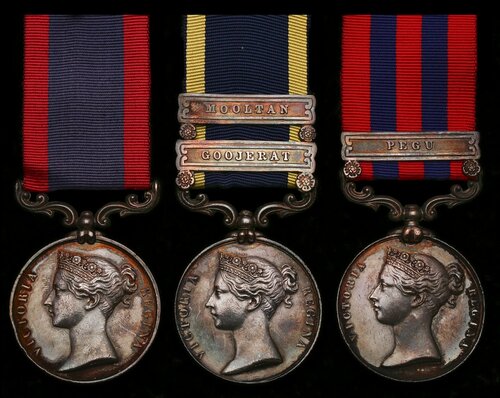
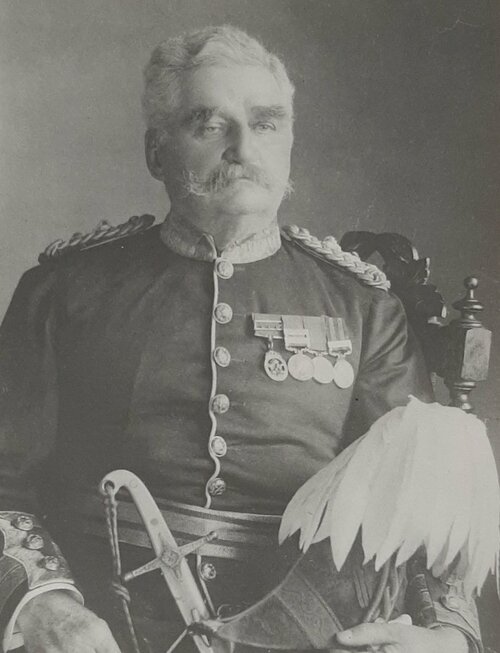
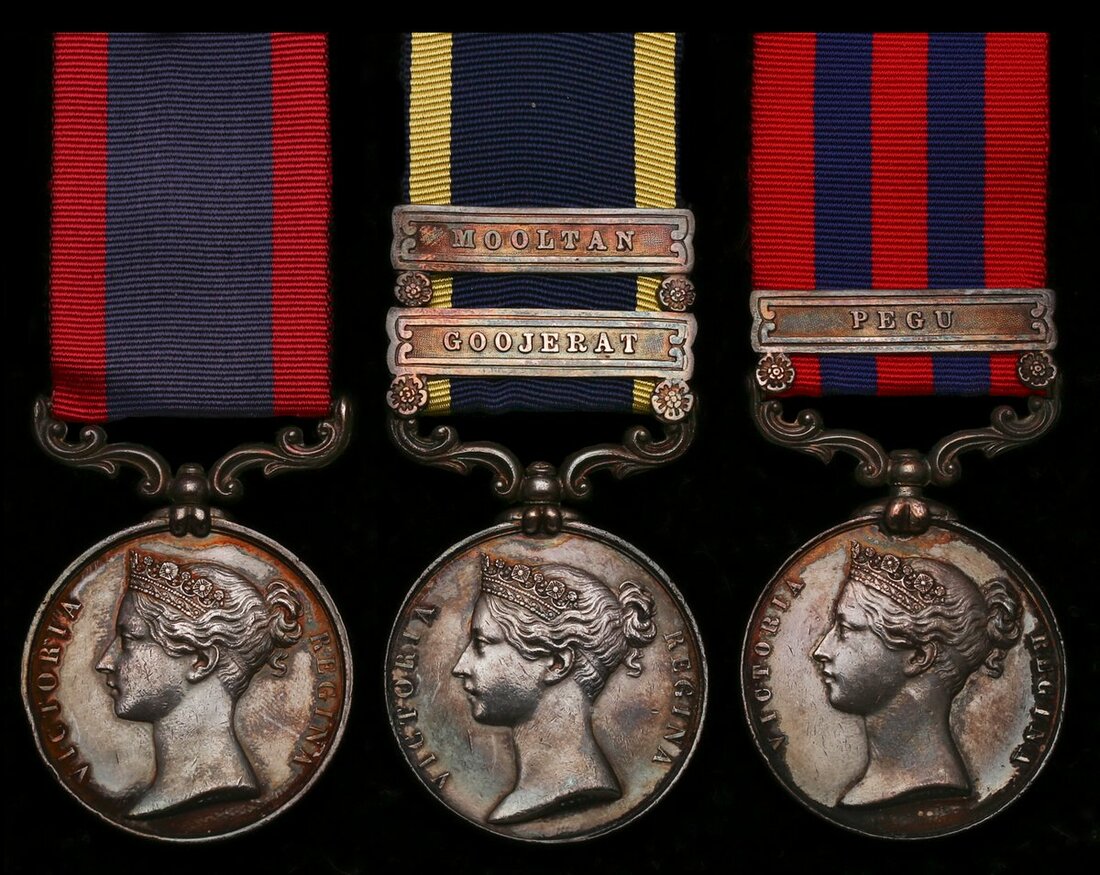
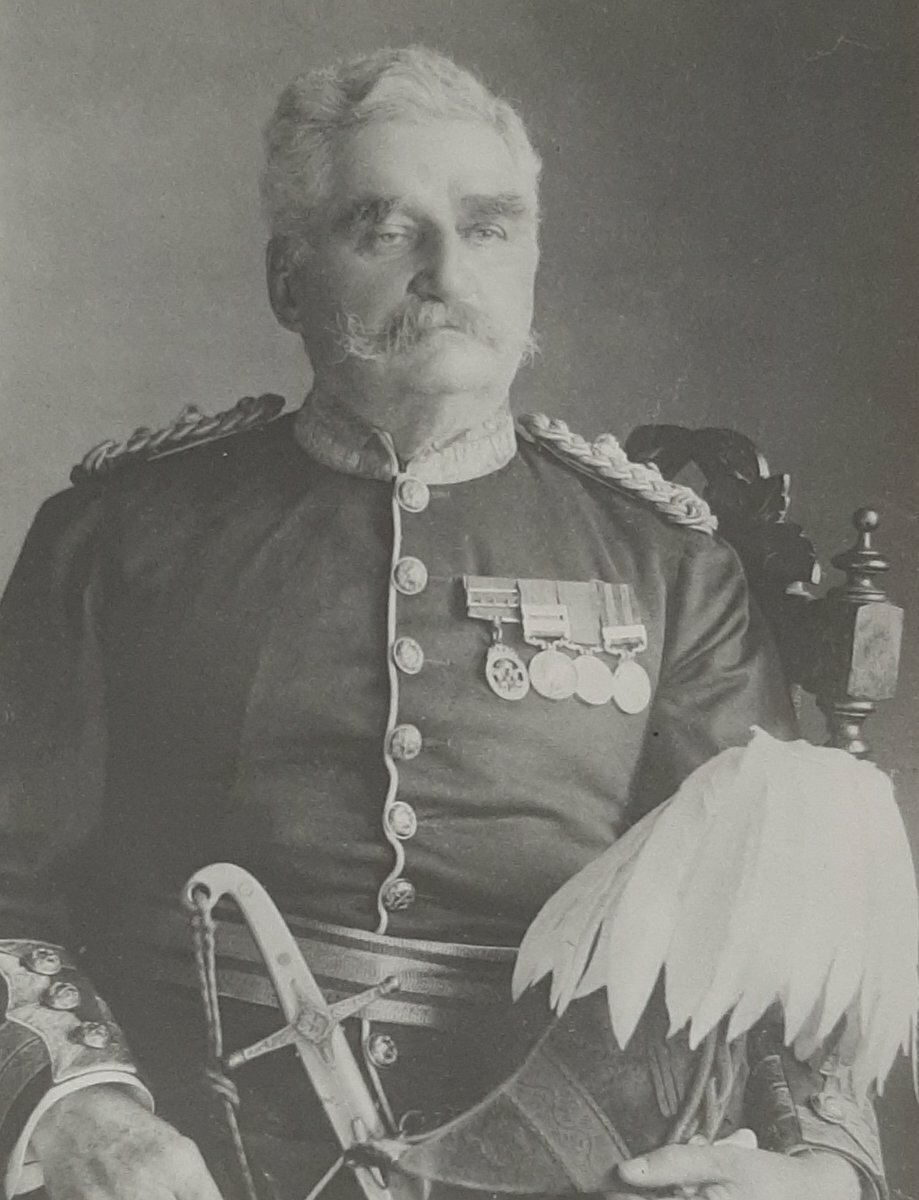
Three: General A. Fraser, Bengal Engineers, Adjutant of the Sappers during the famous Siege of Mooltan for which he was commended, most notably for overseeing the mines which preceded the final attack, he went on to serve in Tonghoo during the 2nd Anglo-Burmese War where he was 'mentioned' in the despatch of Brigadier General Steel
Perhaps most famous for his service in the field of civil engineering which saw him construct many of the public building in Rangoon Fraser was most feted for his work on the construction of the Alguada Reef Lighthouse which saw him appointed a C.B.
Late in life he fathered the future Admiral Bruce Fraser, famous for his sinking of the Battleship Scharnhorst
Sutlej 1845-46, for Sobraon 1846 (Lieutt. A. Fraser Engineers); Punjab 1848-49, 2 clasps, Mooltan, Goojerat (Lieutt. & Adjt. A. Fraser Sappers & Miners); India General Service 1854-94, 1 clasp, Pegu (Lieut. A. Fraser Engineers) the naming officially re-engraved in running script to all, in line with a report that his original medals were lost at sea and the set replaced at the expense by the Calcutta Mint, contact marks and toned, otherwise very fine (3)
Ex-Tim Ash Collection, December 2012.
[C.B.] London Gazette 21 March 1866.
Alexander Fraser was born at Prestbury, Gloucestershire, on 8 May 1824, the son of James and Helen Fraser. It was doubtless his father's own service with the Honourable East India Company's Maritime Service which led the young Fraser into the employ of John Company. Joining the Addiscombe Military Seminary he was awarded the Sword of Merit upon passing out in 1843 and matriculating to the Chatham School of Engineering.
Joining the Bengal Engineers in 1843 he was in action just two years later in the First Anglo-Sikh War. During that time he was twice employed in constructing the bridges of boats at the Khoonda Ghat and Nuggur Ghat which allowed the Army passage over the Sobraon. Appointed Adjutant of the Sappers and Miners under Captain Siddons he served with him before Mooltan and received high praise in his despatch after the Siege which states:
'Custom justifies me in naming my Adjutant, Lieutenant Fraser, as having rendered me the most important assistance in carrying on all the details of the Corps during the Siege, his services were always available when required in the trenches, and he superintended the loading, tamping and during of the mines on the night of the attack.'
(London Gazette 3 May 1849 refers)
Fraser is noted as taking part in the capture of the Fort and Garrison of Cheniote as well as seeing service at Goojerat. After the war he undertook work for the Department of Public Works, where he received the tanks of the Officer commanding the Sappers and Pioneers for his work as Adjutant. It was not long however before his military skills were called upon again and he joined the Army of Burma under General Godwin.
Posted to Brigadier General Steel's Martaban Column, advancing on Tongoo he was 'mentioned' in the despatch which covered the conclusion of that expedition, which states:
'Lieutenant A. Fraser of the Bengal Engineers, Assistant Field Engineer, has been indefatigable in his exertions, both in the higher professional duties of an Engineer and at the head of a Company of Madras Sappers and Miners who have maintained their well earned name in overcoming the many difficulties of the route of march.'
(London Gazette 29 April 1853 refers.)
Returning to Rangoon after the end of the fighting Fraser was ordered to design a new layout for the New Military Cantonments and after some time could claim to have been responsible for most of the public buildings in the city. For his work there he was thanked by the Governor and a positing as Officiating Garrison Engineer to Fort William.
It was whilst there that he was first to become associated with the construction of the Alguada Reef Lighthouse in 1856. The task was a monumental one and took many years, finally being completed on 23 April 1865, the Report of the Operations on Lighthouses during the season 1864-65 quotes Fraser on its completion stating:
'On the night of 23rd April the light was first shown, and will, I hope, be continued for ages to come. There is no doubt but that it is a splendid light. On the 26th I ran down south to take observations on it.'
The next year he was appointed a Companion of the Order of the Bath, being further honoured his Colonelcy in 1874. Appointed to act as Chief Engineer to the Public Works Department in the North West Provinces from 1873 - 1879. He was universally loved for his sterling qualities of mind and heart, his unassuming manners, and retiring disposition. For forty years he served his country well, and was known in Burma as the 'Star of India', for the numerous lighthouses erected under his direction on the Burmese and Indian coasts. General Fraser occupied himself in later years with Indian Railways, being Chairman of H.H. the Nizam's and also Rohilkund and Kumaon Railways.
After the failure of his marriage after many years, Fraser took up with Charlotte Monica Smith in 1883, and out of wedlock had two sons, Cecil born 25 July 1886, and Bruce Austin born 5 February 1888. Bruce Alexander was destined to become Admiral of the Fleet Lord Fraser of North Cape, who sank the German battle cruiser Scharnhorst in December 1943, and later signed the instrument of Japan's surrender for Britain, on 2 September 1945. Alexander Fraser died at Rochford, Essex, on 11 June 1898.
Sold together with a comprehensive file of research including a copy of the article by Tim Ash published in the O.M.R.S. Journal for December 2008, a copy of Fraser of North Cape by Richard Humble and a portrait photograph as well as a copy of the Report of the Operations on Lighthouses during the Season 1854-65.
Subject to 20% VAT on Buyer’s Premium. For more information please view Terms and Conditions for Buyers.
Sold for
£1,000
Starting price
£480

Watch, listen and bid as if you were in the room. Now available for auctions worldwide.
Click here to bid live
An exclusive and confidential service for the discerning collector or vendor.
View the Gallery
Download every Spink catalogue on your iPad, iPod or iPhone using free Spink app.
Download From iTunes© 2026 Spink & Son. All rights reserved.