
Auction: 26001 - Orders, Decorations and Medals
Lot: 95
Sold by Order of the Family
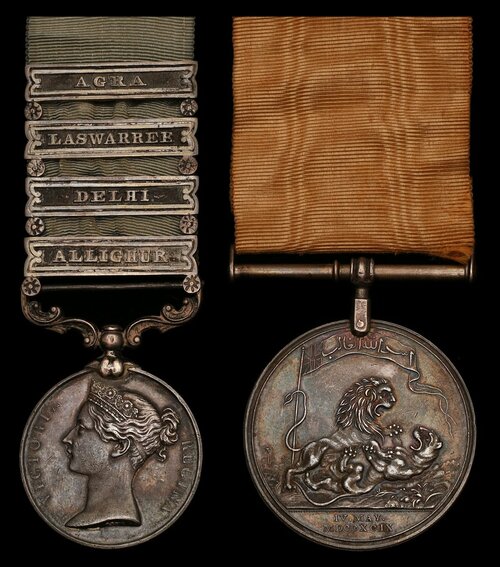
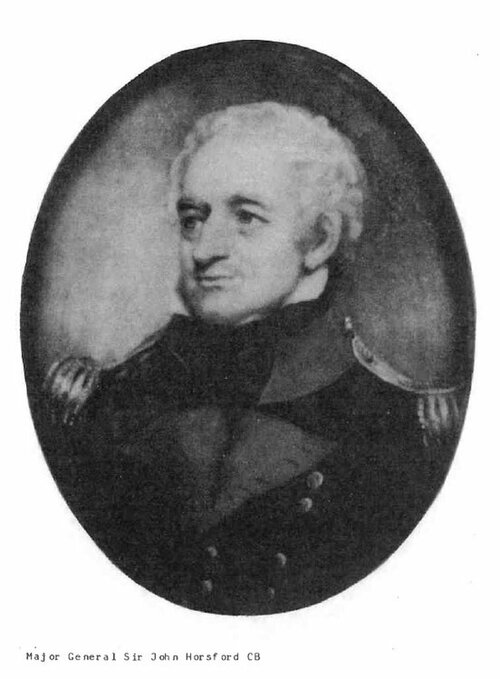
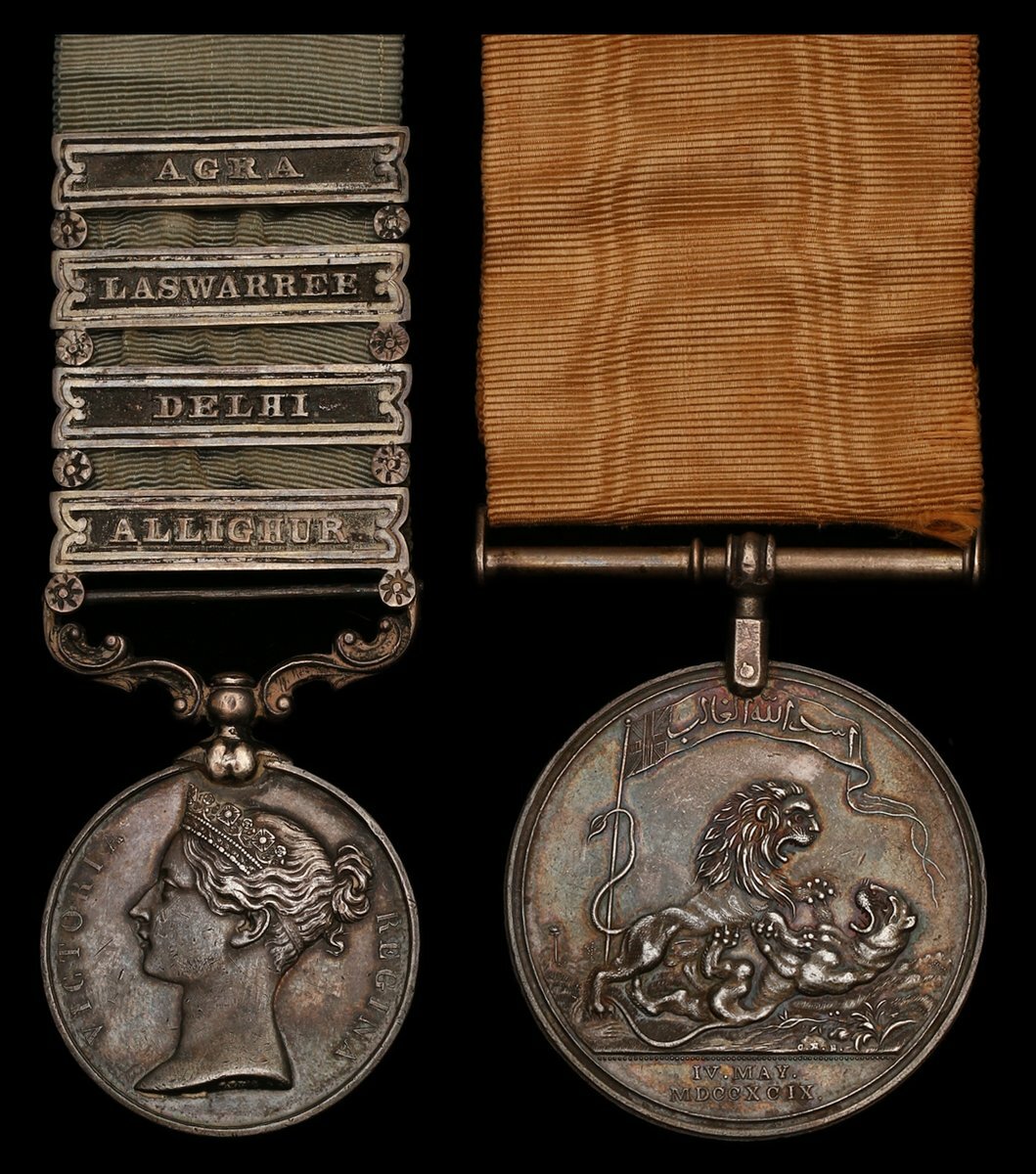
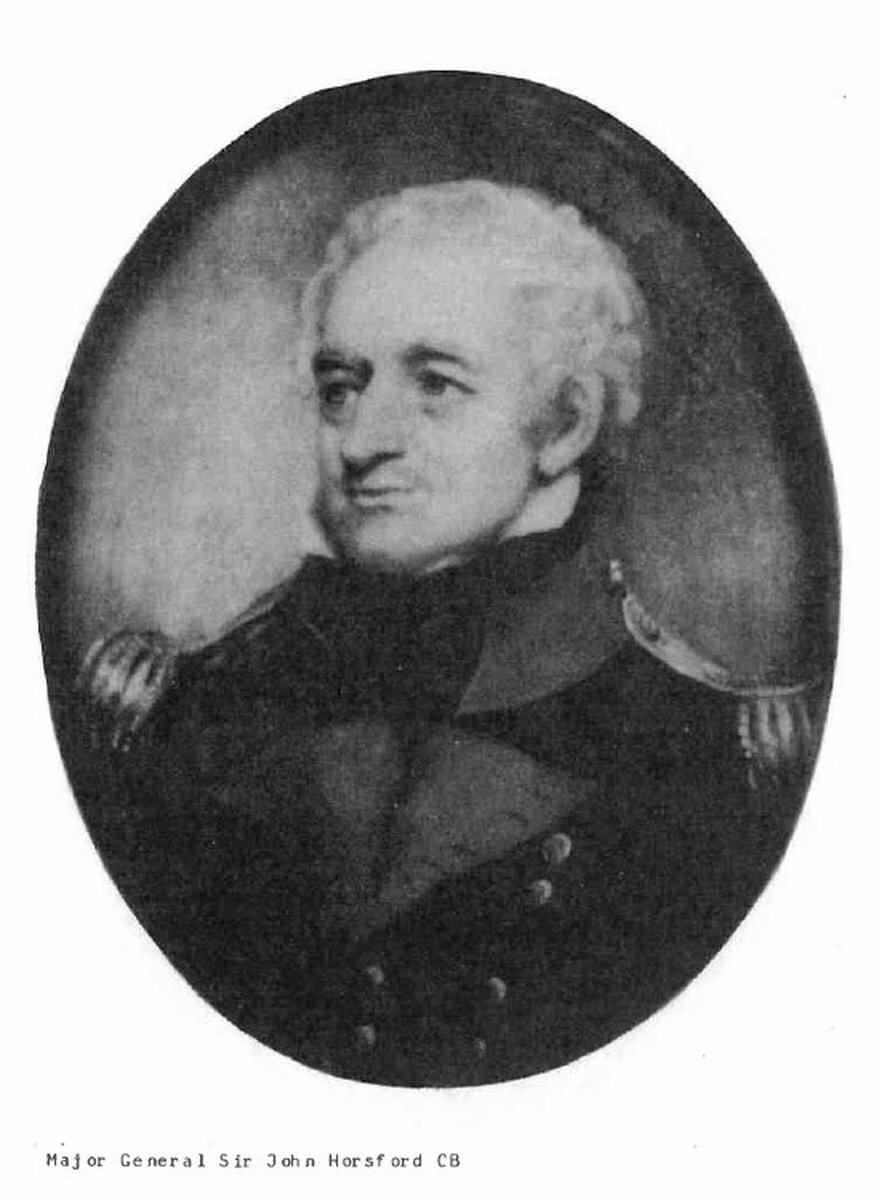
The early Indian campaign pair attributed to Major-General Sir John Horsford K.C.B., an officer of the East India Company's army who spent an astonishing 45 years in India, supposedly never taking a single day of leave during that time
Seringapatam 1799 (Captain J. Horsford Bengal Artillery), silver, 45mm, naming engraved in upright capitals, affixed with a silver post and straight-bar suspension; Army of India 1799-1826, long-hyphen reverse, 4 unofficial clasps, Allighur, Delhi, Laswarree, Agra (Colonel J. Horsford. Bengal Artillery), contemporarily engraved naming in upright capitals, a few minor contact marks to both, generally about very fine (2)
John Horsford was born in east London and received a thorough education at the Merchant Taylors' School and St. John's College, Oxford, where he was a fellow from 1768 - 1771, but left without taking a degree. In 1772, supposedly to avoid entering the church and without his father's knowledge, he enlisted (as a private soldier and using an assume name, John Rover) with the East India Company's forces, Having arrived safely in India Horsford, alias Rover, spent his first six years in the country in the ranks of the Bengal Artillery. Accordingly his 'big break' came one day when he was copying out some papers for the Commanding Officer, Colonel Pearse, and pointed out an error in a Greek quotation. Pearse, surprised that an Other Rank would know such a thing, discovered Horsford's true identity and had him promoted to Cadet!
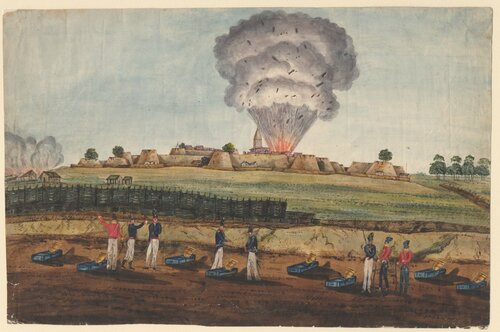
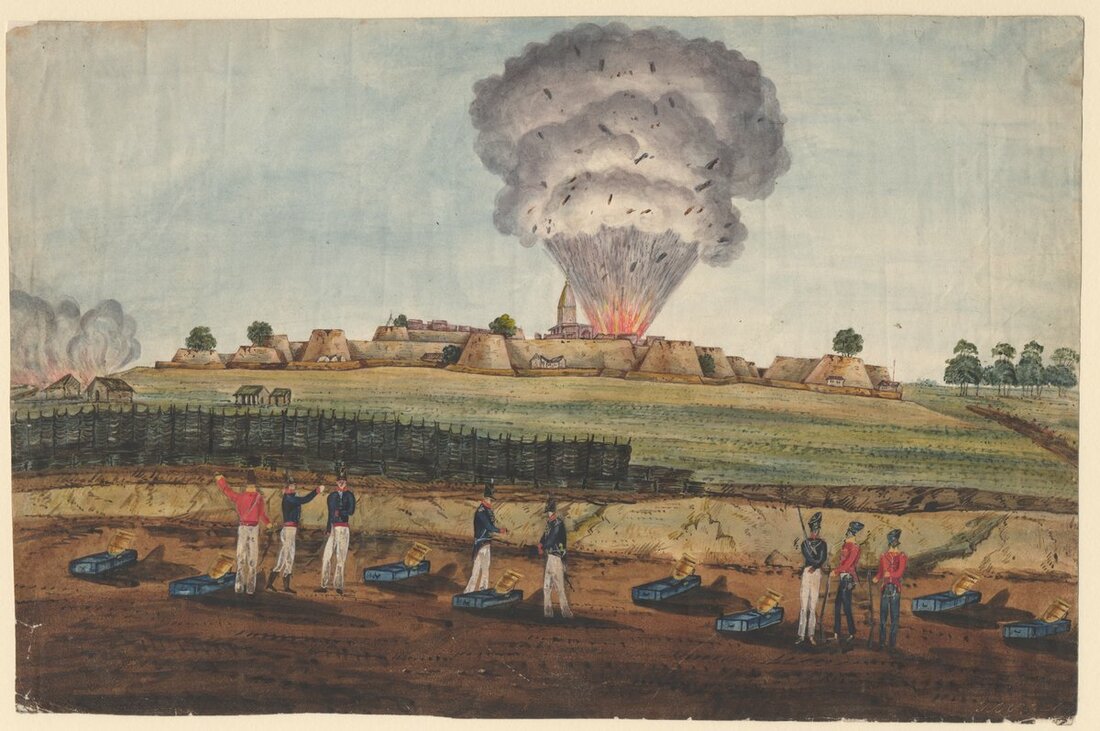
Promoted to First Lieutenant within only eight months and Captain in November 1786, he commanded a company of the Bengal Artillery detached to Madras during the Second Mysore War in 1790-91 and then saw much further action at the Siege of Bangalore, the Battle of Arakere and at both the First and Second sieges of Seringapatam. Advanced to Major on 6 August 1801, he commanded the artillery in Lord Lake's army during the campaigns of 1803-05, including at the battles of Alighur and Delhi; the siege of Agra; capture of Deig; and the siege of Bhurtpore. Clearly an extremely competent officer, Horsford was further promoted Lieutenant-Colonel on 1 May 1804 and next directed all the artillery at the Siege of Komanur in 1807; the following year he succeeded to command of the whole Bengal artillery. Further well-deserved promotions were swift to follow - Colonel in July 1810 and Major-General on 4 June 1811.
Appointed to a well-deserved K.C.B. on 7 April 1815 (London Gazette, 8 April 1815, No. 17001 refers) his last active military operation was command of the artillery at the Siege of Hathras over February - March 1817; returning to Cawnpore at the successful conclusion of the action, Horsford died there only a few days later, on 20 April, at the age of 66. His demise was keenly-felt by many, as a subsequent obituary makes clear:
At Cawnpore, died, on Sunday, the 20th April, in the 65th year of his ages, Major General Sir John Horsford, K.C.B. commanding 1st division field army, and Colonel of the 3d battalion of Artillery.
The State has in him lost a most able and upright servant - the army one of its most distinguished officers, the Honourable Order of the Bath a member worthy of its distinction. He served nearly 39 years with his regiment as an officer, and was much employed on field service during the eight years he commanded the Bengal Artillery. His attention to its interests was chiefly exemplified in improving the situation of the soldier, European and Native, in all the several branches of that extensive and widely dispersed corps. After a service of 45 years, in various parts of India, spent in constant and unwearied devotion to his duty, never even in sickness having enjoyed the indulgence of one day's furlough or leave of absence from his professional labours, this eminent officer, whose sound constitution, hardened by temperance, had long contended with an extraordinary complication of disease, ended a long life of useful services at Hattras. A man of stern principle, sound judgment, extensive knowledge, and independent spirit, his memory will be respected be all who knew him, and his loss long regretted by those who were his selected friends'. (Commercial Chronicle (London), 1 November 1817, p. 1 refers).
Horsford never married, but did have a long-term relationship with an Indian lady called Saheb Juan and together they had several children. He appears to have been a kindly, almost doting, father and very strong supporter of Indian culture and traditions: in both 1797 and 1800 he published two books of poetry (entitled 'A Collection of Poems, Written in the East Indies' and 'Poems in Three Parts' respectively) and excerpts include lines such as: 'I love your India and your India me!', additionally titling one of his poems: 'Ode to My Infant Daughter, Eliza Howrah'. Many of his children apparently made good and successful marriages, including Ann who married a fellow officer of the Bengal Artillery.
By family repute, though Horsford died decades before the authorisation of the Army of India Medal, upon notification of its' institution his descendants made a special application and called in several favours to achieve a successful result, which Medal is offered here. For the Medal of his son-in-law, Lieutenant T. B. Bingley (for whom a similar application was apparently made), see Lot 32. Sold together with a small quantity of copied research.
Subject to 20% VAT on Buyer’s Premium. For more information please view Terms and Conditions for Buyers.
Sold for
£3,000
Starting price
£400
Watch, listen and bid as if you were in the room. Now available for auctions worldwide.
Click here to bid live
An exclusive and confidential service for the discerning collector or vendor.
View the Gallery
Download every Spink catalogue on your iPad, iPod or iPhone using free Spink app.
Download From iTunes© 2026 Spink & Son. All rights reserved.