
Auction: 26001 - Orders, Decorations and Medals
Lot: 47
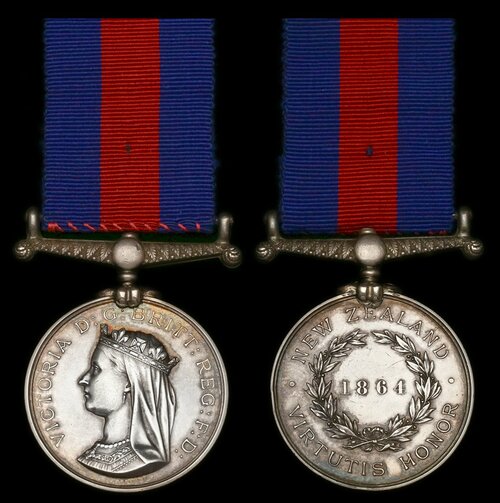
The New Zealand Medal awarded to Private D. McGinty, 40th (Somersetshire) Regiment of Foot, who shared in the action at Mangopiko Creek in February 1864, which earned Captain Heaphy a Victoria Cross
New Zealand 1845-66, reverse dated '1864' (791 D McGinty. 40th Regt.), very fine
Daniel McGinty was born at County Antrim, Ireland in 1831. He first attested prior to 1850 and in the census of 1851 he is serving with the 96th Foot which was based in Barracks at Chatham, Kent. He appears to have had a break in his service as on 27 July 1860 he again enlists for service with the colours, this time as a Private with the 96th Foot. In the census of 1861 he is serving at Fermoy with the service number 658. He transferred to the 40th Foot on 20 August 1863 and was sent to New Zealand aboard Chariot of Fame out of Queenstown, Ireland on 7 October 1863 which arrived at Auckland on 8 January 1864. Following disembarkation McGinty made the 25 mile journey across land to a military redoubt at Waiari was located along the Mangapiko river that fed into the Bay of Plenty on the eastern side of the north island.
There had been a number of brief encounters with Maori warriors in the locality but on 11 February 1864 there was a sharp encounter on the river's edge at Mangopiko Creek, a mile south of their camp. In this fierce engagement, five British soldiers were killed and approximately forty one Maoris died in the engagement. Captain Heaphy of the Auckland Rifle Volunteers was awarded a Victoria Cross, he was struck by five or six bullets whilst trying to rescue a wounded soldier.
The location of the firefight took place very near to an old Maori earthwork where the river doubled back on itself. Just beyond the abandoned Maori Pa, the river narrowed to just 15 feet with the remains of an old bridge. Close by was a large pool which was used by the soldiers from the camp to bathe and was in. Colonel Waddy's camp was the most advanced British outpost in the Bay of Plenty and was situated on a hill which faced towards Paterangi; the tents of the 40th and 50th Regiments were pitched on a gentle slope to the rear, sheltered from Maori bullets.
Unbeknown to the Colonel, Maori scouts had devised a plan to surprise the British camp a night by attacking it from the rear. The Paterangi leaders planned to conceal during the day about 100 of their warriors along the edge of the Mangapiko Creek. Once their surprise attack had begun, the advance party of Maori warriors would be supported by a much larger body of men from the Paterangi Pa.
On the early afternoon of the 11th, a large bathing party of the 40th Regiment had been sent down to the creek to bathe, it seems the hidden Maori raiding party could not resist the opportunity to attack the unarmed soldiers who were bathing in the water whose only protection was a small detachment of soldier.
The Maori ambush caught the soldiers of the 40th Regiment off guard, Colonel Waddy commented afterwards:
'About 2.30 p.m., we received an alarm that a bathing party had been suddenly fired upon by apparently 100 Maoris detached from the Paterangi Pa. The pickets from the camp turned out immediately and hastened to the scene, being reinforced by parties of both the 40th and 50th Regiments as fast as the men could seize their arms'.
A sharp running fight commenced which lasted until darkness fell during which time further Maori reinforcements arrived from the Paterangi Pa and threatened the British rear and flanks. Von Tempsky and his Rangers although two miles away heard the gunfire and immediately rushed to assist, they found Captain Jackson (Forest Rangers) and Captain Heaphy (Auckland Rifle Volunteers) were already caught up in the midst of the action.
After much hot firing, British soldiers were able to dash across a crude bridge over the river which had been formed of a single plank and led into the old Maori entrenchment where the fight continued. In places, the river banks were up to 40-60 ft high, precipitous and densely wooded making the action even more difficult to resolve. A series of hand to hand fighting took place and it was nearly dark by the time the old Pa was finally cleared of Maoris. Skirmishes continued as the soldiers began to make their way back along the paths to the camp with their own casualties. A total of five British soldiers were killed in action and six were wounded with one who died shortly after. The Maoris who fell numbered 41 but only 28 bodies were recovered along with two prisoners who were captured.
McGinty left New Zealand for England on 8 May 1866 and returns to Plymouth in August. He appears to have had a liking for drink and was imprisoned in 1868. He was discharged at Dublin on 24 September 1872.
A total of only 42 medals with 1864 dated reverse were awarded to the 40th Foot.
Subject to 20% VAT on Buyer’s Premium. For more information please view Terms and Conditions for Buyers.
Sold for
£460
Starting price
£380

Watch, listen and bid as if you were in the room. Now available for auctions worldwide.
Click here to bid live
An exclusive and confidential service for the discerning collector or vendor.
View the Gallery
Download every Spink catalogue on your iPad, iPod or iPhone using free Spink app.
Download From iTunes© 2026 Spink & Son. All rights reserved.